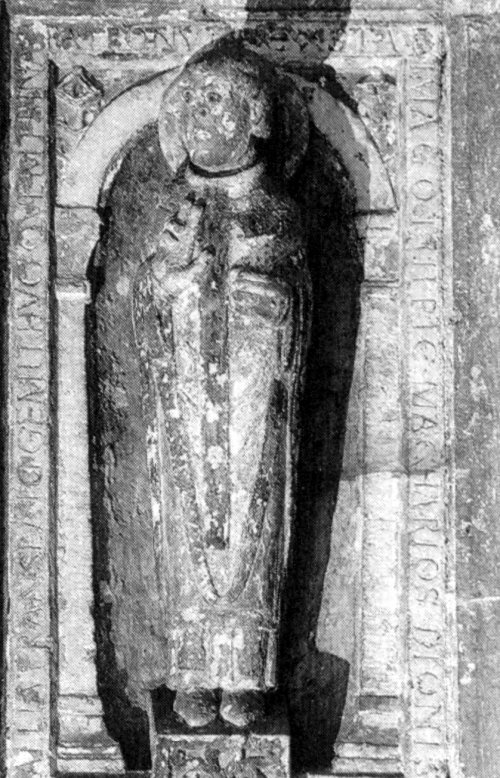
Once I was a clever boy learning the arts of Oxford... is a quotation from the verses written by Bishop Richard Fleming (c.1385-1431) for his tomb in Lincoln Cathedral. Fleming, the founder of Lincoln College in Oxford, is the subject of my research for a D. Phil., and, like me, a son of the West Riding. I have remarked in the past that I have a deeply meaningful on-going relationship with a dead fifteenth century bishop... it was Fleming who, in effect, enabled me to come to Oxford and to learn its arts, and for that I am immensely grateful.


Showing posts with label Abbey of St Denis. Show all posts

Friday, 11 October 2024

Rebuilding at St Denis


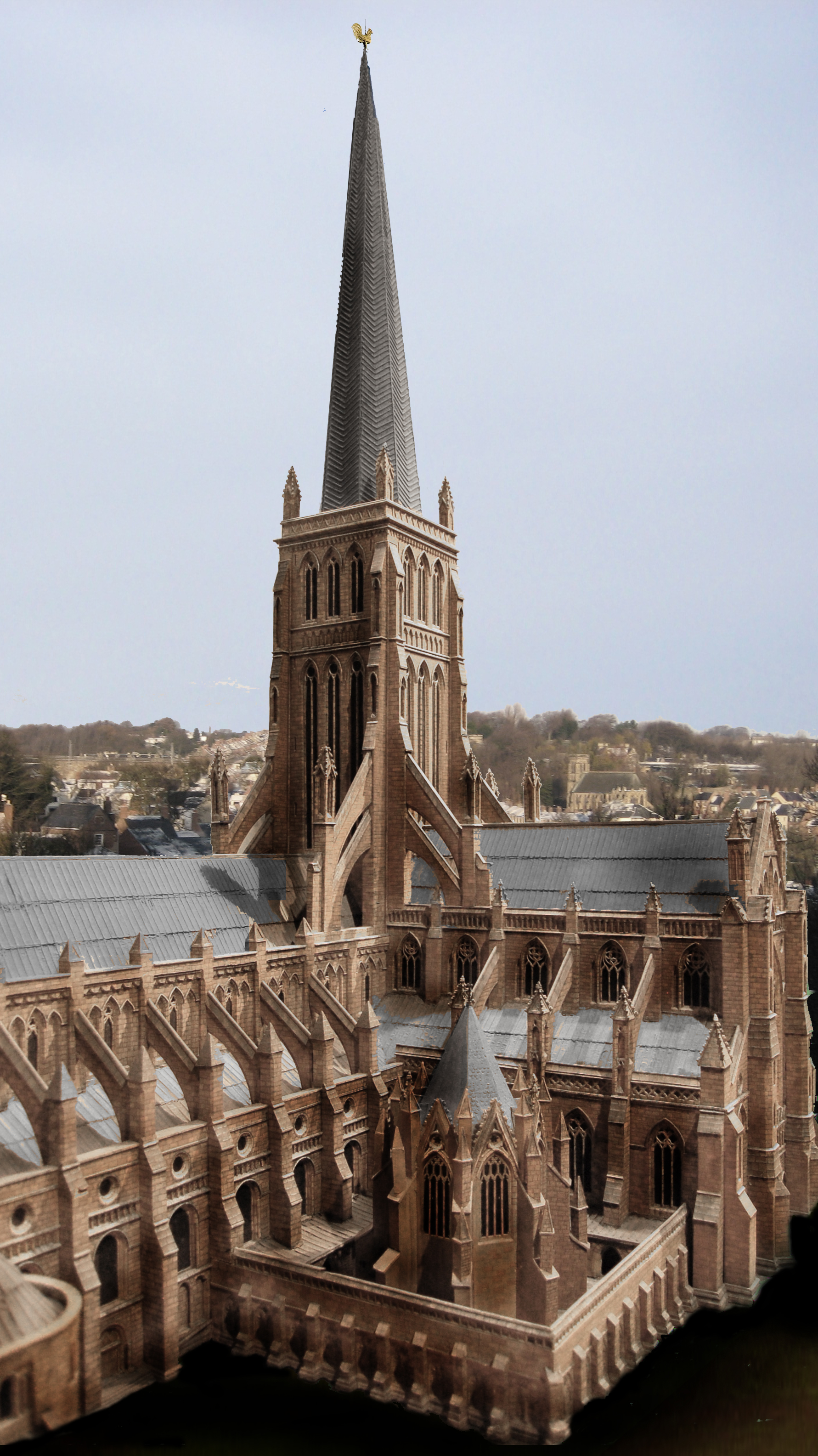
In 2020 I wrote about the proposal to rebuild of missing north-west tower and spire of the Abbey of St Denis. My post can be seen at Restoring St Denis

In it I write enthusiastically in favour of the scheme, and it is one, like the rebuilding of the Frauenkirke in Dresden or watching videos of the ongoing restoration of Wentworth Woodhouse in my home area, that brings a lump to my throat and a tear to my eye. Such is the impact upon me of such restorations that so defiantly resist the destructive urges of recent times.


St Denis as it is now and as it is hoped it will be

Image:FSSPX News


There are those who are not in favour as reported by The Times in French academics at odds over €25m plans to rebuild spire of Basilica of Saint-Denis. and as set out by one critic, founder of La Tribune de l’Art quoted in The Connexion at Rebuilding church’s long lost tower is ‘historic lie’

This reminds me somewhat of the reaction in this country of that pioneering conservation group the Society for the Protection of Ancient Monuments who withdrew their intended donation towards the restoration of the west front of Wells Cathedral because the Dean and Chapter commissioned a new statue of Christ in to replace the damaged one, reduced as it was only to waist height, of the top of the west front. Leaving it as a ruin was seen by the Society as preferable to restoring the figure of Christ on the front of a functioning cathedral.

Whilst I can appreciate some of the reservations expressed by dissenters at St Denis I remain completely convinced this is the right thing to do. The foundations have been found to be secure after all, and the threat to the Merovingian era graves obviated.  There are detailed drawings from the 1840s, and some at least of the original stonework survives. The taking down of the tower and spire in 1845-6 was meant to be a temporary measure. The delay in rebuilding is an indictment of state control of church buildings, not of the idea. The fact that this planned rebuilding began in the reign of Louis Philippe speaks sufficiently for French bureaucracy, neglect and probably anti-clericalism and anti-royalism.

An article last year in Le Monde covered the excavations of the Merovingian levels and the investigation of the foundations and can be seen at Basilica of Saint-Denis: Newly discovered graves bring back the past

The scheme and debate about it is also outlined on the FSSPX News website at Work Begins on the Spire of Saint-Denis

However the nay-sayers appear to have been held at bay, and scheme does seem to be going ahead, albeit rather slowly. A report covers trading new stonemasons at Masons are restoring the church where France's kings were buried for centuries

The rebuilding is entirely privately funded and looks to attract other funding from visitors whilst they work is carried out. This has been found to be a successful fundraising method in France. The hope  is the building work will prove a means of drawing visitors to Saint Denis and thereby benefit the local economy and community. St Denis is noted as a run-down area, with a high immigrant population and a poor reputation with outsiders. One hears stories of intending visitors to the Abbey being advised against such a visit by Parisian hoteliers, or telling them to just visit the Basilica and then to come away. Some of this is covered in a 2017 article on Medieval Histories, which has links to some French websites. It can be seen at Rebuilding or Restoring the spire of Saint-Denis

Wikipedia has a good illustrated history of the fabric of the Abbey, including unrealised proposals for Bonapartist and Orleanist crypts, and of its place in the history of France and of art and architecture at Basilica of Saint-Denis

The misfortunes inflicted upon this great and noble building from the end of the medieval era until the end of the Ancien Regime is outlined in Deterioration and first renovations of the Saint-Denis Basilica. Then followed the horrific ransacking of the royal tombs and remains in 1793.

As a building the Abbey has suffered much from those with wicked intentions and from those with misguided if well intentioned ones. This rebuilding is not - it is positive, it is renewing and restoring one of the most important buildings in the history of France and of Christian Art.

St Denis Pray for this scheme and its completion, and continue to pray for his shrine church.


Sunday, 20 November 2016

A move to take King Charles X and his family to St Denis


A friend has drawn my attention to an article in The Guardian about a proposal to move the bodies of King Charles X, King Louis XIX and Queen Marie-Thérèse from their presnt resting place in Slovenia to St Denis. The article can be read at France calls for remains of King Charles X to be returned from Slovenia

The association with this laudable aim was founded last September and their website can be seen at  http://www.leretourdecharlesx.fr  - which I have added to the sidebar. 

 Related image

King Charles X

Image:teaattrianon

Whatever comes of this initiative it is clear that King Charles and his family, both in life and death, were fated to spend a long time in exile.


King John I of France


Today is the seventh centenary of the death of King John I of France. The son of King Louis X and his Queen Clemence of Hungary, he was born several months after his father's death in June 1316. My post about him can be seen at King Louis X. A regency had ensued as the realm awaited the birth of a male or female heir.

Being born as King is a distinction he shares with King Ladislas V of Hungary and King Alfonso XIII of Spain. The infant King's reign was to be very short, as he was born on November 15th and died on  November 20th 1316. His rapid demise led to accusations at the time of foul play, and Countess Mahaut of Artois was one of those alleged to be responsible. Another tradition has a story of the royal infant being smuggled away and replaced by another baby - that is to be found in Druon's novels about the later Capetians.


Effigy of King John I of France at St Denis

Image:pinterest.com

King John I had the shortest reign of any French monarch unless that of King Louis XIX for twenty minutes or so during the July Revolution in 1830 is accepted - I would be inclined to see that as asituation of duress, and that King Charles X remained the legitimate monarch until his death in 1836 and that he was then succeeded by King Louis XIX until his death in 1844 and the undoubted inheritance at that point of King Henri V.

The death of King John was to be of real significance - for the first time the succession did not go from father to son, and the acceptance of his uncle as King Philip V rather than King Louis X's daughter by his first marriage Jeanne ( Louis had doubts as to her legitimacy, although she did eventually succeed at Queen of Navarre - see Joan_II_of_Navarre ) took France towards developing the Salic law to regulate the succession. There is a biography of  King Philip V at Philip V of France.
Both King Philip V and his younger brother and successior King Charles IV sought to produce a male heir but had only daughters, and in 1328 the succession passed to King Philip VI, by-passing the arguable claim of King Edward III through his mother, Queen Isabella, sister to the previous Kings - but that is another story...


Image result for philip V effigy St Denis

The effigies of King Philip V, of Queen Jeanne of Evreux, third wife of King Charles IV, and of King Charles IV in St Denis

Image: Pinterest - basilique-de-saint-denis


Sunday, 5 June 2016

King Louis X


Today is the seventh centenary of the death of King Louis X of France in 1316. He was 26, and had been King for little more than eighteen months. There is an online life of the King at Louis X of France


His tomb is in the abbey at St Denis. Here are two photographs of the head of the effigy:


Image: kornbluthphoto.com


Image:alamy
Image:themcs.org

King Louis X appears in the first three of Maurice Druon's series of novels on the last Capetians The Accursed Kings. In them he is not depicted especially favourably, and as a man in awe of his father and then disillusioned by his first wife's adultery. The actor Georges Ser gave a good performance as Louis in the original ORTF production in 1973-4.

Image result for Philip IV of France and family

The last Capetians
King Philip IV flanked by, left to right, his younger sons Charles - later King Charles IV - and Philip - later King Philip V -, his daughter Queen Isabella, wife of King Edward II, and by King Louis X as King of Navarre, and by his brother Charles Count of Valois, father of King Philip VI.

King Louis does look distinctly shifty, but that may simply be an artistic trait!

Image: Wikipedia


I suspect one could have a more favourable view of the King, and also allow for the pressures upon him - personal in respect of his marriages and concern for the succession, political in terms of the inevitable reaction following the death of his authoritarian and ruthlessly successful father, socio-economic in that 1315 saw the beginning of a near catastrophic pan-European famine linked to severe weather.
 

King Louis X depicted as King of France and of Navarre
 Image: Britannica.com

 Druon recounts the events leading to the death of Marguerite, Louis' first wife and his marriage to the Angevin princess Clemence of Hungary from Naples and her pregnancy, which was the situationwhen King Louis X died - there had to be a regency until her child was born. The luck of the Capetian dynasty in generating direct male heirs, which had secured their position since the accession of Hugh Capet in 987 was beginning to run out.


Quuen Clémence de Hongrie (1293–12 October 1328) 
Queen consort of France and Navarre, she was the second wife of King Louis X of France


Image:pinterest.com

King Louis X has a particular claim to fame in sporting history - he is the first recorded named player of tennis, and the fever which carried him off ( unless, as in Druon's The Poisoned Crown he was indeed poisoned)  seems to have begun with drinking chilled wine after a game of tennis.


Wednesday, 2 December 2015

Impressions of Saint-Denis


Rorate Caeli yesterday had a post by Kenneth J. Wolfe  about a visit to the royal abbey and basilica of St Denis on the northern edge of Paris. His account of getting there despite the misgivings of others and some fine pictures of this great and historic church can be seen at Saint-Denis

I have travelled past the basilica on the autoroute into Paris, but not so far managed to visit it. One day, perhaps.


Friday, 9 October 2015

St Denis and his companions


Today is by tradition the feast of the mid-third century Bishop of Paris St Denis and his companions in martyrdom SS. Rusticus of Paris and Eleutherius of Paris. For his life and cult, and for details which explain some of the images which follow see the online account at https://en.wikipedia.org/wiki/Denis

Nowadays here in the Birmingham Archdiocese this is, of course, the feast of Bl.John Henry Newman, so St Denis and his companions, together with St John Leonardi, are commemorated on October 8th.


The Medieval Religion discussion group yielded a fine crop of images. Gordon Plumb posted some stained glass depictions:

Chartres, Cathedrale Notre Dame, Bay 116, St Denis gives the Oriflamme to Jean-Clement de Metz:
https://www.flickr.com/photos/22274117@N08/8070019929

Lincoln Cathedral, sII, 1c, c.1225-35:
https://www.flickr.com/photos/22274117@N08/2259035172

York Minster, nXXXVI, 5b-6b, St Denis between two executioners:
https://www.flickr.com/photos/22274117@N08/4793957936

Winchester College, Fromond's Chapel, east window, A10:
https://www.flickr.com/photos/22274117@N08/3453937140
and detail:
https://www.flickr.com/photos/22274117@N08/3453937140


Bourges, Cathedrale Saint-Etienne, Bay 31, Story of St Denis, c.1517-18:
https://www.flickr.com/photos/22274117@N08/2218850130
and two details:
https://www.flickr.com/photos/22274117@N08/2218157075
https://www.flickr.com/photos/22274117@N08/2219153140

Genevra Kornbluth added these examples from her files in stone and wood:
http://www.KornbluthPhoto.com/StDenis.html

John Dillon provided a splendid array of images, many of which show St Denis as a cephalaphore
( now you really should know what that means...) and how artists dealt with that subject.

a) as depicted (at left; at centre and left, Sts. Rusticus and Eleutherius) in an early eleventh-century gradual according to the Use of the abbey of Saint-Denis near Paris (Paris, Bibliothèque Mazarine, ms. 384, fol. 117v):


http://www.enluminures.culture.fr/Wave/savimage/enlumine/irht16/IRHT_065156-p.jpg


b) as portrayed in a mid-eleventh-century relief in the entrance hall to the Kirche St. Emmeram in Regensburg, originally the church of a monastery claiming to possess his remains:


http://www.fantomzeit.de/wp-content/uploads/wibald03.jpg


c) as portrayed in high relief (at centre between Sts. Rusticus and Eleutherius, all achieving martyrdom) in the mid-twelfth-century sculptures on the tympanum of the Portail des Valois (rebuilt in the 1230s or 1240s; restored in the nineteenth century) of the basilique cathédrale Saint-Denis in Saint-Denis (Seine-Saint-Denis):


http://france-romane.com/photos/93-st-denis/Cathedrale_St-Denis-086.jpg


d) as portrayed in high relief (at centre between Sts. Rusticus and Eleutherius) in a mid-twelfth-century walrus ivory plaque from a portable altar in the Musée du Louvre, Paris:


http://www.photo.rmn.fr/archive/90-006373-2C6NU0HLVYSG.html

e) as portrayed in high relief (at centre) in the jambs of the left portal of the south porch (between 1194 and 1230) of the basilique cathédrale Notre-Dame in Chartres:


http://tinyurl.com/4o6rjl

Detail view:


http://tinyurl.com/4zncmm

f) as depicted (at left) in an earlier thirteenth-century window (1228-1231) of the south transept clerestory of the basilique cathédrale Notre-Dame in Chartres (not to miss the important bibliography cited this page's "description" tab):


http://tinyurl.com/3v5epn

g) as portrayed in an earlier thirteenth-century statue on a choir screen in Bamberg's Dom St. Peter und St. Georg (consecrated, 1237):
http://tinyurl.com/69dhonr

h) as depicted (at right at the foot of the page; at left, St. Lambert of Maastricht) in a later thirteenth-century psalter and book for hours according to the Use of Liège (ca. 1251-1300; Den Haag, KB, ms. 76 G 17, fol. 82v):
http://manuscripts.kb.nl/zoom/BYVANCKB%3Amimi_76g17%3A082v

i) as depicted in a later thirteenth-century window (c. 1280) in the Stadtkirche St. Dionys in Esslingen am Neckar:


Saint Dionysus
http://tinyurl.com/yfa8loy

j) as depicted (at centre betw. Sts. Rusticus and Eleutherius, all achieving martyrdom) as in a late thirteenth-century copy of French origin of the Legenda aurea (San Marino, CA, Huntington Library, ms. HM 3027, fol. 142v):
http://digitalassets.lib.berkeley.edu/ds/huntington/images//000923A.jpg

k) as depicted (at left; at right, St. Piatus of Seclin [ Feast day Oct.1st] ) in the late thirteenth-century (c. 1285-1290) Livre d'images de Madame Marie (Paris, BnF, ms. Nouvelle acquisition française 16251, fol. 84v):


http://tinyurl.com/y8v48ko

l) as depicted on a panel of the fourteenth-century rood screen of St Andrew, Hempstead (Norfolk):


http://www.norfolkchurches.co.uk/hempstead/images/hempstead%20(19).JPG
http://tinyurl.com/4q7jgt

m) as portrayed in a fourteenth-century pilgrim's badge in the Musée national du Moyen Âge (Musée de Cluny), Paris:


http://img.over-blog-kiwi.com/0/82/49/44/20140303/ob_8da42f_piece-de-fouille-saint-denis.jpg
http://tinyurl.com/obtg2cb

n) as portrayed (with the better preserved Sts. Rusticus and Eleutherius) in an earlier fourteenth-century marble sculpture (c. 1301-1326; formerly part of an altarpiece) in the Musée du Louvre, Paris:


http://www.photo.rmn.fr/archive/13-550042-2C6NU05JQU03.html

Detail view:


http://www.photo.rmn.fr/archive/13-550043-2C6NU05JQS9J.html

o) as portrayed in high relief (martyrdom; cephalophory) on an earlier fourteenth-century boss (c. 1301-1350) in the cloister of the cathedral church of the Holy and Undivided Trinity in Norwich:

http://www.paradoxplace.com/Photo%20Pages/UK/Britain_Centre/Norwich_Cathedral/Roof_Boss_Images/800/SDenis-Jul07-D0472sAR800.jpg

http://tinyurl.com/o4rgjxc

p) as depicted in the illuminated Vita et passio sancti Dionysii in Latin verse (with Boitbien's translation in French prose) presented to King Philip V in 1317 by an abbot of Saint-Denis (Paris, BnF, ms. Français 2090-2092):
1) seated; at left, Sts. Antoninus and Santoninus; at right, Sts. Rusticus and Eleutherius (BnF, ms. Français 2091, fol. 125r):


http://employees.oneonta.edu/farberas/arth/images/arth_214images/manuscripts/st_denis/commission.jpg

http://tinyurl.com/yk9773y

2) appearing with Sts. Rusticus and Eleutherius before the prefect Fescennius (BnF, ms. Français 2092, fol. 1r):


http://expositions.bnf.fr/fouquet/grand/f634.htm

q) as portrayed in a polychromed earlier fourteenth-century walnut-wood statue from Köln (ca. 1320) in that city's Schnütgen-Museum:


http://www.museum-schnuetgen.de/medien/abb/1434/2650__2720000.jpg

http://tinyurl.com/npqychy

r) as depicted (scenes of his life and and suffering; the last also depicting the martyrdom of Sts. Rusticus and Eleutherius) in an earlier fourteenth-century copy of the Legenda aurea in its French-language version by Jean de Vignay (c. 1326-1350; Paris, BnF, ms. Français 185, fols. 202r, 203v, 204r, 204v, 205v, 206v, 207v):
http://tinyurl.com/ylrytq7
http://tinyurl.com/yllhhq9
http://tinyurl.com/ykgrryk
http://tinyurl.com/yfrz7hr
http://tinyurl.com/yzbemgu
http://tinyurl.com/yfnbkse
http://tinyurl.com/ylppvlk


s) as depicted in an earlier fourteenth-century copy, from the workshop of Richard and Jeanne de Montbaston, of the Legenda aurea in its French-language version by Jean de Vignay (1348; Paris, BnF, ms. Français 241, fol. 275v):


http://tinyurl.com/ykxkqol

t) as depicted in a panel of a later fourteenth-century glass window in the north transept of the Basilica St. Valentinus und Dionysius in Kiedrich (Lkr. Rheingau-Taunus-Kreis) in Hessen:


http://www.kiedrich-geschichte.de/cms/upload/bilder/Abb_4_15_b_Nord_Dionysius.jpg

http://tinyurl.com/3pgesej

The panel's context in the window:
http://www.flickr.com/photos/hen-magonza/4849130575/


u) as depicted in a later fourteenth-century missal for the Use of Paris (after 1375?; Paris, Bibliothèque Mazarine, ms. 411, C fol. 67r):


http://www.enluminures.culture.fr/Wave/savimage/enlumine/irht17/IRHT_08472-p.jpg

http://www.enluminures.culture.fr/Wave/savimage/enlumine/irht17/IRHT_08472-p.jpg

v) as depicted (at left; at centre and right, Sts. Rusticus and Eleutherius; all achieving martyrdom) in a later fourteenth-century copy of the Legenda aurea in its French-language version by Jean de Vignay (ca. 1380; Paris, Bibliothèque Mazarine, ms. 1729, fol. 262v):

http://www.enluminures.culture.fr/Wave/savimage/enlumine/irht16/IRHT_068254-p.jpg

http://www.enluminures.culture.fr/Wave/savimage/enlumine/irht16/IRHT_068254-p.jpg

w) as portrayed in a fourteenth- or fifteenth-century pilgrim's badge in the Musée national du Moyen Âge (Musée de Cluny), Paris:


http://www.photo.rmn.fr/archive/97-011834-2C6NU0S38BSY.html

x) as depicted (betw. Sts. Rusticus and Eleutherius) in the early fifteenth-century Hours of René of Anjou (ca. 1410; London, BL, MS Egerton 1070, fol. 104r; image expandable):
http://www.bl.uk/catalogues/illuminatedmanuscripts/ILLUMIN.ASP?Size=mid&IllID=48351

y) as depicted in two illuminations in the early fifteenth-century Châteauroux Breviary (c. 1414; Châteauroux, Bibliothèque municipale, fols. 364r and 367v):
1) Preaching (third from left, after Sts. Rusticus and Eleutherius; fol. 367v):


http://www.enluminures.culture.fr/Wave/savimage/enlumine/irht2/IRHT_054227-p.jpg


2) Martyrdom (fourth from left, after Sts. Rusticus and Eleutherius; fol. 364r):


http://www.enluminures.culture.fr/Wave/savimage/enlumine/irht2/IRHT_054223-p.jpg


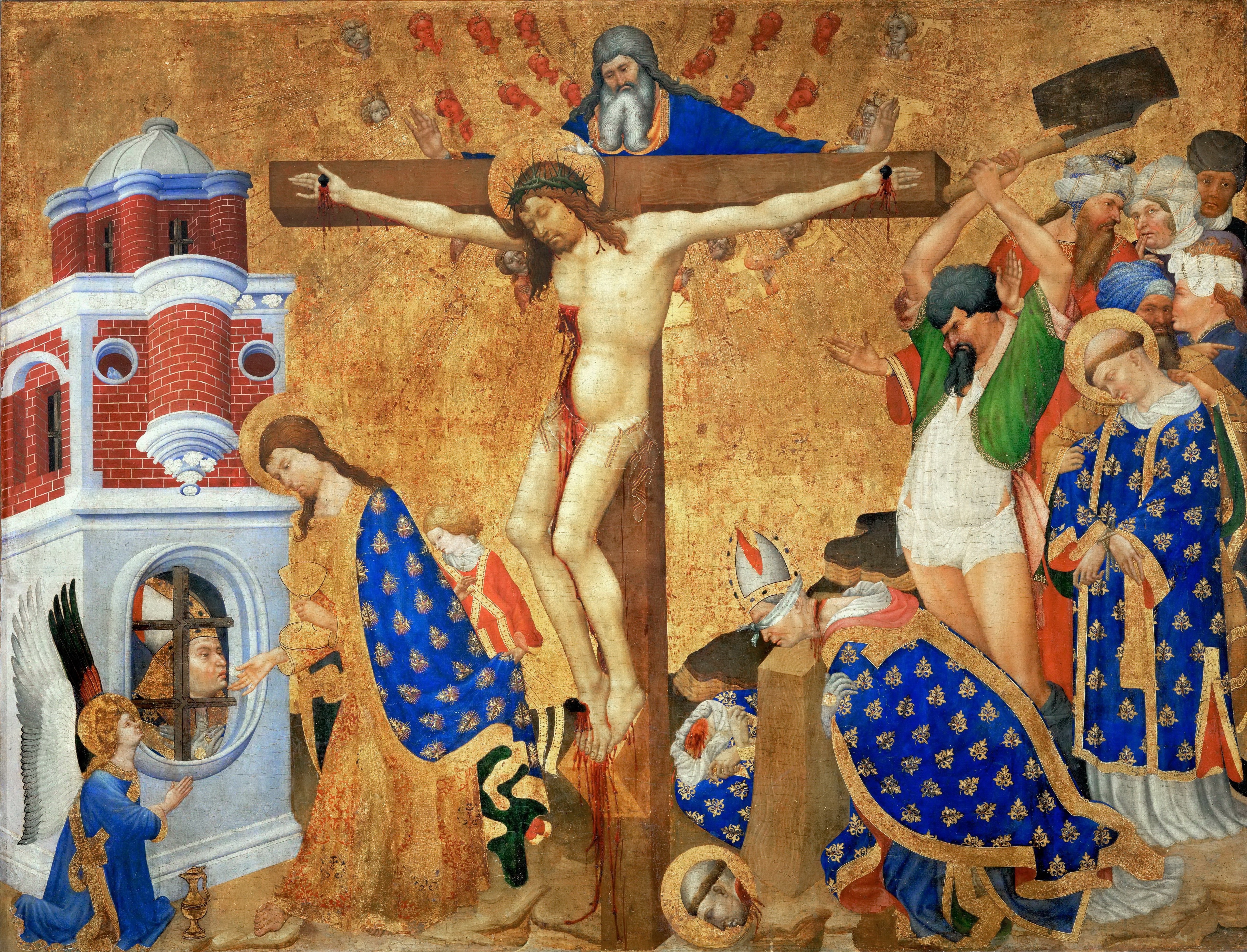
z) as depicted (at left, receiving communion from Jesus while imprisoned; at right, undergoing martyrdom along with Sts. Rusticus and Eleutherius) by Henri Bellechose on an early fifteenth-century altarpiece (paid for in 1416) in the Museé du Louvre in Paris:


https://upload.wikimedia.org/wikipedia/commons/6/64/Henri_Bellechose_001.jpg

http://tinyurl.com/3rey5zj

aa) as depicted in a full-page illumination of French or English workmanship, attributed to the Master of Sir John Fastolf's Hours, in an earlier fifteenth-century Book of Hours (ca. 1430-1440; Los Angeles, J. Paul Getty Museum, ms. 5, fol. 35v):


http://www.getty.edu/art/exhibitions/cult_saints/images/00300601_zm.jpg

http://tinyurl.com/yhcuuh5

Detail view (D.'s severed head):

St. Denis / M. Sir John Fastolf
http://tinyurl.com/ylooxrf

bb) as portrayed in a later fifteenth-century polychromed limestone statue (c. 1460-1470) in the Bode-Museum, Berlin:

https://upload.wikimedia.org/wikipedia/commons/6/60/Le_Moiturier_%28circle%29_Saint_Denis.jpg

http://tinyurl.com/4gvkeg

cc) as depicted (martyrdom and, in the upper register, cephalophory) in a later fifteenth-century copy of the Legenda aurea in its French-language translation by Jean de Vignay (c. 1480-1490; Paris, BnF, ms. Français 245, fol. 135r):


http://tinyurl.com/yg4vhdu

dd) as depicted (between Sts. Rusticus and Eleutherius) in a late fifteenth-century breviary according to the Use of Langres (after 1481; Chaumont, Mediathèque de Chaumont, ms. 33, fol. 456r):


http://www.enluminures.culture.fr/Wave/savimage/enlumine/irht6/IRHT_097055-p.jpg

http://www.enluminures.culture.fr/Wave/savimage/enlumine/irht6/IRHT_097055-p.jpg

ee) as depicted in a hand-colored woodcut in the Beloit College copy of Hartmann Schedel's late fifteenth-century Weltchronik (Nuremberg Chronicle; 1493) at fol. CIXv:


http://www.beloit.edu/nuremberg/book/images/Martyrs/big/Dionysius%20(the%20Areopagite)%20CIXv.jpg

http://tinyurl.com/9ghdm8w

ff) as portrayed in high relief on a polychromed and gilt panel of a late fifteenth- or early sixteenth-century altarpiece (ca. 1490-1510) in the Filialkirche Hl. Leonhard in Pesenbach (Oberösterreich):


http://tarvos.imareal.oeaw.ac.at/server/images/7017908.JPG

http://tarvos.imareal.oeaw.ac.at/server/images/7017908.JPG

gg) as depicted (at right; at left, St. Sebastian) on a panel of the late fifteenth- or early sixteenth-century winged altar (c. 1497-1507) in the Pfarrkirche Hl. Remigius in Gampern (Oberösterreich):


http://tarvos.imareal.oeaw.ac.at/server/images/7017792.JPG

http://tarvos.imareal.oeaw.ac.at/server/images/7017792.JPG

hh) as portrayed in high relief (at far left) on the central panel of the late fifteenth-century Vierzehn-Nothelfer-Altar (1498) in the Münster St. Marien und Jakobus in Heilsbronn (Lkr. Ansbach):


https://upload.wikimedia.org/wikipedia/commons/c/c6/Heilsbronn_M%C3%BCnster_Vierzehn-Nothelfer-Altar_Schrein.jpg

http://tinyurl.com/pcnarog

Detail view:


https://upload.wikimedia.org/wikipedia/commons/b/bc/Heilsbronn_M%C3%BCnster_Vierzehn-Nothelfer-Altar_Hl_Dionys.jpg

http://tinyurl.com/qbceeza

ii) as portrayed in high relief on an early sixteenth-century stall end (between 1501 and 1507) in the choir of the St. Martins-Kirche in Memmingen:


https://upload.wikimedia.org/wikipedia/commons/0/04/Chorgest%C3%BChl_St._Martin_Memmingen_-_St._Dionysos.JPG
http://tinyurl.com/nahwgj9

jj) as depicted (at left; at right, St. Margaret) by Vicente Macip in the central panel of his early sixteenth-century altarpiece (c. 1510) in the capilla de San Dionisio y Santa Margarita in Valencia's catedral de la Asunción de Nuestra Señora:


San Dionisio y Santa Margarita by Meldelen

http://tinyurl.com/3bbdu8b

kk) as depicted by the Master of Messkirch on a panel from a dismembered earlier sixteenth-century altarpiece (c. 1535-1540) in the Staatsgalerie Stuttgart:


https://upload.wikimedia.org/wikipedia/commons/4/47/Heiliger_Dionysius.jpg

http://tinyurl.com/pd6m447


John Dillon subsequently posted two additional images:

Dionysius as depicted in one of four panels of a full-page illumination in the late twelfth-century so-called Bible of Saint Bertin (ca. 1190-1200; Den Haag, KB, ms. 76 F 5, fol. 28v):
http://www.wga.hu/art/zgothic/miniatur/1151-200/3french/22french.jpg
http://manuscripts.kb.nl/zoom/BYVANCKB%3Amimi_76f5%3A028v_min_a2

Dionysius (martyrdom) as depicted in an earlier fifteenth-century prayer book from Brabant (ca. 1430-1440; Baltimore, The Walters Art Museum, ms. W.164, fol. 171r):


To all those I would add this image from the mid-fifteenth century east window of the church of St Denys in York


https://s-media-cache-ak0.pinimg.com/236x/e1/b0/d4/e1b0d44789eaee9c620bbe2cbed2b324.jpg

Image: pinterest/Roger Walton on Flickr

Meanwhile the New Liturgical Movement had an interesting post about the celebration of Mass in Greek by the monks of St Denis in honour of the Greek origin of their patron. The article is by The Greek Mass of St Denys of Paris


Monday, 18 February 2013

Uneasy lies the head


Following on from my recent posts about the positive identification of the skeleton of King Richard III and about the drawing of the skull of King Richard II a German friend has pointed out to me an online article about what is thought or claimed to be the head of King Henri IV of France. The article can be viewed here

I have posted about this particular royal body part before in December 2010 in King Henri's head.


http://s3.amazonaws.com/readers/2010/12/15/henryiv_1.jpg

King Henri IV

Image: Bookstove.com

The King's body was, like that of the other Kings of France sacrilegiously disinterred from St Denis in 1793, and when it was reburied in 1817 in the abbey the head was found to be missing. This head would appear to be that of the King. From what I have read the identification looks very probable, and it is unfortunate that the matter has now been caught up in controversy over the veracity of a book about the discovery, and indeed in differing responses from the rival claimants to the French throne, who would be King Henri VII or King Louis XX. 

If it is adjudged to be in truth the head of the first Bourbon King of France then it would indeed be right and proper for it to be reburied at St Denis. Until then, like the bones of St Edward the Martyr did for so many years in this country, it remains in a bank vault.


Friday, 31 August 2012

The death and obsequies of King Henry V


Today is the 590th anniversary of the death of King Henry V, King of England, Regent and Heir of France, Duke of Normandy and Lord of Ireland in the chateau of Vincennes outside Paris.

http://upload.wikimedia.org/wikipedia/commons/thumb/1/18/King_Henry_V_from_NPG.jpg/344px-King_Henry_V_from_NPG.jpg

King Henry V

 Image:Wikipidia/National Portrait Gallery


Quite apart from the great and far reaching political, military and diplomatic repercussions of the death of this outstanding monarch this set in motion what must have been the most elaborate funeral ceremonies of any English King, and one which celebrated his achievements in his short but remarkable reign.

Of the four previous English Kings who had died in France three were buried there and only King Henry I in 1135-6 had been brought back for burial at Reading abbey. In addition to this lack of precedent was Henry V's position as Regent and Heir of France and as Duke of Normandy, and his personal prestige as the hero-king of the recent wars. The resulting progress with his body from Vincennes to Westminster was a demonstration of both his achievements and of the Lancastrian monarchy's cult of itself.


The donjon of Vincennes where King Henry V died 

Image: Wikipedia

There is a detailed description of the protracted funeral ceremonies in Christopher Allmand's excellent standard biography Henry V (Yale UP, second edn. 1997) on pp 174-78, which I would recommend reading - along with the rest of the book. The whole account is far too long to reproduce here, but it conveys very well the solemnity and grandeur of the events of that autumn, the long procession of mourners, the constant recitation of Masses of Requiem and of the Office of the Dead.

The King's body was embalmed, and the internal organs buried in the church of Saint-Maur-de-Fosses, and then the coffin, bearing an effigy of the deceased monarch robed and crowned was taken on 14 or 15 September to the French royal necropolis of the Abbey of St Denis. It is not clear whether the route passed through Paris itself - accounts differ. The following day a service for the dead was held in the abbey.


The choir of the abbey of St Denis

Image: columbia.edu.com

From St Denis the cortege went by water along the Seine to Mantes, then entered the capital of his Duchy of Normandy, Rouen on 19 September. Here Henry lay in the cathedral which he had entered in triumph as conqueror in January 1419 after the grim and terrible siege of the city. The following day the body was transferred to the castle and on 24 September Queen Katherine, the late King's brother the Duke of Bedford and more of the household arrived, and it was not until 5 October that the journey was resumed.

photo

The interior of Rouen cathedral.
The architecture of the interior is much as it was in 1422,
whilst the present distinctive skyline of the exterior is later.

Image:maxwellgriffith on Flickr

 
Travelling via Abbeville, Hesdin, Montreuil the cortege arrived at Calais. About October 31 Henry's body reached Dover, and was carried in mournful state  through Canterbury, Ospring, Rochester and  Dartford to reach Soutwark and the end of London Bridge on Thursday November 5. Escorted by an ever increasing number of dignitories, including Bishop Fleming of Lincoln, it passed through London to the west door of St Paul's

File:Old St Paul's Cathedral photographic
 reconstruction.jpg

St Paul's cathedral as it might have appeared in 1422
This is a model made in 1908 and now in the London Museum

Image:Wikipedia
Museum+of+London+old+St+Paul+Cathedral

Another view of the model of St Paul's

Image:singaporeaninlondon


On Friday November 6 after more Masses of Requiem there was the last stage of the journey toWestminster Abbey. With the coffin railed in before the altar where he had been crowned nine and a half years earlier Dirige was sung and candles placed about the bier. The Islip Roll, depicting the funeral of Abbot Islip in the abbey on the eve of the reformation gives a very good idea of what would have been erected, with a great hearse decorated with candles over the coffin.

Finally on Saturday November 7 came the burial after another Requiem, and with four horses and their arms led to the altar - presumably represnting England, France, Normandy and Ireland - and a knight wearing the King's coat armour, which was ceremonially offered up.

Henry had directed that a chantry chapel should be raised over his body, at the eastern end of St Edward the Confessor's shrine chapel. This was done by creating a bridge over the ambulatory and erecting the chapel with the King's tomb on top. The tomb lies on the lower level, beneath the arch of the chantry, which is carved with figures of kings and saints. Above him is the Altar of the Annunciation, where Masses were offered for the soul of the King. On the screen walls spanning the ambulatories are sculptures depicting Henry at his coronation and riding armed into battle. The plan is, conciously or not, reminiscent of the plan of barbican gate - can it perhaps be understood as King Henry waiting at the gate of Heaven, and does it perhaps also anticipate the Habsburg ritual of requesting admission, not as monarch but as a penitent sinner, to the Capuchin church in Vienna?

Front of Henry V's Chantry, Westminster. (Decorated English.) Illustration for Knight's Pictorial Gallery of Arts (London Printing and Publishing, c 1860).

The chantry viewed from the Chapel of St Edward

Image: lookand learn.com

The tomb was completed in about 1431. The inscription around the ledge of the tomb platform translates as  Henry V, hammer of the Gauls, lies here. Henry was put in the urn 1422. Virtue conquers all. The fair Catherine finally joined her husband 1437. Flee idleness.

The head of the effigy, sceptre and other regalia were all of silver-gilt, with silver gilt plates covering the figure of the king - an even grander effigy than the gilt bronze effigies of earlier Plantagenets. However, all the silver was stolen in 1546 and the effigy was left as just a plain block of oak for many centuries.

In 1971 a new head, hands and a crown for the effigy were modelled in polyester resin by Louisa Bolt, the features following a contemporary description of the King and the earliest portrait of him. I think that the effigy should be wearing an arched crown, as on the Coronation scene of the King on the side of the chantry, but an open form was chosen for the present head.


CORONATION OF HENRY V. 

The Coronation of King Henry V from the chantry chapel

Image: Project Gutenburg text of E.H. Pearce William de Colchester Abbot of Westmisnter SPCK 1915

 
The saddle, helm and shield, which were part of the King's funeral 'achievements', were for many centuries displayed on the wooden beam above the chantry, but were restored and removed to the Abbey Museum in 1972. The saddle is the earliest surviving example of a new light-weight type, originally covered with blue velvet. The limewood shield has only a small section of crimson velvet remaining on the inner side. The domed helm, about sixteen inches high, is a tilting helm, and would not, therefore, have been worn in battle. A fifteenth century sword, found in the Abbey triforium in 1869, is thought to be part of this funeral armour. There is more about the achievements here.