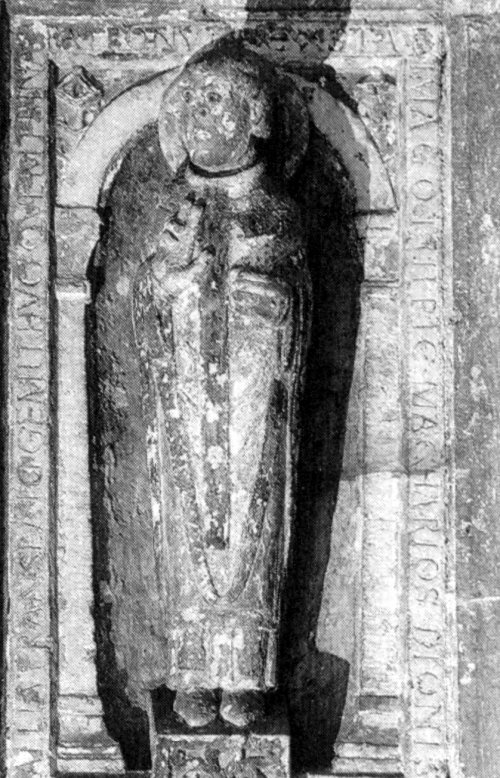
Once I was a clever boy learning the arts of Oxford... is a quotation from the verses written by Bishop Richard Fleming (c.1385-1431) for his tomb in Lincoln Cathedral. Fleming, the founder of Lincoln College in Oxford, is the subject of my research for a D. Phil., and, like me, a son of the West Riding. I have remarked in the past that I have a deeply meaningful on-going relationship with a dead fifteenth century bishop... it was Fleming who, in effect, enabled me to come to Oxford and to learn its arts, and for that I am immensely grateful.


Showing posts with label St Denis. Show all posts

Friday, 11 October 2024

Rebuilding at St Denis


In 2020 I wrote about the proposal to rebuild of missing north-west tower and spire of the Abbey of St Denis. My post can be seen at Restoring St Denis

In it I write enthusiastically in favour of the scheme, and it is one, like the rebuilding of the Frauenkirke in Dresden or watching videos of the ongoing restoration of Wentworth Woodhouse in my home area, that brings a lump to my throat and a tear to my eye. Such is the impact upon me of such restorations that so defiantly resist the destructive urges of recent times.


St Denis as it is now and as it is hoped it will be

Image:FSSPX News


There are those who are not in favour as reported by The Times in French academics at odds over €25m plans to rebuild spire of Basilica of Saint-Denis. and as set out by one critic, founder of La Tribune de l’Art quoted in The Connexion at Rebuilding church’s long lost tower is ‘historic lie’

This reminds me somewhat of the reaction in this country of that pioneering conservation group the Society for the Protection of Ancient Monuments who withdrew their intended donation towards the restoration of the west front of Wells Cathedral because the Dean and Chapter commissioned a new statue of Christ in to replace the damaged one, reduced as it was only to waist height, of the top of the west front. Leaving it as a ruin was seen by the Society as preferable to restoring the figure of Christ on the front of a functioning cathedral.

Whilst I can appreciate some of the reservations expressed by dissenters at St Denis I remain completely convinced this is the right thing to do. The foundations have been found to be secure after all, and the threat to the Merovingian era graves obviated.  There are detailed drawings from the 1840s, and some at least of the original stonework survives. The taking down of the tower and spire in 1845-6 was meant to be a temporary measure. The delay in rebuilding is an indictment of state control of church buildings, not of the idea. The fact that this planned rebuilding began in the reign of Louis Philippe speaks sufficiently for French bureaucracy, neglect and probably anti-clericalism and anti-royalism.

An article last year in Le Monde covered the excavations of the Merovingian levels and the investigation of the foundations and can be seen at Basilica of Saint-Denis: Newly discovered graves bring back the past

The scheme and debate about it is also outlined on the FSSPX News website at Work Begins on the Spire of Saint-Denis

However the nay-sayers appear to have been held at bay, and scheme does seem to be going ahead, albeit rather slowly. A report covers trading new stonemasons at Masons are restoring the church where France's kings were buried for centuries

The rebuilding is entirely privately funded and looks to attract other funding from visitors whilst they work is carried out. This has been found to be a successful fundraising method in France. The hope  is the building work will prove a means of drawing visitors to Saint Denis and thereby benefit the local economy and community. St Denis is noted as a run-down area, with a high immigrant population and a poor reputation with outsiders. One hears stories of intending visitors to the Abbey being advised against such a visit by Parisian hoteliers, or telling them to just visit the Basilica and then to come away. Some of this is covered in a 2017 article on Medieval Histories, which has links to some French websites. It can be seen at Rebuilding or Restoring the spire of Saint-Denis

Wikipedia has a good illustrated history of the fabric of the Abbey, including unrealised proposals for Bonapartist and Orleanist crypts, and of its place in the history of France and of art and architecture at Basilica of Saint-Denis

The misfortunes inflicted upon this great and noble building from the end of the medieval era until the end of the Ancien Regime is outlined in Deterioration and first renovations of the Saint-Denis Basilica. Then followed the horrific ransacking of the royal tombs and remains in 1793.

As a building the Abbey has suffered much from those with wicked intentions and from those with misguided if well intentioned ones. This rebuilding is not - it is positive, it is renewing and restoring one of the most important buildings in the history of France and of Christian Art.

St Denis Pray for this scheme and its completion, and continue to pray for his shrine church.


Wednesday, 9 October 2024

St Denis


Today is traditionally the day on which the Church has commemorated St Denis and his companions, three martyrs from the mid-third century. As the proto-martyrs of Paris their cult flourished in the diocese, and especially around the grave of the martyr bishop to the north of the city. This became the centre of the immensely influential abbey named in his honour, and which witnessed the birth of gothic architecture. Wikipedia has an account of his cult at Denis of Paris

I have posted about St Denis and his depiction in religious art in past years. Unfortunately not all of the images have downloaded but there is still a good selection to view. From 2011 there is St Denis and from 2015 St Denis and his companions


St Denis shown carrying his head after his execution from the Book of Hours of King Charles VIII, painted by Jean Bourdichon. His two companions can be seen at the bottom left.

Image: Wikipedia 

St Denis is probably the most famous cephalaphore saint, and artists and sculptors have depicted him carrying his head in various ways, and sometimes carrying his physical head but having on his shoulders a replacement spiritual one. 


File:Henri Bellechose 001.jpg

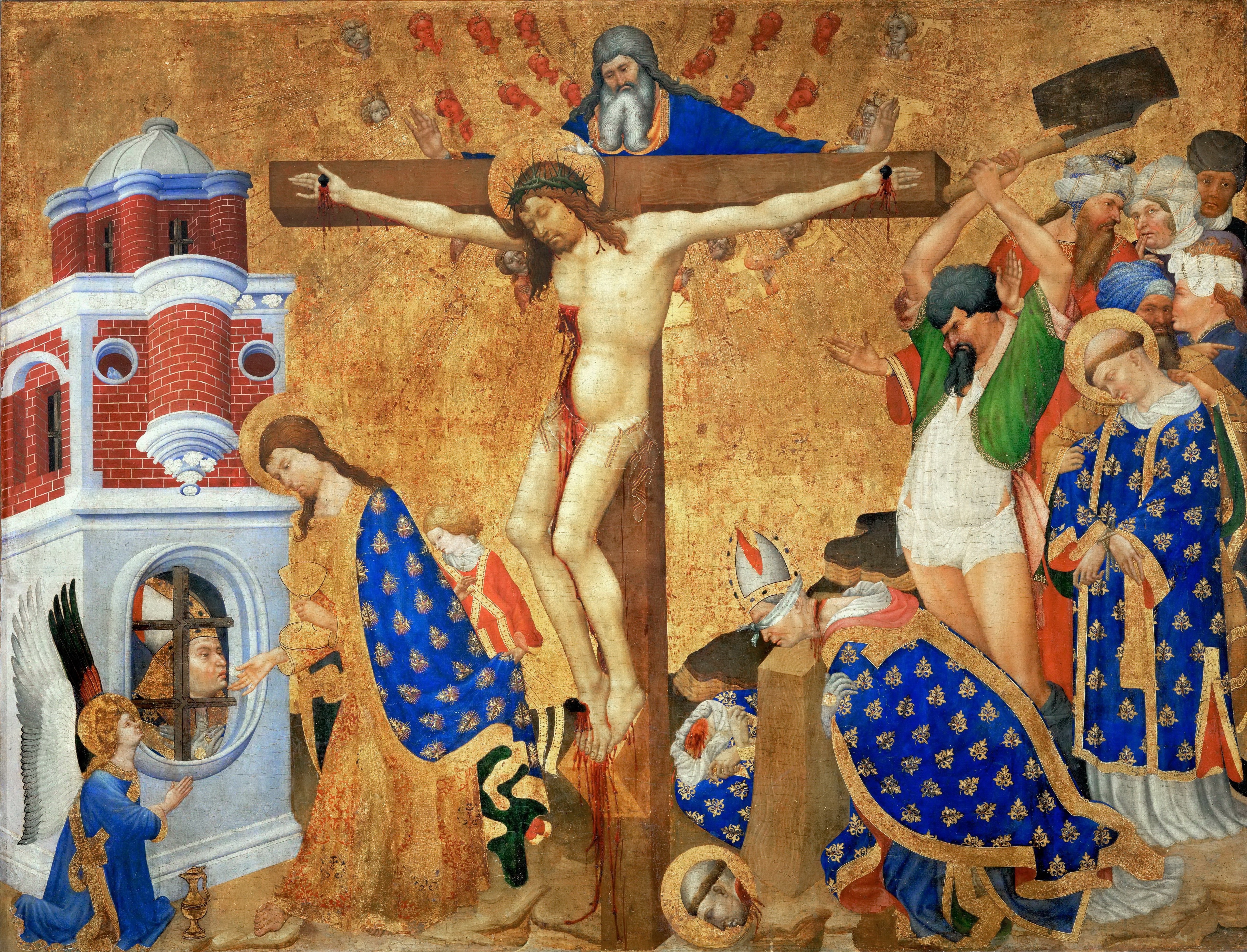
The Last Communion and Martyrdom of St Denis
Commissioned from Henri Bellechose in 1416 by Duke John the Fearless of Burgundy for the Carthusian monastery of Champnol near Dijon. Now in the Louvre.

The spectacular use of blue and gold in the depiction of the vestments is presumably intended to evoke the imagery of the fleur-de-lys of the French monarchy.
The obvious brickwork in the tower on the left points to the Netherlandish origins of the artist. 
The figure of the executioner is interesting. In a painting of the martyrdom of St John the Baptist Rogier van der Weyden, and in a BL Royal MS, executioners are shown like this one as having rolled their hose down to their knees. Was this to avoid blood splatter on their clothing? The axe is typical of the type used for beheadings in Germany and Scandinavia until modern times, and more like a meat cleaver than the English type of executioner’s axe, which can be seen in the example on display in the Tower of London. This looks to be an artist drawing upon actual practice or experience.

Image: Wikipedia 

I will post separately about the plans to rebuild the north western tower of the abbey church - now designated a minor basilica and the cathedral of a diocese - which I wrote about in 2020.


St Denis and his companions Pray for us


Wednesday, 2 December 2015

Impressions of Saint-Denis


Rorate Caeli yesterday had a post by Kenneth J. Wolfe  about a visit to the royal abbey and basilica of St Denis on the northern edge of Paris. His account of getting there despite the misgivings of others and some fine pictures of this great and historic church can be seen at Saint-Denis

I have travelled past the basilica on the autoroute into Paris, but not so far managed to visit it. One day, perhaps.


Friday, 16 October 2015

St Denis - a further thought


Following on from the post on the Medieval Religion discussion group which I copied about St Denis Theresa Gross-Diaz posted this comment

"That ten kilometers [ the distance St Denis walked carrying his severed head and preaching as he went ] provoked my favorite Enlightenment bon mot:
Upon hearing this story told by Cardinal de Polignac. Mme du Deffand (friend of Voltaire) replied, "en de telles affaires, il n'y a que le premier pas qui coute." "

I think we can all agree with that, be we n'er so Enlightened.

Paris - Cathédrale Notre-Dame - Portail de la Vierge - PA00086250 - 003.jpg 

St Denis
Statue on the left portal of Notre Dame in Paris 

Image: Wikipedia

Friday, 9 October 2015

St Denis and his companions


Today is by tradition the feast of the mid-third century Bishop of Paris St Denis and his companions in martyrdom SS. Rusticus of Paris and Eleutherius of Paris. For his life and cult, and for details which explain some of the images which follow see the online account at https://en.wikipedia.org/wiki/Denis

Nowadays here in the Birmingham Archdiocese this is, of course, the feast of Bl.John Henry Newman, so St Denis and his companions, together with St John Leonardi, are commemorated on October 8th.


The Medieval Religion discussion group yielded a fine crop of images. Gordon Plumb posted some stained glass depictions:

Chartres, Cathedrale Notre Dame, Bay 116, St Denis gives the Oriflamme to Jean-Clement de Metz:
https://www.flickr.com/photos/22274117@N08/8070019929

Lincoln Cathedral, sII, 1c, c.1225-35:
https://www.flickr.com/photos/22274117@N08/2259035172

York Minster, nXXXVI, 5b-6b, St Denis between two executioners:
https://www.flickr.com/photos/22274117@N08/4793957936

Winchester College, Fromond's Chapel, east window, A10:
https://www.flickr.com/photos/22274117@N08/3453937140
and detail:
https://www.flickr.com/photos/22274117@N08/3453937140


Bourges, Cathedrale Saint-Etienne, Bay 31, Story of St Denis, c.1517-18:
https://www.flickr.com/photos/22274117@N08/2218850130
and two details:
https://www.flickr.com/photos/22274117@N08/2218157075
https://www.flickr.com/photos/22274117@N08/2219153140

Genevra Kornbluth added these examples from her files in stone and wood:
http://www.KornbluthPhoto.com/StDenis.html

John Dillon provided a splendid array of images, many of which show St Denis as a cephalaphore
( now you really should know what that means...) and how artists dealt with that subject.

a) as depicted (at left; at centre and left, Sts. Rusticus and Eleutherius) in an early eleventh-century gradual according to the Use of the abbey of Saint-Denis near Paris (Paris, Bibliothèque Mazarine, ms. 384, fol. 117v):


http://www.enluminures.culture.fr/Wave/savimage/enlumine/irht16/IRHT_065156-p.jpg


b) as portrayed in a mid-eleventh-century relief in the entrance hall to the Kirche St. Emmeram in Regensburg, originally the church of a monastery claiming to possess his remains:


http://www.fantomzeit.de/wp-content/uploads/wibald03.jpg


c) as portrayed in high relief (at centre between Sts. Rusticus and Eleutherius, all achieving martyrdom) in the mid-twelfth-century sculptures on the tympanum of the Portail des Valois (rebuilt in the 1230s or 1240s; restored in the nineteenth century) of the basilique cathédrale Saint-Denis in Saint-Denis (Seine-Saint-Denis):


http://france-romane.com/photos/93-st-denis/Cathedrale_St-Denis-086.jpg


d) as portrayed in high relief (at centre between Sts. Rusticus and Eleutherius) in a mid-twelfth-century walrus ivory plaque from a portable altar in the Musée du Louvre, Paris:


http://www.photo.rmn.fr/archive/90-006373-2C6NU0HLVYSG.html

e) as portrayed in high relief (at centre) in the jambs of the left portal of the south porch (between 1194 and 1230) of the basilique cathédrale Notre-Dame in Chartres:


http://tinyurl.com/4o6rjl

Detail view:


http://tinyurl.com/4zncmm

f) as depicted (at left) in an earlier thirteenth-century window (1228-1231) of the south transept clerestory of the basilique cathédrale Notre-Dame in Chartres (not to miss the important bibliography cited this page's "description" tab):


http://tinyurl.com/3v5epn

g) as portrayed in an earlier thirteenth-century statue on a choir screen in Bamberg's Dom St. Peter und St. Georg (consecrated, 1237):
http://tinyurl.com/69dhonr

h) as depicted (at right at the foot of the page; at left, St. Lambert of Maastricht) in a later thirteenth-century psalter and book for hours according to the Use of Liège (ca. 1251-1300; Den Haag, KB, ms. 76 G 17, fol. 82v):
http://manuscripts.kb.nl/zoom/BYVANCKB%3Amimi_76g17%3A082v

i) as depicted in a later thirteenth-century window (c. 1280) in the Stadtkirche St. Dionys in Esslingen am Neckar:


Saint Dionysus
http://tinyurl.com/yfa8loy

j) as depicted (at centre betw. Sts. Rusticus and Eleutherius, all achieving martyrdom) as in a late thirteenth-century copy of French origin of the Legenda aurea (San Marino, CA, Huntington Library, ms. HM 3027, fol. 142v):
http://digitalassets.lib.berkeley.edu/ds/huntington/images//000923A.jpg

k) as depicted (at left; at right, St. Piatus of Seclin [ Feast day Oct.1st] ) in the late thirteenth-century (c. 1285-1290) Livre d'images de Madame Marie (Paris, BnF, ms. Nouvelle acquisition française 16251, fol. 84v):


http://tinyurl.com/y8v48ko

l) as depicted on a panel of the fourteenth-century rood screen of St Andrew, Hempstead (Norfolk):


http://www.norfolkchurches.co.uk/hempstead/images/hempstead%20(19).JPG
http://tinyurl.com/4q7jgt

m) as portrayed in a fourteenth-century pilgrim's badge in the Musée national du Moyen Âge (Musée de Cluny), Paris:


http://img.over-blog-kiwi.com/0/82/49/44/20140303/ob_8da42f_piece-de-fouille-saint-denis.jpg
http://tinyurl.com/obtg2cb

n) as portrayed (with the better preserved Sts. Rusticus and Eleutherius) in an earlier fourteenth-century marble sculpture (c. 1301-1326; formerly part of an altarpiece) in the Musée du Louvre, Paris:


http://www.photo.rmn.fr/archive/13-550042-2C6NU05JQU03.html

Detail view:


http://www.photo.rmn.fr/archive/13-550043-2C6NU05JQS9J.html

o) as portrayed in high relief (martyrdom; cephalophory) on an earlier fourteenth-century boss (c. 1301-1350) in the cloister of the cathedral church of the Holy and Undivided Trinity in Norwich:

http://www.paradoxplace.com/Photo%20Pages/UK/Britain_Centre/Norwich_Cathedral/Roof_Boss_Images/800/SDenis-Jul07-D0472sAR800.jpg

http://tinyurl.com/o4rgjxc

p) as depicted in the illuminated Vita et passio sancti Dionysii in Latin verse (with Boitbien's translation in French prose) presented to King Philip V in 1317 by an abbot of Saint-Denis (Paris, BnF, ms. Français 2090-2092):
1) seated; at left, Sts. Antoninus and Santoninus; at right, Sts. Rusticus and Eleutherius (BnF, ms. Français 2091, fol. 125r):


http://employees.oneonta.edu/farberas/arth/images/arth_214images/manuscripts/st_denis/commission.jpg

http://tinyurl.com/yk9773y

2) appearing with Sts. Rusticus and Eleutherius before the prefect Fescennius (BnF, ms. Français 2092, fol. 1r):


http://expositions.bnf.fr/fouquet/grand/f634.htm

q) as portrayed in a polychromed earlier fourteenth-century walnut-wood statue from Köln (ca. 1320) in that city's Schnütgen-Museum:


http://www.museum-schnuetgen.de/medien/abb/1434/2650__2720000.jpg

http://tinyurl.com/npqychy

r) as depicted (scenes of his life and and suffering; the last also depicting the martyrdom of Sts. Rusticus and Eleutherius) in an earlier fourteenth-century copy of the Legenda aurea in its French-language version by Jean de Vignay (c. 1326-1350; Paris, BnF, ms. Français 185, fols. 202r, 203v, 204r, 204v, 205v, 206v, 207v):
http://tinyurl.com/ylrytq7
http://tinyurl.com/yllhhq9
http://tinyurl.com/ykgrryk
http://tinyurl.com/yfrz7hr
http://tinyurl.com/yzbemgu
http://tinyurl.com/yfnbkse
http://tinyurl.com/ylppvlk


s) as depicted in an earlier fourteenth-century copy, from the workshop of Richard and Jeanne de Montbaston, of the Legenda aurea in its French-language version by Jean de Vignay (1348; Paris, BnF, ms. Français 241, fol. 275v):


http://tinyurl.com/ykxkqol

t) as depicted in a panel of a later fourteenth-century glass window in the north transept of the Basilica St. Valentinus und Dionysius in Kiedrich (Lkr. Rheingau-Taunus-Kreis) in Hessen:


http://www.kiedrich-geschichte.de/cms/upload/bilder/Abb_4_15_b_Nord_Dionysius.jpg

http://tinyurl.com/3pgesej

The panel's context in the window:
http://www.flickr.com/photos/hen-magonza/4849130575/


u) as depicted in a later fourteenth-century missal for the Use of Paris (after 1375?; Paris, Bibliothèque Mazarine, ms. 411, C fol. 67r):


http://www.enluminures.culture.fr/Wave/savimage/enlumine/irht17/IRHT_08472-p.jpg

http://www.enluminures.culture.fr/Wave/savimage/enlumine/irht17/IRHT_08472-p.jpg

v) as depicted (at left; at centre and right, Sts. Rusticus and Eleutherius; all achieving martyrdom) in a later fourteenth-century copy of the Legenda aurea in its French-language version by Jean de Vignay (ca. 1380; Paris, Bibliothèque Mazarine, ms. 1729, fol. 262v):

http://www.enluminures.culture.fr/Wave/savimage/enlumine/irht16/IRHT_068254-p.jpg

http://www.enluminures.culture.fr/Wave/savimage/enlumine/irht16/IRHT_068254-p.jpg

w) as portrayed in a fourteenth- or fifteenth-century pilgrim's badge in the Musée national du Moyen Âge (Musée de Cluny), Paris:


http://www.photo.rmn.fr/archive/97-011834-2C6NU0S38BSY.html

x) as depicted (betw. Sts. Rusticus and Eleutherius) in the early fifteenth-century Hours of René of Anjou (ca. 1410; London, BL, MS Egerton 1070, fol. 104r; image expandable):
http://www.bl.uk/catalogues/illuminatedmanuscripts/ILLUMIN.ASP?Size=mid&IllID=48351

y) as depicted in two illuminations in the early fifteenth-century Châteauroux Breviary (c. 1414; Châteauroux, Bibliothèque municipale, fols. 364r and 367v):
1) Preaching (third from left, after Sts. Rusticus and Eleutherius; fol. 367v):


http://www.enluminures.culture.fr/Wave/savimage/enlumine/irht2/IRHT_054227-p.jpg


2) Martyrdom (fourth from left, after Sts. Rusticus and Eleutherius; fol. 364r):


http://www.enluminures.culture.fr/Wave/savimage/enlumine/irht2/IRHT_054223-p.jpg


z) as depicted (at left, receiving communion from Jesus while imprisoned; at right, undergoing martyrdom along with Sts. Rusticus and Eleutherius) by Henri Bellechose on an early fifteenth-century altarpiece (paid for in 1416) in the Museé du Louvre in Paris:


https://upload.wikimedia.org/wikipedia/commons/6/64/Henri_Bellechose_001.jpg

http://tinyurl.com/3rey5zj

aa) as depicted in a full-page illumination of French or English workmanship, attributed to the Master of Sir John Fastolf's Hours, in an earlier fifteenth-century Book of Hours (ca. 1430-1440; Los Angeles, J. Paul Getty Museum, ms. 5, fol. 35v):


http://www.getty.edu/art/exhibitions/cult_saints/images/00300601_zm.jpg

http://tinyurl.com/yhcuuh5

Detail view (D.'s severed head):

St. Denis / M. Sir John Fastolf
http://tinyurl.com/ylooxrf

bb) as portrayed in a later fifteenth-century polychromed limestone statue (c. 1460-1470) in the Bode-Museum, Berlin:

https://upload.wikimedia.org/wikipedia/commons/6/60/Le_Moiturier_%28circle%29_Saint_Denis.jpg

http://tinyurl.com/4gvkeg

cc) as depicted (martyrdom and, in the upper register, cephalophory) in a later fifteenth-century copy of the Legenda aurea in its French-language translation by Jean de Vignay (c. 1480-1490; Paris, BnF, ms. Français 245, fol. 135r):


http://tinyurl.com/yg4vhdu

dd) as depicted (between Sts. Rusticus and Eleutherius) in a late fifteenth-century breviary according to the Use of Langres (after 1481; Chaumont, Mediathèque de Chaumont, ms. 33, fol. 456r):


http://www.enluminures.culture.fr/Wave/savimage/enlumine/irht6/IRHT_097055-p.jpg

http://www.enluminures.culture.fr/Wave/savimage/enlumine/irht6/IRHT_097055-p.jpg

ee) as depicted in a hand-colored woodcut in the Beloit College copy of Hartmann Schedel's late fifteenth-century Weltchronik (Nuremberg Chronicle; 1493) at fol. CIXv:


http://www.beloit.edu/nuremberg/book/images/Martyrs/big/Dionysius%20(the%20Areopagite)%20CIXv.jpg

http://tinyurl.com/9ghdm8w

ff) as portrayed in high relief on a polychromed and gilt panel of a late fifteenth- or early sixteenth-century altarpiece (ca. 1490-1510) in the Filialkirche Hl. Leonhard in Pesenbach (Oberösterreich):


http://tarvos.imareal.oeaw.ac.at/server/images/7017908.JPG

http://tarvos.imareal.oeaw.ac.at/server/images/7017908.JPG

gg) as depicted (at right; at left, St. Sebastian) on a panel of the late fifteenth- or early sixteenth-century winged altar (c. 1497-1507) in the Pfarrkirche Hl. Remigius in Gampern (Oberösterreich):


http://tarvos.imareal.oeaw.ac.at/server/images/7017792.JPG

http://tarvos.imareal.oeaw.ac.at/server/images/7017792.JPG

hh) as portrayed in high relief (at far left) on the central panel of the late fifteenth-century Vierzehn-Nothelfer-Altar (1498) in the Münster St. Marien und Jakobus in Heilsbronn (Lkr. Ansbach):


https://upload.wikimedia.org/wikipedia/commons/c/c6/Heilsbronn_M%C3%BCnster_Vierzehn-Nothelfer-Altar_Schrein.jpg

http://tinyurl.com/pcnarog

Detail view:


https://upload.wikimedia.org/wikipedia/commons/b/bc/Heilsbronn_M%C3%BCnster_Vierzehn-Nothelfer-Altar_Hl_Dionys.jpg

http://tinyurl.com/qbceeza

ii) as portrayed in high relief on an early sixteenth-century stall end (between 1501 and 1507) in the choir of the St. Martins-Kirche in Memmingen:


https://upload.wikimedia.org/wikipedia/commons/0/04/Chorgest%C3%BChl_St._Martin_Memmingen_-_St._Dionysos.JPG
http://tinyurl.com/nahwgj9

jj) as depicted (at left; at right, St. Margaret) by Vicente Macip in the central panel of his early sixteenth-century altarpiece (c. 1510) in the capilla de San Dionisio y Santa Margarita in Valencia's catedral de la Asunción de Nuestra Señora:


San Dionisio y Santa Margarita by Meldelen

http://tinyurl.com/3bbdu8b

kk) as depicted by the Master of Messkirch on a panel from a dismembered earlier sixteenth-century altarpiece (c. 1535-1540) in the Staatsgalerie Stuttgart:


https://upload.wikimedia.org/wikipedia/commons/4/47/Heiliger_Dionysius.jpg

http://tinyurl.com/pd6m447


John Dillon subsequently posted two additional images:

Dionysius as depicted in one of four panels of a full-page illumination in the late twelfth-century so-called Bible of Saint Bertin (ca. 1190-1200; Den Haag, KB, ms. 76 F 5, fol. 28v):
http://www.wga.hu/art/zgothic/miniatur/1151-200/3french/22french.jpg
http://manuscripts.kb.nl/zoom/BYVANCKB%3Amimi_76f5%3A028v_min_a2

Dionysius (martyrdom) as depicted in an earlier fifteenth-century prayer book from Brabant (ca. 1430-1440; Baltimore, The Walters Art Museum, ms. W.164, fol. 171r):


To all those I would add this image from the mid-fifteenth century east window of the church of St Denys in York


https://s-media-cache-ak0.pinimg.com/236x/e1/b0/d4/e1b0d44789eaee9c620bbe2cbed2b324.jpg

Image: pinterest/Roger Walton on Flickr

Meanwhile the New Liturgical Movement had an interesting post about the celebration of Mass in Greek by the monks of St Denis in honour of the Greek origin of their patron. The article is by The Greek Mass of St Denys of Paris


Wednesday, 23 October 2013

DNA and King Henri's head


Like that of King Charles the head of King Henri IV of France keeps cropping up. My previous posts about it can be seen at King Henri's head and Uneasy lies the head.

The identification of the head as that of the first Bourbon King of France and its potential reburial at St Denis, whence it was disinterred, along with the other royal remains in 1793, is of genuine if slightly macabre interest. Such a return to St Denis would be one way of the French atoning for the sacrilege of the revolution, and King Henri remains one of their most popular monarchs 

However having been the victim of assassination, disinterment and separation from its body and turnedinto a museum object the royal head is now at the mercy of experts in DNA, as is reported in this article from the Spanish newspaper El Tempo, which a friend has kindly forwarded to me, and which can be seen here. I must warn readers that it has, rather like the royal head, suffered in the process of transmission, having been put through the Yahoo automatic translation system and coming out in particularly bad Spanglish - which is probably worse to read than battling through the original with little or no knowledge of Spanish.

Nonetheless the article is interesting. It points out how the Bourbon-Orleanist claimant to the throne of France, the Count of paris  -the de jure  King Henri VII has remained somewhat aloof from the controveries around the head, other than wishing for its honourable reburial at St Denis.  DNA tests from members of the Bourbon family, including the Queen of Romania, have established genetic identity between the head and known descendents of King Henri IV.

The article gets very confusing for the unwary when it moves on to the other claimannt to the French throne, the Duke of Anjou-Segovia, who claims as the de jure King Louis XX. When the article writes of "Queen Elizabeth II" and her husband it does not mean those whom you might think, but is a literal Anglicisation of the name of Queen Isabella II, born in 1830 and who died in 1904, having reigned as Queen of Spain from 1833 until 1868/70.

The point here is that the Anjou claim to the throne of France come sthrough that Queen's marriage to her cousin and consort King Francis, whose father was her father's younger brother. Both their parents were siblings, which affects the DNA count, but it is widely believed that none of the children borne by Queen Isabella were actually fathered by her husband (who is thought not to have been able or willing to do that sort of thing if you understand my coyness in such delicate matters), although he recognised them as his progeny.

If the Duke of Anjou-Segovia is not descended from from King Francis d'Asis and the uninterrupted male line of the Bourbons  then he would have no claim to the French throne as King Louis XX - and never mind the treaty of Utrecht's provisions about not conjoining the thrones of France and Spain. 
Hence the article's query as to whether of not the Duke would undergo DNA matching himself.

However, to complicate matters further DNA testing is not quite that simple, as is conveniently explained in the biographical article about King Francis here.


Monday, 18 February 2013

Uneasy lies the head


Following on from my recent posts about the positive identification of the skeleton of King Richard III and about the drawing of the skull of King Richard II a German friend has pointed out to me an online article about what is thought or claimed to be the head of King Henri IV of France. The article can be viewed here

I have posted about this particular royal body part before in December 2010 in King Henri's head.


http://s3.amazonaws.com/readers/2010/12/15/henryiv_1.jpg

King Henri IV

Image: Bookstove.com

The King's body was, like that of the other Kings of France sacrilegiously disinterred from St Denis in 1793, and when it was reburied in 1817 in the abbey the head was found to be missing. This head would appear to be that of the King. From what I have read the identification looks very probable, and it is unfortunate that the matter has now been caught up in controversy over the veracity of a book about the discovery, and indeed in differing responses from the rival claimants to the French throne, who would be King Henri VII or King Louis XX. 

If it is adjudged to be in truth the head of the first Bourbon King of France then it would indeed be right and proper for it to be reburied at St Denis. Until then, like the bones of St Edward the Martyr did for so many years in this country, it remains in a bank vault.


Sunday, 9 October 2011

St Denis


Were today not Sunday, and were it not also the feast of Bl.John Henry Newman, we might well be observing the feast of St Denis and his companions, protomartyrs of France.

His burial place is, of course, the great basilica of St Denis north of Paris, the burial place of French Kings and their families, and often presented as the first gothic church. Despite the appalling sacrilege committed there during the French Revolution and the drastic restoration by Viollet le Duc in the nineteenth century it must surely be one of the most evocative, moving buildings in France. I have only seen it in the distance, driving past on the motorway, but that was enough to make the hairs on the back of my neck tingle.


http://www.paris4travel.com/wp-content/uploads/2009/08/free-wallpaper-of-Basilica-Saint-Denis.jpg

The west front of the Basilica.
The medieval north-west tower and spire were demolished during the mid-nineteenth century 'restoration' of the building.

Image: Paris4Travel.com

Devotion to St Denis was reflected in the art of medieval France. Here is a suitably gruesome image of his death, commissioned by Duke John the Fearless of Burgundy for the Charterhouse at Champmol in 1416.

File:Henri Bellechose 001.jpg

The Last Communion and Martyrdom of St Denis
Henri Bellechose, 1416
The Louvre

Image: Wikipedia

Closer to my own home one of my favourites amongst the historic churches of York is St Denys in Walmgate. It is rather off the tourist route, on the wrong side of the River Foss, and when I used to visit it was not open to the casual visitor - you had to seek out the key holder. As the link above indicates it is only half the size it once was and has lost its spire, but within is some wonderful medieval stained glass, including a fine fifteenth century figure of the patron in cephalaphoric mode in the east window.

St Denis carrying his head from Montartre to his chosen burial place
Stained glass of circa 1452-55

Image: St Denys church website


There is more about the glass by following the link on the parish website. Also in the church is the indent of the brass to the third Earl of Northumberland, killed fighting on the Lancastrian side at the battle of of Towton in 1461. The York inn of the Percy Earls of Northumberland lay in the parish. If you are in York I do urge you to seek out this fascinating church.

Friday, 21 January 2011

King Louis XVI


Today is the anniversary of the death on the guillotine of King Louis XVI in 1793.


File:Louis16-1775.jpg

King Louis XVI aged 20 in 1775

The course of his reign is well known, although revisionist historical work has not always filtered through to many popular perceptions of the causes and course of the terrible events which unfolded from 1789 onwards. Within the national tragedy inflicted upon France by the revolution there is also the personal tragedy of the King himself. Louis XVI's innate decency and moderation, not so say temperament, did not enable him to react as he might otherwise have to events. In many ways he was more suited to the role of King within the contemporary British model of George III rather than trying to resolve a system in need of a major overhaul, and pressures and politicians that did not, would not, wait.


File:LouisXVI-France1.jpg

King Louis XVI in 1786


Louis XVI and his family paid a terrible personal price for whatever failings there were in the Ancien Regime. France as a nation has paid a more terrible price for its rebellion against its historic roots and wellsprings. The sheer ingratitude expressed by so many of the French then and since to the institutions which had called into being - the Crown and the Church - is something I find shocking.

On January 21st 1815 the remains of the King and Queen were reinterred at St Denis, and in 1830 a memorial to the King and his Queen was erected nearby within the basilica.


The memorial to King Louis XVI and Queen Marie Antoinette,
sculptures by Edme Gaulle and Pierre Petitot in St Denis


Today is one on which I always seek to remember King Louis at Mass and to wear the fleur de lys badge I purchased when I was last in France. On a previous visit I was struck by the depiction of King Louis XVI and Queen Marie Antoinette kneeling, and in the presence of the Risen Christ, which decorates the apse of the Basilica of Sacre Coeur in Paris.