Once I was a clever boy learning the arts of Oxford... is a quotation from the verses written by Bishop Richard Fleming (c.1385-1431) for his tomb in Lincoln Cathedral. Fleming, the founder of Lincoln College in Oxford, is the subject of my research for a D. Phil., and, like me, a son of the West Riding. I have remarked in the past that I have a deeply meaningful on-going relationship with a dead fifteenth century bishop... it was Fleming who, in effect, enabled me to come to Oxford and to learn its arts, and for that I am immensely grateful.


Showing posts with label St Denys Walmgate York. Show all posts

Friday, 9 October 2015

St Denis and his companions


Today is by tradition the feast of the mid-third century Bishop of Paris St Denis and his companions in martyrdom SS. Rusticus of Paris and Eleutherius of Paris. For his life and cult, and for details which explain some of the images which follow see the online account at https://en.wikipedia.org/wiki/Denis

Nowadays here in the Birmingham Archdiocese this is, of course, the feast of Bl.John Henry Newman, so St Denis and his companions, together with St John Leonardi, are commemorated on October 8th.


The Medieval Religion discussion group yielded a fine crop of images. Gordon Plumb posted some stained glass depictions:

Chartres, Cathedrale Notre Dame, Bay 116, St Denis gives the Oriflamme to Jean-Clement de Metz:
https://www.flickr.com/photos/22274117@N08/8070019929

Lincoln Cathedral, sII, 1c, c.1225-35:
https://www.flickr.com/photos/22274117@N08/2259035172

York Minster, nXXXVI, 5b-6b, St Denis between two executioners:
https://www.flickr.com/photos/22274117@N08/4793957936

Winchester College, Fromond's Chapel, east window, A10:
https://www.flickr.com/photos/22274117@N08/3453937140
and detail:
https://www.flickr.com/photos/22274117@N08/3453937140


Bourges, Cathedrale Saint-Etienne, Bay 31, Story of St Denis, c.1517-18:
https://www.flickr.com/photos/22274117@N08/2218850130
and two details:
https://www.flickr.com/photos/22274117@N08/2218157075
https://www.flickr.com/photos/22274117@N08/2219153140

Genevra Kornbluth added these examples from her files in stone and wood:
http://www.KornbluthPhoto.com/StDenis.html

John Dillon provided a splendid array of images, many of which show St Denis as a cephalaphore
( now you really should know what that means...) and how artists dealt with that subject.

a) as depicted (at left; at centre and left, Sts. Rusticus and Eleutherius) in an early eleventh-century gradual according to the Use of the abbey of Saint-Denis near Paris (Paris, Bibliothèque Mazarine, ms. 384, fol. 117v):


http://www.enluminures.culture.fr/Wave/savimage/enlumine/irht16/IRHT_065156-p.jpg


b) as portrayed in a mid-eleventh-century relief in the entrance hall to the Kirche St. Emmeram in Regensburg, originally the church of a monastery claiming to possess his remains:


http://www.fantomzeit.de/wp-content/uploads/wibald03.jpg


c) as portrayed in high relief (at centre between Sts. Rusticus and Eleutherius, all achieving martyrdom) in the mid-twelfth-century sculptures on the tympanum of the Portail des Valois (rebuilt in the 1230s or 1240s; restored in the nineteenth century) of the basilique cathédrale Saint-Denis in Saint-Denis (Seine-Saint-Denis):


http://france-romane.com/photos/93-st-denis/Cathedrale_St-Denis-086.jpg


d) as portrayed in high relief (at centre between Sts. Rusticus and Eleutherius) in a mid-twelfth-century walrus ivory plaque from a portable altar in the Musée du Louvre, Paris:


http://www.photo.rmn.fr/archive/90-006373-2C6NU0HLVYSG.html

e) as portrayed in high relief (at centre) in the jambs of the left portal of the south porch (between 1194 and 1230) of the basilique cathédrale Notre-Dame in Chartres:


http://tinyurl.com/4o6rjl

Detail view:


http://tinyurl.com/4zncmm

f) as depicted (at left) in an earlier thirteenth-century window (1228-1231) of the south transept clerestory of the basilique cathédrale Notre-Dame in Chartres (not to miss the important bibliography cited this page's "description" tab):


http://tinyurl.com/3v5epn

g) as portrayed in an earlier thirteenth-century statue on a choir screen in Bamberg's Dom St. Peter und St. Georg (consecrated, 1237):
http://tinyurl.com/69dhonr

h) as depicted (at right at the foot of the page; at left, St. Lambert of Maastricht) in a later thirteenth-century psalter and book for hours according to the Use of Liège (ca. 1251-1300; Den Haag, KB, ms. 76 G 17, fol. 82v):
http://manuscripts.kb.nl/zoom/BYVANCKB%3Amimi_76g17%3A082v

i) as depicted in a later thirteenth-century window (c. 1280) in the Stadtkirche St. Dionys in Esslingen am Neckar:


Saint Dionysus
http://tinyurl.com/yfa8loy

j) as depicted (at centre betw. Sts. Rusticus and Eleutherius, all achieving martyrdom) as in a late thirteenth-century copy of French origin of the Legenda aurea (San Marino, CA, Huntington Library, ms. HM 3027, fol. 142v):
http://digitalassets.lib.berkeley.edu/ds/huntington/images//000923A.jpg

k) as depicted (at left; at right, St. Piatus of Seclin [ Feast day Oct.1st] ) in the late thirteenth-century (c. 1285-1290) Livre d'images de Madame Marie (Paris, BnF, ms. Nouvelle acquisition française 16251, fol. 84v):


http://tinyurl.com/y8v48ko

l) as depicted on a panel of the fourteenth-century rood screen of St Andrew, Hempstead (Norfolk):


http://www.norfolkchurches.co.uk/hempstead/images/hempstead%20(19).JPG
http://tinyurl.com/4q7jgt

m) as portrayed in a fourteenth-century pilgrim's badge in the Musée national du Moyen Âge (Musée de Cluny), Paris:


http://img.over-blog-kiwi.com/0/82/49/44/20140303/ob_8da42f_piece-de-fouille-saint-denis.jpg
http://tinyurl.com/obtg2cb

n) as portrayed (with the better preserved Sts. Rusticus and Eleutherius) in an earlier fourteenth-century marble sculpture (c. 1301-1326; formerly part of an altarpiece) in the Musée du Louvre, Paris:


http://www.photo.rmn.fr/archive/13-550042-2C6NU05JQU03.html

Detail view:


http://www.photo.rmn.fr/archive/13-550043-2C6NU05JQS9J.html

o) as portrayed in high relief (martyrdom; cephalophory) on an earlier fourteenth-century boss (c. 1301-1350) in the cloister of the cathedral church of the Holy and Undivided Trinity in Norwich:

http://www.paradoxplace.com/Photo%20Pages/UK/Britain_Centre/Norwich_Cathedral/Roof_Boss_Images/800/SDenis-Jul07-D0472sAR800.jpg

http://tinyurl.com/o4rgjxc

p) as depicted in the illuminated Vita et passio sancti Dionysii in Latin verse (with Boitbien's translation in French prose) presented to King Philip V in 1317 by an abbot of Saint-Denis (Paris, BnF, ms. Français 2090-2092):
1) seated; at left, Sts. Antoninus and Santoninus; at right, Sts. Rusticus and Eleutherius (BnF, ms. Français 2091, fol. 125r):


http://employees.oneonta.edu/farberas/arth/images/arth_214images/manuscripts/st_denis/commission.jpg

http://tinyurl.com/yk9773y

2) appearing with Sts. Rusticus and Eleutherius before the prefect Fescennius (BnF, ms. Français 2092, fol. 1r):


http://expositions.bnf.fr/fouquet/grand/f634.htm

q) as portrayed in a polychromed earlier fourteenth-century walnut-wood statue from Köln (ca. 1320) in that city's Schnütgen-Museum:


http://www.museum-schnuetgen.de/medien/abb/1434/2650__2720000.jpg

http://tinyurl.com/npqychy

r) as depicted (scenes of his life and and suffering; the last also depicting the martyrdom of Sts. Rusticus and Eleutherius) in an earlier fourteenth-century copy of the Legenda aurea in its French-language version by Jean de Vignay (c. 1326-1350; Paris, BnF, ms. Français 185, fols. 202r, 203v, 204r, 204v, 205v, 206v, 207v):
http://tinyurl.com/ylrytq7
http://tinyurl.com/yllhhq9
http://tinyurl.com/ykgrryk
http://tinyurl.com/yfrz7hr
http://tinyurl.com/yzbemgu
http://tinyurl.com/yfnbkse
http://tinyurl.com/ylppvlk


s) as depicted in an earlier fourteenth-century copy, from the workshop of Richard and Jeanne de Montbaston, of the Legenda aurea in its French-language version by Jean de Vignay (1348; Paris, BnF, ms. Français 241, fol. 275v):


http://tinyurl.com/ykxkqol

t) as depicted in a panel of a later fourteenth-century glass window in the north transept of the Basilica St. Valentinus und Dionysius in Kiedrich (Lkr. Rheingau-Taunus-Kreis) in Hessen:


http://www.kiedrich-geschichte.de/cms/upload/bilder/Abb_4_15_b_Nord_Dionysius.jpg

http://tinyurl.com/3pgesej

The panel's context in the window:
http://www.flickr.com/photos/hen-magonza/4849130575/


u) as depicted in a later fourteenth-century missal for the Use of Paris (after 1375?; Paris, Bibliothèque Mazarine, ms. 411, C fol. 67r):


http://www.enluminures.culture.fr/Wave/savimage/enlumine/irht17/IRHT_08472-p.jpg

http://www.enluminures.culture.fr/Wave/savimage/enlumine/irht17/IRHT_08472-p.jpg

v) as depicted (at left; at centre and right, Sts. Rusticus and Eleutherius; all achieving martyrdom) in a later fourteenth-century copy of the Legenda aurea in its French-language version by Jean de Vignay (ca. 1380; Paris, Bibliothèque Mazarine, ms. 1729, fol. 262v):

http://www.enluminures.culture.fr/Wave/savimage/enlumine/irht16/IRHT_068254-p.jpg

http://www.enluminures.culture.fr/Wave/savimage/enlumine/irht16/IRHT_068254-p.jpg

w) as portrayed in a fourteenth- or fifteenth-century pilgrim's badge in the Musée national du Moyen Âge (Musée de Cluny), Paris:


http://www.photo.rmn.fr/archive/97-011834-2C6NU0S38BSY.html

x) as depicted (betw. Sts. Rusticus and Eleutherius) in the early fifteenth-century Hours of René of Anjou (ca. 1410; London, BL, MS Egerton 1070, fol. 104r; image expandable):
http://www.bl.uk/catalogues/illuminatedmanuscripts/ILLUMIN.ASP?Size=mid&IllID=48351

y) as depicted in two illuminations in the early fifteenth-century Châteauroux Breviary (c. 1414; Châteauroux, Bibliothèque municipale, fols. 364r and 367v):
1) Preaching (third from left, after Sts. Rusticus and Eleutherius; fol. 367v):


http://www.enluminures.culture.fr/Wave/savimage/enlumine/irht2/IRHT_054227-p.jpg


2) Martyrdom (fourth from left, after Sts. Rusticus and Eleutherius; fol. 364r):


http://www.enluminures.culture.fr/Wave/savimage/enlumine/irht2/IRHT_054223-p.jpg


z) as depicted (at left, receiving communion from Jesus while imprisoned; at right, undergoing martyrdom along with Sts. Rusticus and Eleutherius) by Henri Bellechose on an early fifteenth-century altarpiece (paid for in 1416) in the Museé du Louvre in Paris:
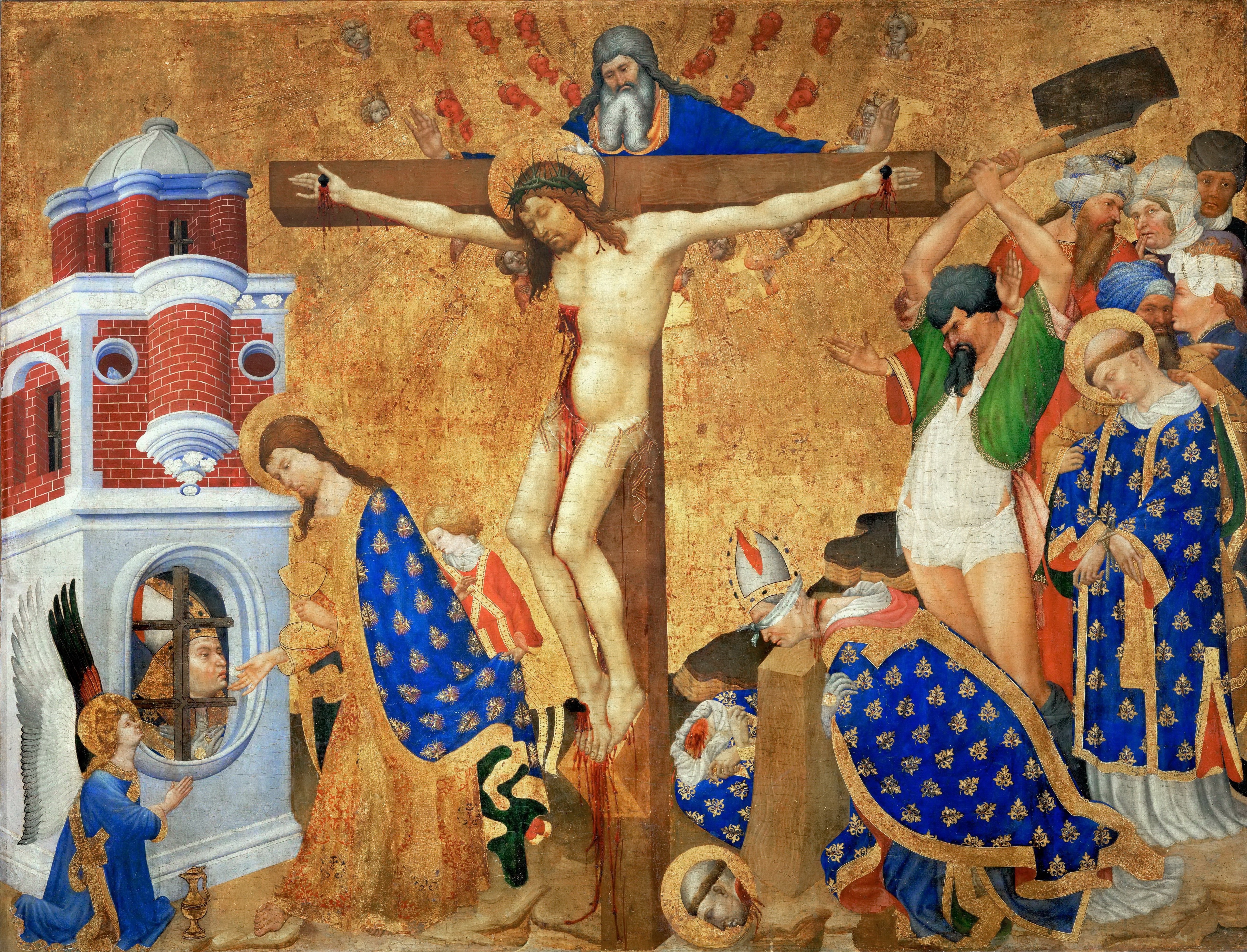

https://upload.wikimedia.org/wikipedia/commons/6/64/Henri_Bellechose_001.jpg

http://tinyurl.com/3rey5zj

aa) as depicted in a full-page illumination of French or English workmanship, attributed to the Master of Sir John Fastolf's Hours, in an earlier fifteenth-century Book of Hours (ca. 1430-1440; Los Angeles, J. Paul Getty Museum, ms. 5, fol. 35v):


http://www.getty.edu/art/exhibitions/cult_saints/images/00300601_zm.jpg

http://tinyurl.com/yhcuuh5

Detail view (D.'s severed head):

St. Denis / M. Sir John Fastolf
http://tinyurl.com/ylooxrf

bb) as portrayed in a later fifteenth-century polychromed limestone statue (c. 1460-1470) in the Bode-Museum, Berlin:

https://upload.wikimedia.org/wikipedia/commons/6/60/Le_Moiturier_%28circle%29_Saint_Denis.jpg

http://tinyurl.com/4gvkeg

cc) as depicted (martyrdom and, in the upper register, cephalophory) in a later fifteenth-century copy of the Legenda aurea in its French-language translation by Jean de Vignay (c. 1480-1490; Paris, BnF, ms. Français 245, fol. 135r):


http://tinyurl.com/yg4vhdu

dd) as depicted (between Sts. Rusticus and Eleutherius) in a late fifteenth-century breviary according to the Use of Langres (after 1481; Chaumont, Mediathèque de Chaumont, ms. 33, fol. 456r):


http://www.enluminures.culture.fr/Wave/savimage/enlumine/irht6/IRHT_097055-p.jpg

http://www.enluminures.culture.fr/Wave/savimage/enlumine/irht6/IRHT_097055-p.jpg

ee) as depicted in a hand-colored woodcut in the Beloit College copy of Hartmann Schedel's late fifteenth-century Weltchronik (Nuremberg Chronicle; 1493) at fol. CIXv:


http://www.beloit.edu/nuremberg/book/images/Martyrs/big/Dionysius%20(the%20Areopagite)%20CIXv.jpg

http://tinyurl.com/9ghdm8w

ff) as portrayed in high relief on a polychromed and gilt panel of a late fifteenth- or early sixteenth-century altarpiece (ca. 1490-1510) in the Filialkirche Hl. Leonhard in Pesenbach (Oberösterreich):


http://tarvos.imareal.oeaw.ac.at/server/images/7017908.JPG

http://tarvos.imareal.oeaw.ac.at/server/images/7017908.JPG

gg) as depicted (at right; at left, St. Sebastian) on a panel of the late fifteenth- or early sixteenth-century winged altar (c. 1497-1507) in the Pfarrkirche Hl. Remigius in Gampern (Oberösterreich):


http://tarvos.imareal.oeaw.ac.at/server/images/7017792.JPG

http://tarvos.imareal.oeaw.ac.at/server/images/7017792.JPG

hh) as portrayed in high relief (at far left) on the central panel of the late fifteenth-century Vierzehn-Nothelfer-Altar (1498) in the Münster St. Marien und Jakobus in Heilsbronn (Lkr. Ansbach):


https://upload.wikimedia.org/wikipedia/commons/c/c6/Heilsbronn_M%C3%BCnster_Vierzehn-Nothelfer-Altar_Schrein.jpg

http://tinyurl.com/pcnarog

Detail view:


https://upload.wikimedia.org/wikipedia/commons/b/bc/Heilsbronn_M%C3%BCnster_Vierzehn-Nothelfer-Altar_Hl_Dionys.jpg

http://tinyurl.com/qbceeza

ii) as portrayed in high relief on an early sixteenth-century stall end (between 1501 and 1507) in the choir of the St. Martins-Kirche in Memmingen:


https://upload.wikimedia.org/wikipedia/commons/0/04/Chorgest%C3%BChl_St._Martin_Memmingen_-_St._Dionysos.JPG
http://tinyurl.com/nahwgj9

jj) as depicted (at left; at right, St. Margaret) by Vicente Macip in the central panel of his early sixteenth-century altarpiece (c. 1510) in the capilla de San Dionisio y Santa Margarita in Valencia's catedral de la Asunción de Nuestra Señora:


San Dionisio y Santa Margarita by Meldelen

http://tinyurl.com/3bbdu8b

kk) as depicted by the Master of Messkirch on a panel from a dismembered earlier sixteenth-century altarpiece (c. 1535-1540) in the Staatsgalerie Stuttgart:


https://upload.wikimedia.org/wikipedia/commons/4/47/Heiliger_Dionysius.jpg

http://tinyurl.com/pd6m447


John Dillon subsequently posted two additional images:

Dionysius as depicted in one of four panels of a full-page illumination in the late twelfth-century so-called Bible of Saint Bertin (ca. 1190-1200; Den Haag, KB, ms. 76 F 5, fol. 28v):
http://www.wga.hu/art/zgothic/miniatur/1151-200/3french/22french.jpg
http://manuscripts.kb.nl/zoom/BYVANCKB%3Amimi_76f5%3A028v_min_a2

Dionysius (martyrdom) as depicted in an earlier fifteenth-century prayer book from Brabant (ca. 1430-1440; Baltimore, The Walters Art Museum, ms. W.164, fol. 171r):


To all those I would add this image from the mid-fifteenth century east window of the church of St Denys in York


https://s-media-cache-ak0.pinimg.com/236x/e1/b0/d4/e1b0d44789eaee9c620bbe2cbed2b324.jpg

Image: pinterest/Roger Walton on Flickr

Meanwhile the New Liturgical Movement had an interesting post about the celebration of Mass in Greek by the monks of St Denis in honour of the Greek origin of their patron. The article is by The Greek Mass of St Denys of Paris


Saturday, 15 August 2015

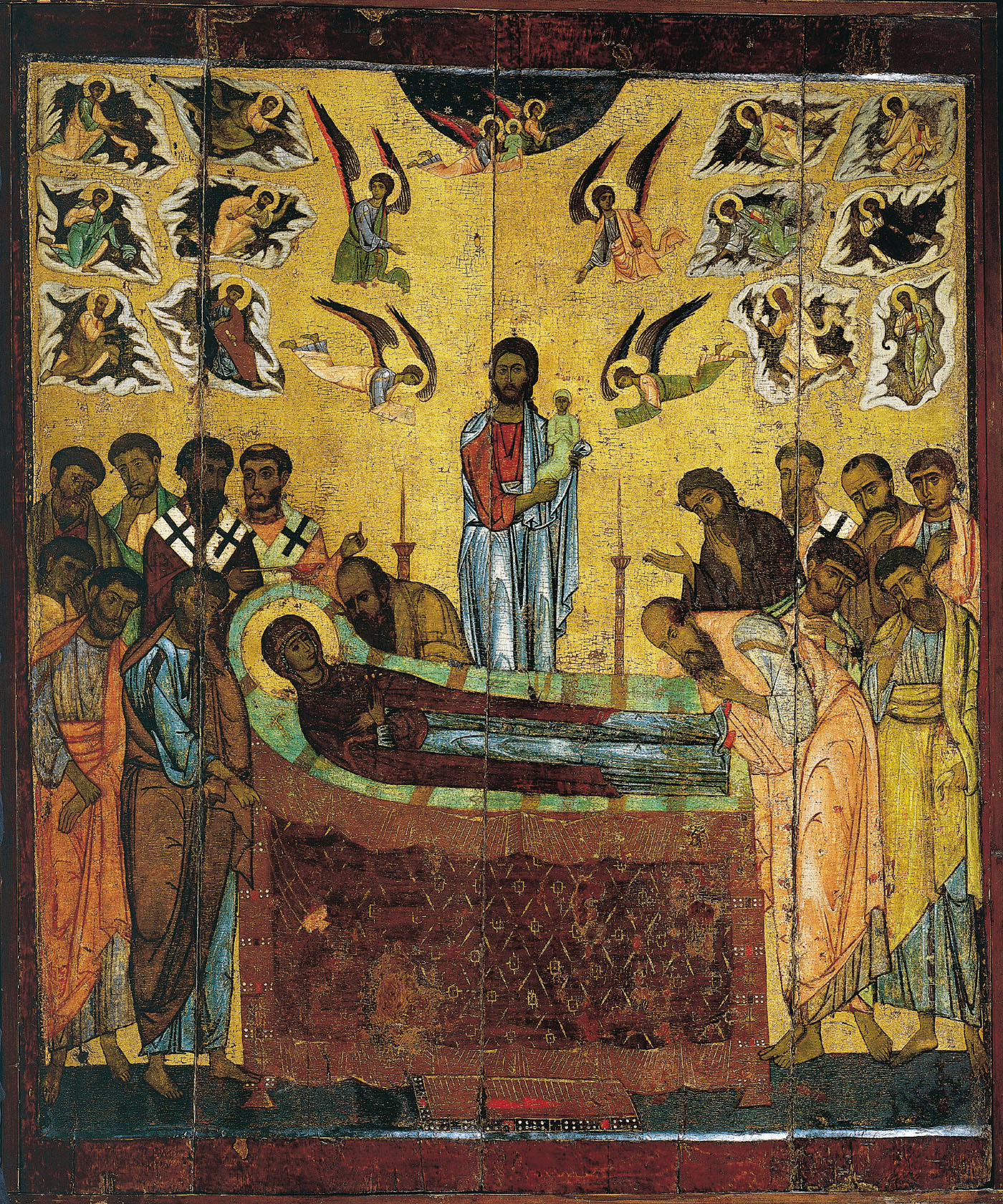
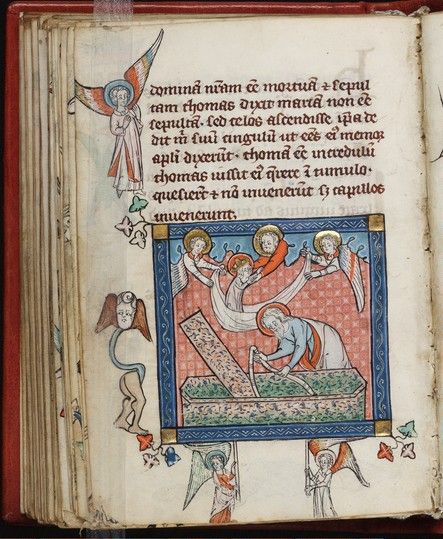
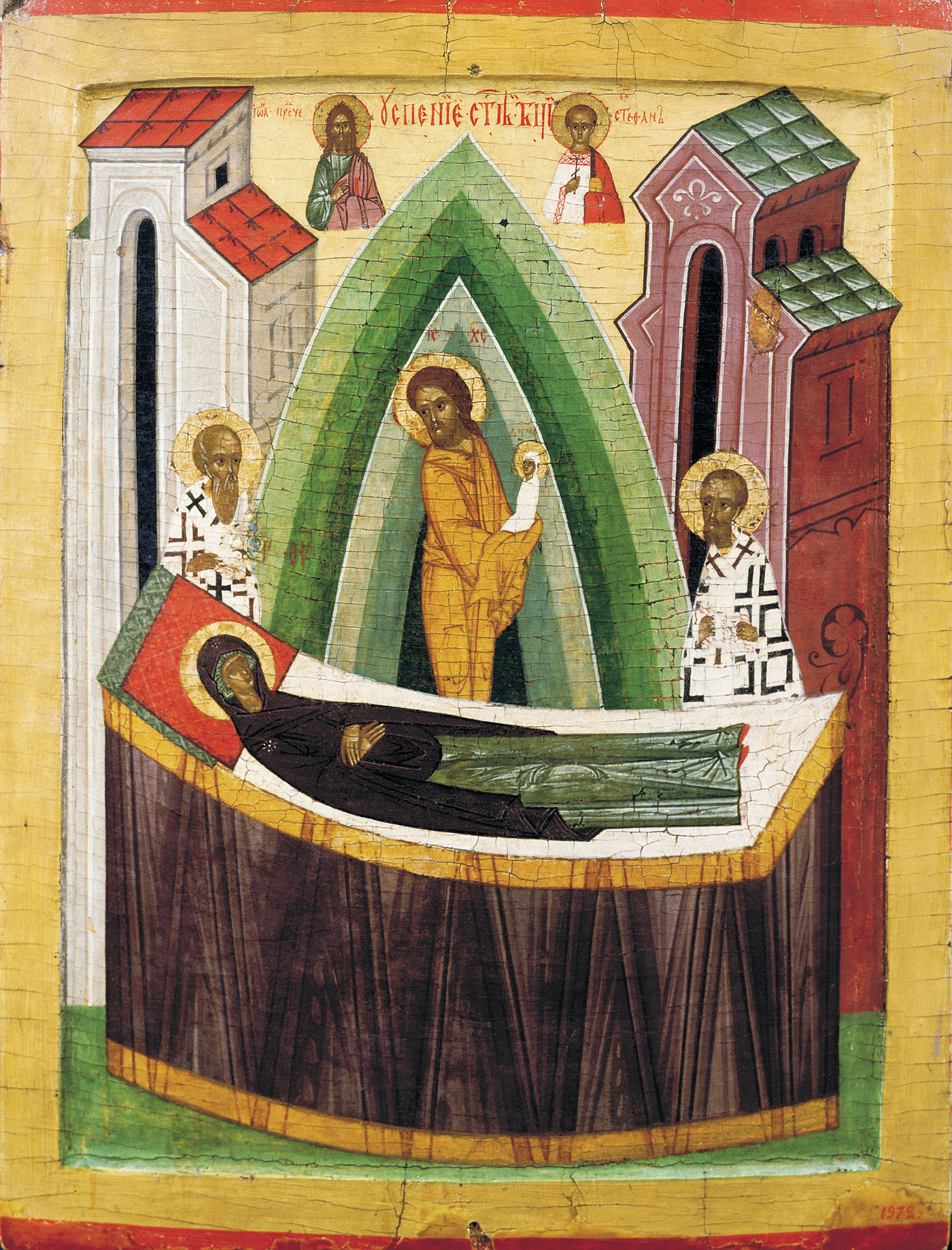
The Assumption of the Blessed Virgin Mary


John Dillon has posted on the medieval-religion discussion group the following, which I have very slightly edited and adapted:

Today, August 15th, is the feast day of:
1a) The Dormition of the Theotokos.
1b) The Assumption of the Blessed Virgin Mary.

As indicated by the entry in the early sixth-century Calendar of Carthage for an August feast of Mary among the Saints, these two closely related Marian feasts are probably at least as old as the later fifth century. Narrative texts providing diverging accounts of Mary's transit are known from at least the mid-fifth century onward; these will have stimulated a desire for formal celebration, despite whatever theological reservations such writings will have evoked (e.g. a book called_The Assumption of Holy Mary is among the apocrypha specifically rejected in the sixth-century Decretum Gelasianum). A major study of these early texts, with English-language translations of them, is Stephen J. Shoemaker, Ancient Traditions of the Virgin Mary's Dormition and Assumption (Oxford Univiversity Press, 2002).

In some places in late antiquity (e.g. Egypt, Arabia, Gaul) the feast in question took place in January; in others (e.g. Palestine) it was kept in August, though not always on this day: the aforementioned Calendar of Carthage has it on August 12th. The Emperor Maurice (d. 602) is reported to have established it for the empire as a whole as falling on  August 15th. In Thessaloniki, at least, the observance seems to have begun only in the time of its earlier seventh-century bishop John (610-649), to whom we owe the oldest surviving Greek-language sermon for this feast.

Differences in emphasis led early to the feast's being called in Greek that of the Dormition (Koimēsis; 'Falling Asleep', a metaphor for death), beginning with Mary's death (in what became the standard view for medieval Hellenophones, her soul ascended immediately and her body was taken up after its burial), and, in Latin, that of the Assumption (a term that avoids declaring a position on Mary's physical state upon her entry into Heaven). As the divergent narrative constructions and theological interpretations have hardened over time, it has become customary to speak -- in modern contexts, at least -- of two feasts rather than of one.

A late nineteenth-century translation into English of the three sermons by St. John of Damascus on the Dormition of the Theotokos is here:
http://legacy.fordham.edu/halsall/basis/johndamascus-komesis.asp


A few period-pertinent representations of Mary's Dormition and/or Assumption, supplementing those in various media accessible at Genevra Kornbluth's Archive page dedicated to the Dormition, Assumption, and Coronation of the Virgin at: www.kornbluthphoto.com/DormitionVirgin.html

a) The Dormition as portrayed in relief in three late tenth- or early eleventh-century Byzantine ivories:
1) late tenth-century; in the Metropolitan Museum of Art, New York:
http://www.metmuseum.org/toah/works-of-art/17.190.132
2) late tenth- or early eleventh-century; in the Musée National du Moyen Âge (Musée de Cluny) in Paris:
http://en.wikipedia.org/wiki/File:Dormition_de_la_Vierge.JPG
3) late tenth- or early eleventh-century; in the Worcester Art Museum, Worcester, MA:
http://tinyurl.com/pnoosf6

b) The mid-twelfth-century Dormition mosaic (betw. 1146 and 1151) in the chiesa di Santa Maria dell'Ammiraglio (a.k.a. chiesa della Martorana) in Palermo:

 http://rubens.anu.edu.au/raid1cdroms/sicily/palermo/churches/martorana/interior/mosaics/P1015512.JPG

Detail views:
http://tinyurl.com/ppdaphu
http://tinyurl.com/pwv7e5v

c) The Assumption as portrayed in relief by the Master of Cabestany on the later twelfth-century former tympanum (ca. 1150-1180) of the église Notre-Dame at Cabestany (Pyrénees Orientales) now in the Centre de Sculpture Romane "Maître de Cabestany" there:

 http://www.wga.hu/art/m/master/cabestan/1cabesta.jpg


d) The Dormition as depicted (at far right) on a later twelfth-century iconostasis beam in the Holy Monastery of the God-trodden Mount Sinai (a.k.a. St. Catherine's monastery), St. Catherine, South Sinai governorate:
http://www.icon-art.info/hires.php?lng=en&type=1&id=3667

e) The later twelfth-century (1170s?) Dormition (right) and Assumption (left) reliefs on the lintel of the central portal of the west facade of Senlis' cathédrale Notre-Dame:

The tympanum relief above portrays the Virgin in Majesty:

 http://www.shafe.co.uk/crystal/images/lshafe/Senlis_Notre_Dame_Coronation_of_the_Virgin.jpg

f) The Dormition as portrayed in relief by Bonannus of Pisa in a panel of his late twelfth-century bronze doors (later 1180s) for the Porta San Ranieri of Pisa's cattedrale metropolitana primaziale di Santa Maria Assunta, and now in the Museo dell'Opera del Duomo there:
https://www.flickr.com/photos/44884174@N08/14405264453

g) The Dormition as depicted in a late twelfth- or early thirteenth-century icon from the Desyatinny monastery in Veliky Novgorod, now in the State Tretyakov Gallery, Moscow:
http://www.belygorod.ru/img2/Ikona/Used/257Uspenie12_13.jpg

h) The Dormition as depicted in panels of the early thirteenth-century Glorification of the Virgin window (betw. 1205 and 1215) in the basilique cathédrale Notre-Dame, Chartres:
http://tinyurl.com/o2mfczk
http://tinyurl.com/oac7hya

i) The earlier thirteenth-century Dormition and Assumption reliefs (betw. 1205 and 1230) on the lintel of the central portal of the north porch, basilique cathédrale Notre-Dame, Chartres:
1) Dormition: http://tinyurl.com/4xskuah
2) Assumption: http://tinyurl.com/3phkjl4

j) The Dormition and the Coronation of the Virgin as depicted in the earlier thirteenth century Psalter of St. Louis and Blanche of Castile (ca. 1225; Paris, BnF, ms. Arsenal 1186, fol. 29v):
http://gallica.bnf.fr/ark:/12148/btv1b7100723j/f66.image

k) The Assumption as depicted in the earlier thirteenth-century northern rose window (ca. 1230) of the basilique cathédrale Notre-Dame, Chartres:
http://manuelcohen.photoshelter.com/image/I0000zDh8M7xMONc

l) The earlier thirteenth-century tympanum relief of the Dormition (ca. 1240?) on the south portal of the basilique cathédrale Notre-Dame, Strasbourg:

 http://www.bluffton.edu/~sullivanm/strasbourg/southdormition.jpg

http://www.bluffton.edu/~sullivanm/strasbourg/southdormitiondet.jpg

m) The Dormition as depicted in a mid-thirteenth-century glass window (ca. 1250-1260) in the Museum Schnütgen, Köln (photograph by Gordon Plumb):
https://www.flickr.com/photos/22274117@N08/4050070890

n) The later thirteenth-century Dormition fresco (either ca. 1263-1270 or slightly later) in the monastery church of the Holy Trinity at Sopoćani:
1) lower part (on earth): http://tinyurl.com/4246jtd
2) upper part (in Heaven): http://tinyurl.com/4yqm6jv
Greatly expandable detail views are here:
http://tinyurl.com/3tnycct

o) The Dormition as depicted in a late thirteenth-century copy of French origin of the Legenda aurea (San Marino, CA, Huntington Library, ms. HM 3027, fol. 101r; image greatly expandable):
http://digitalassets.lib.berkeley.edu/ds/huntington/images//000890A.jpg

p) The Dormition as depicted by Eutychios and Michael Astrapas in a late thirteenth-century fresco (1294 or 1295) in the church of the Peribleptos (now Sv. Kliment Ohridski) in Ohrid:
https://plus.google.com/photos/110067756467697073060/albums/5249227995814221297/5249235355444298674?pid=5249235355444298674&oid=110067756467697073060
Detail view:
https://plus.google.com/photos/110067756467697073060/albums/5249227995814221297/5249235443048502434?pid=5249235443048502434&oid=110067756467697073060

q) The Dormition as depicted by Jacopo Torriti in his late thirteenth-century apse mosaic (completed, 1296) in Rome's basilica di Santa Maria Maggiore:
http://www.wga.hu/art/t/torriti/mosaic/5scene5.jpg
Detail views:
http://www.wga.hu/art/t/torriti/mosaic/5scene51.jpg
http://www.wga.hu/art/t/torriti/mosaic/5scene52.jpg

r) Pietro Cavallini's late thirteenth-century Dormition mosaic (betw. 1296 and 1300) in Rome's basilica di Santa Maria in Trastevere:


http://www.wga.hu/art/c/cavallin/mosaic/6scene.jpg

Detail view:
http://www.wga.hu/art/c/cavallin/mosaic/6scene1.jpg
The verse inscriptions for this cycle were composed by Cardinal Jacopo Stefaneschi, a brother of the donor; as this example shows, insufficient attention was given to insuring that the mosaicists would render accurately the written texts.

s) The Assumption as depicted in the late thirteenth- or early fourteenth-century Rothschild Canticles, a devotional miscellany of Flemish or Rhineland origin (New Haven, CT, Beinecke Library, Beinecke MS 404, fol. 185v):
http://brbl-media.library.yale.edu/images/1011872_quarter.jpg

t) The Dormition as depicted in an early fourteenth-century fresco (ca. 1310) in the church of the Dormition in the Žiča monastery in Kruševica:
http://www.maletic.org/serbian-frescoes/single-gallery/2856690

u) The Dormition as depicted in an earlier fourteenth-century mosaic (betw. 1315 and 1321), Chora Church (Kariye Camii), Istanbul:
http://mlewiphotos.com/d/9939-2/43210_01-12-SI+51zxs.jpg
http://tinyurl.com/ox8yx88

v) The Dormition as depicted in the earlier fourteenth-century frescoes (betw. 1313 and 1318; conservation work in 1968) by Michael Astrapas and Eutychios in the church of St. George at Staro Nagoričane:
https://plus.google.com/photos/110067756467697073060/albums/5245687190076668897/5245713881427488098?pid=5245713881427488098&oid=110067756467697073060

w) The Assumption as depicted in an earlier fourteenth-century copy (ca. 1326-1350) of the Legenda aurea in its French-language version by Jean de Vignay (Paris, BnF, ms. Français 185, fol. 23r):
http://tinyurl.com/3namtmw

x) The Dormition and the Funeral of Mary as depicted in an earlier fourteenth-century French-language legendary of Parisian origin (ca. 1327), with illuminations attributed to the Fauvel Master (Paris, BnF, ms. Français 183, fols. 58r, 59v):
1) Dormition: http://tinyurl.com/4xp7bq4
2) Funeral: http://tinyurl.com/3qopwxv

y) The Dormition and the Assumption as depicted in earlier fourteenth-century frescoes (1330s) in the nave of the church of the Hodegetria in the Patriarchate of Peć:
1) Dormition:
http://tinyurl.com/3ggkb74
2) Assumption:
http://tinyurl.com/4xyuqgw
Detail view (Assumption):
http://tinyurl.com/3ue2yj8

z) The Dormition as depicted in a mid-fourteenth-century (1348) copy of the Legenda aurea in its French-language version by Jean de Vignay (Paris, BnF, ms. Français 241, fol. 204r):
http://tinyurl.com/3za6eus

aa) The Dormition and Assumption as portrayed in high relief by Andrea Orcagna on his later fourteenth-century Tabernacle (1359) in Florence's chiesa di Orsanmichele:
http://www.wga.hu/art/o/orcagna/tabern_2.jpg

bb) The Dormition as depicted in the later fourteenth-century frescoes (1360s and 1370s; restored in 1968-1970) in the church of St. Demetrius in Marko's Monastery at Markova Sušica:
http://users.stlcc.edu/mfuller/monmarkovi/MadonnaDormition.jpg
Detail view:
http://users.stlcc.edu/mfuller/monmarkovi/MaryDormCX.jpg

cc) The Dormition and Assumption as depicted in an early fifteenth-century missal for the Use of Gand / Ghent (Valenciennes, Bibliothèque de Valenciennes, ms. 122, fol. 27v):
http://tinyurl.com/qgnlm3z

dd) The Dormition as depicted in an early fifteenth-century copy (ca. 1410-1412) of Marco Polo's Devisement du monde (Paris: BnF, ms. Français 2810, fol. 163r):
http://tinyurl.com/4xz59y8

ee) The Dormition as depicted in an earlier fifteenth-century Novgorod School icon now in the State Russian Museum, St. Petersburg:
http://www.belygorod.ru/img2/Ikona/Used/258UspenieGRM.jpg

ff) The Dormition as depicted by Andrea del Castagno in an earlier fifteenth-century mosaic (1442 or 1443) in the basilica di San Marco in Venice:
http://www.wga.hu/art/a/andrea/castagno/1_1440s/042dormi.jpg

gg) The Dormition and Assumption as portrayed in high relief by Veit Stoss in the central panel of his late fifteenth-century polychromed wood altarpiece (betw. 1477 and 1489) in the church of St. Mary, Kraków:

 https://upload.wikimedia.org/wikipedia/commons/6/6a/Altar_of_Veit_Stoss%2C_St._Mary%27s_Church%2C_Krakow%2C_Poland.jpg

Detail view (Dormition):
http://tinyurl.com/okzjf6b
Detail view (Assumption):
http://tinyurl.com/qyow5eb

hh) The Assumption as depicted in a late fifteenth-century addition (1491?) in the guildbook of the London's Worshipful Company of Skinners' Confraternity of the Assumption of the Blessed Virgin Mary (London, Guildhall Library, MS 31692):
http://www.english.cam.ac.uk/medieval/images/full_p58_assumption.jpg

ii) The Assumption as portrayed in high relief by Tilman Riemenschneider in the central panel of his early sixteenth-century limewood altarpiece of Mary (ca. 1510) in the Herrgottskirche in Creglingen (Lkr. Main-Tauber-Kreis) in Baden-Württemberg:
https://www.flickr.com/photos/hen-magonza/9798485103
Many detail views here:
https://www.flickr.com/photos/gripspix/albums/

Gordon Plumb has also posted some Assumption images in glass plus one textile fragment:


Saint-Nicholas-de-Port, Bay 23, 2c:
https://www.flickr.com/photos/22274117@N08/15022597834
and detail:
https://www.flickr.com/photos/22274117@N08/15457218748
Bay 23, 1a-2a, Glass by Valentin Bousch, the Alsatian glazier; date, c.1514-20:
https://www.flickr.com/photos/22274117@N08/15640633501


Elland, St Mary the Virgin W. Yorks., east window, 2b:
https://www.flickr.com/photos/22274117@N08/15032047739

Glasgow, Burrell Collection, (ex Hampton Court Hereforshire):

https://www.flickr.com/photos/22274117@N08/2212659812

Angers Cathedral, Bay 123, 5b-5c:
https://www.flickr.com/photos/22274117@N08/10293464646
and

https://www.flickr.com/photos/22274117@N08/6048290101


Wrangle, St Mary and St Nicholas, Lincolnshire, nV, 2d:
https://www.flickr.com/photos/22274117@N08/8164595993

York, St Mary, sIII:
https://www.flickr.com/photos/22274117@N08/6046643403

Stanford-on-Avon, St Nicholas, Northamptonshire, sVI, 2b:
https://www.flickr.com/photos/22274117@N08/8681972558

York Minster, CHnII, 8e:
https://www.flickr.com/photos/22274117@N08/5033252986
York Minster, Chapter House, CHnII, 8c:
https://www.flickr.com/photos/22274117@N08/5033249132

Normanton, All Saints W Yorks, east window, 3c, Thomas receiving Virgin's girdle:
https://www.flickr.com/photos/22274117@N08/4322986955

North Moreton, All Saints, Oxfordshire, sII, 3e:
https://www.flickr.com/photos/22274117@N08/2945593238

Troyes, Cathédrale St Pierre et St Paul, Bay 201, scene on left:
https://www.flickr.com/photos/22274117@N08/2197859715

York, St Denys, sIII, 2b:
https://www.flickr.com/photos/22274117@N08/3218202676

Careby, St Stephen, Lincolnshire, detail of cope fragment:
https://www.flickr.com/photos/22274117@N08/2209918427

East Harling, St Peter and St Paul, Norfolk, east window, 2e:
https://www.flickr.com/photos/22274117@N08/2481558468


Warwick, St Mary, Beauchamp Chantry, nIII, A1-A6:
This glass contains the opening part of the antiphon "Gaudeamus", which forms the first part of the introit appointed in the Sarum Gradual for the festival of the Assumption of the BVM.
https://www.flickr.com/photos/22274117@N08/4373047659

Cambridge, Corpus Christi College Chapel:
https://www.flickr.com/photos/22274117@N08/6512358415

Monday, 20 July 2015

St Margaret of Antioch


Traditionally today is the feast of St Margaret of Antioch, Virgin and Martyr. A very popular saint in the middle ages - she was invoked by women in childbirth - she does not appear in the novus ordo calendar at all, and devotion to her appears to have largely disappeared.

Matthew Heintzelman posted about her on the Medieval Religion discussion group as follows from the online account here

“Olybrius, Governor of the Roman Diocese of the East, asked to marry her but with the price of her renunciation of Christianity. Upon her refusal she was cruelly tortured, during which various miraculous incidents occurred. One of these involved being swallowed by Satan in the shape of a dragon, from which she escaped alive when the cross she carried irritated the dragon's innards.” [ Hence her concern for women in labour - Clever Boy ]

Gordon Plumb posted these medieval English stained glass depictions of her on the discussion group:

Leicester, Jewry Wall Museum:

Landwade, St Nicholas, Cambridgeshire, nIII, 2a:

Stanford-on-Avon, St Nicholas, Northamptonshire, nIV, 1b:

Stanford-on-Avon, St Nicholas, sV, 3b:

Wrangle, St Mary & St Nicholas, nVIII, B3:

York Minster, nXXX, 1c-2c:

York, St Michael Spurriergate, sV, 1b:

Addlethorpe, St Nicholas, Lincs, nIV, A5:

Oxford, Balliol College Chapel, nV, 1c:

York Minster, sXXXIV, 2a:

Winchester Cathedral, nVIII, A7:

Winchester College, Chapel, Thurburn's Chantry, south window A2:

York, St Denys, nIV, 2a-3a:

South Ormsby, St Leonard, Lincs, sIII, 1b:

Langport, All Saints, Somerset, East window, B6:

Oxford, Trinity College, Dining Hall, roundel c.1515:

Kirk Sandall, St Oswald, South Yorkshire, nIV, 2d:

Oxford, Christ Church Cathedral, nVI, 3a:

These examples inclusde ones from some of the parish churches for which I have a particular enthusiasm - St Oswald Kirk Sandal, with the marvellous Rokeby chantry where the image of St Margaret is to be found, St Denys Walmgate in York and St Nicholas Stanford-on-Avon - all very well worth visiting, and none of them as well known as they should be.


Sunday, 9 October 2011

St Denis


Were today not Sunday, and were it not also the feast of Bl.John Henry Newman, we might well be observing the feast of St Denis and his companions, protomartyrs of France.

His burial place is, of course, the great basilica of St Denis north of Paris, the burial place of French Kings and their families, and often presented as the first gothic church. Despite the appalling sacrilege committed there during the French Revolution and the drastic restoration by Viollet le Duc in the nineteenth century it must surely be one of the most evocative, moving buildings in France. I have only seen it in the distance, driving past on the motorway, but that was enough to make the hairs on the back of my neck tingle.


http://www.paris4travel.com/wp-content/uploads/2009/08/free-wallpaper-of-Basilica-Saint-Denis.jpg

The west front of the Basilica.
The medieval north-west tower and spire were demolished during the mid-nineteenth century 'restoration' of the building.

Image: Paris4Travel.com

Devotion to St Denis was reflected in the art of medieval France. Here is a suitably gruesome image of his death, commissioned by Duke John the Fearless of Burgundy for the Charterhouse at Champmol in 1416.

File:Henri Bellechose 001.jpg

The Last Communion and Martyrdom of St Denis
Henri Bellechose, 1416
The Louvre

Image: Wikipedia

Closer to my own home one of my favourites amongst the historic churches of York is St Denys in Walmgate. It is rather off the tourist route, on the wrong side of the River Foss, and when I used to visit it was not open to the casual visitor - you had to seek out the key holder. As the link above indicates it is only half the size it once was and has lost its spire, but within is some wonderful medieval stained glass, including a fine fifteenth century figure of the patron in cephalaphoric mode in the east window.

St Denis carrying his head from Montartre to his chosen burial place
Stained glass of circa 1452-55

Image: St Denys church website


There is more about the glass by following the link on the parish website. Also in the church is the indent of the brass to the third Earl of Northumberland, killed fighting on the Lancastrian side at the battle of of Towton in 1461. The York inn of the Percy Earls of Northumberland lay in the parish. If you are in York I do urge you to seek out this fascinating church.