John Dillon has posted on the medieval-religion discussion group the following, which I have very slightly edited and adapted:
Today, August 15th, is the feast day of:
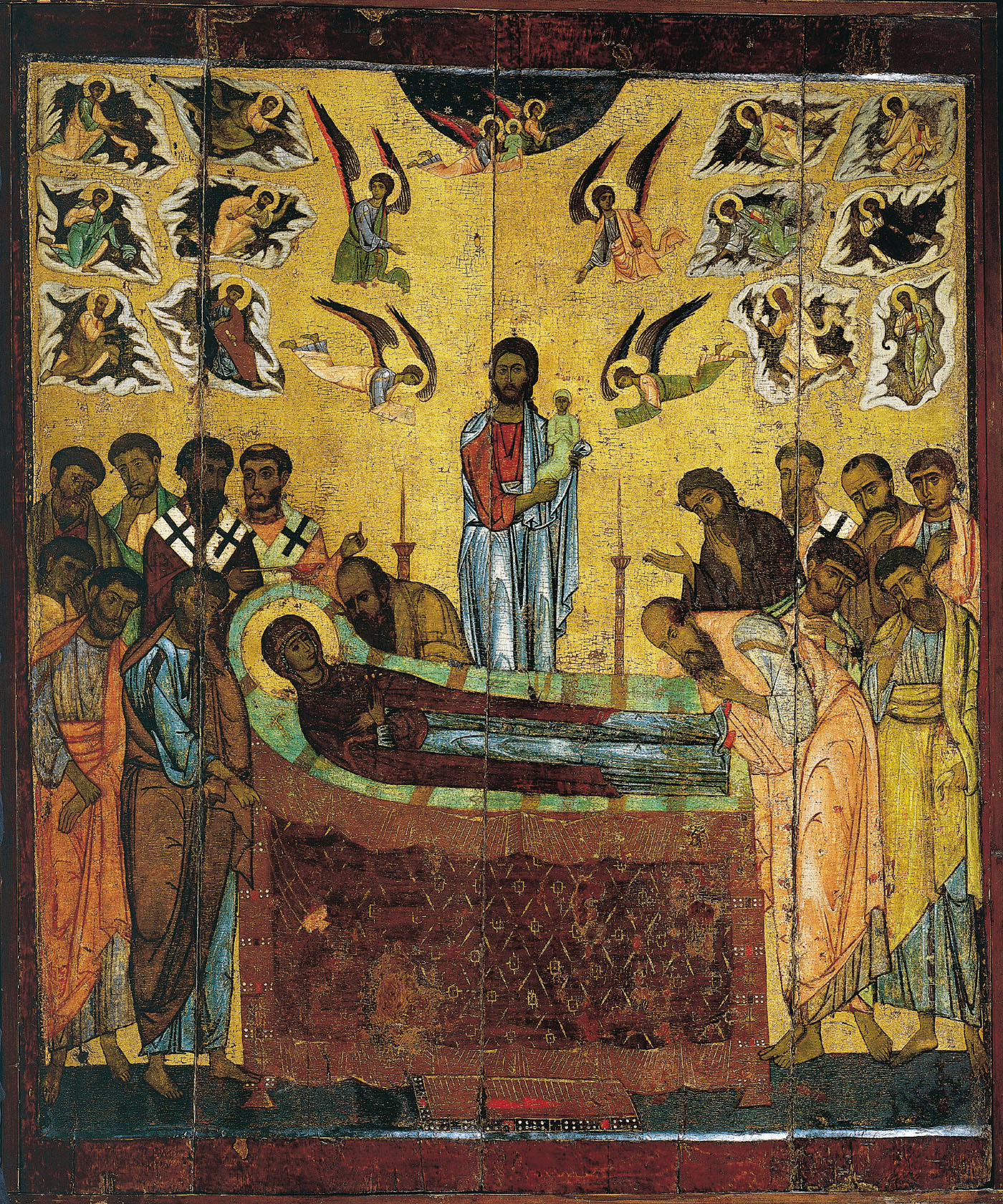
1a) The Dormition of the Theotokos.
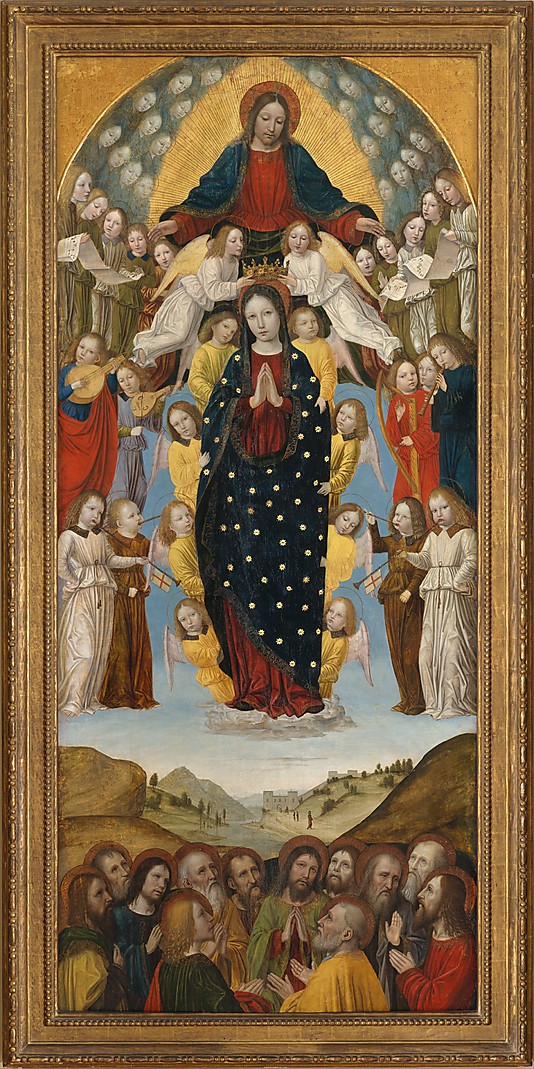
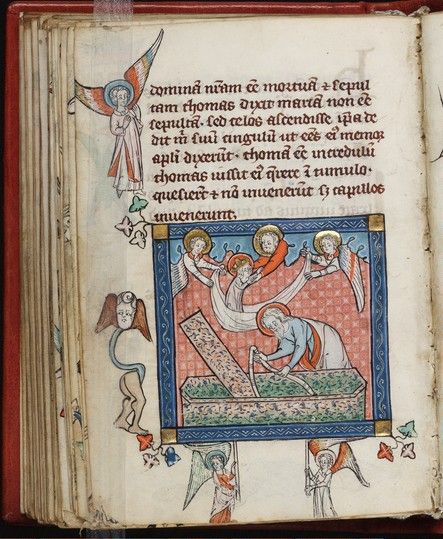
1b) The Assumption of the Blessed Virgin Mary.
As indicated by the entry in the early sixth-century Calendar of Carthage for an August feast of Mary among the Saints, these two closely related Marian feasts are probably at least as old as the later fifth century. Narrative texts providing diverging accounts of Mary's transit are known from at least the mid-fifth century onward; these will have stimulated a desire for formal celebration, despite whatever theological reservations such writings will have evoked (e.g. a book called_
The Assumption of Holy Mary is among the apocrypha specifically rejected in the sixth-century
Decretum Gelasianum). A major study of these early texts, with English-language translations of them, is Stephen J. Shoemaker,
Ancient Traditions of the Virgin Mary's Dormition and Assumption (Oxford Univiversity Press, 2002).
In some places in late antiquity (e.g. Egypt, Arabia, Gaul) the feast in question took place in January; in others (e.g. Palestine) it was kept in August, though not always on this day: the aforementioned Calendar of Carthage has it on August 12th. The Emperor Maurice (d. 602) is reported to have established it for the empire as a whole as falling on August 15th. In Thessaloniki, at least, the observance seems to have begun only in the time of its earlier seventh-century bishop John (610-649), to whom we owe the oldest surviving Greek-language sermon for this feast.
Differences in emphasis led early to the feast's being called in Greek that of the Dormition (
Koimēsis; 'Falling Asleep', a metaphor for death), beginning with Mary's death (in what became the standard view for medieval Hellenophones, her soul ascended immediately and her body was taken up after its burial), and, in Latin, that of the Assumption (a term that avoids declaring a position on Mary's physical state upon her entry into Heaven). As the divergent narrative constructions and theological interpretations have hardened over time, it has become customary to speak -- in modern contexts, at least -- of two feasts rather than of one.
A late nineteenth-century translation into English of the three sermons by St. John of Damascus on the Dormition of the Theotokos is here:
http://legacy.fordham.edu/halsall/basis/johndamascus-komesis.asp
A few period-pertinent representations of Mary's Dormition and/or Assumption, supplementing those in various media accessible at Genevra Kornbluth's Archive page dedicated to the Dormition, Assumption, and Coronation of the Virgin at:
www.kornbluthphoto.com/DormitionVirgin.html
a) The Dormition as portrayed in relief in three late tenth- or early eleventh-century Byzantine ivories:
1) late tenth-century; in the Metropolitan Museum of Art, New York:
http://www.metmuseum.org/toah/works-of-art/17.190.132
2) late tenth- or early eleventh-century; in the Musée National du Moyen Âge (Musée de Cluny) in Paris:
http://en.wikipedia.org/wiki/File:Dormition_de_la_Vierge.JPG
3) late tenth- or early eleventh-century; in the Worcester Art Museum, Worcester, MA:
http://tinyurl.com/pnoosf6
b) The mid-twelfth-century Dormition mosaic (betw. 1146 and 1151) in the chiesa di Santa Maria dell'Ammiraglio (a.k.a. chiesa della Martorana) in Palermo:
Detail views:
http://tinyurl.com/ppdaphu
http://tinyurl.com/pwv7e5v
c) The Assumption as portrayed in relief by the Master of Cabestany on the later twelfth-century former tympanum (ca. 1150-1180) of the église Notre-Dame at Cabestany (Pyrénees Orientales) now in the Centre de Sculpture Romane "Maître de Cabestany" there:
d) The Dormition as depicted (at far right) on a later twelfth-century iconostasis beam in the Holy Monastery of the God-trodden Mount Sinai (a.k.a. St. Catherine's monastery), St. Catherine, South Sinai governorate:
http://www.icon-art.info/hires.php?lng=en&type=1&id=3667
e) The later twelfth-century (1170s?) Dormition (right) and Assumption (left) reliefs on the lintel of the central portal of the west facade of Senlis' cathédrale Notre-Dame:
The tympanum relief above portrays the Virgin in Majesty:
f) The Dormition as portrayed in relief by Bonannus of Pisa in a panel of his late twelfth-century bronze doors (later 1180s) for the Porta San Ranieri of Pisa's cattedrale metropolitana primaziale di Santa Maria Assunta, and now in the Museo dell'Opera del Duomo there:
https://www.flickr.com/photos/44884174@N08/14405264453
g) The Dormition as depicted in a late twelfth- or early thirteenth-century icon from the Desyatinny monastery in Veliky Novgorod, now in the State Tretyakov Gallery, Moscow:
http://www.belygorod.ru/img2/Ikona/Used/257Uspenie12_13.jpg
h) The Dormition as depicted in panels of the early thirteenth-century Glorification of the Virgin window (betw. 1205 and 1215) in the basilique cathédrale Notre-Dame, Chartres:
http://tinyurl.com/o2mfczk
http://tinyurl.com/oac7hya
i) The earlier thirteenth-century Dormition and Assumption reliefs (betw. 1205 and 1230) on the lintel of the central portal of the north porch, basilique cathédrale Notre-Dame, Chartres:
1) Dormition:
http://tinyurl.com/4xskuah
2) Assumption:
http://tinyurl.com/3phkjl4
j) The Dormition and the Coronation of the Virgin as depicted in the earlier thirteenth century Psalter of St. Louis and Blanche of Castile (ca. 1225; Paris, BnF, ms. Arsenal 1186, fol. 29v):
http://gallica.bnf.fr/ark:/12148/btv1b7100723j/f66.image
k) The Assumption as depicted in the earlier thirteenth-century northern rose window (ca. 1230) of the basilique cathédrale Notre-Dame, Chartres:
http://manuelcohen.photoshelter.com/image/I0000zDh8M7xMONc
l) The earlier thirteenth-century tympanum relief of the Dormition (ca. 1240?) on the south portal of the basilique cathédrale Notre-Dame, Strasbourg:
http://www.bluffton.edu/~sullivanm/strasbourg/southdormitiondet.jpg
m) The Dormition as depicted in a mid-thirteenth-century glass window (ca. 1250-1260) in the Museum Schnütgen, Köln (photograph by Gordon Plumb):
https://www.flickr.com/photos/22274117@N08/4050070890
n) The later thirteenth-century Dormition fresco (either ca. 1263-1270 or slightly later) in the monastery church of the Holy Trinity at Sopoćani:
1) lower part (on earth):
http://tinyurl.com/4246jtd
2) upper part (in Heaven):
http://tinyurl.com/4yqm6jv
Greatly expandable detail views are here:
http://tinyurl.com/3tnycct
o) The Dormition as depicted in a late thirteenth-century copy of French origin of the
Legenda aurea (San Marino, CA, Huntington Library, ms. HM 3027, fol. 101r; image greatly expandable):
http://digitalassets.lib.berkeley.edu/ds/huntington/images//000890A.jpg
p) The Dormition as depicted by Eutychios and Michael Astrapas in a late thirteenth-century fresco (1294 or 1295) in the church of the Peribleptos (now Sv. Kliment Ohridski) in Ohrid:
https://plus.google.com/photos/110067756467697073060/albums/5249227995814221297/5249235355444298674?pid=5249235355444298674&oid=110067756467697073060
Detail view:
https://plus.google.com/photos/110067756467697073060/albums/5249227995814221297/5249235443048502434?pid=5249235443048502434&oid=110067756467697073060
q) The Dormition as depicted by Jacopo Torriti in his late thirteenth-century apse mosaic (completed, 1296) in Rome's basilica di Santa Maria Maggiore:
http://www.wga.hu/art/t/torriti/mosaic/5scene5.jpg
Detail views:
http://www.wga.hu/art/t/torriti/mosaic/5scene51.jpg
http://www.wga.hu/art/t/torriti/mosaic/5scene52.jpg
r) Pietro Cavallini's late thirteenth-century Dormition mosaic (betw. 1296 and 1300) in Rome's basilica di Santa Maria in Trastevere:
Detail view:
http://www.wga.hu/art/c/cavallin/mosaic/6scene1.jpg
The verse inscriptions for this cycle were composed by Cardinal Jacopo Stefaneschi, a brother of the donor; as this example shows, insufficient attention was given to insuring that the mosaicists would render accurately the written texts.
s) The Assumption as depicted in the late thirteenth- or early fourteenth-century Rothschild Canticles, a devotional miscellany of Flemish or Rhineland origin (New Haven, CT, Beinecke Library, Beinecke MS 404, fol. 185v):
http://brbl-media.library.yale.edu/images/1011872_quarter.jpg
t) The Dormition as depicted in an early fourteenth-century fresco (ca. 1310) in the church of the Dormition in the Žiča monastery in Kruševica:
http://www.maletic.org/serbian-frescoes/single-gallery/2856690
u) The Dormition as depicted in an earlier fourteenth-century mosaic (betw. 1315 and 1321), Chora Church (Kariye Camii), Istanbul:
http://mlewiphotos.com/d/9939-2/43210_01-12-SI+51zxs.jpg
http://tinyurl.com/ox8yx88
v) The Dormition as depicted in the earlier fourteenth-century frescoes (betw. 1313 and 1318; conservation work in 1968) by Michael Astrapas and Eutychios in the church of St. George at Staro Nagoričane:
https://plus.google.com/photos/110067756467697073060/albums/5245687190076668897/5245713881427488098?pid=5245713881427488098&oid=110067756467697073060
w) The Assumption as depicted in an earlier fourteenth-century copy (ca. 1326-1350) of the
Legenda aurea in its French-language version by Jean de Vignay (Paris, BnF, ms. Français 185, fol. 23r):
http://tinyurl.com/3namtmw
x) The Dormition and the Funeral of Mary as depicted in an earlier fourteenth-century French-language legendary of Parisian origin (ca. 1327), with illuminations attributed to the Fauvel Master (Paris, BnF, ms. Français 183, fols. 58r, 59v):
1) Dormition:
http://tinyurl.com/4xp7bq4
2) Funeral:
http://tinyurl.com/3qopwxv
y) The Dormition and the Assumption as depicted in earlier fourteenth-century frescoes (1330s) in the nave of the church of the Hodegetria in the Patriarchate of Peć:
1) Dormition:
http://tinyurl.com/3ggkb74
2) Assumption:
http://tinyurl.com/4xyuqgw
Detail view (Assumption):
http://tinyurl.com/3ue2yj8
z) The Dormition as depicted in a mid-fourteenth-century (1348) copy of the
Legenda aurea in its French-language version by Jean de Vignay (Paris, BnF, ms. Français 241, fol. 204r):
http://tinyurl.com/3za6eus
aa) The Dormition and Assumption as portrayed in high relief by Andrea Orcagna on his later fourteenth-century Tabernacle (1359) in Florence's chiesa di Orsanmichele:
http://www.wga.hu/art/o/orcagna/tabern_2.jpg
bb) The Dormition as depicted in the later fourteenth-century frescoes (1360s and 1370s; restored in 1968-1970) in the church of St. Demetrius in Marko's Monastery at Markova Sušica:
http://users.stlcc.edu/mfuller/monmarkovi/MadonnaDormition.jpg
Detail view:
http://users.stlcc.edu/mfuller/monmarkovi/MaryDormCX.jpg
cc) The Dormition and Assumption as depicted in an early fifteenth-century missal for the Use of Gand / Ghent (Valenciennes, Bibliothèque de Valenciennes, ms. 122, fol. 27v):
http://tinyurl.com/qgnlm3z
dd) The Dormition as depicted in an early fifteenth-century copy (ca. 1410-1412) of Marco Polo's
Devisement du monde (Paris: BnF, ms. Français 2810, fol. 163r):
http://tinyurl.com/4xz59y8
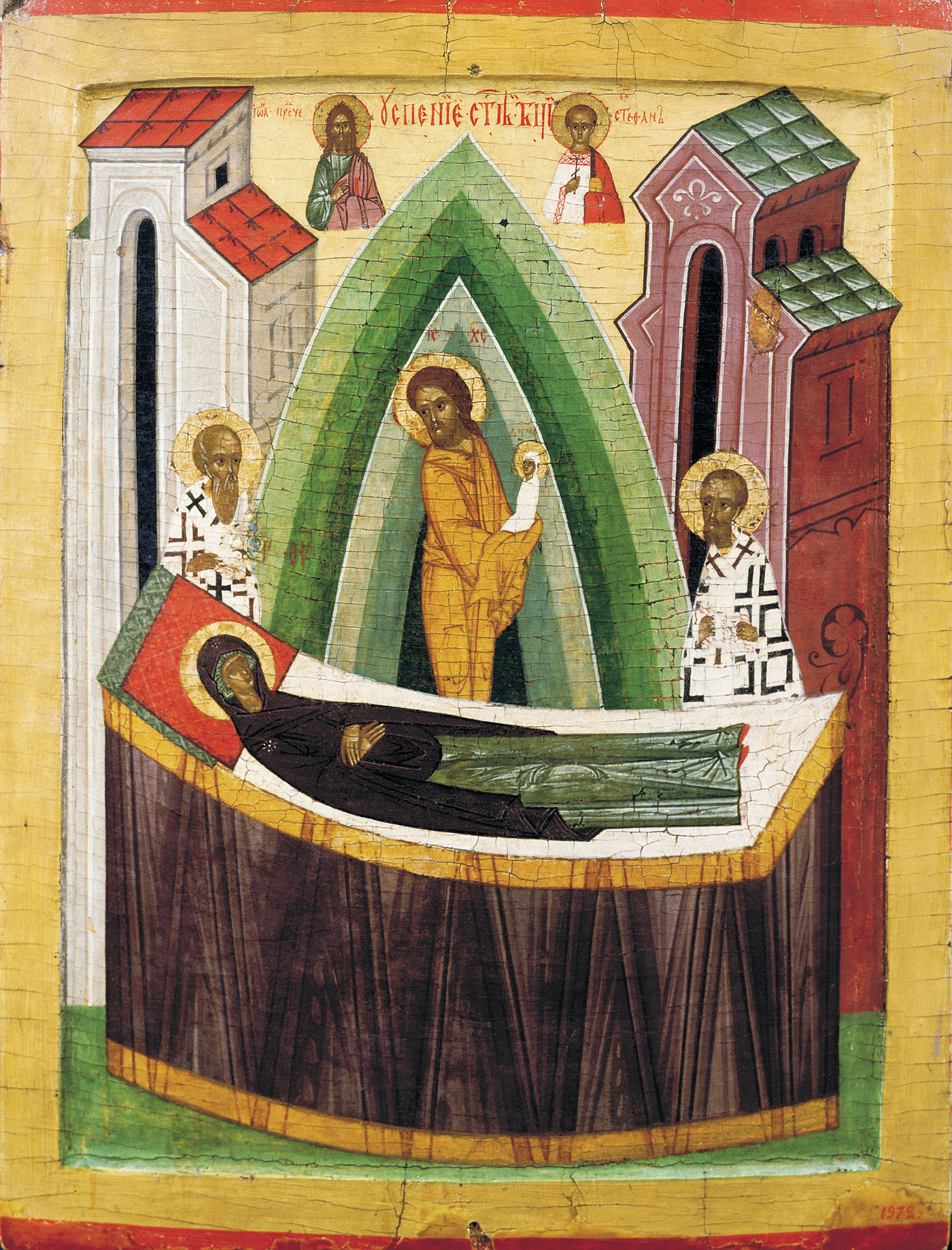
ee) The Dormition as depicted in an earlier fifteenth-century Novgorod School icon now in the State Russian Museum, St. Petersburg:
http://www.belygorod.ru/img2/Ikona/Used/258UspenieGRM.jpg
ff) The Dormition as depicted by Andrea del Castagno in an earlier fifteenth-century mosaic (1442 or 1443) in the basilica di San Marco in Venice:
http://www.wga.hu/art/a/andrea/castagno/1_1440s/042dormi.jpg
gg) The Dormition and Assumption as portrayed in high relief by Veit Stoss in the central panel of his late fifteenth-century polychromed wood altarpiece (betw. 1477 and 1489) in the church of St. Mary, Kraków:
Detail view (Dormition):
http://tinyurl.com/okzjf6b
Detail view (Assumption):
http://tinyurl.com/qyow5eb
hh) The Assumption as depicted in a late fifteenth-century addition (1491?) in the guildbook of the London's Worshipful Company of Skinners' Confraternity of the Assumption of the Blessed Virgin Mary (London, Guildhall Library, MS 31692):
http://www.english.cam.ac.uk/medieval/images/full_p58_assumption.jpg
ii) The Assumption as portrayed in high relief by Tilman Riemenschneider in the central panel of his early sixteenth-century limewood altarpiece of Mary (ca. 1510) in the Herrgottskirche in Creglingen (Lkr. Main-Tauber-Kreis) in Baden-Württemberg:
https://www.flickr.com/photos/hen-magonza/9798485103
Many detail views here:
https://www.flickr.com/photos/gripspix/albums/
Gordon Plumb has also posted some Assumption images in glass plus one textile fragment:
Saint-Nicholas-de-Port, Bay 23, 2c:
https://www.flickr.com/photos/22274117@N08/15022597834
and detail:
https://www.flickr.com/photos/22274117@N08/15457218748
Bay 23, 1a-2a, Glass by Valentin Bousch, the Alsatian glazier; date, c.1514-20:
https://www.flickr.com/photos/22274117@N08/15640633501
Elland, St Mary the Virgin W. Yorks., east window, 2b:
https://www.flickr.com/photos/22274117@N08/15032047739
Glasgow, Burrell Collection, (ex Hampton Court Hereforshire):
https://www.flickr.com/photos/22274117@N08/2212659812
Angers Cathedral, Bay 123, 5b-5c:
https://www.flickr.com/photos/22274117@N08/10293464646
and
https://www.flickr.com/photos/22274117@N08/6048290101
Wrangle, St Mary and St Nicholas, Lincolnshire, nV, 2d:
https://www.flickr.com/photos/22274117@N08/8164595993
York, St Mary, sIII:
https://www.flickr.com/photos/22274117@N08/6046643403
Stanford-on-Avon, St Nicholas, Northamptonshire, sVI, 2b:
https://www.flickr.com/photos/22274117@N08/8681972558
York Minster, CHnII, 8e:
https://www.flickr.com/photos/22274117@N08/5033252986
York Minster, Chapter House, CHnII, 8c:
https://www.flickr.com/photos/22274117@N08/5033249132
Normanton, All Saints W Yorks, east window, 3c, Thomas receiving Virgin's girdle:
https://www.flickr.com/photos/22274117@N08/4322986955
North Moreton, All Saints, Oxfordshire, sII, 3e:
https://www.flickr.com/photos/22274117@N08/2945593238
Troyes, Cathédrale St Pierre et St Paul, Bay 201, scene on left:
https://www.flickr.com/photos/22274117@N08/2197859715
York, St Denys, sIII, 2b:
https://www.flickr.com/photos/22274117@N08/3218202676
Careby, St Stephen, Lincolnshire, detail of cope fragment:
https://www.flickr.com/photos/22274117@N08/2209918427
East Harling, St Peter and St Paul, Norfolk, east window, 2e:
https://www.flickr.com/photos/22274117@N08/2481558468
Warwick, St Mary, Beauchamp Chantry, nIII, A1-A6:
This glass contains the opening part of the antiphon "Gaudeamus", which forms the first part of the introit appointed in the Sarum Gradual for the festival of the Assumption of the BVM.
https://www.flickr.com/photos/22274117@N08/4373047659
Cambridge, Corpus Christi College Chapel:
https://www.flickr.com/photos/22274117@N08/6512358415