Once I was a clever boy learning the arts of Oxford... is a quotation from the verses written by Bishop Richard Fleming (c.1385-1431) for his tomb in Lincoln Cathedral. Fleming, the founder of Lincoln College in Oxford, is the subject of my research for a D. Phil., and, like me, a son of the West Riding. I have remarked in the past that I have a deeply meaningful on-going relationship with a dead fifteenth century bishop... it was Fleming who, in effect, enabled me to come to Oxford and to learn its arts, and for that I am immensely grateful.


Thursday, 13 June 2013

Rebuilding the Berlin Stadtschloss


I was interested to see the report on the BBC website tonight about the commencement of the rebuilding of the shell of the Stadtschloss in Berlin. The report can be read here.

The schloss was the winter palace of the Kings of Prussia until 1918. Although damaged by bombing early in 1945 it was destroyed for ideological and political rather than structural reasons by the East German regime in 1950 when it was dynamited. Since 1989 there has been much debate about the proposal to rebuild it, and what form that should take. These disussion are summarized along with the history of the palace in the illustrated online article here.

photo

An aerial view of the Berlin Schloss taken in 1910

Image:Wolf on Flickr

Kaiser Wilhelm II apparently did not like living in the palace - he felt it was not secure enough in case of an attack, and after the outbreak of war in 1914 he and the Empress lived at another of the Berlin palaces

Now I do feel tempted to add that if they can begin to rebuild the palace, firstly do it properly and completely, including reconstructing the interiors, and secondly, restore the people it was built for.

The Edict of Milan


Today is the date given for the publication of the edict of Milan in 313, so today marks the 1700h anniversary. 

The facts are,however, a little more complicated than that statement of facts. The Emperors Constantine and Licinius had met at Milan earlier in the year and agreed on a policy of toleration for Christians within their portions of the Roman Empire. Today's anniversary is of the publication at Nicomedia on June 13 of the agreement already made. Whereas Constantine was clearly favourable to Christianity in his westernmost part of the Empire, Licinius himself was a pagan, and what he published for his territories in the Balkans was not an edict as such but a letter notifying his officials of the policy. The text is preserved in Lactantius, and was issued after the defeat of the aggressively pagan Maximian Daia.
 

photo

Emperor Licinius

Image: ISTORAX on Flickr

It is not clear if there was an official "Edict of Milan" at all. What was notified was the establishment of freedom of religion and to worship for Christians and also for others, and restores civil rights and property. There is an online account of the background and discussion of the issues here.

Licinius himself, of whom there is an online biography here, may possibly have converted to Christianity, but was to be defeated and deposed by Constantine in 324, and hanged in 325 for conspiring against his former colleague.  Constantine was left as the ruler of the entire Empire.


Emperor Constantine the Great
 
Image:mybyzantine.wordpress.com


St Anthony of Padua


Today is the feast day of St Anthony of Padua, 1195-1231. There is an account of the life of this noted Franciscan preacher and teacher and of his continuing role in the life of the Church here.


St Anthony of Padua
Metropolitan Museum New Yotk
Image: aug.edu

From the website which provided this fourteenth century image of the saint, which is more forceful than so many recent and modern ones which are often very sentimental, I found this piece about his iconography, which I have adapted for this post:

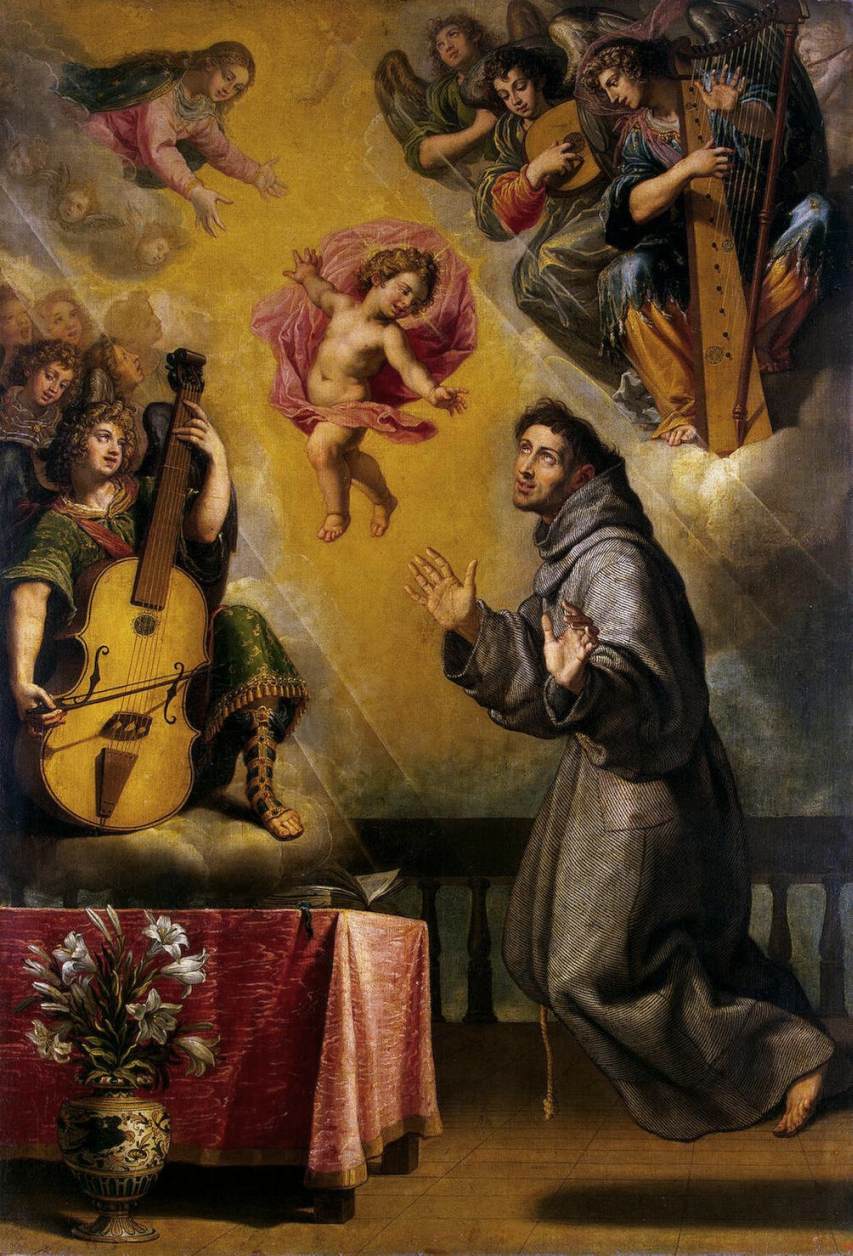
Those who have visited any number of Catholic churches will be familiar with the representation of St. Anthony of Padua as a young Franciscan holding the Christ Child on one arm  This tradition is based on a vision of the Christ Child that the saint is said to have had while staying with a nobleman. The man looked into the room he had provided for Anthony and saw him holding the Child in his arms.

This account did not enter the iconography until the 16th century, and even then the Child is shown standing upon the book that had until then always been Anthony's most common attribute. The book refers to Anthony's standing as the most famous preacher of his time and the Franciscan order's first Lector in Theology. The earliest images of him have the saint holding a closed book in his left hand and wearing the tonsure and habit of the Franciscan order, as above.

After the Child became a common feature, many painters put him on the opened pages of the book, as if he had appeared to Anthony while the saint was meditating on the scriptures . The Child is variously portrayed as a toddler, a boy , or even a small-scale man .

Because of the legend that he had once preached to the fish, these were sometimes used as his attribute.  He is also often seen with a lily stalk . Another convention denotes St. Anthony's visionary fervor by means of a red heart held up in the right hand , sometimes aflame .

In former Venetian areas Anthony often figures in group paintings – anachronistically welcoming into Heaven martyrs from ancient times (examples: St. Anthony of Antioch, St. Eugene) and assisting at the Invention of the True Cross . He is also shown interceding with Mary and the Christ Child for souls in Purgatory . This subject is possibly related to the story, briefly mentioned in his Vita, of a nun who feared Purgatory but who through the prayers of Anthony was able to be cleansed in this life, or perhaps to the more numerous and fully detailed accounts of the saint coming from Heaven to counsel women in despair of their salvation.

Given the large number of  portraits and statues of
Anthony in Italy and worldwide , there are surprisingly few narrative images. One of the more popular types represents the "Miracle of the Mule": A Catharist said he would believe in the Real Presence only if a dumb animal were to prefer the consecrated host to a bundle of feed. Anthony arranged for a mule to be brought forward and given that choice - the mule went to the Host and knelt down in adoration.


Here is an extract from a sermon by St Anthony of Padua used in the Office of Readings for today:

We should speak, then, as the Holy Spirit gives us the gift of speech. Our humble and sincere request to the Spirit for ourselves should be that we may bring the day of Pentecost to fulfilment, insofar as he infuses us with his grace, by using our bodily senses in a perfect manner and by keeping the commandments. Likewise we shall request that we may be filled with a keen sense of sorrow and with fiery tongues for confessing the faith, so that our deserved reward may be to stand in the blazing splendour of the saints and to look upon the triune God.


Vision of St Anthony VCarducho.jpg


St Anthony, the Christ Child and a pot of lilies

Image:communio.stglogs.org
The text for traditional blessing of lilies for the feast of Saint Anthony of Padua is available here.

Tuesday, 11 June 2013

The Young King


Today is the 830th anniversary of the death at Martel near Limoges of Henry the Young King, the eldest of the sons of King Henry II and Queen Eleanor of Aquitaine to reach maturity. Their second son he was born on February 28th 1155, just after his father's accession and coronation. He himself was crowned in his father's lifetime as King in 1170 - an action which enraged St Thomas of Canterbury as the coronation, a privilege of his see, was performed by Archbishop Roger Pont L'Evêque of York - but died in 1183, six years before his father. As a result he has tended to disappear from regnal lists, and indeed he has no numeral indicator; maybe we should follow the German practice and designate him King Henry (III), but that would cause confusion. Still it should be remembered that there have been nine, not merely eight, crowned English Kings called Henry - and if you are Jacobite in sympathies, then there is also Cardinal York...

One attempt to draw attention to his life is a blog Henry the Young King which offers interesting posts about him.

There is an online account of him here, which cites this description of him :  

A Latin poem by a court official written to commemorate the coronation hints at the charisma of this young prince. There he is described as a charming youth of striking beauty, tall but well proportioned, broad-shouldered with a long and elegant neck, pale and freckled skin, bright and wide blue eyes, with a thick mop of the reddish-gold hair characteristic of his dynasty.


Henry the Young King.jpg

The Coronation of Young King Henry

Image; Wikipedia

As that online account and Elizabeth Hallam's life of him in the Oxford DNB, which can be read here, show he was not universally popular with his contemporaries. This aspect is discussed in the post
A Lovely Place of Sin from the blog about his life.


Given little real authority by his father he spent much of his time jousting. A popular and affable young man, but perhaps not the strongest character - Gerald of Wales wrote of him and his brother Richard that they were "both tall in stature, rather above the middle size, and of commanding aspect. In courage and magnanimity they were nearly equal; but in the character of their virtues there was great disparity... [Henry] was admirable for gentleness and liberality...had a commendable suavity... commended for his easy temper... remarkable for his clemency... the vile and undeserving found their refuge in [Henry]... was the shield of bad men... was bent on martial sports... bestowed his favours on foreigners... [Henry's] ambition magnanimously compassed the world." 

His father's reported statement about him has genuine pathos - "He cost me much, but I wish he had lived to cost me more."


http://theplantagenets.com/wp-content/uploads/2010/10/Yungking.jpg 

The head of the effigy of theYoung King in Rouen cathedral

Image: the plantagenets.com

His Queen was Margaret of France, daughter of King Louis VII and his second wife Constance of Castile; Margaret's elder half sisters, being the daughters of Queen Eleanor from her first marriage, were thus the Young King's half sisters as well. They had a son William who lived for three days in 1177. Following Henry's death she returned to the French court and married secondly King Béla III of Hungary  - thus becoming the only Queen of both England and Hungary.


Henry the Young King

The effigy in the choir ambulatory at Rouen cathedral

Image:professor-moriarty.com


Henry the Young King

A close-up of the face

Image:professor-moriarty.com


One consequence of his death was that when his brother Richard succeeded their father as King in 1189 there was not a division of the Angevin empire within France, as might have happened if the Young King and lived and Ricahrd had been left as Duke of Aquitaine. As it was the Duchy remained linked to the English crown until 1453.
 
In the weeks before his death the Young King had been plundering shrines such as St Martial at Limoges and Roqueamadour to fund a campaign against his father; struck down by dysentery he spent his last days, as is recounted in the Wikipedia article cited above, in penitence and seeking forgiveness. This, and doubtless the reaction to the death of a handsome young ruler who had a considerable following, led to an attempt to present him as a potential saint. As a result his body, on its journey for interment was Rouen as he had requested, was seized for burial at Le Mans by the Bishop before being recovered by the Dean of Rouen and taken to the cathedral there, where it was finally buried on July 22nd. The effigy over his tomb appears similar to that over the heart burial of his brother King Richard I which is also in the choir, and probably dates from the years after 1200.

 
The seal of Henry the Young King

Image; Henry the Young King blogspot


The death of King James III


Today is the 525th anniversary of the battle of Sauchieburn and the murder of King James III of Scots in 1488.


http://www.englishmonarchs.co.uk/images/stewart/james_iii_james_iv.jpg

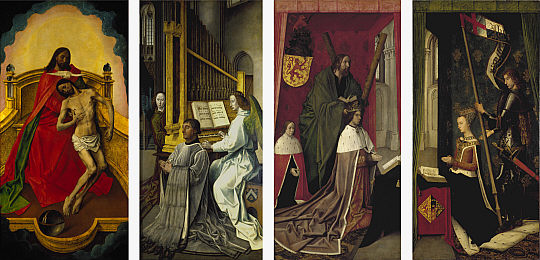
The portrait of the King from the Trinity altarpiece

Image:englishmonarchs.co.uk

This is the largest  copy I can find on the internet of this really wonderful portrait - it does not do it justice. The portrait of the King and of his Queen is hauntingly beautiful, and that may have raised my awareness of the King and his reign when I first saw it, many years ago, reproduced in Gordon Donaldson's Scottish Monarchs. In not a few ways King James III is reminiscent of King Richard II, and perhaps also King Edward II, in fourteenth century England. Tensions within the royal house and with the nobility and a strong sense of their independent royal authority led all three kings to their violent downfall.  Anthony Tuck's telling point in Richard II and the English Nobility that the deposition and violent death of two English kings in the fourteenth century points to the strength of the English crown - the only wayt to restrain the monarch was to remove him - applies also in fifteenth century Scotland - hence the fate sof Kings James I and III, and indeed the military deaths on campaign of Kings James II and IV indicate the risks they were willing to undertake in campaigns against their more powerful southern neighbour.

There are introductions to his life and reign here and here. The biography by Norman Macdougall from the recent Oxford DNB can be read here and there is an illustrated online account which appears to be influenced by Macdougall's account here.
Neither of these are especially not favourable to view that the King was a considerable patron of the arts, pointing to what few actual references or examoples there are, and to others as the patrons. Nonetheless such things as do survive from the reign do show what it was possible to see in the Scotland of the late fifteenth century - a pre-Reformation, pre-Calvinist Scotland that is far more difficult to imagine than pre-Reformation England at time because so little survives. Supreme amongst these survivals is the Trinity Altarpiece by Hugo van der Goes, part of the Royal Collection and now on display in the National gallery of Scotland in Edinburg, which was probably not commissioned by the King, although it contains his portrait and that of his Queen and of his son. Given that the panels were painted for the Trinity College Kirk was founded by the King's mother and was her burial place it seems likely that at very least the King was aware of the paintings.


The Trinity Altarpiece

Image:Wikipedia/National allery of Scotland

My own sense, and it is an instinct rather than based on any detailed study of the subject and period, is that modern historians may, if only becaus e of the paucity of surviving evidence, not be giving King James sufficient credit for such artistic patronage as there was. It would not be unreasonable to imahine taht he had some say in the currency produced in his later years, including the gold Unicorn and the first conciously representational potrait of a monarch from either of the realms that made up Britain on the silver groats:


Obverse (front) and reverse

Gold Unicorn of 1484-88 (enlarged)

Image:British Museum

http://www.aberdeenquest.com/web/MultimediaFiles/MS011936.JPG
Groat from the later years of the reign 

Image:aberdeenquest.com

In his later years the King was deemed avaricious, and a detailed inventory of his treasure survives - amongst the pieces was a collar whose design of thistles and rue [Andrew] became the pattern for that of the Order of the Thistle - unless one subscribes to the older view that King James III was indeed the founder of the Order; that view is rather discounted by modern historians, but the collar design is clearly recorded.


http://www.undiscoveredscotland.co.uk/stirling/cambuskenneth/images/abbey-450.jpg

The tomb of King James III and Queen Margaret in the ruins of Cambuskenneth Abbey

Image: undiscoveredscotland.co.uk

King James III was killed at or after the battle of Sauchie[burn], to the east of Cambuskenneth. His body was taken to Cambuskenneth abbey for burial. He was interred in front of the high altar alongside his queen, Margaret of Denmark, who had died two years earlier. Bones thought to be the remains of the King and Queen were excavated in 1864 and re-interred, at Queen Victoria’s command, under a stone monument within the choir.


Monday, 10 June 2013

The birth of King James III and VIII


Today is the 325th anniversary of the birth in 1688 of Prince James Francis Edward, son of King James II and VII and Queen Mary of Modena, the Prince of Wales whose birth was to lead to the overthrow of his father in the late autumn of that year. Despite scurrilous attempts to claim that he was a changeling as he grew the physical resemblance to both his parents became ever more apparent.


http://25.media.tumblr.com/tumblr_m3up59iGsz1qbohcko1_500.jpg

The young Prince James
Nicholas Lagilliere

Image: thestuartkings.tumblr.com

He succeeded his father as the de jure King James III and VIII in 1701, and died on January 1st 1766 - thus claiming the crown longer than the reign of Queen Victoria.

There is an online life of him here. Edward Gregg's not especially sympathetic biography from the Oxford DNB is here.

His life was spent almost entirely in exile, a life of genteel and pious frugality, indeed a life noted for its piety derived from both of his parents, in St Germain and the fringes of the French court, Avignon and the Palazzo Muti in Rome. It was an unhappy life much of the time, waiting for a restoration that never happened, and with an unhappy marriage and estrangement from his elder son. Nonetheless a not inconsiderable number of impressive portraits were commissioned from painters, presumably in response to demand as well as the need to publicise his claims.

Thus he appears as the appealing and romantic young claimant to the throne in this portrait by Jean-Francois Detroy now at Fairfax House in York:

http://ichef.bbci.co.uk/arts/yourpaintings/images/paintings/yfh/large/ny_yfh_ct1989_339_large.jpg

Image:BBC

He appears as a dashing but serious young man in 1712

https://upload.wikimedia.org/wikipedia/commons/thumb/c/c9/Prince_James_Francis_Edward_Stuart_by_Alexis_Simon_Belle.jpg/220px-Prince_James_Francis_Edward_Stuart_by_Alexis_Simon_Belle.jpg

Image:Wikipedia

and as a monarch in waiting in Alexis-Simon Belle's portrait of 1712-14 now in the British Embassy in Paris:

http://www.gac.culture.gov.uk/images/standard/14900.jpg

Image: gac.culture,.gov.uk

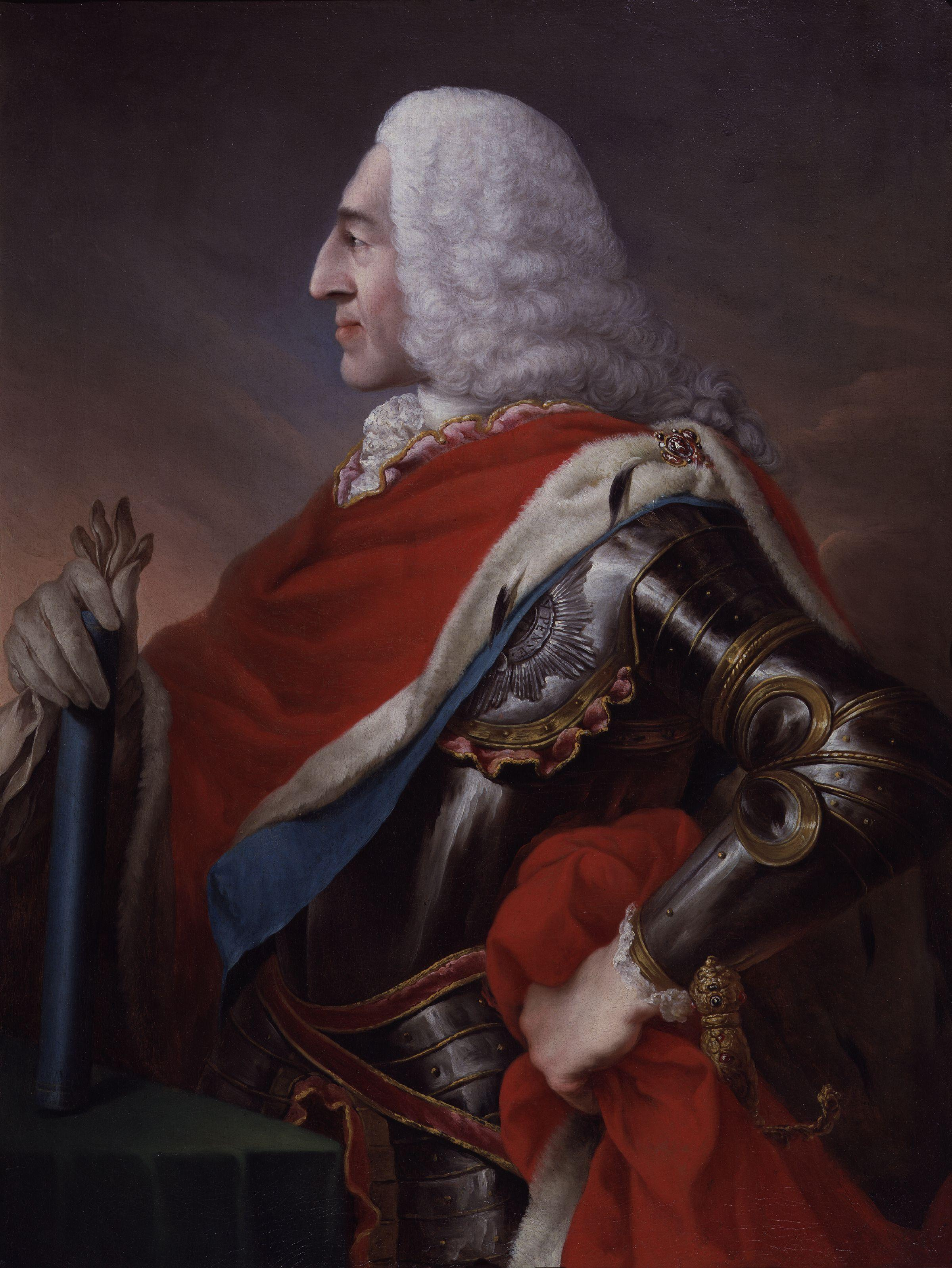
Louis Gabriel Blanchet's portrait of 1741 now in the National Portrait Gallery suggests a majestic presence, even if the reality was somewhat different: 


File:Prince James Francis Edward Stuart by Louis Gabriel Blanchet.jpg
 
Image:Wikipedia
 

In some respects he was  not that unlike King George I and King George II - not least in his estrangement from his heir. In his later years he was referred to by Hanoverian agents as Old Mr Melancholy. Had he been willing to give up his Catholicism then his life might have been very different, and there would no doubt, had he done so by that time, have been no Hanoverian succession in 1714. His own view was that he was happy to offered tolerance to his subjects, but sought it in return for his own deeply held beliefs

Loyal as I am to Her Majesty I am sure that had I been around in years after 1688 I would have been a Jacobite. Had I been a Catholic then I can see myself clearly as a Jacobite and had I been an Anglican then Non-Juring would have been the option.

I cannot really be logical and say when I would have stopped being Jacobite - I might well have found an excuse with the death of Cardinal York/ King Henry IX in 1807, but then again I might not - I suspect it was with the long continuance of Hanoverian rule that people came to accept it. I do not know if anyone has worked out indicators of support for the two lines or dynasties at anything like the popular level in 1688-9, 1701, 1714, 1715, 1745 or whenever. In 1745 there was certainly a popular welcome for Prince Charles Edward as he marched south, and panic in London at his approach.

I am not alone in my a
mbivalence - King George IV made a contribution to Canova's tomb for the exiled Stuarts in St Peter's, Queen Victoria erected a memorial to King James II and VII in the church at St Germain, and was to be heard, certainly when in Scotland expressing sympathies for Charles Edward and the events of the '45, and in 1939 it is said that King George VI discreetly paid the costs of the new Stuart tomb when their bodies were moved to accommodate the burial of Pope Piux XI. Today the Queen's website has this to say today about the man born to be King 325 years ago.
.

Happy birthday and good wishes


Today is the 92nd birthday of Prince Philip and this is a way of expressing both my congratulations on his birthday and my regard for his many years of public service as Consort to the Queen, and also as a means of sending my good wishes for his recovery after surgery and for continuing good health.


Saturday, 8 June 2013

Popr Gregory VII and liturgical reform


I was interested to read in a recent post on the Medieval Religion discussion group that Pope Gregory VII started to mandate a standardisation of the liturgical rite in early 1074.  His letters in March 1074 to King Alphonso VI of Castile and Leon and King Sancho IV of Navarre are clear that the kings need to get the liturgical life of their realms aligned with Rome (he mentions that the Toledan/Mozarabic order will not be sufficient - it must be the Roman order).  He returns to the subject in a letter to King Alphonso VI in 1081, praising him, and holding him up as an exemplar, for restoring the Roman rite.  In that he can perhaps be seen as a precursor of King Philip II and his insistence that the decrees of the Council of Trent be enforced in his realms in the later sixteenth century.

With regard to the Hildebrandine reform, as the MR contributor points out, these letters, if nothing else, gives us a significant indicator at a starting point for the attempt at standardisation - and that it was tied, from the Pope’s perspective,  to his broader reform programme. It is also an answer, in part, to those who claim that such Papal initiatives are a modern thing, and indeed, that they are unjustified and unprecedented actions.


Pope Gregory VII

Image: uncouthreflections.wordpress

There is an online account of King Alfonso VI here and for those with Spanish there is a fuller version here.   The King was a notable patron of the abbey of Cluny and encouraged the Cluniac presence in his kingdom along the pilgrimage route to Compostella.

King Sancho IV was to be a victim in 1076 of the fratricidal tendencies not infrequently displayed in these years by the Iberian royal houses as can be seen in the online account of him here.


King Alfonso VI
Twelfth century minaiture at Santiago de Compostella cathedral

Image: Wikipedia