Once I was a clever boy learning the arts of Oxford... is a quotation from the verses written by Bishop Richard Fleming (c.1385-1431) for his tomb in Lincoln Cathedral. Fleming, the founder of Lincoln College in Oxford, is the subject of my research for a D. Phil., and, like me, a son of the West Riding. I have remarked in the past that I have a deeply meaningful on-going relationship with a dead fifteenth century bishop... it was Fleming who, in effect, enabled me to come to Oxford and to learn its arts, and for that I am immensely grateful.


Wednesday, 15 August 2012

Assumpta es Maria


The Assumption of the Virgin by El Greco

The Assumption of the Virgin
El Greco, 1577

Image:backtoclassics.com


Tuesday, 14 August 2012

The Spanish Privilege at the Oxford Oratory


I noted at the Vigil Mass for the Assumption at the Oxford Oratory this evening that the celebrant was vested in Spanish blue in honour of Our Lady. I gather the handsome Low Mass set is a recent acquisition for the sacristy, and looks very fine. I posted about the use of this liturgical colour in Spanish Blue. I am assured that the Oratorians are fully entitled to use the Spanish Privilege in this matter.

Now all we want is the High Mass set...

Monday, 13 August 2012

Blenheim Revisited


As today is the 308th anniversary of the battle of Blenheim in 1704 and as I led three groups from an Oxford summer school out to Blenheim Palace on Saturday and Sunday and gave them introductory talks about the history of the building and the Churchill family and a tour it seems appropriate to write something about it today.


Blenheim Palace

Image: Blenheim7k.co.uk

When I give these tours, and I have done several this summer, I stress the fact that in building the palace as a thank offering to the first Duke of Marlborough the political nation was very much aware of the significance of his victory at Blenheim and of his later victories at Ramilles, Oudenarde and Malplaquet, over the armies of King Louis XIV.
 
Firstly these were the first major defeats of the formidable French military machine in many decades.
 
Secondly this was the first time an English land army had secured a major victory over the old enemy on the continent since the battle of  Verneuil in 1424, 280 years earlier.
 
Thirdly we can see with hindsight that Marlborough's military victories do mark - or recognise - the emergence of Britain as a major military and diplomatic power in the Europe of the eighteenth century - something we had not really been as a country, and despite what we might like to think, since the fifteenth century - we had been too pre-occupied with our own succession disputes and the disasters of reformation and civil war.
In recent years the presentation of Blenheim Palace has been greatly improved - in the 1980s it was not getting very good reviews in the heritage press - and there is a lot to see and do with exhibitions about both the Marlborough family and about Winston Churchill who was, of course, born at the Palace in 1874.

The way in which the Palace celebrates the French opponent is rather surprising - not only does King Louis XIV preside in a state portrait over on e of the great reception rooms, and the fleur de lys is prominent on captured standards from Marlborough's victories and the standards presented annually to the Sovereign as rent for the Woodstock estate, but most strikingly in the great bust of Le Roi Soleil which sits on top of the centre of the south facade of Vanburgh's building - captured in the Low Countries by the first Duke he brought it back and incorporated it in his new building. It may be grandiloquent as a gesture, but it also suggest repect and magnanimity towards an opponent

Sunday, 12 August 2012

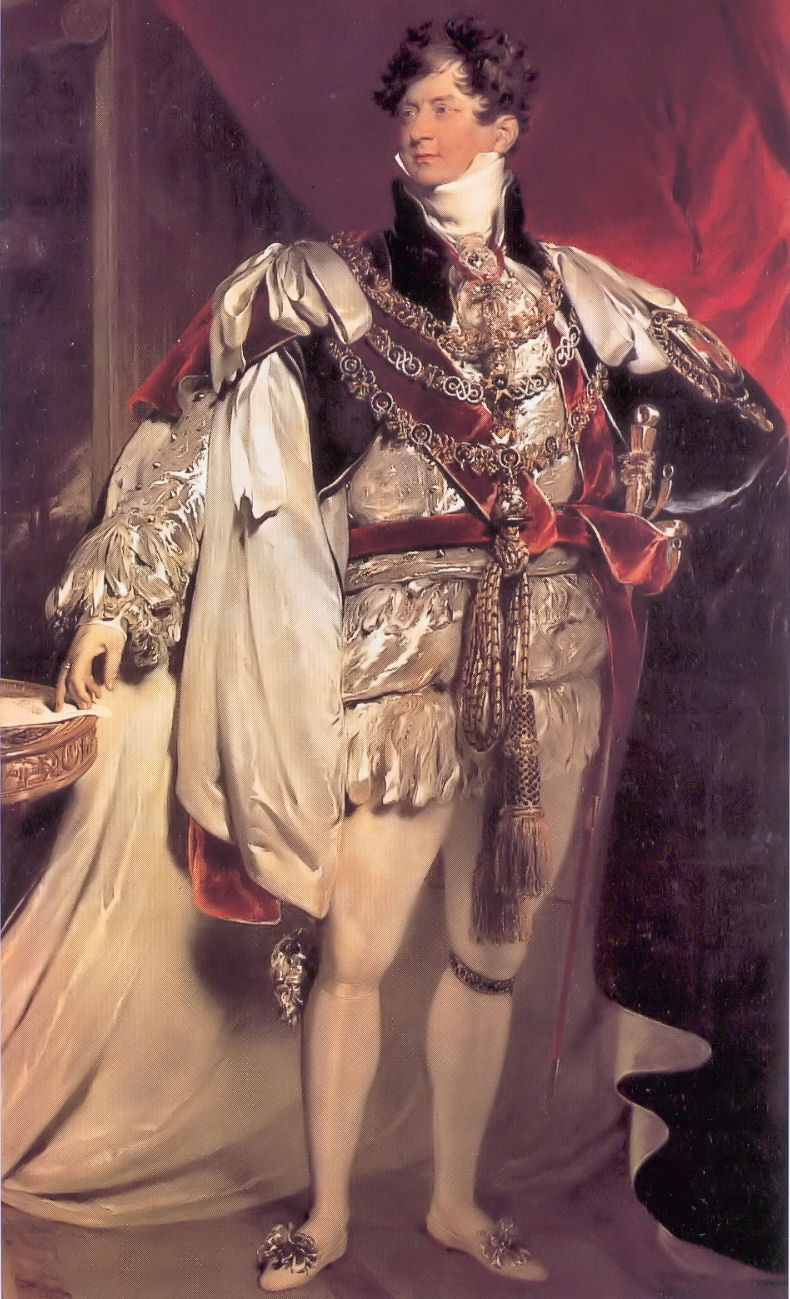
King George IV


Today is the 250th anniversary of the birth of King George IV in 1762.

File:George IV van het Verenigd Koninkrijk.jpg

King George IV in the robes of the Order of the Garter
Sir Thomas Lawrence
 
The King is also wearing the collars of the Spanish Order of the Golden Fleece, and those of his own Orders of St Michael and St George and of the Bath in addition to that of the Garter. As Prince Regent he revised and extended the Order of the Bath in 1815, and founded that of St Michael and St George in 1818.
 
The crown at his side was made for his coronation in 1821, replacing that used since 1661. Used again for King William IV in 1831 it was replaced in 1838 by the present Imperial State Crown. The frames of both the 1661 and 1821 crowns can now be seen in the Tower of London
 
Image: Wikipedia

There is an online biography of the King here which seesm to be even handed in its assessment and explores his life in the context of his times.

It is not difficult to see why many people found him difficult and dislikeable, and also to see that he did have genuine abilities and excellent qualities. His legacy to the Monarchy is not inconsiderable - not only the building of Buckingham Palace and the drastic but dramatic restoration and rebuilding of Windsor Castle, but the acquisition of significant parts of the Royal Collection, as well as the extraordinary Brighton Pavlion, which his neice sold off. More importantly still may have been his visits to Ireland in 1821 and Scotland in 1822 - the first by a reigning sovereign respectively since 1399 and 1651. Although King William IV and Queen Victoria reacted against King George's style and lavish expenditure - not to say indulgence - he had created both the setting and the revived concept of the royal visit that have become very significant parts of the modern British monarchy. A complex man, often selfish, but one who managed to leave a not inconsiderable legacy.


Saturday, 11 August 2012

A new gadget


Recently a friend very kindly passed on to me a new iPhone that was surplus to his requirements - my own mobile phone was on its last legs (or whatever mobile phones have). Being me I did not rush to get it set up, but finally this last week decided to treat it as a birthday present and changed over my account to the new device.

I am now having great fun familiarising myself with its touch sensitive screen and technical wizardry and trnsferring and editing my address book. One of the many benefits it affords is a functioning camera - the old one would not transfer photographs - so maybe I can illustrate posts with my own photographic efforts. Watch this space...

Friday, 10 August 2012

The church of St Laurence Ludlow


Amongst the not inconsiderable number of medieval English churches dedicated to St Lawrence ( or St Laurence) that of St Laurence at Ludlow is perhaps outstanding. Built in its present form during the later middle ages it is a commanding landmark in this historic and beautiful town, and more than repays a visit by anyone interested in historic churches. For those of a literary turn of mind it also has the grave of A.E. Housman in the churchyard. In the sixteenth century John Leland described St Laurence's as: Very fayre and large and richly adorned and taken for the fairest in all these quarters, and that statement is still probably true.


The church has fine medieval woodwork and notable medieval glass - that in the Palmer's Chapel narrates the well known story of St Edward the Confessor's meeting with avision of a disguised St John the Evangelist and is a celebration of pilgrimage in the chaple of the local pilgrim guild. The chancel has spectacular figures of the apostles - including a triple tiara wearing St Peter that somehow survived the iconoclasm of the reformation, and the east window has the story of St Laurence. Much restored and although in many essentials a nineteenth century reconstruction like the other windows in the church it does show the splendour of late medieval glazing and the effect it would have created upon the liturgy and worshippers.
  • Stained Glass Window - the Martydom of St Laurence

  • The east window with the story of St Laurence - his martyrdom is in the lowest row of scenes
  • At the top of the window is a representation of the Holy Trinity, and in the twop panels immediately below are King Henry VI and  Thomas Spofford OSB, Bishop of Hereford 1421/2-1448, kneeling in adoration. The Bishop, formerly Abbot of St Mary's York - whither he retired in 1448 - was a friend or aquaintance of Bishop Fleming.
  • Image: davidkennardphotography


    Here is another example of fifteenth century glass from the church - the faces somehow look very familiar:
  • photo

    Image: peet astn's photostream on Flickr

The Martyrdom of St Lawrence


Image: fanilyfeast and feria


The trial of St Lawrence


This scene depicts the trial of St Lawrence: