Once I was a clever boy learning the arts of Oxford... is a quotation from the verses written by Bishop Richard Fleming (c.1385-1431) for his tomb in Lincoln Cathedral. Fleming, the founder of Lincoln College in Oxford, is the subject of my research for a D. Phil., and, like me, a son of the West Riding. I have remarked in the past that I have a deeply meaningful on-going relationship with a dead fifteenth century bishop... it was Fleming who, in effect, enabled me to come to Oxford and to learn its arts, and for that I am immensely grateful.


Friday, 9 October 2015

St Denis and his companions


Today is by tradition the feast of the mid-third century Bishop of Paris St Denis and his companions in martyrdom SS. Rusticus of Paris and Eleutherius of Paris. For his life and cult, and for details which explain some of the images which follow see the online account at https://en.wikipedia.org/wiki/Denis

Nowadays here in the Birmingham Archdiocese this is, of course, the feast of Bl.John Henry Newman, so St Denis and his companions, together with St John Leonardi, are commemorated on October 8th.


The Medieval Religion discussion group yielded a fine crop of images. Gordon Plumb posted some stained glass depictions:

Chartres, Cathedrale Notre Dame, Bay 116, St Denis gives the Oriflamme to Jean-Clement de Metz:
https://www.flickr.com/photos/22274117@N08/8070019929

Lincoln Cathedral, sII, 1c, c.1225-35:
https://www.flickr.com/photos/22274117@N08/2259035172

York Minster, nXXXVI, 5b-6b, St Denis between two executioners:
https://www.flickr.com/photos/22274117@N08/4793957936

Winchester College, Fromond's Chapel, east window, A10:
https://www.flickr.com/photos/22274117@N08/3453937140
and detail:
https://www.flickr.com/photos/22274117@N08/3453937140


Bourges, Cathedrale Saint-Etienne, Bay 31, Story of St Denis, c.1517-18:
https://www.flickr.com/photos/22274117@N08/2218850130
and two details:
https://www.flickr.com/photos/22274117@N08/2218157075
https://www.flickr.com/photos/22274117@N08/2219153140

Genevra Kornbluth added these examples from her files in stone and wood:
http://www.KornbluthPhoto.com/StDenis.html

John Dillon provided a splendid array of images, many of which show St Denis as a cephalaphore
( now you really should know what that means...) and how artists dealt with that subject.

a) as depicted (at left; at centre and left, Sts. Rusticus and Eleutherius) in an early eleventh-century gradual according to the Use of the abbey of Saint-Denis near Paris (Paris, Bibliothèque Mazarine, ms. 384, fol. 117v):


http://www.enluminures.culture.fr/Wave/savimage/enlumine/irht16/IRHT_065156-p.jpg


b) as portrayed in a mid-eleventh-century relief in the entrance hall to the Kirche St. Emmeram in Regensburg, originally the church of a monastery claiming to possess his remains:


http://www.fantomzeit.de/wp-content/uploads/wibald03.jpg


c) as portrayed in high relief (at centre between Sts. Rusticus and Eleutherius, all achieving martyrdom) in the mid-twelfth-century sculptures on the tympanum of the Portail des Valois (rebuilt in the 1230s or 1240s; restored in the nineteenth century) of the basilique cathédrale Saint-Denis in Saint-Denis (Seine-Saint-Denis):


http://france-romane.com/photos/93-st-denis/Cathedrale_St-Denis-086.jpg


d) as portrayed in high relief (at centre between Sts. Rusticus and Eleutherius) in a mid-twelfth-century walrus ivory plaque from a portable altar in the Musée du Louvre, Paris:


http://www.photo.rmn.fr/archive/90-006373-2C6NU0HLVYSG.html

e) as portrayed in high relief (at centre) in the jambs of the left portal of the south porch (between 1194 and 1230) of the basilique cathédrale Notre-Dame in Chartres:


http://tinyurl.com/4o6rjl

Detail view:


http://tinyurl.com/4zncmm

f) as depicted (at left) in an earlier thirteenth-century window (1228-1231) of the south transept clerestory of the basilique cathédrale Notre-Dame in Chartres (not to miss the important bibliography cited this page's "description" tab):


http://tinyurl.com/3v5epn

g) as portrayed in an earlier thirteenth-century statue on a choir screen in Bamberg's Dom St. Peter und St. Georg (consecrated, 1237):
http://tinyurl.com/69dhonr

h) as depicted (at right at the foot of the page; at left, St. Lambert of Maastricht) in a later thirteenth-century psalter and book for hours according to the Use of Liège (ca. 1251-1300; Den Haag, KB, ms. 76 G 17, fol. 82v):
http://manuscripts.kb.nl/zoom/BYVANCKB%3Amimi_76g17%3A082v

i) as depicted in a later thirteenth-century window (c. 1280) in the Stadtkirche St. Dionys in Esslingen am Neckar:


Saint Dionysus
http://tinyurl.com/yfa8loy

j) as depicted (at centre betw. Sts. Rusticus and Eleutherius, all achieving martyrdom) as in a late thirteenth-century copy of French origin of the Legenda aurea (San Marino, CA, Huntington Library, ms. HM 3027, fol. 142v):
http://digitalassets.lib.berkeley.edu/ds/huntington/images//000923A.jpg

k) as depicted (at left; at right, St. Piatus of Seclin [ Feast day Oct.1st] ) in the late thirteenth-century (c. 1285-1290) Livre d'images de Madame Marie (Paris, BnF, ms. Nouvelle acquisition française 16251, fol. 84v):


http://tinyurl.com/y8v48ko

l) as depicted on a panel of the fourteenth-century rood screen of St Andrew, Hempstead (Norfolk):


http://www.norfolkchurches.co.uk/hempstead/images/hempstead%20(19).JPG
http://tinyurl.com/4q7jgt

m) as portrayed in a fourteenth-century pilgrim's badge in the Musée national du Moyen Âge (Musée de Cluny), Paris:


http://img.over-blog-kiwi.com/0/82/49/44/20140303/ob_8da42f_piece-de-fouille-saint-denis.jpg
http://tinyurl.com/obtg2cb

n) as portrayed (with the better preserved Sts. Rusticus and Eleutherius) in an earlier fourteenth-century marble sculpture (c. 1301-1326; formerly part of an altarpiece) in the Musée du Louvre, Paris:


http://www.photo.rmn.fr/archive/13-550042-2C6NU05JQU03.html

Detail view:


http://www.photo.rmn.fr/archive/13-550043-2C6NU05JQS9J.html

o) as portrayed in high relief (martyrdom; cephalophory) on an earlier fourteenth-century boss (c. 1301-1350) in the cloister of the cathedral church of the Holy and Undivided Trinity in Norwich:

http://www.paradoxplace.com/Photo%20Pages/UK/Britain_Centre/Norwich_Cathedral/Roof_Boss_Images/800/SDenis-Jul07-D0472sAR800.jpg

http://tinyurl.com/o4rgjxc

p) as depicted in the illuminated Vita et passio sancti Dionysii in Latin verse (with Boitbien's translation in French prose) presented to King Philip V in 1317 by an abbot of Saint-Denis (Paris, BnF, ms. Français 2090-2092):
1) seated; at left, Sts. Antoninus and Santoninus; at right, Sts. Rusticus and Eleutherius (BnF, ms. Français 2091, fol. 125r):


http://employees.oneonta.edu/farberas/arth/images/arth_214images/manuscripts/st_denis/commission.jpg

http://tinyurl.com/yk9773y

2) appearing with Sts. Rusticus and Eleutherius before the prefect Fescennius (BnF, ms. Français 2092, fol. 1r):


http://expositions.bnf.fr/fouquet/grand/f634.htm

q) as portrayed in a polychromed earlier fourteenth-century walnut-wood statue from Köln (ca. 1320) in that city's Schnütgen-Museum:


http://www.museum-schnuetgen.de/medien/abb/1434/2650__2720000.jpg

http://tinyurl.com/npqychy

r) as depicted (scenes of his life and and suffering; the last also depicting the martyrdom of Sts. Rusticus and Eleutherius) in an earlier fourteenth-century copy of the Legenda aurea in its French-language version by Jean de Vignay (c. 1326-1350; Paris, BnF, ms. Français 185, fols. 202r, 203v, 204r, 204v, 205v, 206v, 207v):
http://tinyurl.com/ylrytq7
http://tinyurl.com/yllhhq9
http://tinyurl.com/ykgrryk
http://tinyurl.com/yfrz7hr
http://tinyurl.com/yzbemgu
http://tinyurl.com/yfnbkse
http://tinyurl.com/ylppvlk


s) as depicted in an earlier fourteenth-century copy, from the workshop of Richard and Jeanne de Montbaston, of the Legenda aurea in its French-language version by Jean de Vignay (1348; Paris, BnF, ms. Français 241, fol. 275v):


http://tinyurl.com/ykxkqol

t) as depicted in a panel of a later fourteenth-century glass window in the north transept of the Basilica St. Valentinus und Dionysius in Kiedrich (Lkr. Rheingau-Taunus-Kreis) in Hessen:


http://www.kiedrich-geschichte.de/cms/upload/bilder/Abb_4_15_b_Nord_Dionysius.jpg

http://tinyurl.com/3pgesej

The panel's context in the window:
http://www.flickr.com/photos/hen-magonza/4849130575/


u) as depicted in a later fourteenth-century missal for the Use of Paris (after 1375?; Paris, Bibliothèque Mazarine, ms. 411, C fol. 67r):


http://www.enluminures.culture.fr/Wave/savimage/enlumine/irht17/IRHT_08472-p.jpg

http://www.enluminures.culture.fr/Wave/savimage/enlumine/irht17/IRHT_08472-p.jpg

v) as depicted (at left; at centre and right, Sts. Rusticus and Eleutherius; all achieving martyrdom) in a later fourteenth-century copy of the Legenda aurea in its French-language version by Jean de Vignay (ca. 1380; Paris, Bibliothèque Mazarine, ms. 1729, fol. 262v):

http://www.enluminures.culture.fr/Wave/savimage/enlumine/irht16/IRHT_068254-p.jpg

http://www.enluminures.culture.fr/Wave/savimage/enlumine/irht16/IRHT_068254-p.jpg

w) as portrayed in a fourteenth- or fifteenth-century pilgrim's badge in the Musée national du Moyen Âge (Musée de Cluny), Paris:


http://www.photo.rmn.fr/archive/97-011834-2C6NU0S38BSY.html

x) as depicted (betw. Sts. Rusticus and Eleutherius) in the early fifteenth-century Hours of René of Anjou (ca. 1410; London, BL, MS Egerton 1070, fol. 104r; image expandable):
http://www.bl.uk/catalogues/illuminatedmanuscripts/ILLUMIN.ASP?Size=mid&IllID=48351

y) as depicted in two illuminations in the early fifteenth-century Châteauroux Breviary (c. 1414; Châteauroux, Bibliothèque municipale, fols. 364r and 367v):
1) Preaching (third from left, after Sts. Rusticus and Eleutherius; fol. 367v):


http://www.enluminures.culture.fr/Wave/savimage/enlumine/irht2/IRHT_054227-p.jpg


2) Martyrdom (fourth from left, after Sts. Rusticus and Eleutherius; fol. 364r):


http://www.enluminures.culture.fr/Wave/savimage/enlumine/irht2/IRHT_054223-p.jpg


z) as depicted (at left, receiving communion from Jesus while imprisoned; at right, undergoing martyrdom along with Sts. Rusticus and Eleutherius) by Henri Bellechose on an early fifteenth-century altarpiece (paid for in 1416) in the Museé du Louvre in Paris:
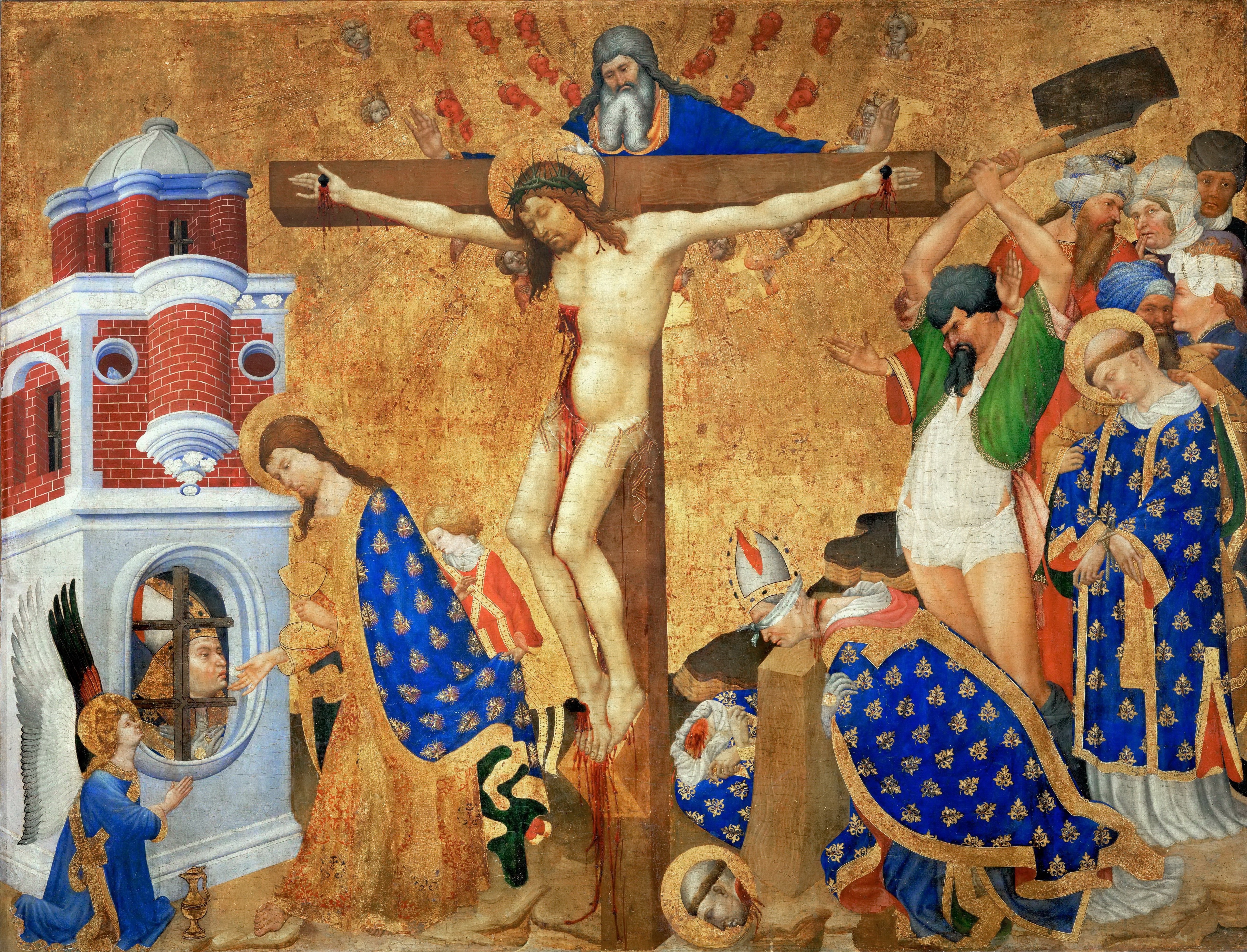

https://upload.wikimedia.org/wikipedia/commons/6/64/Henri_Bellechose_001.jpg

http://tinyurl.com/3rey5zj

aa) as depicted in a full-page illumination of French or English workmanship, attributed to the Master of Sir John Fastolf's Hours, in an earlier fifteenth-century Book of Hours (ca. 1430-1440; Los Angeles, J. Paul Getty Museum, ms. 5, fol. 35v):


http://www.getty.edu/art/exhibitions/cult_saints/images/00300601_zm.jpg

http://tinyurl.com/yhcuuh5

Detail view (D.'s severed head):

St. Denis / M. Sir John Fastolf
http://tinyurl.com/ylooxrf

bb) as portrayed in a later fifteenth-century polychromed limestone statue (c. 1460-1470) in the Bode-Museum, Berlin:

https://upload.wikimedia.org/wikipedia/commons/6/60/Le_Moiturier_%28circle%29_Saint_Denis.jpg

http://tinyurl.com/4gvkeg

cc) as depicted (martyrdom and, in the upper register, cephalophory) in a later fifteenth-century copy of the Legenda aurea in its French-language translation by Jean de Vignay (c. 1480-1490; Paris, BnF, ms. Français 245, fol. 135r):


http://tinyurl.com/yg4vhdu

dd) as depicted (between Sts. Rusticus and Eleutherius) in a late fifteenth-century breviary according to the Use of Langres (after 1481; Chaumont, Mediathèque de Chaumont, ms. 33, fol. 456r):


http://www.enluminures.culture.fr/Wave/savimage/enlumine/irht6/IRHT_097055-p.jpg

http://www.enluminures.culture.fr/Wave/savimage/enlumine/irht6/IRHT_097055-p.jpg

ee) as depicted in a hand-colored woodcut in the Beloit College copy of Hartmann Schedel's late fifteenth-century Weltchronik (Nuremberg Chronicle; 1493) at fol. CIXv:


http://www.beloit.edu/nuremberg/book/images/Martyrs/big/Dionysius%20(the%20Areopagite)%20CIXv.jpg

http://tinyurl.com/9ghdm8w

ff) as portrayed in high relief on a polychromed and gilt panel of a late fifteenth- or early sixteenth-century altarpiece (ca. 1490-1510) in the Filialkirche Hl. Leonhard in Pesenbach (Oberösterreich):


http://tarvos.imareal.oeaw.ac.at/server/images/7017908.JPG

http://tarvos.imareal.oeaw.ac.at/server/images/7017908.JPG

gg) as depicted (at right; at left, St. Sebastian) on a panel of the late fifteenth- or early sixteenth-century winged altar (c. 1497-1507) in the Pfarrkirche Hl. Remigius in Gampern (Oberösterreich):


http://tarvos.imareal.oeaw.ac.at/server/images/7017792.JPG

http://tarvos.imareal.oeaw.ac.at/server/images/7017792.JPG

hh) as portrayed in high relief (at far left) on the central panel of the late fifteenth-century Vierzehn-Nothelfer-Altar (1498) in the Münster St. Marien und Jakobus in Heilsbronn (Lkr. Ansbach):


https://upload.wikimedia.org/wikipedia/commons/c/c6/Heilsbronn_M%C3%BCnster_Vierzehn-Nothelfer-Altar_Schrein.jpg

http://tinyurl.com/pcnarog

Detail view:


https://upload.wikimedia.org/wikipedia/commons/b/bc/Heilsbronn_M%C3%BCnster_Vierzehn-Nothelfer-Altar_Hl_Dionys.jpg

http://tinyurl.com/qbceeza

ii) as portrayed in high relief on an early sixteenth-century stall end (between 1501 and 1507) in the choir of the St. Martins-Kirche in Memmingen:


https://upload.wikimedia.org/wikipedia/commons/0/04/Chorgest%C3%BChl_St._Martin_Memmingen_-_St._Dionysos.JPG
http://tinyurl.com/nahwgj9

jj) as depicted (at left; at right, St. Margaret) by Vicente Macip in the central panel of his early sixteenth-century altarpiece (c. 1510) in the capilla de San Dionisio y Santa Margarita in Valencia's catedral de la Asunción de Nuestra Señora:


San Dionisio y Santa Margarita by Meldelen

http://tinyurl.com/3bbdu8b

kk) as depicted by the Master of Messkirch on a panel from a dismembered earlier sixteenth-century altarpiece (c. 1535-1540) in the Staatsgalerie Stuttgart:


https://upload.wikimedia.org/wikipedia/commons/4/47/Heiliger_Dionysius.jpg

http://tinyurl.com/pd6m447


John Dillon subsequently posted two additional images:

Dionysius as depicted in one of four panels of a full-page illumination in the late twelfth-century so-called Bible of Saint Bertin (ca. 1190-1200; Den Haag, KB, ms. 76 F 5, fol. 28v):
http://www.wga.hu/art/zgothic/miniatur/1151-200/3french/22french.jpg
http://manuscripts.kb.nl/zoom/BYVANCKB%3Amimi_76f5%3A028v_min_a2

Dionysius (martyrdom) as depicted in an earlier fifteenth-century prayer book from Brabant (ca. 1430-1440; Baltimore, The Walters Art Museum, ms. W.164, fol. 171r):


To all those I would add this image from the mid-fifteenth century east window of the church of St Denys in York


https://s-media-cache-ak0.pinimg.com/236x/e1/b0/d4/e1b0d44789eaee9c620bbe2cbed2b324.jpg

Image: pinterest/Roger Walton on Flickr

Meanwhile the New Liturgical Movement had an interesting post about the celebration of Mass in Greek by the monks of St Denis in honour of the Greek origin of their patron. The article is by The Greek Mass of St Denys of Paris


Night walk to Littlemore


Last night I joined in the annual night walk to Littlemore to commemorate the reception into the Catholic Church of Bl. John Henry Newman by Bl. Dominic Barberi. The walk takes in places associated with Newman's life in Oxford and the events of October 8th 1845 when Bl. Dominic arrived here and travelled out to Littlemore. The following day - now Newman's feast day - Bl Dominic received him and others into the Church, the One Fold of the Redeemer. This was the 170th anniversary of those events.

Not only does the walk commemorate an historical anniversary but it also is designed as an act of prayerful witness, with stations for readings and collects along the way and ends with a Holy Hour in the Catholic church in Littlemore and then moves to the College where Newman and his friends were received in the oratory.

I have done the walk each year since my reception into the Church in 2005, and despite something of a gammy leg, - and after giving two walking tours of Oxford in the afternoon - I managed one again to do the walk. It is an occasion upon which one can have a series of intentions to offer as well as offering up any minor hardships.

I was asked to be the voice of Bl. John Henry in the readings at the various stops we made en route from the Oxford Oratory to Littlemore. This was a gesture I appreciated as not only a convert from Anglicanism but also a member of Oriel.

Following the reflections and benediction in the church of Bl. Dominic Barberi we processed into the College for the final readings in the library, and prayers and veneration of a relic of Bl. John Henry in the restored chapel.


The Library in the College at Littlemore
It was here that Newman knelt at Barberi's feet to seek admission to the Church

Image: Supremacy and Survival

As is customary on this occasion - and seemingly all other visits to the College - the pilgrims were provided with tea and cake by the Sisters of the Work who care for the building and provide an always warm and kindly welcome to this very special place. The College has a quiet holiness that derives from what Newman created there in the years leading up to his reception for himself and his companions - or perhaps I should say was provided for them by Higher Powers - and which so impressed Bl. Dominic - he remarked that the life of Newman and his friends there was much stricter than that of most contemporary orders.


The meeting of the two future beati - a bronze relief in Littlemore Catholic church

Image: newmanfriendsinternational.org


Thursday, 8 October 2015

Oxford Benedictine Oblates


Last night we held the first meeting of our revived Benedictine Oblates group here in Oxford. For the last couple of years we have languished somewhat but over the summer we made plans to revive it, and have resumed meetings. Our aspiration is to be linked to the developing foundation at Norcia, St Benedict's birthplace.


St Benedict and St Scholastica

Image:forallsaints.wordpress.com

Under the name of the Sodality of St Benedict and St Scholastica we aim to meet initially on the first Wednesday of each month at 7pm in the church of SS Gregory and Augustine; the meeting follows on from the 6pm Mass, and is designed to last for an hour. We are very grateful to Fr John Saward for his welcome and support.

Although only some of us were able to meet last night we found it a suitable, indeed successful format, and certainly achieved a prayerful quiet that to my mind savoured very much of the Benedictine ideal and spirit.

We followed the structure of an Oblate manual from 1937 which had been provided by one of our group, and are grateful to him for his work in producing a traditional and reflective office. Another member had the excellent idea of our turning the month's calendar of Benedictine saints into a litany, which worked well. We had two readings - one from Bishop Fulton Sheen on the Rosary ( it was, after all, the Feast of the Rosary ) and one from St Gregory the Great on the Gospel in the EF for last Sunday. This included an example from the life of his monastery on the Coelian Hill, which seemed eminently apposite. We ended by saying Compline in the traditional Benedictine form.

We hope this can become a regular part of the devotional life of Oxford, and anyone interested would be most welcome to join us at our next meeting on November 4th.


Thursday, 1 October 2015

St Remigius of Reims


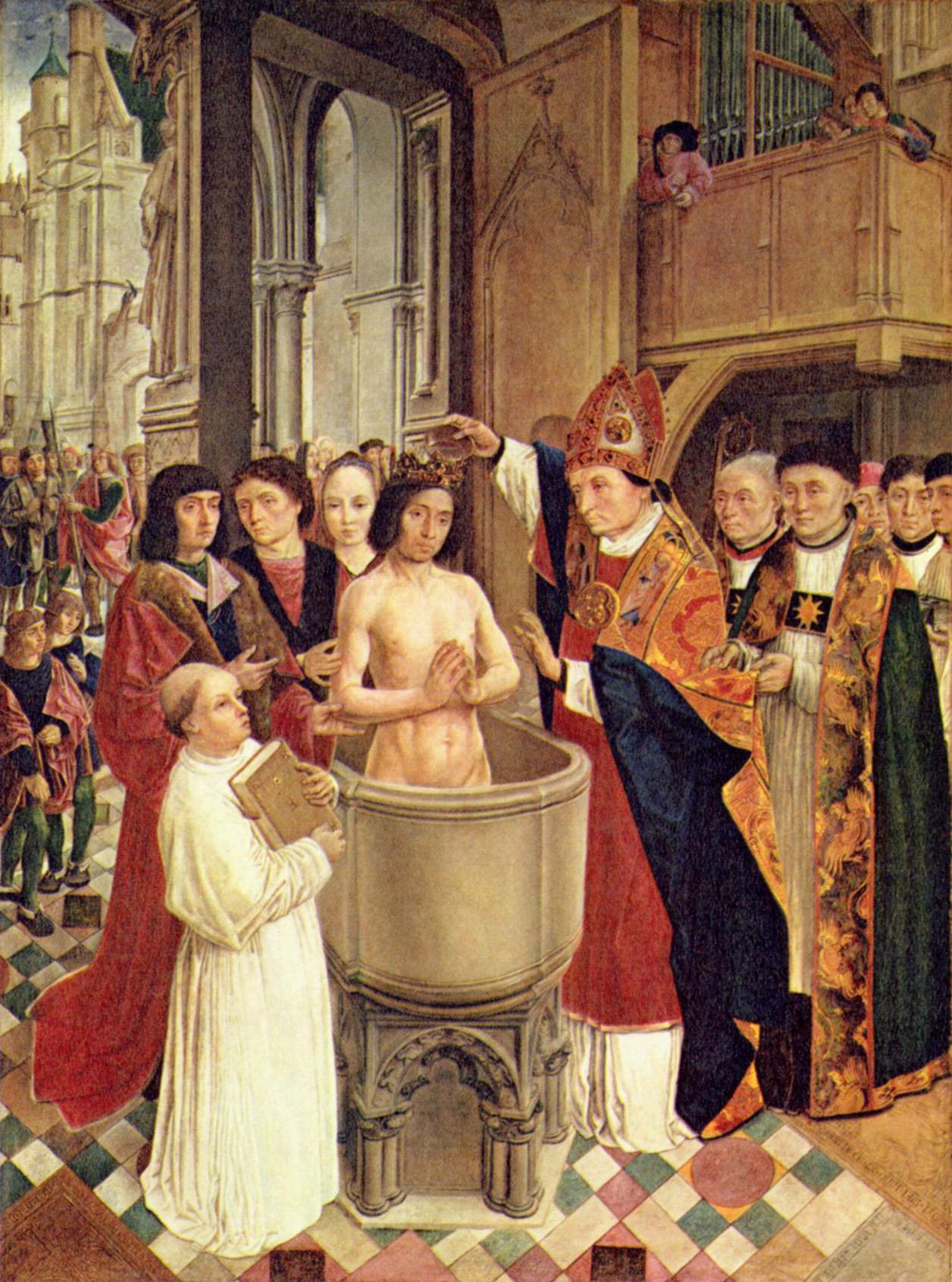
John Dillon posted this piece on the Medieval Religion discussion group about another French saint whose feast falls today besides St Thérèse of Lisieux, St Remigius, whose baptism of King Clovis in 496 was the crucial event in the creation of a Christian Kingdom of France:

St Remigius of Reims (d. 532 or 533; in standard French, Rémi, Rémy; at Reims, usually but not always Remi or Remy), the "apostle of the Franks", is said in his Vita by "Fortunatus, bishop of Poiters" (BHL 7150; it is not by St. Venantius Fortunatus) to have been of noble birth and to have been elected bishop of Reims at the age of twenty-two. St. Gregory of Tours' Historia Francorum is our first narrative source for his having baptized the Frankish King Clovis. Gregory credits him with various miracles, one being the suppression of a fire threatening to consume his city. Remigius' originally ninth-century Vita by Hincmar of Reims (BHL 7152-7164) makes him a member of a prominent noble and ecclesiastical family and adds other miracles, including that of the ampule of chrism miraculously provided for Clovis' baptismal ceremony.

Florus of Lyon and Hincmar both give January 13th as Remigius' dies natalis; this is the date under which he is commemorated in the Roman Martyrology as revised in 2001. His traditional feast on October 1st, removed in 1969 from the general Roman Calendar but still observed in the diocese of Reims-Ardennes, commemorates his translation in 1099 from Reims' cathedral to the abbey church of Saint-Remi. Remigius' putative remains repose in the latter's largely eleventh to thirteenth-century successor, today's basilique Saint-Remi.

Some period-pertinent images of St. Remigius of Reims (the geographic suffix distinguishes him from a sainted archbishop of Rouen):

a) as portrayed (three miracles: restoring to life a girl from Toulouse; replenishing a wine barrel; the heavenly dove providing chrism for Clovis' baptism) on a later ninth-century ivory book cover in the Musée de Picardie, Amiens:


b) as depicted (at left, with St. Anselm of Canterbury and St. Audemarus / Omer) in one of four panels of a full-page illumination in the late twelfth-century so-called Bible of Saint Bertin (ca. 1190-1200; Den Haag, KB, ms. 76 F 5, fol. 29r):
http://manuscripts.kb.nl/zoom/BYVANCKB%3Amimi_76f5%3A029r_min_b2
The page as a whole:
http://manuscripts.kb.nl/zoom/BYVANCKB%3Amimi_76f5%3A029r

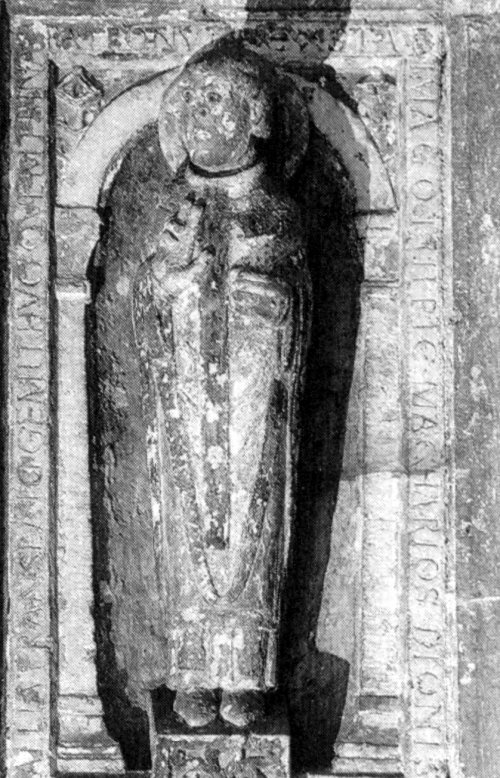
c) as portrayed on an early thirteenth-century great seal (in use in 1219) of the abbey of Saint-Remi in Reims (cast from the Archives Nationales, Paris):


d) as depicted in the earlier thirteenth-century St. Rémi window (c. 1220-25) in Chartres' basilique cathédrale de Notre-Dame:
http://tinyurl.com/qedofzr - key and links to the scenes
http://tinyurl.com/yd5ens

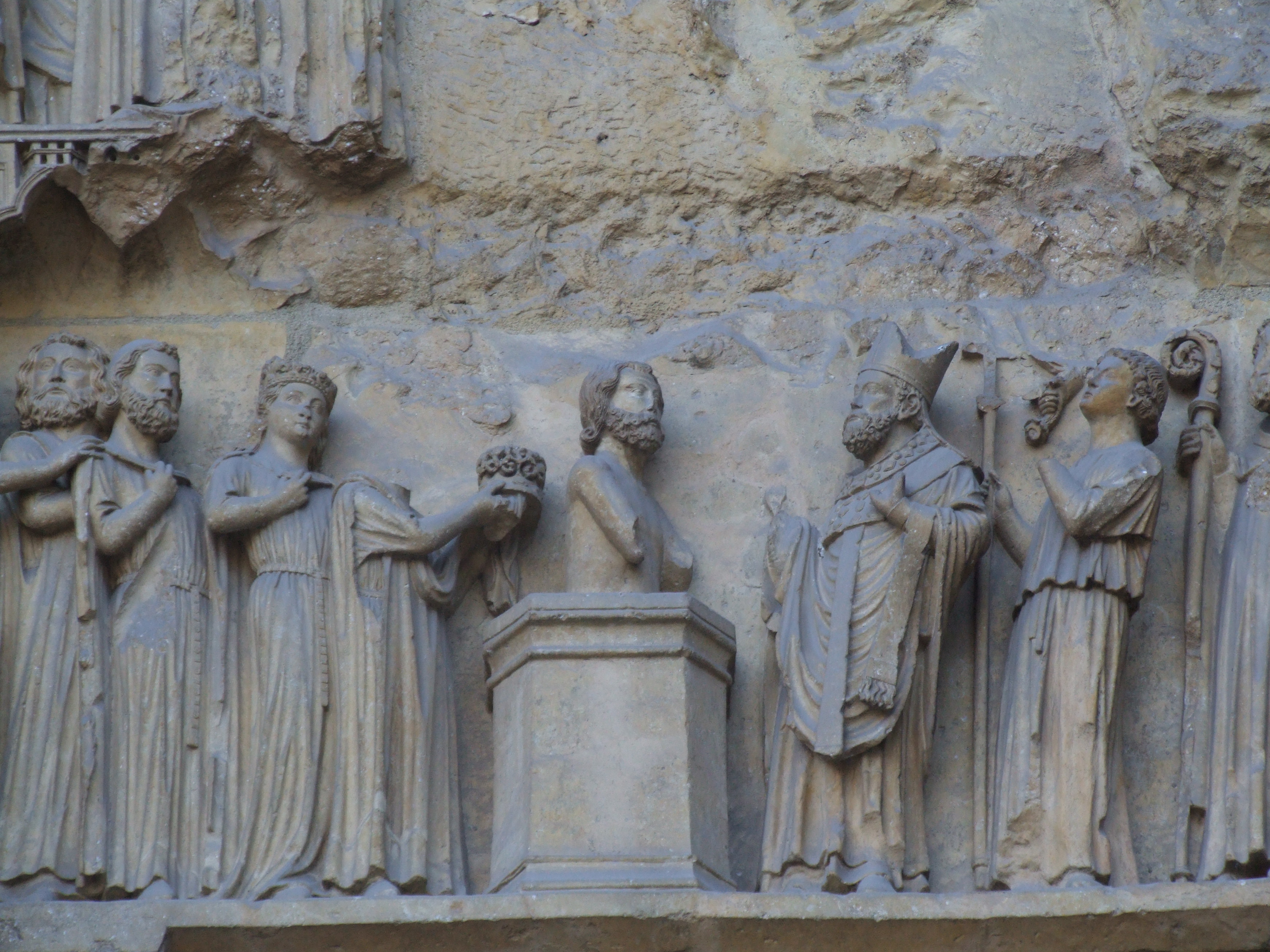
e) as portrayed several times on the originally earlier thirteenth-century "Portail des Saints" (c. 1220-1230) of the north transept of Reims' cathédrale de Notre-Dame (NB: Many of the carvings on this building were reworked in the nineteenth and twentieth centuries):
1) Second register from top (operating miracles):

 http://peregrinations.kenyon.edu/photobank/30.jpg

2) Just right of centre (at the baptism of Clovis):

 https://upload.wikimedia.org/wikipedia/commons/a/a5/Reims_Cathedrale_Notre_Dame_010_clovis_baptism.JPG


f) as depicted in a panel of a later thirteenth-century glass window (c. 1270; w. 207) in Strasbourg's cathédrale Notre-Dame:


g) as depicted (upper register, fourth from left; baptizing Clovis) in a late thirteenth-century copy of a French-language version of a Vita of St. Dionysius / Denis of Paris and companions (c. 1280-1285; Paris, BnF, ms. Nouvelle acquisition française 1098, fol. 50r):
http://tinyurl.com/nuzcd9x
A closer view:

 https://frmarkdwhite.files.wordpress.com/2012/12/clovis-baptism-st-remi.jpg


h) as portrayed (second from right in another scene of Clovis' baptism) in the "Galerie des Rois" on the originally fourteenth-century west front of Reims' cathédrale de Notre-Dame (NB: Many of the carvings on this building were reworked in the nineteenth and twentieth centuries):


i) as portrayed in high relief (exorcising the girl from Toulouse) in a fourteenth-century sculpture in the Musée Saint-Remi in Reims:

 https://upload.wikimedia.org/wikipedia/commons/1/10/St-R%C3%A9mi_exorcisant.jpg


j) as depicted (at foot of page: second from right, baptizing Clovis) in an earlier fourteenth-century copy of the Grandes Chroniques de France (between 1332 and 1350; London, BL, Royal MS 16 G VI, fol. 16r):
http://www.bl.uk/manuscripts/Viewer.aspx?ref=royal_ms_16_g_vi_fs001r

k) as depicted in a mid-fourteenth-century copy of a French-language version of Richer of Saint-Remi's tenth-century Vita of Remigius (Brussels, KB / BrB, ms. 5365, fol. 1r):

http://www.europeanaregia.eu/sites/www.europeanaregia.eu/files/manuscripts/thumbnail_kbr_5365.jpg

[Note the French Royal Arms and an early version of the arms of the Dauphin - Clever Boy]
For the locations in this now digitized ms. of other illuminations depicting Remigius see:
http://belgica.kbr.be/fr/coll/ms/ms5365_fr.html

l) as depicted (rear register, second from left) by Giottino in his later fourteenth-century Pietà of San Remigio (between 1360 and 1365) in the Galleria degli Uffizi, Florence:


m) as depicted (second from left, baptizing Clovis) in the later fourteenth-century Grandes Chroniques de France de Charles V (c. 1370-1380; Paris, BnF, ms. Français 2813, fol. 12v):


n) as depicted (third from right, baptizing Clovis) in another later fourteenth-century copy of the Grandes Chroniques de France (c. 1375-1400; Paris, BnF, ms. Français 10135, fol. 13r):
http://gallica.bnf.fr/ark:/12148/btv1b84525476/f33.item.zoom

o) as depicted (at right, baptizing Clovis) in the second volume of a late fourteenth- or early fifteenth-century copy of Don Gonzalo de la Hinojosa's chronicle of Burgos in its French-language translation by Jean Golein (c. 1400; Besançon, Bibliothèques municipales, ms. 1150, fol. 85v):

 http://www.enluminures.culture.fr/Wave/savimage/enlumine/irht5/IRHT_085692-p.jpg


p) as depicted in a lightly colored pen-and-ink illumination (at left, baptizing Clovis) in an early fifteenth-century copy of the Grandes Chroniques de France (c. 1401-1410; Valenciennes, Bibliothèque de Valenciennes, ms. 637, fol. 14v):

 http://www.enluminures.culture.fr/Wave/savimage/enlumine/irht5/IRHT_091849-p.jpg


q) as depicted (left-hand column) in the early fifteenth-century Hours of René of Anjou (c. 1405-1410; London, BL, Egerton MS 1070, fol. 103v; image zoomable):
http://www.bl.uk/catalogues/illuminatedmanuscripts/ILLUMIN.ASP?Size=mid&IllID=48375

r) as depicted in the early fifteenth-century Châteauroux Breviary (ca. 1414; Châteauroux, Bibliothèque municipale, fol. 359r):

http://www.enluminures.culture.fr/Wave/savimage/enlumine/irht2/IRHT_054213-p.jpg


s) as depicted (in two scenes: at centre in the first, at right in the second) in a mid-fifteenth-century copy of Giovanni Colonna's Mare historiarum (between 1447 and 1455; Paris, BnF, ms. Latin 4915, fol. 290v):
http://gallica.bnf.fr/ark:/12148/btv1b6000905v/f650.item.zoom

t) as depicted (at left, baptizing Clovis) by Jacques de Besançon in a late fifteenth-century copy of the Legenda aurea in its French-language version by Jean de Vignay (c. 1480-1490; Paris, BnF, ms. Français 245, fol. 122v):


u) as depicted in a late fifteenth-century breviary according to the Use of Langres (after 1481; Chaumont, Mediathèque de Chaumont, ms. 33, fol. 447v):

 http://www.enluminures.culture.fr/Wave/savimage/enlumine/irht6/IRHT_097043-p.jpg


v) as depicted (second from left in main panel) in a late fifteenth-century copy of the Chroniques abrégées des Anciens Rois et Ducs de Bourgogne attributed to Olivier de la Marche (c. 1485-1486; London, BL, Yates Thompson MS 32, fol. 4v):
http://www.bl.uk/manuscripts/Viewer.aspx?ref=yates_thompson_ms_32_fs004v

w) as depicted (sixth from right, baptizing Clovis) by the Master of St. Giles in a late fifteenth or early sixteenth-century panel painting (ca. 1500) in the National Gallery of Art, Washington, DC:

https://upload.wikimedia.org/wikipedia/commons/f/f1/Meister_des_Heiligen_%C3%84gidius_001.jpg


http://www.nga.gov/content/ngaweb/Collection/art-object-page.41597.html

x) as depicted (at centre, having miraculously replenished a wine barrel) in an early sixteenth-century panel painting of Swiss origin (c. 1500-1505) in the Metropolitan Museum of Art, New York:

 Saint Remigius Replenishing the Barrel of Wine; (interior) Saint Remigius and the Burning Wheat


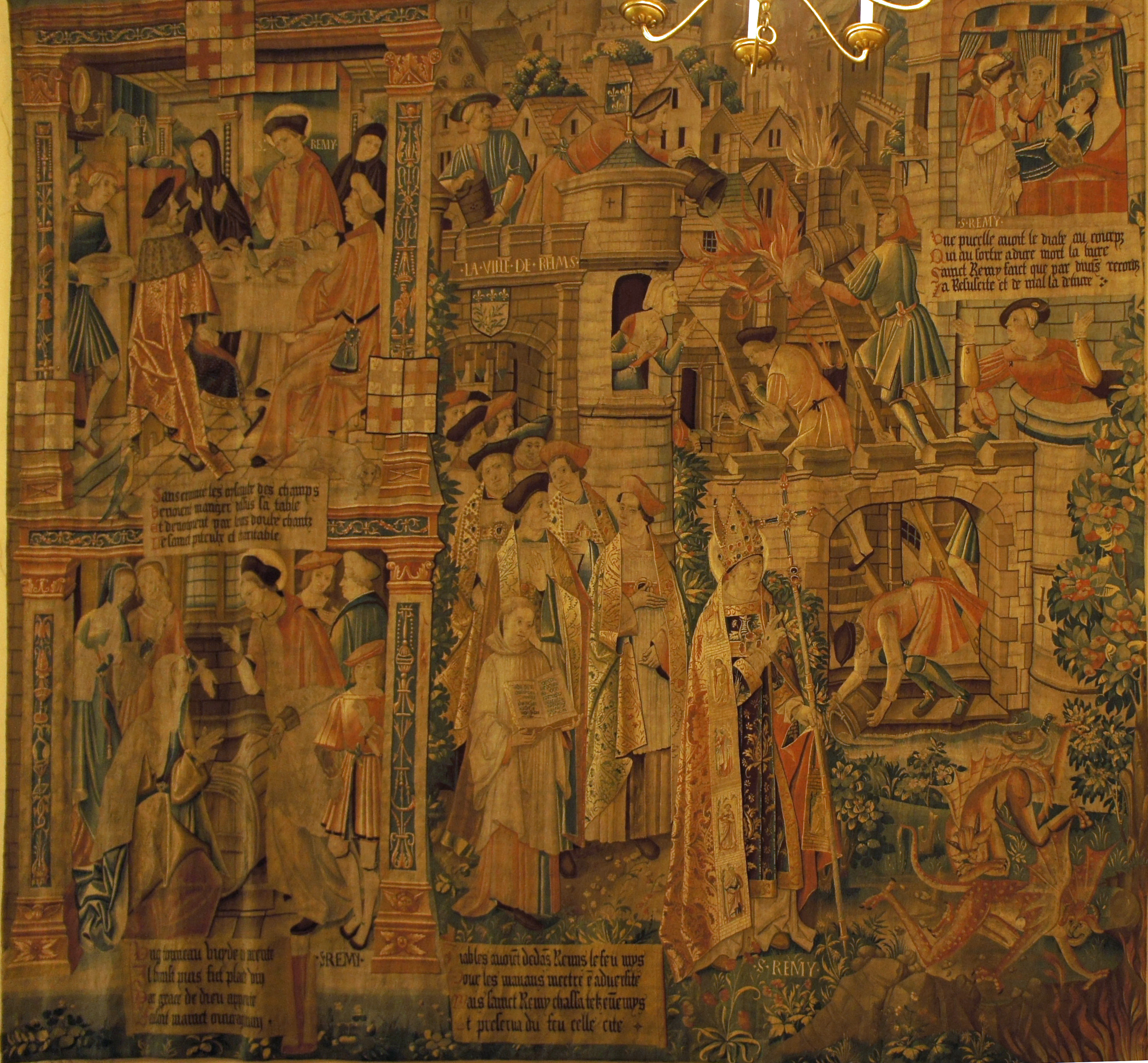
y) as depicted in two early sixteenth-century tapestries (completed by or in 1509) in the Musée Saint-Remi in Reims:
1) at bottom centrre and bottom right (infancy scenes):

 https://upload.wikimedia.org/wikipedia/commons/c/cf/1_naissance_de_Remy_Celine_Emiles_rend_la_vue_%C3%A0_M%C3%B4tain.JPG

2) at bottom right (miracle of the fire of Reims):

 https://upload.wikimedia.org/wikipedia/commons/6/62/3_incendie_de_Reims_%282%29.jpg

z) as depicted (second from right, baptizing Clovis) in King François I's copy of Guillaume Crétin's early sixteenth-century Recueil sommaire des cronicques françoyses (1515-1516; Paris, BnF, ms. Français 2817, fol. 40r):


St Thérèse of Lisieux


Today has been the feast of  Saint Thérèse of the Child Jesus and the Holy Face, O.C.D., probably better known as St Thérèse of Lisieux, or the Little Flower.

This evening after Mass for her feast at the Oxford Oratory we had Solemn Benediction to mark the occasion - she was adopted as a patron of the parish following the visit of her relics here in 2009.

Afterwards I went for supper to a friend's house and we watched his DVD of the film Thérèse with Lindsay Younce playing the saint. Although it told the basic story of Thérèse Martin I personally found it rather too sentimental and too glossy - as do others judging from comments on the Amazon website in their 163 customer reviews. They indeed query some of the details as depicted in the film.

Having read the Autobiography, which is not to everyone's taste, and more significantly, some of her letters and advice as Novice Mistress I think St Thérèse was a much more substantial figure than depicted in this film and in so many other ways. She needs to be seen both as a saint for future generations to look to and as a product of a church and a church-going section of society that was increasingly under threat in the France of her lifetime.  In many ways her sister's photographs of her are the most revealing insight into her - her very simple yet utterly profound idea, her great insight into how one should approach God is too big an idea for sentimentality.


http://carmelitesofeldridge.org/Therese1896.jpg


St Thérèse of Lisieux


 Image:carmelitesofeldridge.org


May St Thérèse continue to pray for us


October


Image: Wikipedia

This calendar page in the Très Riches Heures of John Duke of Berry is attributed to Paul Limbourg, with possible additions by Jean Colombe in the 1480s

The scene in the foreground is winter sowing and harrowing, with crows and magpies eating some of the seeds. The harrow is shown as horse drawn rather than by oxen. Beyond there is an archer in the middle ground with pollarded willows on the river bank. Meanwhile in the background people walk by the Seine, across which small boats ply. Once again this is a tranquil, reassuring scene of agricultural harmony. This is an idealised view as the building which dominates the scene is the palace of the Louvre, then at the western end of Paris, but the foreground would have been built up as it would be part of the Ile de la Cite or the left bank of the Seine.

The Louvre was originally built by King Philip II (1180-1223)  - the impressive foundations of his fortress are once again visible in the basement of the museum complex - but the Louvre as depicted was the result of its  remodelling as a residence by Duke John's elder brother, King Charles V, after his accession to the throne in 1364. As at Saumur in last month's illustration the palace fortress is decorated with elaborate finials and the chimneys point to domestic comfort inside the royal residence.

October 1415 was to see the English army make its doubtless in many ways weary way north-eastwards on the route towards Calais, with King Henry V seeking, it would appear, to avoid engagement with the French. That was not to be and the road to Calais was the road to the battle of Agincourt....