Once I was a clever boy learning the arts of Oxford... is a quotation from the verses written by Bishop Richard Fleming (c.1385-1431) for his tomb in Lincoln Cathedral. Fleming, the founder of Lincoln College in Oxford, is the subject of my research for a D. Phil., and, like me, a son of the West Riding. I have remarked in the past that I have a deeply meaningful on-going relationship with a dead fifteenth century bishop... it was Fleming who, in effect, enabled me to come to Oxford and to learn its arts, and for that I am immensely grateful.


Showing posts with label Reims Cathedral. Show all posts

Wednesday, 14 October 2015

Pope St Callistus I


October 14th is the feast day of Callistus I, Pope (also Calixtus; d. 222).

John Dillon posted about him on the Medieval Religion discussion group as follows:

Callistus was elected Bishop of Rome in 217, succeeding pope St. Zephyrinus. Our chief sources for him are the tendentious Philosophoumena or Refutatio omnium haeresium of an Hippolytus who tends be called Hippolytus of Rome [ for whom see Hippolytus-of-Rome] and the not altogether reliable Liber pontificalis. According to Hippolytus, Callistus had been born into servile status and had twice been punished for crimes. In the second instance he had been sentenced to the mines in Sardinia and probably at that time ceased to be the property of his former master, a Christian of the imperial household. Some nine or ten years after Callistus' release from the mines Zephyrinus put him in charge of the Christian cemetery at Rome that still bears Callistus' name. Herewith an illustrated, Italian-language page on the cemetery of Callistus:
http://it.wikipedia.org/wiki/Catacombe_di_San_Callisto

In his brief pontificate Callistus condemned the theologian Sabellius for heresy and had to endure accusations of similar purport from the aforementioned Hippolytus, who set himself up as a rival bishop of Rome. Callistus died under Alexander Severus, who is not reliably known to have persecuted Christians, his activity in that regard being transmitted solely in Passiones of legendary character.

Kevin Jones of the Dome of Home website also posted about St Callistus as follows:

Most of what we know of Callistus comes from attacks by his contemporaries, notably Tertullian and the antipope Hippolytus.

As a young slave Callistus was put in charge of a bank by his master Carpophorus, in which the brethren and widows lodged money. Callistus lost it all, and fled. When his master caught up with his ship Callistus jumped overboard to escape capture but was saved from drowning. He was given the punishment reserved for slaves, that of turning the pistrinum or hand-mill. His creditors got him released in the hope that he could retrieve some of their money, but when he tried to get back some of the money he had lent to Jews the result was a fight for which he was re-arrested. He was denounced as a Christian and was condemned to work in the mines of Sardinia (thus, incidentally, ceasing to be the slave of Carpophorus). Marcia, a mistress of the Emperor Commodus, obtained the release of the Christians including Callistus. His health was so weakened that he was sent to Antium to recuperate and was given a pension by Pope Victor I.

Somehow, from a weakened ex-slave in receipt of a invalidity pension, Callistus rose to be archdeacon, had charge of the Roman catacomb which now bears his name, and ended up as Pope. The oppressed Church of the early third century had more important things to do than keep detailed archives of its decision-making processes, but we can be sure that Tertullian’s story that Callistus obtained influence over the ignorant, illiterate and grasping Pope Zephyrinus through bribes is just polemical fiction.

What so irritated Tertullian and Hippolytus and made them so keen to vilify Callistus is what made him such an important figure in the history of the Church. The question of what to do about repentant sinners was a matter of intense debate and dissension, and many of the violent splits in the Church of the early centuries hinged on this very point. What were you to do if someone committed a serious sin? The rigorists – we might call them the “slip once and you’re damned” school – held that once you had done such evil acts you were for ever separated from the true, the pure Church, and there was no way back. Callistus decreed that sinners – for example, fornicators and adulterers – could be readmitted to communion if they repented and did penance for their sin. Callistus based the theology of his decree on the power that Christ gave to Peter and his successors, both to bind and to loose. Tertullian and Hippolytus argued that this power had been given to Peter personally and could not be passed on, so that Callistus’ decree was an innovation, and invalid. They similarly accused him of reprehensible laxity in other matters of Church discipline.

Callistus’ gift to the Church was crucial in the arguments of the fourth century, where the Donatist schism in Africa arose precisely over the question of what should be done about those who, during the persecutions of Domitian, had given up the sacred Scriptures to the authorities – or, conversely, about those who had flaunted their Christianity so as to attract prosecution, imprisonment, and consequently notoriety and admiration among the Christians. The calm good sense shown by orthodox bishops (sometimes patchily but ultimately successfully) has its roots in this manifestation of charity and mercy by Callistus.

Not much is known about how Callistus died. He is the earliest pope found in a fourth-century martyrology, but details are scarce. Since he lived in a time of peace under the Emperor Alexander Severus, whose mother was a Christian, he may have been killed in a riot.

Catholic Online has an article about him at St. Callistus I

John Dillon had this to say about the development of the cult of St Callistus and the distribution of his relics:

By the earlier fourth century he had come to be considered a martyr. The Depositio martyrum of the Chronographer of 354 enters under today Callistus' laying to rest at a milestone that accords with the location of the cemetery of Calepodius. The latter is given as the site of Callistus' burial by both the Liber pontificalis_ and Callistus' legendary Passio (BHL 1523; oldest witness is of the ninth century; a condensed version in hexameters is in the earlier to mid-tenth-century De triumphis Christi in Italia of Flodoard of Reims). Callistus' remains are said to have been translated, perhaps by Pope Gregory III (731-741), to Rome's church of Santa Maria in Trastevere where later Pope Gregory IV (827-844) gave him the honor of a re-burial in the church's apse.

In 854 relics believed to be those of Callistus were translated by Count St. Evrardus (Everardus) of Friuli to the monastery he had founded at today's Cysoing (Nord) in French Hainaut. The monastery, which took Callistus' name and which lasted until 1792, became a dependency of the church of Reims in 892. Callistus' relics, teste Flodoard in his Historia ecclesiae Remensis, were translated thither in the same year and were laid to rest in the then cathedral next to those of St. Nicasius of Reims.

Since the early fifteenth century a head thought by some to be that of Pope St. Callistus I has been in St. George's Chapel of Český Krumlov Castle, Český Krumlov (in German: Böhmisch Krumau) in what's now the Czech Republic:
http://tinyurl.com/3935dbt


Some period-pertinent images of Pope St. Callistus I:

a) as portrayed in an earlier thirteenth-century statue on the trumeau of the central portal of the north transept of the cathédrale Notre-Dame in Reims:


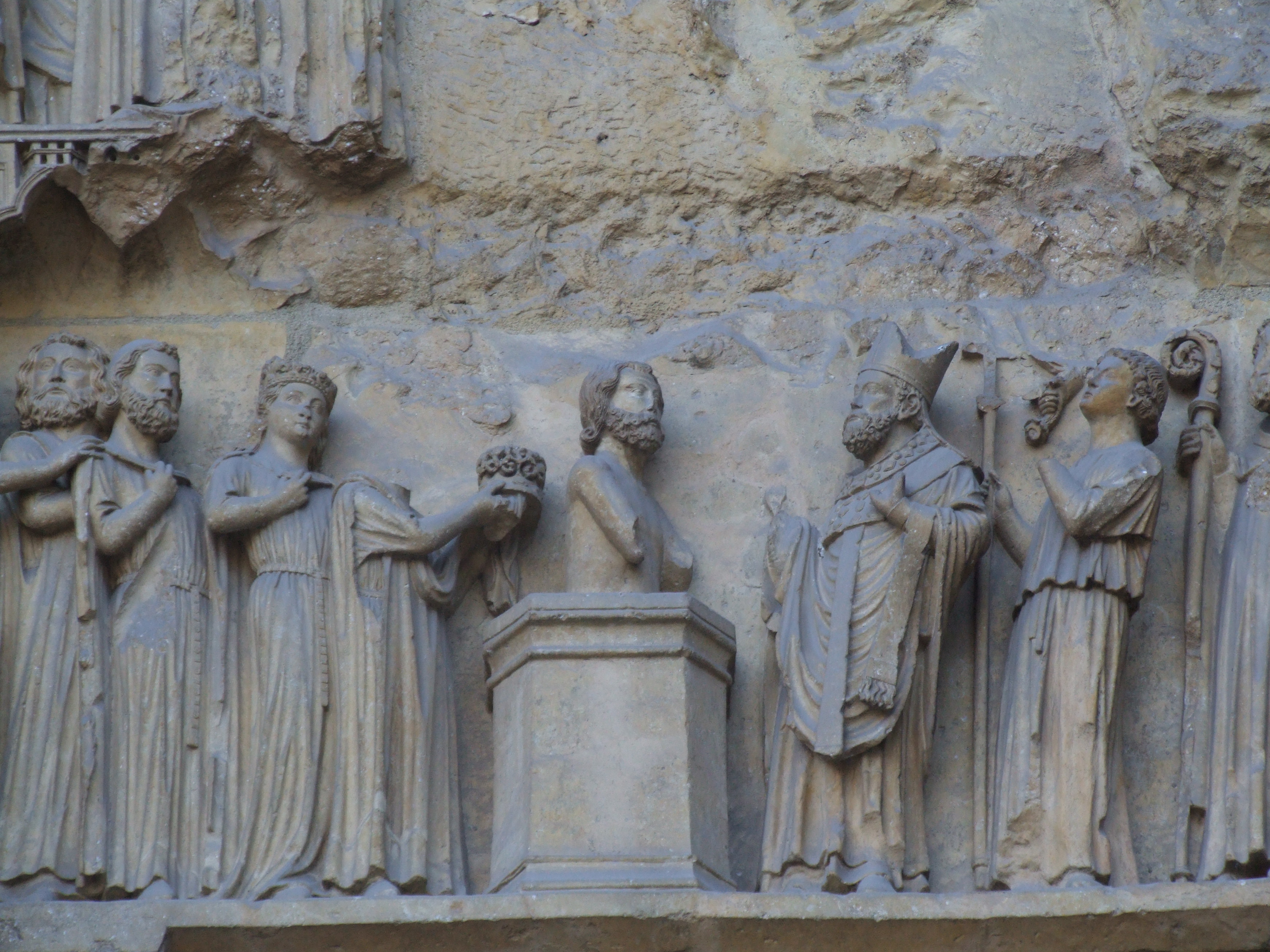
The scene over the door on the right is the Baptism of Clovis, which I wrote about in my recent post about St Remigius - Clever Boy


https://upload.wikimedia.org/wikipedia/commons/1/1c/Reims-Portail_Nord-St_Calixte.jpg


The Clever Boy thinks this is a very interesting figure, showing how an earlier thirteenth century Pope in full vestments would appear. The Papal tiara has only one circlet and rises as a cone to its finial. On his breast the figure is wearing a rationale, an episcopal ornament deriving. I think I am right to say, from OT High Priests, and now worn by only four diocesans, including the Archbishop of Cracow. If he is wearing the distinctive Papal fanon that is not visible, and presumably would have been worn under the chasuble.

b) as depicted (martyrdom) in a late thirteenth-century copy of French origin of the Legenda aurea (San Marino, CA, Huntington Library, ms. HM 3027, fol. 143v):
http://digitalassets.lib.berkeley.edu/ds/huntington/images//000922A.jpg

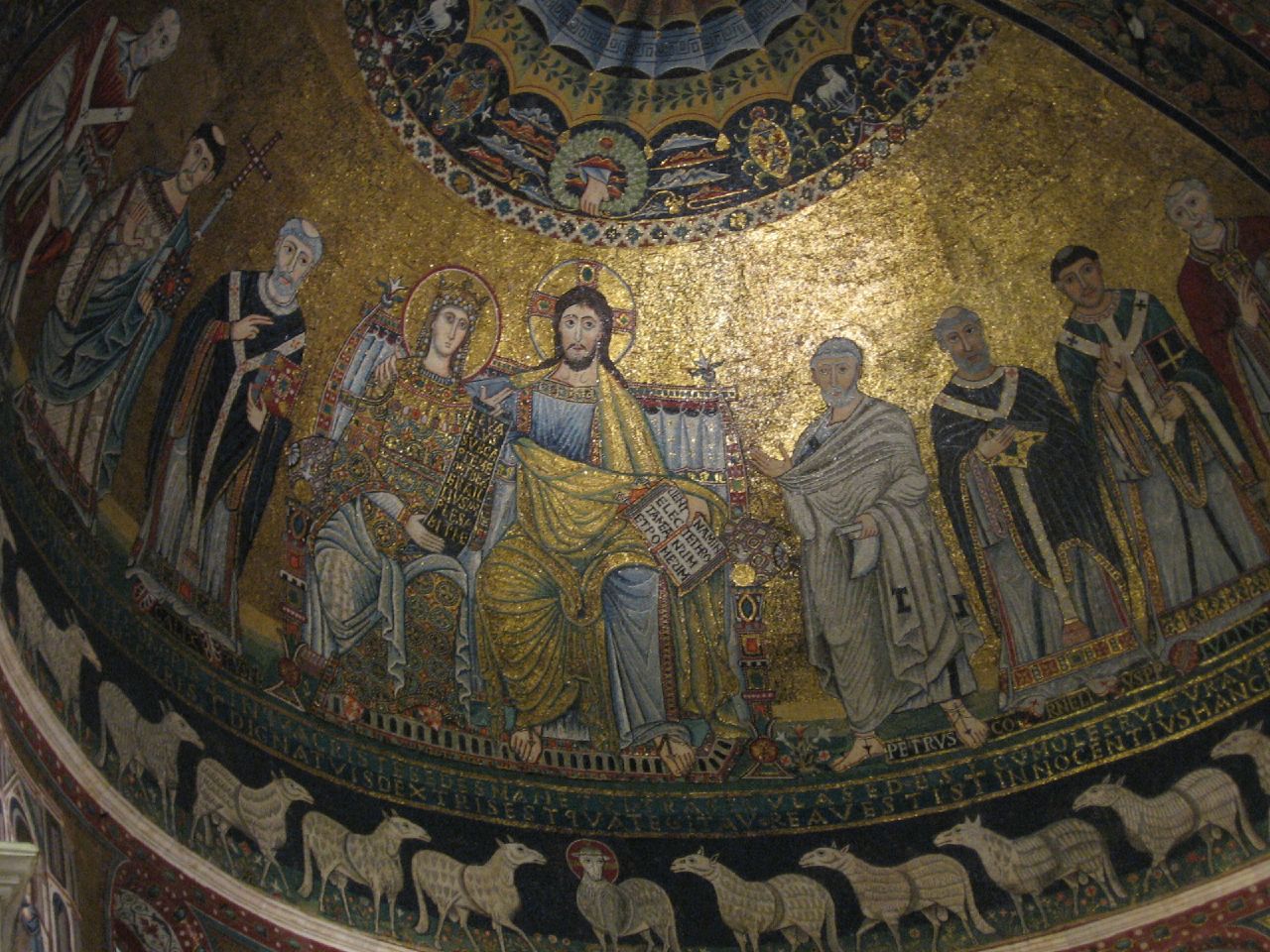
c) as depicted (third from left) in the late thirteenth-century apse mosaic (c. 1290; attributed to Pietro Cavallini) of Rome's Santa Maria in Trastevere:


d) as depicted (promulgating his supposed decree mandating fasting in all four seasons [a spurious text transmitted in the False Decretals]) in an earlier fourteenth-century copy of the Legenda aurea in its French-language version by Jean de Vignay (c. 1326-1350; Paris, BnF, ms. Français 185, fol. 201r):


e) as depicted (at right, promulgating his supposed decree on fasting in all four seasons) in an earlier fourteenth-century copy, from the workshop of Richard and Jeanne de Montbaston, of the Legenda aurea in its French-language version by Jean de Vignay (1348; Paris, BnF, ms. Français 241, fol. 60r):
http://tinyurl.com/2dc984p

f) as depicted in a later fourteenth-century Roman missal of north Italian origin (ca. 1370; Avignon, Bibliothèque-Médiathèque Municipale Ceccano, ms. 136, fol. 276r):

http://www.enluminures.culture.fr/Wave/savimage/enlumine/irht2/IRHT_055393-p.jpg


g) as depicted (martyrdom) in an early fifteenth-century copy of the Legenda aurea in its French-language version by Jean de Vignay followed by the Festes nouvelles attributed to Jean Golein (ca. 1401-1425; Paris, BnF, ms. Français 242, fol. 234v):
http://gallica.bnf.fr/ark:/12148/btv1b8426005j/f484.item.zoom

h) as depicted in the early fifteenth-century Châteauroux Breviary (c. 1414; Châteauroux, Bibliothèque municipale, ms. 2, fol. 371r):
http://www.enluminures.culture.fr/Wave/savimage/enlumine/irht2/IRHT_054230-p.jpg

i) as depicted (martyrdom) in an early fifteenth-century copy of the Elsässische Legenda aurea (1419; Heidelberg, Universitätsbibliothek, Cod. Pal. germ. 144, fol. 159v):

Facsimile


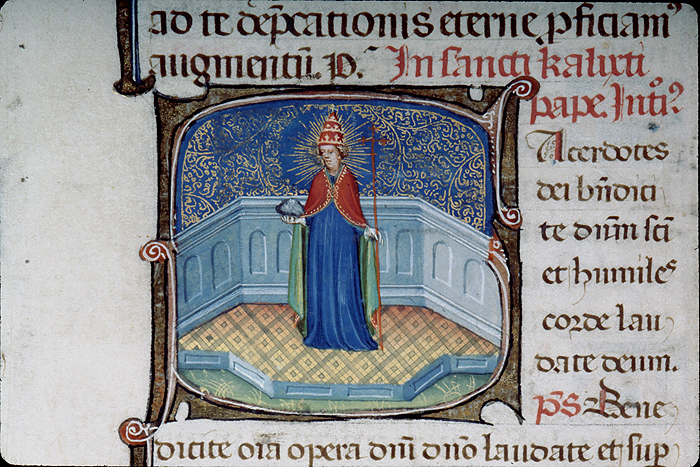
j) as depicted (holding a large stone) in an earlier fifteenth-century breviary from Bruges (ca. 1420; New York, The Pierpont Morgan Library, MS. M.374, fol. 144v):
http://ica.themorgan.org/icaimages/3/m374.144vc.jpg

k) as depicted (martyrdom) in a mid- or slightly later fifteenth-century copy from Bruges of the Legenda aurea in its French-language version by Jean de Vignay (ca. 1445-1465; New York, The Pierpont Morgan Library, MS M.672-675, vol. IV, fol. 145r):


A man, holding staff, looks on as two tormentors strike Callixtus I, nimbed, wearing triple-crowned tiara, with clubs and lead him toward building.
From window of building, two men throw Callixtus I (represented twice), nimbed, wearing triple-crowned tiara, into a well.

l) as depicted (at left, baptizing) in a later fifteenth-century copy of Vincent of Beauvais' Speculum historiale in its French-language version by Jean de Vignay (1463; Paris, BnF ms. Français 51, fol. 9r):


m) as depicted (right margin at bottom) in a hand-colored woodcut in the Beloit College copy of Hartmann Schedel's late fifteenth-century Weltchronik (Nuremberg Chronicle; 1493) at fol. CXIIIIv):
http://www.beloit.edu/nuremberg/book/6th_age/left_page/18%20%28Folio%20CXIIIIv%29.pdf

The Clever Boy will add that In the east window of the chapel of St Calixtus in the south transept of Wells cathedral is a handsome early twentieth century figure of the saint complete with Papal tiara. The dedication of the chapel may well reflect the presence at the nearby abbey at Glastonbury of relics of St Callistus in the middle ages.


Image: pinterest.com


Thursday, 1 October 2015

St Remigius of Reims


John Dillon posted this piece on the Medieval Religion discussion group about another French saint whose feast falls today besides St Thérèse of Lisieux, St Remigius, whose baptism of King Clovis in 496 was the crucial event in the creation of a Christian Kingdom of France:

St Remigius of Reims (d. 532 or 533; in standard French, Rémi, Rémy; at Reims, usually but not always Remi or Remy), the "apostle of the Franks", is said in his Vita by "Fortunatus, bishop of Poiters" (BHL 7150; it is not by St. Venantius Fortunatus) to have been of noble birth and to have been elected bishop of Reims at the age of twenty-two. St. Gregory of Tours' Historia Francorum is our first narrative source for his having baptized the Frankish King Clovis. Gregory credits him with various miracles, one being the suppression of a fire threatening to consume his city. Remigius' originally ninth-century Vita by Hincmar of Reims (BHL 7152-7164) makes him a member of a prominent noble and ecclesiastical family and adds other miracles, including that of the ampule of chrism miraculously provided for Clovis' baptismal ceremony.

Florus of Lyon and Hincmar both give January 13th as Remigius' dies natalis; this is the date under which he is commemorated in the Roman Martyrology as revised in 2001. His traditional feast on October 1st, removed in 1969 from the general Roman Calendar but still observed in the diocese of Reims-Ardennes, commemorates his translation in 1099 from Reims' cathedral to the abbey church of Saint-Remi. Remigius' putative remains repose in the latter's largely eleventh to thirteenth-century successor, today's basilique Saint-Remi.

Some period-pertinent images of St. Remigius of Reims (the geographic suffix distinguishes him from a sainted archbishop of Rouen):

a) as portrayed (three miracles: restoring to life a girl from Toulouse; replenishing a wine barrel; the heavenly dove providing chrism for Clovis' baptism) on a later ninth-century ivory book cover in the Musée de Picardie, Amiens:


b) as depicted (at left, with St. Anselm of Canterbury and St. Audemarus / Omer) in one of four panels of a full-page illumination in the late twelfth-century so-called Bible of Saint Bertin (ca. 1190-1200; Den Haag, KB, ms. 76 F 5, fol. 29r):
http://manuscripts.kb.nl/zoom/BYVANCKB%3Amimi_76f5%3A029r_min_b2
The page as a whole:
http://manuscripts.kb.nl/zoom/BYVANCKB%3Amimi_76f5%3A029r

c) as portrayed on an early thirteenth-century great seal (in use in 1219) of the abbey of Saint-Remi in Reims (cast from the Archives Nationales, Paris):


d) as depicted in the earlier thirteenth-century St. Rémi window (c. 1220-25) in Chartres' basilique cathédrale de Notre-Dame:
http://tinyurl.com/qedofzr - key and links to the scenes
http://tinyurl.com/yd5ens

e) as portrayed several times on the originally earlier thirteenth-century "Portail des Saints" (c. 1220-1230) of the north transept of Reims' cathédrale de Notre-Dame (NB: Many of the carvings on this building were reworked in the nineteenth and twentieth centuries):
1) Second register from top (operating miracles):

 http://peregrinations.kenyon.edu/photobank/30.jpg

2) Just right of centre (at the baptism of Clovis):

 https://upload.wikimedia.org/wikipedia/commons/a/a5/Reims_Cathedrale_Notre_Dame_010_clovis_baptism.JPG


f) as depicted in a panel of a later thirteenth-century glass window (c. 1270; w. 207) in Strasbourg's cathédrale Notre-Dame:


g) as depicted (upper register, fourth from left; baptizing Clovis) in a late thirteenth-century copy of a French-language version of a Vita of St. Dionysius / Denis of Paris and companions (c. 1280-1285; Paris, BnF, ms. Nouvelle acquisition française 1098, fol. 50r):
http://tinyurl.com/nuzcd9x
A closer view:

 https://frmarkdwhite.files.wordpress.com/2012/12/clovis-baptism-st-remi.jpg


h) as portrayed (second from right in another scene of Clovis' baptism) in the "Galerie des Rois" on the originally fourteenth-century west front of Reims' cathédrale de Notre-Dame (NB: Many of the carvings on this building were reworked in the nineteenth and twentieth centuries):


i) as portrayed in high relief (exorcising the girl from Toulouse) in a fourteenth-century sculpture in the Musée Saint-Remi in Reims:

 https://upload.wikimedia.org/wikipedia/commons/1/10/St-R%C3%A9mi_exorcisant.jpg


j) as depicted (at foot of page: second from right, baptizing Clovis) in an earlier fourteenth-century copy of the Grandes Chroniques de France (between 1332 and 1350; London, BL, Royal MS 16 G VI, fol. 16r):
http://www.bl.uk/manuscripts/Viewer.aspx?ref=royal_ms_16_g_vi_fs001r

k) as depicted in a mid-fourteenth-century copy of a French-language version of Richer of Saint-Remi's tenth-century Vita of Remigius (Brussels, KB / BrB, ms. 5365, fol. 1r):

http://www.europeanaregia.eu/sites/www.europeanaregia.eu/files/manuscripts/thumbnail_kbr_5365.jpg

[Note the French Royal Arms and an early version of the arms of the Dauphin - Clever Boy]
For the locations in this now digitized ms. of other illuminations depicting Remigius see:
http://belgica.kbr.be/fr/coll/ms/ms5365_fr.html

l) as depicted (rear register, second from left) by Giottino in his later fourteenth-century Pietà of San Remigio (between 1360 and 1365) in the Galleria degli Uffizi, Florence:


m) as depicted (second from left, baptizing Clovis) in the later fourteenth-century Grandes Chroniques de France de Charles V (c. 1370-1380; Paris, BnF, ms. Français 2813, fol. 12v):


n) as depicted (third from right, baptizing Clovis) in another later fourteenth-century copy of the Grandes Chroniques de France (c. 1375-1400; Paris, BnF, ms. Français 10135, fol. 13r):
http://gallica.bnf.fr/ark:/12148/btv1b84525476/f33.item.zoom

o) as depicted (at right, baptizing Clovis) in the second volume of a late fourteenth- or early fifteenth-century copy of Don Gonzalo de la Hinojosa's chronicle of Burgos in its French-language translation by Jean Golein (c. 1400; Besançon, Bibliothèques municipales, ms. 1150, fol. 85v):

 http://www.enluminures.culture.fr/Wave/savimage/enlumine/irht5/IRHT_085692-p.jpg


p) as depicted in a lightly colored pen-and-ink illumination (at left, baptizing Clovis) in an early fifteenth-century copy of the Grandes Chroniques de France (c. 1401-1410; Valenciennes, Bibliothèque de Valenciennes, ms. 637, fol. 14v):

 http://www.enluminures.culture.fr/Wave/savimage/enlumine/irht5/IRHT_091849-p.jpg


q) as depicted (left-hand column) in the early fifteenth-century Hours of René of Anjou (c. 1405-1410; London, BL, Egerton MS 1070, fol. 103v; image zoomable):
http://www.bl.uk/catalogues/illuminatedmanuscripts/ILLUMIN.ASP?Size=mid&IllID=48375

r) as depicted in the early fifteenth-century Châteauroux Breviary (ca. 1414; Châteauroux, Bibliothèque municipale, fol. 359r):

http://www.enluminures.culture.fr/Wave/savimage/enlumine/irht2/IRHT_054213-p.jpg


s) as depicted (in two scenes: at centre in the first, at right in the second) in a mid-fifteenth-century copy of Giovanni Colonna's Mare historiarum (between 1447 and 1455; Paris, BnF, ms. Latin 4915, fol. 290v):
http://gallica.bnf.fr/ark:/12148/btv1b6000905v/f650.item.zoom

t) as depicted (at left, baptizing Clovis) by Jacques de Besançon in a late fifteenth-century copy of the Legenda aurea in its French-language version by Jean de Vignay (c. 1480-1490; Paris, BnF, ms. Français 245, fol. 122v):


u) as depicted in a late fifteenth-century breviary according to the Use of Langres (after 1481; Chaumont, Mediathèque de Chaumont, ms. 33, fol. 447v):

 http://www.enluminures.culture.fr/Wave/savimage/enlumine/irht6/IRHT_097043-p.jpg


v) as depicted (second from left in main panel) in a late fifteenth-century copy of the Chroniques abrégées des Anciens Rois et Ducs de Bourgogne attributed to Olivier de la Marche (c. 1485-1486; London, BL, Yates Thompson MS 32, fol. 4v):
http://www.bl.uk/manuscripts/Viewer.aspx?ref=yates_thompson_ms_32_fs004v

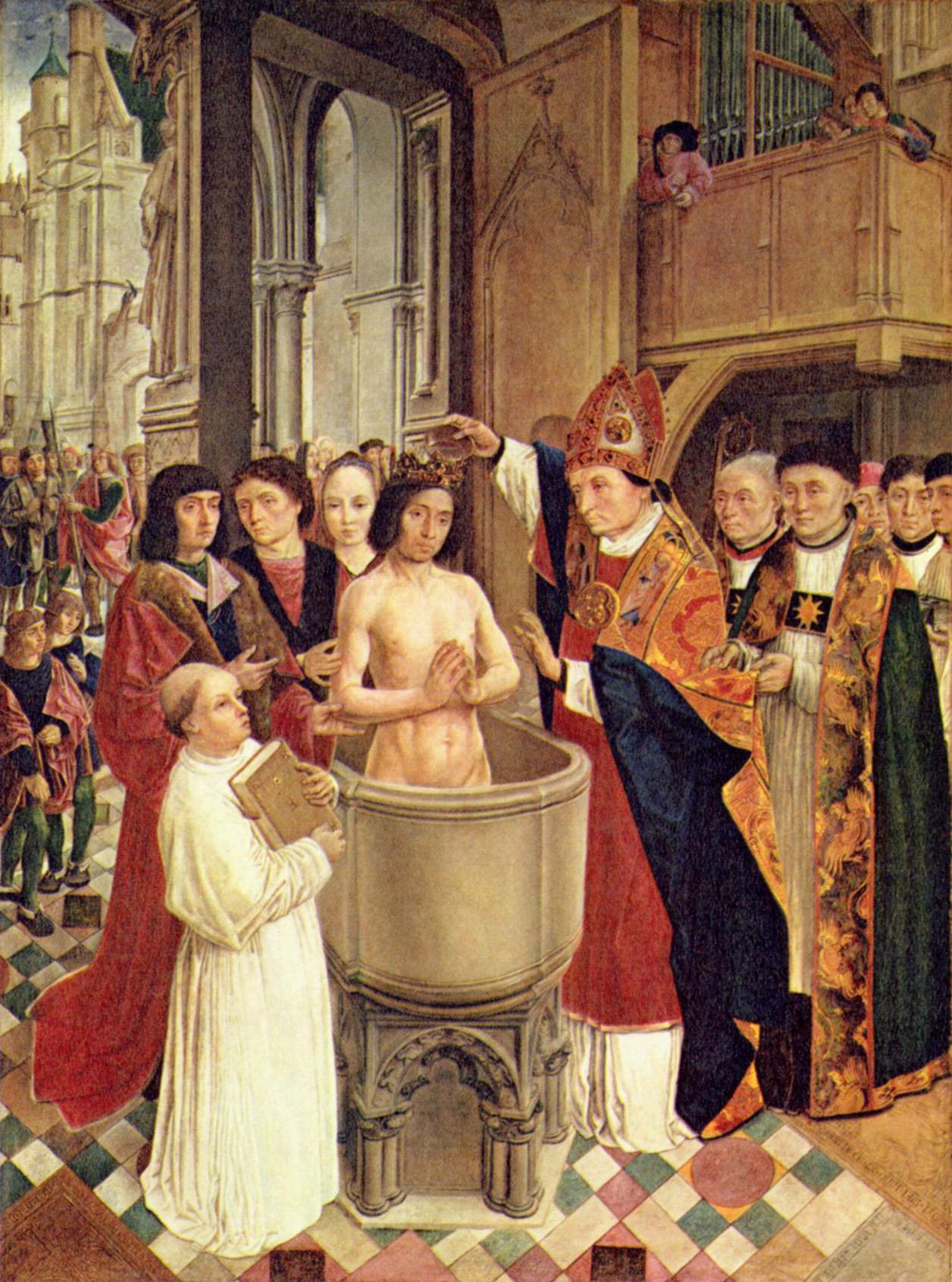
w) as depicted (sixth from right, baptizing Clovis) by the Master of St. Giles in a late fifteenth or early sixteenth-century panel painting (ca. 1500) in the National Gallery of Art, Washington, DC:

https://upload.wikimedia.org/wikipedia/commons/f/f1/Meister_des_Heiligen_%C3%84gidius_001.jpg


http://www.nga.gov/content/ngaweb/Collection/art-object-page.41597.html

x) as depicted (at centre, having miraculously replenished a wine barrel) in an early sixteenth-century panel painting of Swiss origin (c. 1500-1505) in the Metropolitan Museum of Art, New York:

 Saint Remigius Replenishing the Barrel of Wine; (interior) Saint Remigius and the Burning Wheat


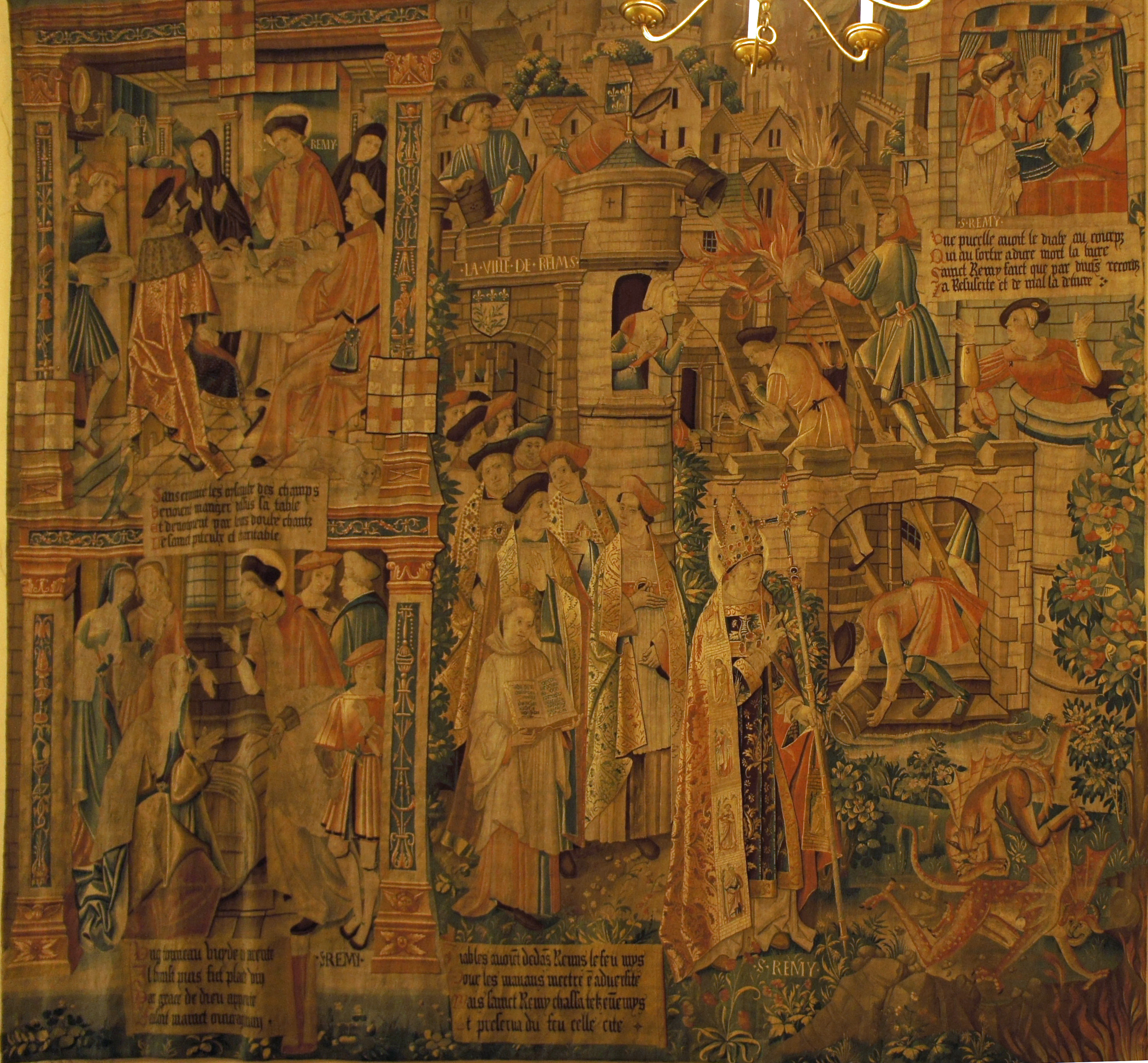
y) as depicted in two early sixteenth-century tapestries (completed by or in 1509) in the Musée Saint-Remi in Reims:
1) at bottom centrre and bottom right (infancy scenes):

 https://upload.wikimedia.org/wikipedia/commons/c/cf/1_naissance_de_Remy_Celine_Emiles_rend_la_vue_%C3%A0_M%C3%B4tain.JPG

2) at bottom right (miracle of the fire of Reims):

 https://upload.wikimedia.org/wikipedia/commons/6/62/3_incendie_de_Reims_%282%29.jpg

z) as depicted (second from right, baptizing Clovis) in King François I's copy of Guillaume Crétin's early sixteenth-century Recueil sommaire des cronicques françoyses (1515-1516; Paris, BnF, ms. Français 2817, fol. 40r):


Sunday, 14 October 2012

St Callistus


Were today not Sunday it would, as it is October 14th, be the feast of  Pope St Callistus I (d. 222). Callistus, also, and probably better known as Calixtus, was elected bishop of Rome in 217, succeeding Pope St. Zephyrinus. Our chief sources for him are the tendentious Philosophoumena or Refutatio omnium haeresium of an Hippolytus who tends be called Hippolytus of Rome and the not altogether reliable Liber pontificalis. According to Hippolytus, Callistus had been born into servile status and had twice been punished for crimes. In the second instance he had been sentenced to the mines in Sardinia and probably at that time ceased to be the property of his former master, a Christian of the Imperial household. Some nine or ten years after Callistus's release from the mines Pope Zephyrinus put him in charge of the Christian cemetery at Rome that still bears Callistus's name. There is an illustrated, Italian-language, page on the cemetery of Callistus here.

There is more about the stories of his earlier life and about his death in the online account which can be read here.

In his brief pontificate Callistus condemned Sabellius for heresy. Though he died under Alexander Severus, who is not known to have persecuted Christians, by the earlier fourth century Callistus. had come to be considered a martyr. The Depositio martyrum of the Chronographer of 354 enters under today Callistus's laying to rest at a milestone that accords with the location of the cemetery of Calepodius. The latter is given as the site of Callistus's burial by both the Liber pontificalis and Callistus's legendary Passio (BHL 1523; oldest witness is of the ninth century and a condensed version in hexameters is in the earlier to mid-tenth-century De triumphis Christi in Italia of Flodoard of Reims). Callistus's remains are said to have been translated, perhaps by Pope Gregory III (731-741), to Rome's church of Santa Maria in Trastevere where later Pope Gregory IV (827-844) gave him the honour of re-burial in the church's apse. Callistus. third from the left, is depicted in the late thirteenth-century apse mosaic (ca. 1290; attributed to Pietro Cavallini) in  Santa Maria in Trastevere which can be viewed here.

 In 854 relics believed to be those of St Callistus were translated by count St. Evrardus (Everardus) of Friuli to the monastery he had founded at today's Cysoing (Nord) in French Hainaut. The monastery, which survived until 1792, took Callistus's name but in 892 it became a dependency of the church of Reims and his relics, teste Flodoard in his Historia ecclesiae Remensis, were translated thither in the same year and laid to rest in the  cathedral, next to those of St. Nicasius of Reims.

Since the early fifteenth century a head thought to be Callistus's has been in St. George's Chapel of Český Krumlov Castle. The website for the castle at Český Krumlov (in German: Böhmisch Krumau) in Bohemia is here.

St Callistus is portrayed in an earlier thirteenth-century statue on the trumeau of the central portal of the north transept of the present cathédrale Notre-Dame in Reims which, as mentioned above, housed some of his relics:


Image: learn.columbia.edu


There is another view of the statue here:


http://upload.wikimedia.org/wikipedia/commons/1/1c/Reims-Portail_Nord-St_Calixte.jpg

Image: Wikimedia Commons

This  statue is, I think, interesting not because it is portrait, which it clearly is not - although it does suggest a similar iconography to the mosaic in Santa Maria in Trastevere in the link above - but because it depicts a Pope as he was expected to appear when vested to an early thirteenth century audience - the tiara still has only one circlet, and the Pope appears to be wearing a rationale over his pallium.

Spurious letters of St Callistus are included in the collection known as the False Decretals. One of these decrees fasting in each of four seasons - the Ember Days. Here, in a earlier fourteenth-century (ca. 1326-1350) collection of French-language saint's lives, is an image of Callistus promulgating this decree, again wearing an early form of the Papal tiara: 


Source: Paris, BnF, ms. Français 185, fol. 201r

Image: BnF

St Callistus is shown at the left, baptizing, in a later fifteenth-century copy (1463) of Vincent of Beauvais' Speculum historiale in its French-language version by Jean de Vignay. In this picture he wears the familiar triple crown tiara: 


Source: Paris, BnF ms. Français 51, fol. 9r

Image: BnF

In England the one chapel dedicated to St Callistus that comes to my mind is in the south transept of Wells cathedral, which has a handsome modern stained glass depiction of him, wearing a triple tiara.
Adapted, with additional comments of my own, from John Dillon's post on the Medieval Religion discussion group.