Once I was a clever boy learning the arts of Oxford... is a quotation from the verses written by Bishop Richard Fleming (c.1385-1431) for his tomb in Lincoln Cathedral. Fleming, the founder of Lincoln College in Oxford, is the subject of my research for a D. Phil., and, like me, a son of the West Riding. I have remarked in the past that I have a deeply meaningful on-going relationship with a dead fifteenth century bishop... it was Fleming who, in effect, enabled me to come to Oxford and to learn its arts, and for that I am immensely grateful.


Sunday, 9 December 2012

Emperor Sigismund


Today is the 575th anniversary of the death of the Holy Roman Emperor Sigismund in 1437. Born in 1368 a younger son of the Emperor Charles IV he became King of Hungary by marriage, King of the Romans and, ultimately, Holy Roman Emperor by election and King of Bohemia by inheritance.
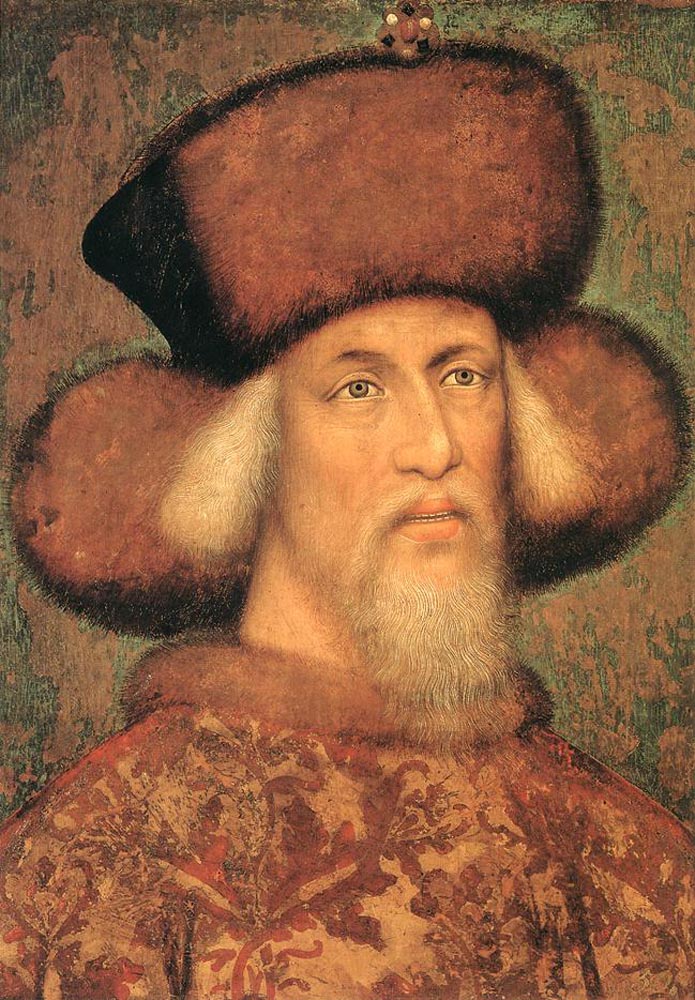


Emperor Sigismund

The painting is attributed to Pisanello and shows Sigismund at about the age of 50, that is about 1418.
He appears to have reqularly worn a hat of this type as he is always depicted wearing one.
Kunsthistorisches Museum Vienna

Image: Wikipedia


There is an illustrtaed online life of him here.  He played amajor part in convening and supporting the Council of Constance in 1414-18, and travelled to Spain, France and Englandin 1416 to secure the adhesion of the Iberian kingdoms to the Council and to negotiate with the government of King Charles VI of France and with King Henry V. Initially this was mediation in the wake of King Henry's success at Agincourt the previous year, but when he came  to England he entered by the Trearty of Canterbury into alliance with King Henry.He was feted in England, and the monarch's exchanged gifts and honours, including Sigismund being made a Knight of the Garter. He gave, inter alia relics of St George to the chapel of the Order at Windsor

One aim of the allaince was to pursue Church reform ahead of the electuion of a new, unquestioned, Pope. However in the autumn of the following year the English King deceided to fall in with other realms and support the elction of anew pope following on from what had been achieved in the way of reform. So it fell to Richard Fleming, by then a leading figure in the English delegation at Constance to tell Sigismund of the change in English policy. In the weeks that followed Cardinal Colonna became Pope Martin V and Richard Fleming entered the Apostolic Household.

In the summer of 1422 Fleming, bu now Bishop of Lincoln, was sent on a diplomatic mission by King henry to woo poloiticala nd miliatry support from the Elector Palatine and the three Archbishop Electors and to attend the Imperial Diet Sigismund had summoned to Nuremburg. It was whilst this was meeting that King Henry V died and Fleming returned home.

A link with Sigismund's visit in 1416 survives in York in the city's Sword of State. Granted the privilege by King Richard II of the sword and a cap of mainatence to indicate its rank as a city and county of the city, the civic authorities were given the sword by Henry Hanslap, a native of York, and canon of Windsor in 1439. Two years earlier when the Emperor Sigismund died his Garter stall at St Georges was dismanted and the sword and helm removed from the chapel, passing to the
Dean and Canons of Windsor. The Dean later gave it to one of his canons,  Hanslap, who then  presented it to his native city in 1439. The sword was redecorated in 1586, as is recorded on the blade, and has been frequently repaired.


http://mek.oszk.hu/02000/02096/html/saxon03.jpg
The Sigismund Sword 
The Dragons refer to the Order of the Dragon, founded by Sigismund as King of Hungary

Image:mek.oszk.hu

http://www.thediamondjubilee.org/sites/www.thediamondjubilee.org/files/styles/lightbox/public/LN-TQ-Apr12-Micklegate.jpg

The Sigismund Sword is presented to The Queen on her visit to York for the Royal Maundy service this year.
The Swordbearer is wearing the other distinctive piece of insignia of the City, the Cap of Maintenance

Image:thediamondjubilee.org

photo

The Sword of State, Cap of Maintenance and Mace

Image: City of York Council photostream on Flickr 


Saturday, 8 December 2012

Celebrating the Immaculate Conception at the Oxford Oratory

Our Lady conceived without sin is the patroness both of the Congregation of the Oratory and of the Archdiocese of Birmingham. It was therefore fitting and proper that the Solemnity of her Immaculate Conception was celebrated once again in style at the Oxford Oratory.

We prepared, as usual,  with a Novena and Benediction following the evening Mass at the Oratory from a week last Wednesday.

Last night on there was Solemn First Vespers sung by the Oratorians and the choir, followed once again by Benediction. This was the first occasion on which a very handsome Gothic style monstrance which is currently in the care of the Oxford Oratory was used on such an occasion here, and it was a fine addition to the ceremonial.

1354995676.jpg


Image: Oxford Oratory


This morning there was a Solemn Mass at 10 which drew a good congregation. The celebrant and preacher was Bishop Paul Hendricks, an assisatnt in the Archdiocese of Southwark.
For the Mass Bishop Hendricks used the chalice presented to the parish by Blessed Pope Pius IX, who defined the dogma of the Immaculate Conception in 1854.

The following photographs from the Oratory website, show the Bishop entering the church in procession at the beginning of the Mass and at the reception afterwards. There is another reason for including them, and that is, well, I have to be honest, a type of vanity - by mischance I have got on to the right hand side of both photographs - but never mind that.


1354995369.jpg

Image: Oxford Oratory


1354995745.jpg

Image: Oxford Oratory


Friday, 7 December 2012

Oxford Benedictine Oblates


Last night I attended the first meeting of the Oxford Benedictine Oblates group.


St Benedict and St Scholastica
Pray for us

This is an initiative organised by Fr Richard Duffield, Cong.Orat., who has ties to Ampleforth Abbey, to draw together anyone in the area interested in Benedictine sprituality, with or without oblation to a specific abbey. When we met we found we had links, either formal or informal, to Ampleforth, Douai, Downside, Belmont, Prinknash and Buckfast as well as the recently established foundation at Norcia.

The meeting, scheduled as weekly, begin with a period of recreation and hospitality, then the reading of the day's Chapter from the Rule of St Benedict with a commentary before moving into the Oratory church for lectio divina of one's choice, and then the singing of the monastic form of Compline, the anthem to Our Lady and sprinkling before departing into our own Great Silence.

On the basis of yesterday evening this looks to be a promising group and one which I felt offered a spiritual path worth further exploration. My own experience of Benedictine life is mainly from Belmont and the retreat at Quarr last July, but I have also visited Ampleforth, Buckfast and Prinknash. As I mentioned recently in a post I have been, over twenty years ago, on a retreat led by Esther de Waal on adapting the Benedctine Rule and life to lay conditions.

The meetings begin at 8pm in the Oxford Ortaory and are scheduled last for about an hour and a half.

Fr Richard has set up a website/blog which can be viewed at Oxford Benedictine Oblates. 

Thursday, 6 December 2012

St Nicholas


Today is the feast day of St Nicholas, Bishop of Myra in the fourth century and who became one of the most popular saints on the middle ages, and retains his appeal to the present day. I posted about him last year in Celebrating St Nicholas.

 
http://uploads0.wikipaintings.org/images/fra-angelico/st-nicholas-of-bari-1424.jpg!HalfHD.jpg

St Nicholas
Fr Angelico 1423-4

Image:Wikipaintings


Today his relics are at Bari in Apulia. In 1071 Bari had been captured by Robert Guiscard, following a three year siege. Under Norman rule the Basilica di San Nicola was founded in 1087 to receive the relics of the saint, which had been surreptitiously brought from Myra in Lycia, in Byzantine territory. The saint thereby began his development from Saint Nicholas of Myra into Saint Nicholas of Bari and began to attract pilgrims, whose encouragement and care became central to the local economy. Pope Urban II consecrated the Basilica in 1089.

I was interested to read recently in D.C.Douglas'  The Normans and their Achievement  how the translation of St Nicholas' relics to Bari led to the rapid dissemination of the cult of this essentially eastern saint across the Norman world. It is an interesting illustration of the spread of ideas and devotion in the period and of the cultural contacts of the Normans. Thus it looks as if most ancient English churches dedicated to him date from after this famous incident of furta sacra and were new developments of parishes in existing towns or to serve entirely new developments. Thus the churches of St Nicholas in Great Yarmouth, King's Lynn, Newcastle upon Tyne (all sea faring towns of course, and St Nicholas is the patron of seafarers), Nottingham and Thorne, as well as a lost chapel near where I live in Oxford appear to represent the rapid and extensive devotion to him in the wake of the Norman acquisition of his remains. Indeed I think another such example can be cited from my own home town of Pontefract where the hospital (almshouse) of St Nicholas appears to have comeinto being under that name by the 1090s, although based around a possibly older foundation.By the thirteenth century what appears to have been the ancestor of my old school was attached to the hospital - a suitable link given St Nicholas' role as patron of children.


Tuesday, 4 December 2012

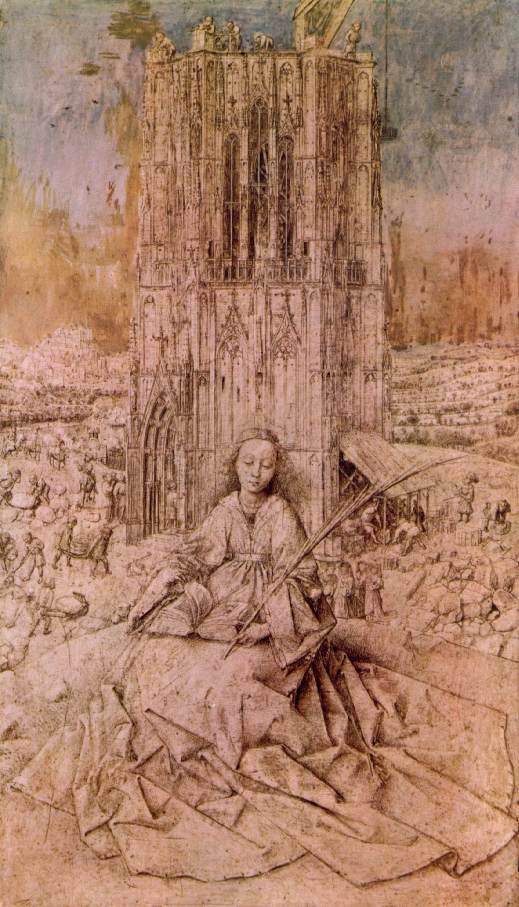
St Barbara in art and architecture


Last year I posted a piece on this her feast day about St Barbara and thought that this year I would share some more images of her they are taken from a post by John Dillon on the Medieval Religion discussion group.

The Great Martyr Barbara
St Barbara
Mid - eighth century
Sant' Maria Antiqua, Rome

Image: icon-art.info


A forceful painting from eleventh century Campania

 Image: cattedrale-calvirisorta


St. Barbara, St. Thomas near Frymburk, about 1380, wooden poly-chromic sculpture, state after restoration, complex restoration by done Stojan Genčev, Company Kotangens s.r.o., Prague, 1997-1998

A relatively recently restored later fourteenth-century (circa 1380) polychromed wooden statue of St Barbara from the church of St. Thomas (Sv. Tomáš) near Frymburk (Český Krumlov dist.)
in the Czech Republic, now in the regional Museum in Český Krumlov following restoration in 1997-8.

Image: encyklopedie.ckrumlov


Statue of St Barbara and her tower c. 1430
 
Image: Bode-Museum Berlin


St Barbara
Tilman Riemanschneider
Bayerisches Nationalmuseum

Image: Wikimedia

Probably the finest later medieval church dedicated to her is the church of St Barbara at Kutna Hora in Bohemia.


The church of St Barbara Kutna Hora

Image:vtourist.com

A mining town it began this great church to the patroness of miners in 1388 but it was not completed until 1905. There is an account of it here. It is of the wonders of later medieval central European gothic architecture and there are some fine photographs of the vaults here.


Saturday, 1 December 2012

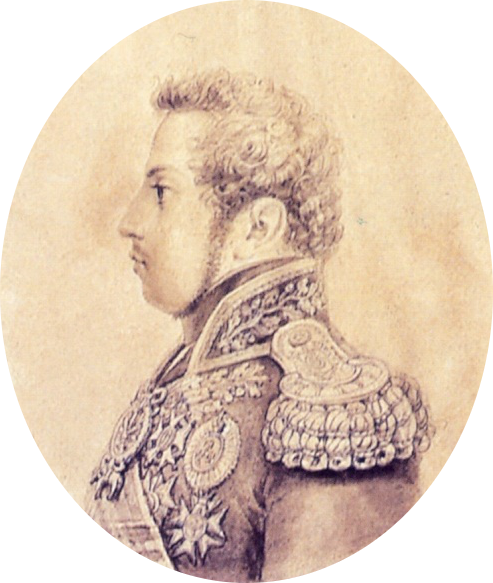
Coronation of Emperor Pedro I of Brazil 1822


Today is the 190th anniversary of the coronation of Dom Pedro I, the first Emperor of Brazil, in 1822.


File:Pedro I Imperador 1823 (crop).png

Emperor Pedro I in 1823

Image: Wikipedia

The Emperor, born in 1798, and the son of King Joao VI of Portugal, was in many ways the architect of Brazilian indepedence, and is still hailed as such. As Regent he had proclaimed Brazil's independence on September 7th 1822, and was acclaimed Emperor on October 12th. In 1826 he was also King Pedro IV of Portugal from March to May in succession to his father before abdicating the throne in favour of his daughter Queen Maria II. In 1831 he abdicated as Emperor in favour of his son Pedro II so as to invade Portugal on behalf of his daughter whose position, and that of the liberal constitionalists was being disputed by Pedro's younger, more traditionalist, brother as King Miguel I. Having secured his daughter's rights he used the title Duke of Braganza, and died in 1834.

There is an illustrated online biography of the Emperor and his remarkable career here.

The crown used for his coronation was made quickly and in 1841 replaced with a new one for the coronation of Emperor Pedro II, as detailed here.

The fact of their being a Brazilian coronation is in itself interesting. The parent monarchy in Portugal had abandoned the ceremony with the accession of King Joao IV in the successful revolt for independence against King Philip III ( IV of Spain ) in 1640. King Joao had then proclaimed the Virgin Mary as Queen of Portugal.

The coronations of both the reigning Emperors of Brazil, and indeed the fact that the present Portuguese crown was made in Rio de Janeiro during the long residence of King Joao VI there as an exile from the Peninsular War, points perhaps to a romantic revival in such ceremonial and an appreciation of its value in the early nineteenth century.

Campion country


Today is the feast day of St Edmund Campion, who was martyred on this day at Tyburn in 1581 along with St Ralph Sherwin and St Alexander Bryant. I posted about St Edmund last year in St Edmund Campion.

Although he was both born in London, in 1540, and died there, it is the area around Oxford which holds many of the most important associations with Campion and with his ministry in 1580-81.

A member of St John's College and then as an Anglican deacon, chosen to deliver one of the addresses of welcome to Queen Elizabeth I on her visit  to the city and university in 1566, he was eventually to return to the area. At Stonor near Henley he had printed his Decem Rationes - probably written at Mount St John in the North Riding of Yorkshire earlier in 1581 - and, with typical panache, left copies of the tract in the pews of St Mary ther Virgin for the commencement service of that summer and was speaking to Oxford students when he was persuaded, fatefully, to return to Lyford Grange in Berkshire that July. His subsequent capture at Lyford was followed by his public parading as a captive to London through Abingdon.


December


Image: Wikipedia

The December calendar page from the Très Riches Heures is attributed to Paul Limbourg. In the foreground is a hunting scene. Judging from the way the dogs are crowding around the quarry it is difficult to know if much will be left for the feasting it may be intended for in the chateau - but perhaps that is just artistic licence.

In the background is the great French royal palace-fortress of Vincennes. this had originated asa  hunting lodge for King Louis VII about 1150 but had become a major royal residence during the thirteenth century. The donjon in the centre of the view was built by King Philip VI in 1337, and is the tallest building of its type in Europe. It was in the donjon that King Henry V was to die in 1422, only a few years after the minature was painted.The towers on the surrounding curtain wall were reduced to the height of the walls with one exception in the early 1800s.

There is more about the history and architercture of the building  to be read at the link Château de Vincennes.