Once I was a clever boy learning the arts of Oxford... is a quotation from the verses written by Bishop Richard Fleming (c.1385-1431) for his tomb in Lincoln Cathedral. Fleming, the founder of Lincoln College in Oxford, is the subject of my research for a D. Phil., and, like me, a son of the West Riding. I have remarked in the past that I have a deeply meaningful on-going relationship with a dead fifteenth century bishop... it was Fleming who, in effect, enabled me to come to Oxford and to learn its arts, and for that I am immensely grateful.


Showing posts with label Queen Elizabeth II. Show all posts

Sunday, 4 June 2017

The Order of the British Empire


Today is the centenary of the foundation by King George V on June 4 1917 of The Most Excellent Order of the British Empire.

Last month the College of Arms web newsletter had an article about the Order and its insignia which the College introduced follows:

Dr Lynsey Darby, College of Arms Archivist, periodically creates online exhibitions from the College archives, which give a good overview of some of the kinds of archival material held here. The most recent addition is an exhibition on The Order of the British Empire and the Order of the Companions of Honour, to mark the centenary of their foundations, which includes a look at a predecessor Hanoverian order, the Royal Guelphic Order.

I adpted her material about the Royal Guelphic Order to produce a separate post last month, but that material can be seen again in Dr Darby's post.

There is another useful illustrated online introduction to the Order from Wikipedia at Order of the British Empire

Both accounts draw attention to that fact that women were admitted alongside men to the Order, but the use of the style of Dame has an older precedent. During the Civil War King Charles I createdat least one lady baronet, Mary Bolles from the West Riding of Yorkshire, and she was thereafter known as Dame Mary Bolles.

It might also be suggested that the Order had a precedent in the The Most Eminent Order of the Indian Empire, founded in 1878 and reorganised in 1887. This had a similar title, not totally disimilar insignia and the riband was similar in colour to that assigned in 1917, but changed in 1937 for the Order of the British Empire. Both had a similar type of recipient. There is more about that Order at Order of the Indian Empire

Queen Elizabeth II wearing the Girls of Great Britain Tiara 

H.M.The Queen in the her robes as Sovereign of the Order of the British Empire

Image:Pinterest/indypendentroyalty.tumblr.com

The present distinctive rose-pink and grey robes and riband were introduced at the suggestion of Queen Mary who became Grand Master of the Order in 1936 as well as the conjoint portraits of King George V and herself rather than the figure of Britannia on the original insignia.


Friday, 12 May 2017

Coronation Day 1937


Today is the eightieth anniversary of the Coronation of King George VI and Queen Elizabeth in 1937.

Image result for george vi coronation

Image: E-Bay


Portrait of H.M. King George VI in Coronation Robes, 1937 (oil on canvas) Queen Elizabeth's father.

Image:Pinterest/bridgemanart.com

http://68.media.tumblr.com/d9b8053b03e1992ae9b11d97ab9cb1e3/tumblr_o7369qLJrY1r65o3qo1_1280.jpg

Image: Tumblr
Image result for george vi coronation

Image: Daily Mail 

The Daily Express article King George VI's coronation: An event filled with mishaps recounts aspects of the day, and the problems involved in such an immensely complex event that turns very much on the actions of a few central participants.

Image result for george vi coronation

Image:gettyimages 


The information service Royal Central has a post, which I have slightly adapted, about the present Queen's diary for that day:

In a diary entry on 12 May 1937, from the then 11-year-old Princess Elizabeth recorded the experience of watching her father’s coronation at Westminster Abbey.

The diary entry opened with the fact that the day saw the young princess awakened at the early hour of 05:00 by the music of the Royal Marines band outside her window. Following an early breakfast, Princess Elizabeth got dressed in a gown of “silk and cream lace” with “little gold bows all the way down the middle” and “puffed sleeves with one little bow in the centre.”

After kissing “mummy” goodbye, the Princess and her younger sister, Princess Margaret, joined other relatives in a carriage heading towards the Abbey. “At first it was very jolty but we soon got used to it.”

Of the service, Elizabeth wrote of how her father looked “very beautiful in a crimson robe and the Cap of State” as he walked down the long aisle. She also noted that “I thought it all very, very wonderful and I expect the Abbey did, too. The arches and beams at the top were covered with a sort of haze of wonder as Papa was crowned, at least I thought so."

The young princess grew tired during the long service, however, noting afterwards that the “inordinately long” ceremony seemed to drag on for hours. She wrote that "at the end, the service got rather boring as it was all prayers" and that she and her grandmother “smiled at each other” in relief when they saw the word “Finis” on the final page.

Following the Coronation, the Royal Family returned to Buckingham Palace where they appeared on the balcony to greet the gathered crowds. The young princess noted that “millions of people were waiting below” on the Mall.

Following tea at 6 pm the tired Princess climbed into bed with legs that “ached terribly”.


Monday, 6 February 2017

Sapphire Jubilee


Today is the sixty-fifth anniversary of the accession of Her Majesty The Queen, and has been termed the Sapphire Jubilee.

The only other monarchs to celebrate a Sapphire Jubilee are King Louis XIV of France, who reigned for 72 years (the longest reign in European history); Emperor Franz Joseph I of Austria, who reigned for very nearly 68 years; Prince Johann II of Lichtenstein, who reigned for 70 years; and the recently-deceased King Bhumibol of Thailand, who reigned for 70 years.

In addition amongst exiled or claimant monarchs there are the King of Romania 1927-30 and since 1940, and Emperor-King Otto of Austria-Hungary for the period 1922-2011.

It is also longer than the claim of King James III and VIII - September 1701 to January 1766


 Image result for Elizabeth Ii Sapphire Jubilee

Image: New York Times

On 6 February 2017, Buckingham Palace re-released an official 2014 portrait of The Queen by David Bailey, wearing the sapphire jewellery which she received from her father, the so-called 'George VI Victorian Suite'. It was a wedding gift from her father, George VI to her on her marriage to Prince Philip of Greece and Denmark in 1947.

A parure is a set of jewellery which normally includes a tiara or diadem; the parure came to true popularity in the 17th century. According to Encyclopaedia Britannica, a parure in around 1700 could mean "earrings, brooch, necklace or clasp, ring and sometimes shoulder brooches or buckles, all set with diamonds" and its design is invariably adaptable, which allows its many component pieces to be reset. Without at least three matching pieces, the suite does not constitute a proper 'parure', and a 'demi-parure' is instead the correct term for a necklace worn alone, together with earrings or a bracelet or brooch. The term 'parure' comes from the French for 'finery' and means 'a set' in the collaborative. The suite of matching jewellery is intended to be worn as an overall ensemble.

The 'George VI Victorian Suite' is part of The Queen's personal jewellery collection and originally was a sapphire and diamond necklace and pendant earrings set. The 'George VI Victorian Suite' is called Victorian, because the stones date from around 1850. It was purchased by George VI from Carrington and Co. The set was altered by Garrards in 1952 to shorten the 18 sapphire cluster necklace by four and again in 1959, so that a pendant could be made from the largest sapphire - however, the suite did not properly become a 'parure' until 1963 when a sapphire and diamond bracelet and tiara were made to match the other pieces. The tiara was made from a necklace that had originally belonged to Princess Louise of Belgium, daughter of King Leopold II of Belgium and wife of Prince Philip of Saxe-Coburg-Gotha.


The Queen also owns the so-called 'Prince Albert Sapphire Brooch', perhaps better known as the 'Queen Victoria's Wedding Brooch' which was gifted by Prince Albert to Queen Victoria the day before their wedding and consisting of a large oblong sapphire surrounded with open-backed diamonds. Queen Victoria wore the brooch on her wedding day, 10 February 1840 - and continued to wear it often until the Prince's death in 1861. Queen Victoria willed the brooch as a Crown heirloom, and the brooch has been worn ever since.

Adapted from a post on the website Royal Central:
 
Queen-Elizabeth-Sapphire-Jewels

The original owner Princess Louise wearing the necklace, the tiara being worn by The Queen and the necklace and earrings given to her by King George VI

Image:the naturalsapphirecomany 

There is more about these particular jewels together with pictures at The Modern Sapphire Tiara
from last year. They and other pieces are also featured in The 10 Most Amazing Royal Sapphire Tiaras Of All Time


Thursday, 19 January 2017

Empress Carlota


Ninety years ago today there occurred the death of the Empress Carlota of Mexico. Born on June 7 1840 Princess Charlotte ( Marie Charlotte Amélie Augustine Victoire Clémentine Léopoldine ) of Belgium she married Archduke Maximilian of Austria, in preference to King Pedro V of Portugal, and when Maximilian accepted the proffer of being Emperor of Mexico in 1864 she became the Empress Carlota.

Their story as rulers of Mexico and its terrible end - a firing squad for Maximilian and insanity for Carlota is well known. There is a biography of her at Carlota of Mexico and at The Mexican Adventure: Empress Carlota of Mexico. That raises the point about the varying state of her mental health in that long widowhood. At its beginning she said she would waut for her husband for sixty years, and more or less she did.

At her death at Meise as the Mad Monarchist pointed out in a blog post her coffin was escorted to burial at Laeken by the few elderly survivors of the Belgian Legion, the Empress Carlota Guards, who had fought for her in Mexico.


Empress Carlota in old age, with her attendants.
The Empress Carlota on her death bed.
 Images: godsandfoolishgrandeur.blogspot.co.uk

That was in 1927 and the events of 1867 must have seemed very remote then to almost everyone except the widowed Empress and her few faithful followers.

However it is worth pointing out that the Empress is not quite as remote a figure as might at first be thought. She was remembered by her great-neice, the late Queen Marie-Jose of Italy, who died in 2001 - and lived at one time in exile in Mexico - as can be read at Marie Jose of Belgium On Her Great-Aunt Empress Carlota of Mexico

When the Empress died it was in the lifetime of her first cousin four times removed, who had been born the previous year, and is now Queen Elizabeth II, and the Empress' great great great nephew is the present King of the Belgians.


Friday, 14 October 2016

Battle of Hastings 950


Today is the 950th anniversary of the Battle of Hastings. This was arguably the most important event in English - and by extension British/UK  - history in the last thousand years. I posted something about the victor in 2012 at William the Conqueror

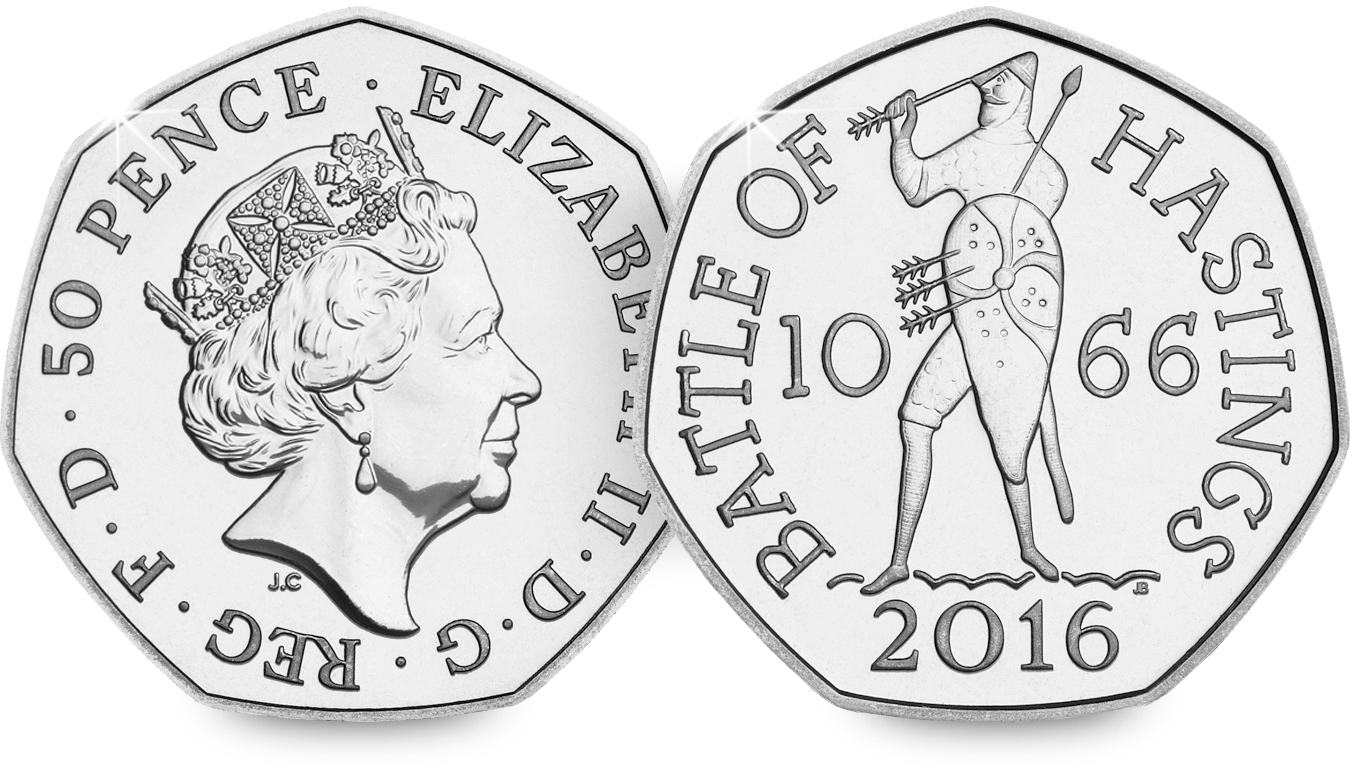
The anniversary is being commemorated on the latest 50pence piece with the figure, traditionally assumed to be King Harold II, on the reverse.

 Image result for Hastings commemorative coin

Image: changechecker.org

Guernsey has issued a £5 coin to mark the occasion - and as the Channel Islanders are wont to do may be seen as their celebration of 'their' conquest of Engalnd.
 Image result for Hastings commemorative coin

Image: The Westmister Collectyion 

The coins have the portrait of The Queen, who is, of course, descended from both King Harold II and King William I as Montcrieff and Pottinger pointed out in Blood Royal many years ago - Queen Philippa of Hainault was descended from King Harold, so all descendents of her and her husband King Edward III share this joint ancestry.


Sunday, 12 June 2016

The Queen at 90


This weekend has seen the culmination of The Queen's Ninetieth Birthday celebrations both nationally and locally. Here in Oxford at the Oratory we had a street partry - indoors in the Parish Centre because of the doubtful weather - together with our friends and neighbiours from St Giles Amnglican church across Woodstock Road. This was a very happy and enjoyable occasion with bunting and decorations as well as plenty to eat and drink.

The historian in me falls to reflecting that ninety is not only a great achievement as an age for Her Majesty - and she seems to thrive in her present situation - but it is also a bridge to a past world.  When the Queen was born in April 1926 the Great War was not yet eight years over, and its upheavels but ill-digested. Three of Queen Victoria's children were still alive, all of whom she was to know.

Kaiser Wilhelm II was living in exile at Doorn the guest of Queen Wilhelmina, King Alfonso XIII of Spain and King Ferdinand I of Romania still reigned, "Foxy" Ferdinand of Bulgaria was an exile in his native Germany, King Manuel II of Portugal and his Queen lived in Twickenham, the year before Queen Maria Sophia of The Two Sicilies ( sister of the Empress Elisabeth) had died in Munich and lost to reality in Laeken the infant Priness Elizabeth of York's first cousin four times removed the Empress Charlotte of Mexico still lived in the time when she and Emperor Maximillian had gone out to the New World - she was to finally die the following year.

Ninety years is a long time and these ninety have seen more than many others might appear to have - but we live in an era of mass information - but it is sobering to see how much The Queen's life has spanned in terms of her fellow monarchs, let alone the lives and histories of their subjects.


Monday, 6 June 2016

The Loch Ness Monster - by Royal Appointment?


The Daily Telegraph had an interesting little story the other day as to how the Loch Ness Monster was nearly named after The Queen.

According to a new book scientists wanted to name the Monster after The Queen to aid its survival as an endagered species but she politely declined, warning the choice would be ‘most regrettable’ if Nessie turned out to be a hoax. The somewhat eccesntric story can be read here.


Thursday, 21 April 2016

The Queen at 90


Today is the 90th birthday of H.M.The Queen and this post is a way of expressing my loyal greetings and good wishes to Her Majesty on this notable personal as well as historic occasion. The main public celebrations are scheduled for the Sovereign's Official Birthday in June, but this year the actual anniversary is attracting, understandably, more attention than usual.

Thursday, 24 March 2016

Royal Maundy


The BBC news website has an illustrated report about The Queen marking Maundy Thursday with the traditional service and distribution of the Maundy money at St George's Chapel in Winsdor Castle.  Commemorative coins were included in the other Maundy purse - the money given in lieu of provisions and the Queen's Gown redemption money - to 90 men and 90 women, each representing one of her 90 years.


The report can be viewed at  http://www.bbc.co.uk/news/uk-35890750

Friday, 18 March 2016

Emperor Nicholas II's Royal Victorian Chain


The Special Correspondent sent me the following link about the loan by The Queen to the Kremlin museums of the rediscovered Royal Victorian Chain which King Edward VII had bestowed upon Emperor Nicholas II. The story can be viewed at http://royalcentral.co.uk/uk/thequeen/queen-elizabeths-gift-to-the-moscow-kremlin-museums-57930

The survival of the decoration outside the state collections in post-1917 Russia raises intruiging questions as to who rescued it and how it reappeared.


Wednesday, 9 September 2015

A Royal milestone


Today, at about 5.30 this afternoon, Her Majesty The Queen became the longest reigning British monarch.

The Special Correspondent sent me the link about calculating the exact time when the current reign would break the previous record and which can be seen at http://www.macleans.ca/society/crown-calculus-the-math-behind-queen-victorias-record-reign/

The BBC News website has acomparison of the two longest reigns in  Queen Elizabeth II: Elizabeth and Victoria in numbers

The Daily Telegraph has an illustrated account of the day's events which can be seen at Queen Elizabeth II becomes longest-reigning monarch on a day of characteristic modesty

Now I know Jacobites will, of course, cite the longer de jure reign of King James III and VIII from 1701 -1766. However Princess Philip of the Hellenes, as some Jacobites regard Queen Elizabeth II, will outstrip that in 2016 on May 21st if my rough calculation is right.

Long may she reign ! 


Monday, 20 July 2015

Silly Season Nastiness


As far as the Royal family are concerned the Silly Season in the media appears to have started early and nastily. First we had the Sun with its fragment of film from over eighty years ago of the present Queen, her mother and sister making what appear to be a Fascist salute at the encouraging of her uncle, the then Prince of Wales.

Today there are reports that Channel 4 ( no real surprise there) has a programme in the offing about Prince Philip's sisters, their marriages and life in Germany between 1933 and 1945, including comments made at the time that indicate a less than totally hostile view of the Third Reich.

Home movies are an opportunity for anyone - royal or non-royal, now as eight years ago - to do silly things in front of the camera, assuming it is not going to be made public, eight decades later, and to, in all probability, privately make fun of others in the public eye.

I am not surprised that the Queen is reported to be "livid" about these reports.

King Edward VIII may well have had an interest in what was happening in Germany. Like many others, including Lloyd George and Churchill, and some of his German cousins, he may well have thought in the 1930s National Socialism offered a way of recovery for the country, especially given growing doubts about the wisdom or fairness of the Treaty of Versailles.

Furthermore we can see that in the inter-war period, with no ability on the part of anyone to foresee, indeed to imagine, the horrors that were to come, the alternatives facing much of Europe - Soviet Communism or one of the variants on Fascism - attracted not a few devotees who later thought better of their enthusiasms. Pluralist government under the rule of law looked an uncertain survivor, and to be challenged from both left and right.

That as Duke of Windsor he retained some links with representatives of National Socialism is known as is the fact that he was slow to end them. In part this may have been that he was flattered to be entertained with his new wife by the Nazi regime late in 1937. In this the cause may partly be that his father King George V, doubtful of his heir's abilities, did not involve him or initiate him into public business before his death. After the abdication the Duke of Windsor appears to have been left without a "minder" to inform and advise him, but relied on a rather odd coterie of old and new friends with often freakish and ill-considered ideas.

I suspect there is a somewhat sinister hidden agenda in the Sun story aimed at the present Prince of Wales. Just as King Edward VIII had regrettable in hindsight contacts with German leaders in the 1930s, so his great-nephew's contact with environmentalists and Muslims can be represented as dangerous, and the attempt made to set him aside in favour of his son, somewhat on the lines of the 1936 Abdication -itself often interpreted as providential. I am sure such nonsense will not succeed ( it is worthy of some of the daft ideas emanating from some of the Duke of Windsor's so-called friends) but if it is there, as I suspect it may be, it is an unpleasant thought.


Friday, 24 April 2015

The Queen and the Order of Australia


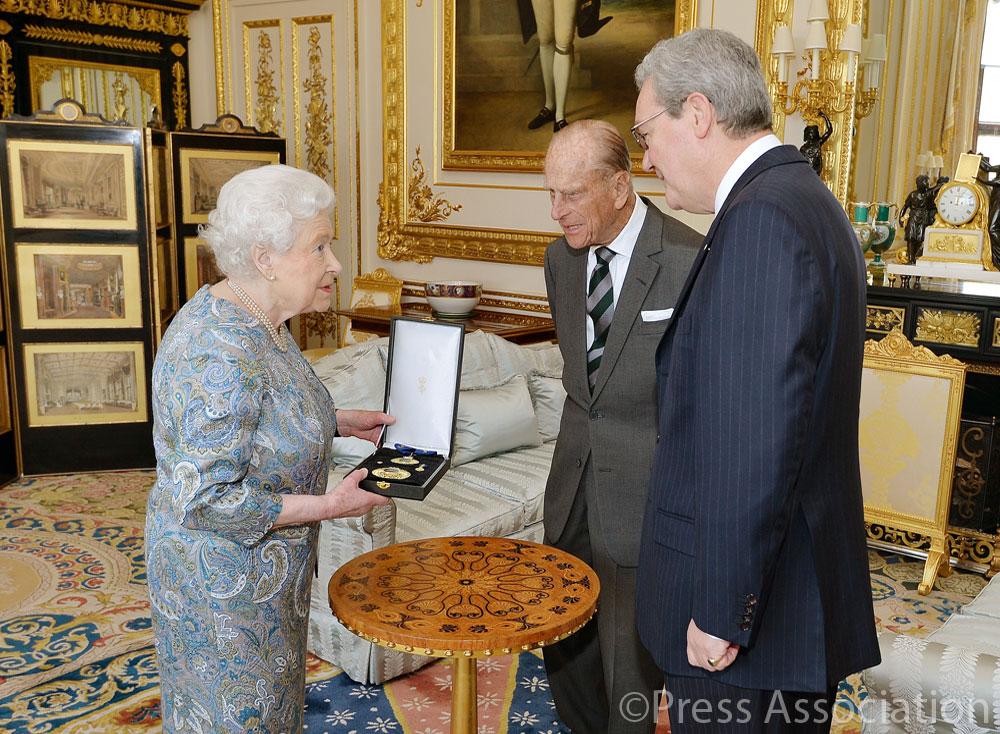
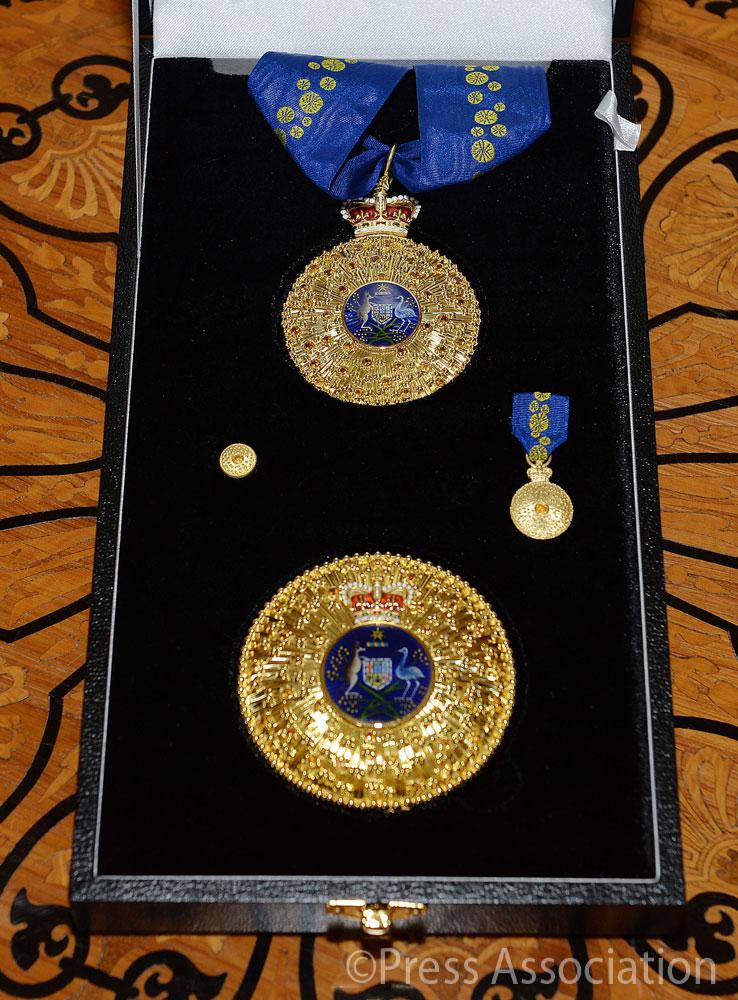
Both the Special Correspondent and the BBC News website had picked up the story of H.M. The Queen investing Prince Philip with his Knighthood of the Order of Australia the other day. The illustrated BBC report can be seen at Queen presents Prince Philip with Australian knighthood.

This - typically one might add - efers to the controversy the appointment raised in Australia. I cannot see why such an award should do so - it is, after all, the norm for the Monarch or head of state and their family to hold or be awarded national honours. I wonder if the furore has more to do not only with the rather languishing (as I understand it) Australian republican tradition but also with political rivalries and kealousies arounf Tony Abbott who as Australian Prime minister make no secret of his strong support for the monarchy.


The insignia of a Knight of the Order of Australia
 
Images:twitter.com/British Monarchy/ & Press Association


Tuesday, 21 April 2015

Happy Birthday Ma'am

Today is the 89th birthday of Her Majesty The Queen, and this post is to express my loyal greetings and warmest good wishes for the anniversary.

Wednesday, 4 March 2015

The Queen's Commonwealth Orders


One of my regular correspondents - indeed he might be described as in  the old Daily Telegraph style as a Special Correspondent for this blog - sent me the link to the Royal Collection website and this gallery of the Queen’s Commonwealth Orders:


The site is interactive, so simply click on the individual images of the insignia to get more information about each Order.

As my friend points out what is particularly interesting about it is that it shows the ‘crown jewels’ of some of the Queen’s other realms; namely the Sovereign’s insignia of the Antiguan Order of the Nation, the Order of Australia, the Order of Canada and the Canadian Order of Military Merit, the Order of New Zealand and the New Zealand Queen’s Service Order, and the Papua New Guinean Order of Logohu.

Saturday, 28 February 2015

Good news from Canada


I see from the BBC website that the Supreme Court of Canada has upheld the traditional Oath of Allegiance to the Queen for those taking up Canadian citizenship. This is clearly good news, and looks to be a case of finding a few - in this case three - of the usual sort of malcontents to create a case so as to change the established law. This time, happily, it has not worked. 


The Arms of H.M.The Queen in Right of Canada

Image: Wikipedia

There is information about the coat of arms at Arms of Canada

Friday, 6 February 2015

Accession Day


Today is the sixty third anniversary of H.M.The Queen ascending the throne in 1952, and it is an ideal opportunity to express loyal good wishes to the Sovereign.

As we enter 64 Elizabeth II we are also reminded that by early September The Queen will have reigned longer than her great great grandmother Queen Victoria. Within a year of that she will have also exceeded the putative reign of the Jacobite King James III and VIII.

Long may she reign!


Wednesday, 24 September 2014

You stupid boy


I think some of my friends did not agree with my describing the Prime Minister as an idiot in my post The Scottish Crisis about the risk of the break-up of the United Kingdom if Scotland voted to secede, and about his part in creating the situation as it was at that point.

Happily that possibility has not materialised, but now as if to prove my point, we have the almighty gaffe from Mr Cameron of telling an American - a rebel colonial indeed - and, moreover, being picked by a microphone in so doing, what he claimed The Queen had said to him over the telephone. This is after the care shown by Her Majesty to avoid being drawn into the political debate, as I commented upon in The Queen's message to Scotland. The Daily Telegraph has a report on the story at David Cameron: Queen 'purred' down line over Scottish Independence vote and their cartoonist Matt has his own take on the incident:


'It's Prince Philip for you, Prime Minister. He's not purring...'

Image:Matt in the Daily Telegraph


As Captain Mainwaring would have said to Private Pike, "You stupid boy."


Friday, 19 September 2014

The Queen's message to Scotland


The Honours of Scotland
© Crown copyright Reproduced courtesy of Historic Scotland/bestofedinburgh.com
 
The Queen has issued a statement following the Scottish referendum in which voters rejected independence by 2,001,926 votes to 1,617,989 on Thursday.
In the statement Her Majesty says: 
"After many months of discussion, debate, and careful thought, we now know the outcome of the referendum, and it is a result that all of us throughout the United Kingdom will respect.

"For many in Scotland and elsewhere today, there will be strong feelings and contrasting emotions - among family, friends and neighbours.

 "That, of course, is the nature of the robust democratic tradition we enjoy in this country. But I have no doubt that these emotions will be tempered by an understanding of the feelings of others."

"Now, as we move forward, we should remember that despite the range of views that have been expressed, we have in common an enduring love of Scotland, which is one of the things that helps to unite us all.

"Knowing the people of Scotland as I do, I have no doubt that Scots, like others throughout the United Kingdom, are able to express strongly-held opinions before coming together again in a spirit of mutual respect and support, to work constructively for the future of Scotland and indeed all parts of this country.

"My family and I will do all we can to help and support you in this important task."
Last week, after various press reports claimed the Queen was growing increasingly concerned about Scotland breaking away, and some MPs -  doubtless unwisely - urged her to intervene publicly, Buckingham Palace issued a clear statement maintaining that she was above politics:

"Any suggestion that the Queen would wish to influence the outcome of the current referendum campaign is categorically wrong. Her Majesty is simply of the view this is a matter for the people of Scotland," the Palace said. Commentators noted this statement as particularly emphatic.
 Last Sunday on leaving Crathie Kirk near Balmoral the Queen did however comment to the extent of saying that she hoped voters would think very carefully about the issues involved. Dressed in the shade of green often associoated wirth royal ceremonial in Scotland that was was all Her Majesty said - politically neutral but pointing to the importance of the decision. As was pointed out on the BBC Radio 4 coverage of the referendum in the small hours of this morning the comment at Crathie was carefully orchestrated, with the press allowed close to the group of well wishers outside the church and hence the opportunity to get the Royal message heard. Skillful and understated - the essence of the Queen's exercise of her office.
 

Monday, 12 May 2014

Ceremonial of the Order of the Bath


Last week the news that The Queen had delegated a part of the ceremonial at the service of the Order of the Bath - the Offering - to the Prince of Wales as Great Master of the Order led to more media coverage of the ceremony than might otherwise have happened. That Her Majesty at 88 might be advised to save herself a potentially awkward move down steep steps in evening dress and the robes of the Order from her stall to the altar and back is, in itself, no very great surprise.

There is in a sense more interest in both the interest this has caused as a news story, and in the fact that images of the ceremonies of the Order are readily available online.


Order of the Bath

The Queen arrives at Westminster Abbey for the service

Image BBC/Getty images


Last Saturday's Daily Telegraph has good coverage in Queen drops out of ceremonial role over concerns about steep steps and the BBC website, which can be seen here also features archive images.


photo

The Prince of Wales as Great Master of the Order presents the Offering during the service

Image: The British Monarchy on Flickr

There is an online history of the Order, its insignia and officers at Order of the Bath.