Once I was a clever boy learning the arts of Oxford... is a quotation from the verses written by Bishop Richard Fleming (c.1385-1431) for his tomb in Lincoln Cathedral. Fleming, the founder of Lincoln College in Oxford, is the subject of my research for a D. Phil., and, like me, a son of the West Riding. I have remarked in the past that I have a deeply meaningful on-going relationship with a dead fifteenth century bishop... it was Fleming who, in effect, enabled me to come to Oxford and to learn its arts, and for that I am immensely grateful.


Showing posts with label Scottish monarchy. Show all posts

Saturday, 10 December 2016

Face to face with King Robert I


By chance the other day I found this article about the latest work in facial reconstruction on the skull of King Robert I of Scots:

https://uk.yahoo.com/news/heres-what-robert-the-bruces-face-would-have-looked-like-thanks-to-science-140441526.html

A reconstruction of the face of Robert The Bruce

The King's scull and the reconstruction

Image: University of Glasgow/Daily Telegraph

The information site Royal Central has the following post about the research:

A new reconstruction of Robert the Bruce’s face shows that the medieval King of Scots suffered from leprosy.
The reconstruction, a joint project between the University of Glasgow and Liverpool John Moores University, determined that due to the disfigured jaw and nose, it was extremely likely that the legendary warrior-king suffered from the ailment.
Professor Caroline Wilkinson, the director of the Face Lab at Liverpool John Moores University, told The Daily Telegraph that two versions of Robert the Bruce’s face were constructed – one without leprosy and one with mild leprosy.
“We could accurately establish the muscle formation from the positions of the skull bones to determine the shape and structure of the face,” Wilkinson said.
Regarding whether the King suffered from leprosy, she said, “He may have had leprosy, but if he did it is likely that it did not manifest strongly on his face.”
Professor Wilkinson also reconstructed the face of Richard III after his remains were found under a car park in Leicester.
No visual depictions exist of Robert the Bruce, and no written accounts include a description of his appearance. Professor Wilkinson says the team relied on “statistical evaluation to determine that Robert the Bruce most likely had brown hair and light brown eyes.”
Robert the Bruce reigned from 25 March 1309 to 7 June 1329 and led Scotland in the First Scottish War of Independence. He is best known as a warrior-king, having launched campaigns in Scotland, England, and Ireland. He defeated Edward II’s armies in 1314.
The cause of Robert the Bruce’s death is uncertain, but the rumour has spread in the ensuing centuries that he suffered from leprosy. Records from his reign show that he suffered from a mystery illness several times, but it is never named.
Historians and experts at the Robert the Bruce Heritage Centre say it would have been impossible for him to attend to his regular duties if he’d suffered from leprosy. Today, leprosy – or Hansen’s Disease – is a rare and treatable infection that can be cured with a multidrug therapy treatment.
Robert the Bruce’s tomb was discovered on 17 February 1818, when workmen broke through the ground on the site of Dunfermline Abbey in Scotland and uncovered a vault. Inside, a decaying oak coffin was found, and once opened, researchers found the body encased in lead. It was later removed from the lead and inspected, and researchers discovered that the skeleton measured 5 feet 11 inches, and the sternum had been sawn to allow the heart to be removed and buried separately – a common practice at the time.
A plaster cast of the King’s skull was taken to the Royal College of Surgeon’s Hunterian Museum, and several reconstructions have taken place since then.
His coffin was reinterred on 5 November 1819, placed into a new lead coffin to preserve the remains.
Dr Martin MacGregor led the project. Dr MacGregor, a senior lecturer at the University of Glasgow, says he was inspired by the reconstruction of Richard III’s face and wanted to apply the methods to Robert the Bruce.
“The case of Richard III revealed how far the technology had advanced and I saw an opportunity to apply the technology to the Hunterian skull held here at Glasgow.”

Yesterday's Daily Telegraph had an illustrated article about the project which supplies additional historical and scientific information and which can be seen at  http://www.telegraph.co.uk/science/2016/12/08/face-robert-bruce-reconstructed-showing-scottish-king-had-leprosy/

Thursday, 4 December 2014

King William the Lion


Today is the 800th anniversary of the death at Stirling of King William I of Scots - probably better known as William the Lion - in 1214. Born circa 1142 he had been King of Scots for almost forty nine years, having succeeded his brother King Malcolm IV in 1165. His son and successor, the sixteen year old King Alexander II, was enthroned and crowned at Scone on December 6th.

There is an online account of him here and the British Monarchy website has a biography of him here.

The Oxford Dictionary of National Biography life by W.W.Scott can be read at William I. In it he emerges as an energetic and capable monarch, operating in the traditions of his grandfather King David I.


The Great Seal of King William I

Images:mernick.co.uk

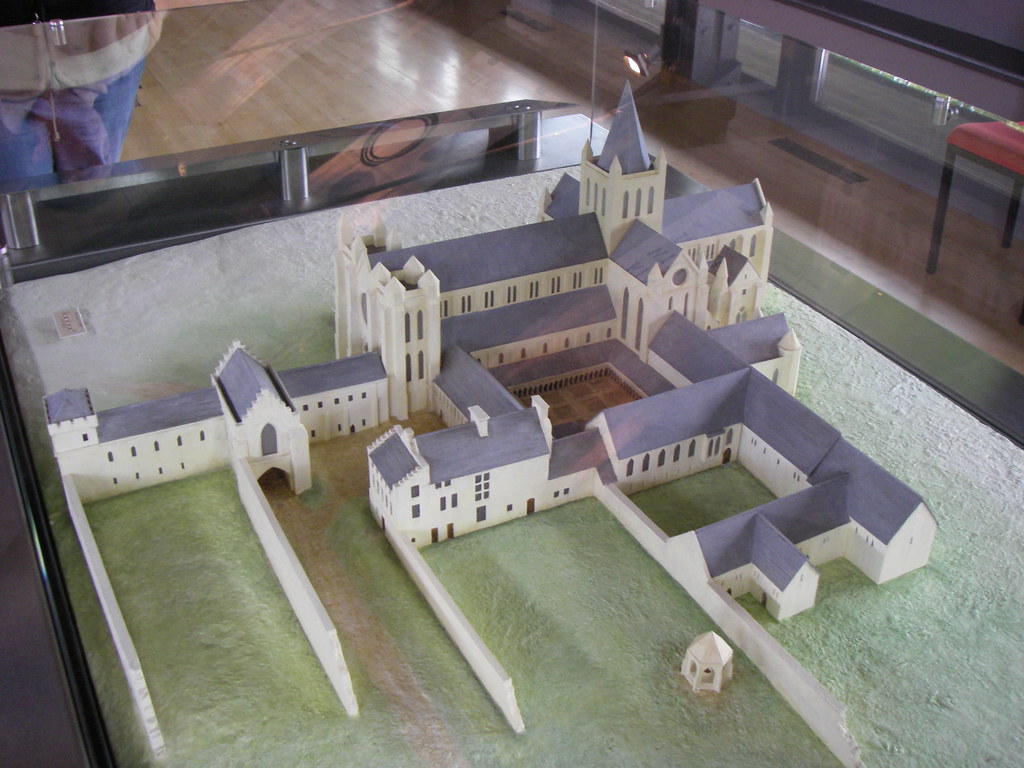
King William had founded the Tironensian abbey of St Thomas of Canterbury at Arbroath in 1178, about which there is an introduction to its history and remains here, and it was there that he was buried on December 10th.

photo

Model of Arbroath Abbey

Image Christine Barnes on Flickr


The remains of Arbroath Abbey*
The King was buried before the High Altar

Image:rcahms.gov.uk

* This photograph from the Royal Commission on Ancient and Historic Monuments for Scotland was published like this on their website. It is in fact in reverse, but still gives an idea of the total remains - and near total wreck - of the abbey. Hence I have included it. Blame RCAHMS, not the Clever Boy.


Arbroath Abbey 2 

The remains of the west front of the abbey

Image:bikearoundbritain.com

Arbroath Abbey: Arboath Abbey


View along the nave of Arbroath Abbey

Image:tripadvisor.com

What is believed to be the effigy from his tomb has been recovered on the site and can be seen in the museum there. It dates from the fourteenth century and is, alas, missing its head. There is an online article about it, complete with photographs, at Lion hunt: a royal tomb-effigy at Arbroath Abbey

 
Drawing showing effigies of Bishop Paniter and William the Lion, Arbroath Abbey. SC848136 Copyright RCAHMS

 The effigies of Bishop Paniter and King William I from Arbroath Abbey

Image:canmore.rcahms.gov.uk

His successor King Alexander II reigned until 1249. There is an online biography of him here, and the Oxford DNB life of him, by Keith Stringer, can be read at Alexander II. It is clear from that life that King Alexander continued policies based on those of his father, proving to be an energetic monarch, consolidating his realm and his authority over it.


Friday, 19 September 2014

The Queen's message to Scotland


The Honours of Scotland
© Crown copyright Reproduced courtesy of Historic Scotland/bestofedinburgh.com
 
The Queen has issued a statement following the Scottish referendum in which voters rejected independence by 2,001,926 votes to 1,617,989 on Thursday.
In the statement Her Majesty says: 
"After many months of discussion, debate, and careful thought, we now know the outcome of the referendum, and it is a result that all of us throughout the United Kingdom will respect.

"For many in Scotland and elsewhere today, there will be strong feelings and contrasting emotions - among family, friends and neighbours.

 "That, of course, is the nature of the robust democratic tradition we enjoy in this country. But I have no doubt that these emotions will be tempered by an understanding of the feelings of others."

"Now, as we move forward, we should remember that despite the range of views that have been expressed, we have in common an enduring love of Scotland, which is one of the things that helps to unite us all.

"Knowing the people of Scotland as I do, I have no doubt that Scots, like others throughout the United Kingdom, are able to express strongly-held opinions before coming together again in a spirit of mutual respect and support, to work constructively for the future of Scotland and indeed all parts of this country.

"My family and I will do all we can to help and support you in this important task."
Last week, after various press reports claimed the Queen was growing increasingly concerned about Scotland breaking away, and some MPs -  doubtless unwisely - urged her to intervene publicly, Buckingham Palace issued a clear statement maintaining that she was above politics:

"Any suggestion that the Queen would wish to influence the outcome of the current referendum campaign is categorically wrong. Her Majesty is simply of the view this is a matter for the people of Scotland," the Palace said. Commentators noted this statement as particularly emphatic.
 Last Sunday on leaving Crathie Kirk near Balmoral the Queen did however comment to the extent of saying that she hoped voters would think very carefully about the issues involved. Dressed in the shade of green often associoated wirth royal ceremonial in Scotland that was was all Her Majesty said - politically neutral but pointing to the importance of the decision. As was pointed out on the BBC Radio 4 coverage of the referendum in the small hours of this morning the comment at Crathie was carefully orchestrated, with the press allowed close to the group of well wishers outside the church and hence the opportunity to get the Royal message heard. Skillful and understated - the essence of the Queen's exercise of her office.
 

Tuesday, 18 June 2013

The Scottish Coronation in 1633


Today is the 380th anniversary of the coronation of King Charles I as King of Scots at Holyrood in 1633.

File:Charles I in 1633.jpg

King Charles I in 1633
The print commemorates the Coronation
Image: Wikimedia


Holyrood Palace in the early seventeenth century.
A drawing by James Gordon of Rothiemay about 1649

Image:Wikipedia


This was the first coronation in Scotland since that of King James VI in 1567, and as with the coronations of King James V and Queen Mary I, had been that of an infant. Not since that of James IV in 1488, at the age of 16, had there been the coronation of near adult, and before that it was that of King James I in 1424 which had last seen an adult ritually receive the Honours of Scotland. Probably for these reasons the King appointed acommission to research the rite, and this is a major source for our knowledge of the Scottish ceremony. Only once since has there been a Scottish coronation - that of King Charles II in 1651 - and were, as is, I think to be desired, there to be a restoration of the ceremony and as discussed here in the context of possible independence, the 1633 report would be an important source.

The 1513 and 1543 ceremonies had taken place in the Chapel Royal at Stirling and that of 1567 in the parish church of the Holy Rood there. The abbey of Scone, traditional place of coronations up to 1424, had been destroyed, and for this occasion the ceremonial was located in the remains of Holyrood abbey, which had seen the coronation of King James II in 1437.

All that remained of the abbey was the nave, the remainder of the church having been demolished in 1570, and the structure was now restored for the occasion.


z-7166.jpg

The interior of the Chapel Royal in the late seventeenth century

Image:leithhistory.co.uk

Further renovated by King James VIi to act as the Chapel of the Order of the Thistle in 1687 it was sacked by the edinburgh mob in the following year during the revolution and was left in decay. In 1768 the vault collapsed, reducing it to ruins:


The interior of the Chapel Royal today

  Image:Wikipedia

A late nineteenth century plan to restore it for the Thistle Chapel was deemed impractical, and the new Chapel of the Order added to St Giles Cathedral in the centre of the city. Incidentally it was on this visit to Scotland that King Charles  establsihed the new diocese of Edinburgh with St Giles as its cathedral.

The service was an opportunity to show liturgical ideas in accord with the ideas of Bishop William L aud of London who accompanied the King on his journey, and the episcopal genuflections in the service caused raised eyebrows, and indeed raised ire amongst the more Presbyterian of the King's subjects.

The principal officiant was Archbishop John Spottiswoode of St Andrews, of whom there is a biography here. The Oxford DNB life of him by A.S.W.Pearce can be seen here.


Archbishop Spottiswood, Lord High Chancellor


Archbishop John Spottiswoode of St Andrews

Image: scottish-places.info

For the ceremony the King wore the mantle of King James IV - as with other realms then and now such state vesture can have along life.

The text of the Coronation Oath sworn by Kings of Scots from King James VI onwards was approved by the Scottish Parliament  in 1567:
I, N.N., promise faithfully, in the presence of the eternal, my God, that I, enduring the whole Course of my Life, shall serve the same Eternal, my God, to the utmost of my Power, accordingly as he required in his most Holy Word, revealed and contained in the New and Old Testament; and according to the same Word shall maintain the true Religion of Jesus Christ, the preaching of his Holy Word, and due and right administration of his Sacraments, now received and practised within this Realm; and shall abolish and oppose all false Religion contrary to the same; and shall rule the People committed to my Charge, according to the Will and Command of God, revealed in his foresaid Word, and according to the lovable Laws and Constitutions received in this Realm, in no way repugnant to the said Word of the Eternal, my God; and shall procure to my utmost to the Kirk of God and whole Christian people true and perfect Peace in all times coming; the Rights and Rents, with all just privileges of the Crown of Scotland, I shall preserve and keep inviolate, neither shall I transfer nor alienate the same; I shall forbid and repress in all Estates and all Degrees theft, Oppression and all kind of Wrong; in all Judgements, I shall command and procure that Justice and Equity be kept to all creatures without exception, as he be merciful to me and you that is the Lord and Father of all Mercies; and out of all my lands and empire I shall be careful to root out all Heresy and Enemies to the true Worship of God, that shall be convicted by the true Kirk of God of the foresaid Crimes; and these Things above-written I faithfully affirm by my solemn Oath.
A later version was introduced in 1689.

A new ampulla for the oil of anointing was made for the occasion - it can be seen today in the National Museum of Scotland in Edinburgh:

Gold ampulla

The gold ampulla which held the anointing oil for King Charles I at his 1633 Scottish coronation

Image: homesand property.co.uk

Scottish monarchs had been anointed since 1329 following a grant of the right to King Robert I for his successors by Pope John XXII in that year.

The regalia used were the Honours of Scotland as still to be seen in the Crown Room at Edinburgh Castle, and about which there is an article here.


http://graphics.stanford.edu/~bjohanso/england/edinburgh/honours.jpg

The Honours of Scotland

Image: graphics.stanford.edu

The Coronation was also marked by the issue of commemorative medals by the King's favoured medallist, Nicholas Briot:

Charles I, Scottish Coronation 1633, silver medal by Nicholas Briot

Coronation medal by Nicholas Briot

Image:charlesriley.co.uk


Several buildings erected in that Coronation year record in their plasterwork national symbols and the number of monarchs since the establishment of the monarchy by King Fergus I in the fourth century BC.
As part of the 1633 celebrations portraits of 107 kings were displayed, some of which (by George Jamesone) survive. There is more about this legendary history here.

Tuesday, 11 June 2013

The death of King James III


Today is the 525th anniversary of the battle of Sauchieburn and the murder of King James III of Scots in 1488.


http://www.englishmonarchs.co.uk/images/stewart/james_iii_james_iv.jpg

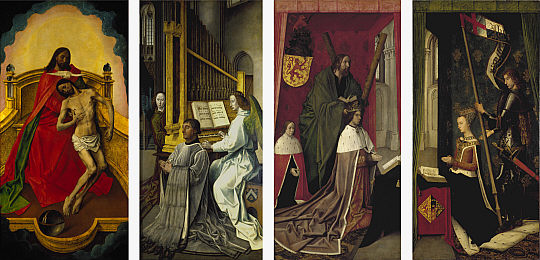
The portrait of the King from the Trinity altarpiece

Image:englishmonarchs.co.uk

This is the largest  copy I can find on the internet of this really wonderful portrait - it does not do it justice. The portrait of the King and of his Queen is hauntingly beautiful, and that may have raised my awareness of the King and his reign when I first saw it, many years ago, reproduced in Gordon Donaldson's Scottish Monarchs. In not a few ways King James III is reminiscent of King Richard II, and perhaps also King Edward II, in fourteenth century England. Tensions within the royal house and with the nobility and a strong sense of their independent royal authority led all three kings to their violent downfall.  Anthony Tuck's telling point in Richard II and the English Nobility that the deposition and violent death of two English kings in the fourteenth century points to the strength of the English crown - the only wayt to restrain the monarch was to remove him - applies also in fifteenth century Scotland - hence the fate sof Kings James I and III, and indeed the military deaths on campaign of Kings James II and IV indicate the risks they were willing to undertake in campaigns against their more powerful southern neighbour.

There are introductions to his life and reign here and here. The biography by Norman Macdougall from the recent Oxford DNB can be read here and there is an illustrated online account which appears to be influenced by Macdougall's account here.
Neither of these are especially not favourable to view that the King was a considerable patron of the arts, pointing to what few actual references or examoples there are, and to others as the patrons. Nonetheless such things as do survive from the reign do show what it was possible to see in the Scotland of the late fifteenth century - a pre-Reformation, pre-Calvinist Scotland that is far more difficult to imagine than pre-Reformation England at time because so little survives. Supreme amongst these survivals is the Trinity Altarpiece by Hugo van der Goes, part of the Royal Collection and now on display in the National gallery of Scotland in Edinburg, which was probably not commissioned by the King, although it contains his portrait and that of his Queen and of his son. Given that the panels were painted for the Trinity College Kirk was founded by the King's mother and was her burial place it seems likely that at very least the King was aware of the paintings.


The Trinity Altarpiece

Image:Wikipedia/National allery of Scotland

My own sense, and it is an instinct rather than based on any detailed study of the subject and period, is that modern historians may, if only becaus e of the paucity of surviving evidence, not be giving King James sufficient credit for such artistic patronage as there was. It would not be unreasonable to imahine taht he had some say in the currency produced in his later years, including the gold Unicorn and the first conciously representational potrait of a monarch from either of the realms that made up Britain on the silver groats:


Obverse (front) and reverse

Gold Unicorn of 1484-88 (enlarged)

Image:British Museum

http://www.aberdeenquest.com/web/MultimediaFiles/MS011936.JPG
Groat from the later years of the reign 

Image:aberdeenquest.com

In his later years the King was deemed avaricious, and a detailed inventory of his treasure survives - amongst the pieces was a collar whose design of thistles and rue [Andrew] became the pattern for that of the Order of the Thistle - unless one subscribes to the older view that King James III was indeed the founder of the Order; that view is rather discounted by modern historians, but the collar design is clearly recorded.


http://www.undiscoveredscotland.co.uk/stirling/cambuskenneth/images/abbey-450.jpg

The tomb of King James III and Queen Margaret in the ruins of Cambuskenneth Abbey

Image: undiscoveredscotland.co.uk

King James III was killed at or after the battle of Sauchie[burn], to the east of Cambuskenneth. His body was taken to Cambuskenneth abbey for burial. He was interred in front of the high altar alongside his queen, Margaret of Denmark, who had died two years earlier. Bones thought to be the remains of the King and Queen were excavated in 1864 and re-interred, at Queen Victoria’s command, under a stone monument within the choir.


Tuesday, 22 February 2011

King David II


Today is the 640th anniversary of the unexpected death at the age of 46 of King David II of Scots in 1371, an event which brought to the throne the Stewart family in the person of his nephew King Robert II. There is an illustrated online biography of King David here. A much fuller critical biography and assessment by Bruce Webster in the Oxford DNB can be read here and provides an excellent account of his life and reign.

That life and reign, with its pattern of minority and regency, upbringing abroad and english invasion and domination, not to mention personal and marital difficulties was typical of most Scottish monarchs until the accession of King James VI to the English throne in 1603. What is almost more remarkable is the achievement of the Scottish monarchy in retaining and consolidating its hold on the country. Historians today are, as Webster indicates more inclined to a positive view of his achievements as monarch than was the case in the past, notably in the eighteenth and nineteenth centuries

The illuminated initial of him with his brother-in-law King Edward III reproduced below has always struck me as more than usually insightful for such a piece. It is not only elegant, but manages to convey the Scottish King's discomfiture in the presence of the seemingly more urbane and successful English King, of whom he was a prisoner. King David looks somehow rather dowdy by comparison with the more fashionably attired King Edward.
David II with Edward III

King David II and King Edward III after the battle of Neville's Cross, 1346.
Each king is surmounted by his Coat of Arms
© British Library

Image: royal.gov.uk


On his Great Seal King David II does look more confidently regal:

News Photo: royal seal from 1329 depicting David II King…

Image: Getty images.com