Once I was a clever boy learning the arts of Oxford... is a quotation from the verses written by Bishop Richard Fleming (c.1385-1431) for his tomb in Lincoln Cathedral. Fleming, the founder of Lincoln College in Oxford, is the subject of my research for a D. Phil., and, like me, a son of the West Riding. I have remarked in the past that I have a deeply meaningful on-going relationship with a dead fifteenth century bishop... it was Fleming who, in effect, enabled me to come to Oxford and to learn its arts, and for that I am immensely grateful.


Showing posts with label King George VI. Show all posts

Friday, 12 May 2017

Coronation Day 1937


Today is the eightieth anniversary of the Coronation of King George VI and Queen Elizabeth in 1937.

Image result for george vi coronation

Image: E-Bay


Portrait of H.M. King George VI in Coronation Robes, 1937 (oil on canvas) Queen Elizabeth's father.

Image:Pinterest/bridgemanart.com

http://68.media.tumblr.com/d9b8053b03e1992ae9b11d97ab9cb1e3/tumblr_o7369qLJrY1r65o3qo1_1280.jpg

Image: Tumblr
Image result for george vi coronation

Image: Daily Mail 

The Daily Express article King George VI's coronation: An event filled with mishaps recounts aspects of the day, and the problems involved in such an immensely complex event that turns very much on the actions of a few central participants.

Image result for george vi coronation

Image:gettyimages 


The information service Royal Central has a post, which I have slightly adapted, about the present Queen's diary for that day:

In a diary entry on 12 May 1937, from the then 11-year-old Princess Elizabeth recorded the experience of watching her father’s coronation at Westminster Abbey.

The diary entry opened with the fact that the day saw the young princess awakened at the early hour of 05:00 by the music of the Royal Marines band outside her window. Following an early breakfast, Princess Elizabeth got dressed in a gown of “silk and cream lace” with “little gold bows all the way down the middle” and “puffed sleeves with one little bow in the centre.”

After kissing “mummy” goodbye, the Princess and her younger sister, Princess Margaret, joined other relatives in a carriage heading towards the Abbey. “At first it was very jolty but we soon got used to it.”

Of the service, Elizabeth wrote of how her father looked “very beautiful in a crimson robe and the Cap of State” as he walked down the long aisle. She also noted that “I thought it all very, very wonderful and I expect the Abbey did, too. The arches and beams at the top were covered with a sort of haze of wonder as Papa was crowned, at least I thought so."

The young princess grew tired during the long service, however, noting afterwards that the “inordinately long” ceremony seemed to drag on for hours. She wrote that "at the end, the service got rather boring as it was all prayers" and that she and her grandmother “smiled at each other” in relief when they saw the word “Finis” on the final page.

Following the Coronation, the Royal Family returned to Buckingham Palace where they appeared on the balcony to greet the gathered crowds. The young princess noted that “millions of people were waiting below” on the Mall.

Following tea at 6 pm the tired Princess climbed into bed with legs that “ached terribly”.


Saturday, 1 June 2013

The Regency crisis that never really was


My attention was drawn to a somewhat sensationalised account in today's Daily Mail about scheming by a certain Kenneth de Courcey to enable the Duke of Windsor to return as Regent for the ailing King George VI. The article is interesting, if it is accurate - and it does contain errors: Queen Mary was not "German-born" unless Kensington Palace was in Germany in 1867 - in recording tensions in and around the Royal family in the later 1940s, and centred on the Mountbatten family. 

Any possible discussions, as it recounts them, sound like late-night ruminations that were never going to be attempted - other than by someone like de Courcey who would seem to have been the type of social butterfly attracted by and to the erstwhile King Edward VIII. As it was whatever was discussed or thought about - and whether available or not to researchers today - does not seem to have been pursued by the Duke of Windsor himself when he might have. That suggests he realised that, when it came to the point, he had renounced his rights in 1936, and that was that. He, and his wife, might dally with ideas of some sort of return, but that it would not happen was pretty clear to all concerned.

The article, by Christopher Wilson, can be read here.


Saturday, 12 May 2012

Coronation Day 1937


Today is the seventy-fifth anniversary of the Coronation of King George VI and Queen Elizabeth in 1937.

This was the first British coronation to be fully photographed and filmed, and one in which the liturgy was further revised on traditional lines. Most noteworthy was the fact that the King having been crowned with St Edward's Crown did not have it immediately replaced with the Imperial State Crown, as his father did in 1911, but wore it for the enthronisation, the homage and up to the Communion.

http://www.openlettersmonthly.com/issue/wp-content/uploads/2011/07/coronation-of-george-vi.jpg

The beginning of the ceremony

Image: openlettersmonthly

http://www.periodpaper.com/media/catalog/product/cache/1/image/8022f01105bea4edf676ba39d5976c14/I/L/ILL1_231_1.JPG

The dialogue with the Archbishop of Canterbury at the Oath-taking

Image:periodpaper.com

https://blogger.googleusercontent.com/img/b/R29vZ2xl/AVvXsEgeRLR_b88cDzjWDMF1iaTB0nFrVi2FfSv9FbTrBUhhGnxOnAHOkRy737SrNJs7Lx5pLAL9OKEoJEHhOtGwsL8MkeCq6KUTnyqMdgkdOB87EBirhCLF3-wE8atwVkl6Fogcn_F7UcuNUpO8/s400/King-George-VI-coronation.jpg


Image:meghmath

http://estherwritesat.files.wordpress.com/2011/03/king-george-vi-and-family.jpg 


Image:estherwritesatwordpress.com

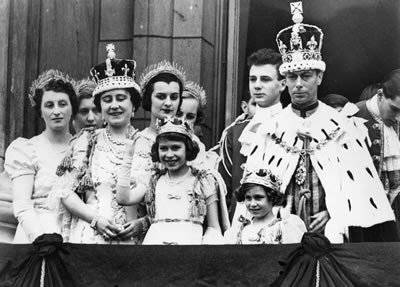
In these photographs of the King and Queen, Queen Mary and the Princesses Elizabeth and Margaret the crowns can be seen. 
The Imperial State Crown was altered and provided with a new frame for the present Queen's Coronation in 1953 and the arches returned to their somewhat lower angles as when it was made for Queen Victoria's coronation in 1838.
Queen Elizabeth's Crown was made for her in 1937, using as its base a circlet made for Queen Victoria.
Queen Mary is wearing the crown made for her in 1911, but without its arches and cross.
The two Princesses circlets were designed by their father, there not being a precedent in modern times for such coronets.  

http://i.dailymail.co.uk/i/pix/2012/01/03/article-2081633-0009668E00000258-697_472x522.jpg

The King and Queen enthroned.
The King holds the Sovereign's Sceptre and the orb, the Queen the Queen's Sceptre with the cross and the Queen's Ivory Rod with the Dove.

Image:Daily Mail


Buy at Art.com 

The King and Queen in state

Image:oldmagazinearticles.com


Sunday, 1 January 2012

New Year - the Gate of the Year


So we are now in 2012, and we can all wish one another a happy and prosperous New Year. What it will actually bring is, of course, largely hidden from us. Some things are clearly going to happen - we can look forward to the Queen's Diamond Jubilee and to the Olympics - though the latter will keep me well away from London in July and August if I can help it - and we shall have to endure coverage of both a French and a US presidential election. Apart from that, and a predictable continuing economic crisis, we do not know what is going to happen. The experts normally fail to forsee events - just think back to this time last year. Who predicted the Arab Spring, the phone hacking scandal or the scale of the Eurozone problem? We can say that those will continue to make the news, but in what way, and with what consequences - that we do not know. The one thing we can predict at any New Year is that the unpredictable and unpredicted will happen.

Given the times in which we are living I am minded to think of the lines, originally published in 1908, which King George VI quoted in his Christmas broadcast in 1939 and the advice of the man who stood at the gate of the year, and to put one's hand into the hand of God:

God Knows

And I said to the man who stood at the gate of the year: “Give me a light that I may tread safely into the unknown.”
And he replied:
“Go out into the darkness and put your hand into the Hand of God. That shall be to you better than light and safer than a known way.”
So I went forth, and finding the Hand of God, trod gladly into the night. And He led me towards the hills and the breaking of day in the lone East.

So heart bestill:
What need our little life
Our human life to know,
If God hath comprehension?
In all the dizzy strife
Of things both high and low,
God hideth His intention.

God knows. His will
Is best. The stretch of years
Which wind ahead, so dim
To our imperfect vision,
Are clear to God. Our fears
Are premature; In Him,
All time hath full provision.

Then rest: until
God moves to lift the veil
From our impatient eyes,
When, as the sweeter features
Of Life’s stern face we hail,
Fair beyond all surmise
God’s thought around His creatures
Our mind shall fill.

Minnie Louise Haskins (1875-1957)

There is an article by Christopher Howse about the poem and its author here.