Once I was a clever boy learning the arts of Oxford... is a quotation from the verses written by Bishop Richard Fleming (c.1385-1431) for his tomb in Lincoln Cathedral. Fleming, the founder of Lincoln College in Oxford, is the subject of my research for a D. Phil., and, like me, a son of the West Riding. I have remarked in the past that I have a deeply meaningful on-going relationship with a dead fifteenth century bishop... it was Fleming who, in effect, enabled me to come to Oxford and to learn its arts, and for that I am immensely grateful.


Showing posts with label Habsburgs. Show all posts

Wednesday, 17 May 2017

Empress Maria Theresa


Today is the 300th anniversary of the birth of the future Empress Maria Theresa in 1717.

Image result for empress maria theresa

Empress Maria Theresa
Portrait by Martin van Meytens 1759

Image: Wikipedia


There is an illustrated online biography of the Empress-Queen at Maria Theresa which covers not only the issues she faced and dealt with as ruler of the Habsburg lands but also her complex character - forceful and down-to-earth but also sentimental, not always logical or consistent and not infrequently quixotic, and emphatically feminine ( or should one say feminist today?)


The news service Royal Central had a post about the commemorations of this tercentenary a couple of months ago:

This year marks the 300th anniversary of the birth of one of Austria’s most important figures. A major exhibition open until 29 November will be hosted this year at Schönbrunn Palace and across three sites in Vienna and Lower Austria, entitled “Maria Theresa, Strategist, Mother, Reformer”, to mark the tercentenary of her birth, each of which opens to the public on 15 March. The exhibition will explore the monarch's life and legacy, her political achievements and works, allowing us a rare insight into the many facets of her personality and also the darker periods of her reign.
Such was the power of her personality and legacy that she still can dominate today: she stands in the form of the great monument on the square in Vienna that bears her name, the Maria-Theresien-Platz. This monument does much to symbolise the many ways in which she has come to leave her mark on popular culture, showing her synonymously as both powerful Empress and unmistakable woman, which was part of the cult that Maria Theresa consciously cultivated. And then there is the depiction of her as Austria’s ‘Great Mother’, as a monarch ruling over her subjects as her first children - a remark which Maria Theresa actually made - meaning that in equal reverse, her children were first ruled like subjects, to whom she was devoted but who she nevertheless expected to be compliant when it came to their personal futures, which were decided by way of dynastic marriages to strengthen the Franco-Austrian alliance for the ultimate benefit of the state.  Maria Theresa promoted many reforms during her reign which would help to modernize the state - for which reason she is justly remembered today - although it is important to remember that she rather receives the credit for these as they took place during her reign, although her ministers and co-regent and successor Joseph II were more probably responsible for them.
She was born the eldest surviving child of the Holy Roman Emperor Charles VI and his bride, Elisabeth Christine of Braunschweig-Wolfenbüttel, on 17 May 1717 at the Hofburg Palace, the Imperial residence in Vienna, being christened later that day with the names Maria Theresa Walburga Amalia Christina. Her sex was a source of disappointment at her birth. Charles VI had issued a variation of Leopold I’s Pact of Succession - the so-called Pragmatic Sanction in 1713 - which meant that his children could succeed before the daughters of his elder brother. Charles VI was deeply concerned that the Sanction should be recognised by the European Great Powers, although it was issued during the wait for the longed-for male heir to arrive, as the Sanction pre-dated Maria Theresa’s birth by four years. It seems to have been made as the last strategy at the end of a long-held hope: ultimately, with Maria Theresa’s recognition as his heir, marriage negotiations would eventually follow which would enable the Imperial elective throne of Holy Roman Emperor to be given to her future husband, Francis Stephan of Lorraine in 1745, thus making her Holy Roman Empress herself, albeit by marriage. On the sudden death of Charles VI, Maria Theresa found herself inexperienced and vulnerable to the attacks which soon followed: Shortly afterwards, several of the European powers that had acknowledged the Sanction repudiated their recognition of her rights, notably Prussia, with Frederick II’s invading of Austria’s hereditary territory of Silesia, thereby striking the match for what would become known as the War of the Austrian Succession. The loss of Silesia during this War meant that it would remain a bone of bitter contention, as it belonged to the inherited body of her dominions and was something which - despite the great Austrian victory at the battle of Kolin - was not recovered during the subsequent Seven Years’ War.
Maria Theresa fought in another way too. To achieve the dynastic marriages so desired by the state, she was prepared to make a personal sacrifice by way of her children. Among these were the future Emperors Joseph II, Leopold II, Queen Maria Carolina of Naples and Queen Marie Antoinette of France, who all made dynastic marriages negotiated by Maria Theresa’s State Chancellor, Prince von Kaunitz. The main aim of these state marriages was to support a volte-face in Austrian foreign policy: the rapprochement between the Hapsburg and Bourbon monarchies, underpinned by the 1756 Treaty of Versailles. The Roman Catholic Maria Theresa’s clever embracing of her sex in the form of a ‘Great Mother’ has meant that this is largely as she is remembered today, something which she promoted during her own lifetime.
The Maria-Theresa-Denkmal in Vienna  

Image: Wikimedia
Typical of the time in which she was born, Maria Theresa does, in fact, embody an era’s gradual dawning in transition, viewing reform with a caution which her natural conservatism could never entirely overcome. The many modernising advances introduced during her reign were essentially for the betterment of the state and not because of her philosophical convictions, along the lines of what has become known as 'enlightened absolutism'.  It was her son, Joseph II, who better personified a enlightened attitude in the next generation with the abolition of torture in 1776, for example. 

Arguably the greatest legacy of her reign was the renovation of the Imperial palace of Schönbrunn. A major exhibition in Vienna will be hosted this year at Schönbrunn and across other sites, entitled “Maria Theresa, Strategist, Mother, Reformer”, to mark 300 years since her birth. Her other main residence in Vienna was the Hofburg Palace where she was born and the wing in which she lived – the Leopoldinischer Trakt – is today the Chancellery of the Austrian President. The President’s Salon is presided over by an enormous portrait of Maria Theresia, in her former bedroom: The Empress has her place in Vienna’s future, as well as its past.


To this the Clever Boy would add that she exemplified many of the best qualities of successful female hereditary rulership and of the traditions of her dynasty. Edward Crankshaw's biography, though dating from the 1960s is still very readable, and she displayed an energy and commitment, a confidence and a directness that is striking and engaging. A formidable women in all things.


Thursday, 19 January 2017

Empress Carlota


Ninety years ago today there occurred the death of the Empress Carlota of Mexico. Born on June 7 1840 Princess Charlotte ( Marie Charlotte Amélie Augustine Victoire Clémentine Léopoldine ) of Belgium she married Archduke Maximilian of Austria, in preference to King Pedro V of Portugal, and when Maximilian accepted the proffer of being Emperor of Mexico in 1864 she became the Empress Carlota.

Their story as rulers of Mexico and its terrible end - a firing squad for Maximilian and insanity for Carlota is well known. There is a biography of her at Carlota of Mexico and at The Mexican Adventure: Empress Carlota of Mexico. That raises the point about the varying state of her mental health in that long widowhood. At its beginning she said she would waut for her husband for sixty years, and more or less she did.

At her death at Meise as the Mad Monarchist pointed out in a blog post her coffin was escorted to burial at Laeken by the few elderly survivors of the Belgian Legion, the Empress Carlota Guards, who had fought for her in Mexico.


Empress Carlota in old age, with her attendants.
The Empress Carlota on her death bed.
 Images: godsandfoolishgrandeur.blogspot.co.uk

That was in 1927 and the events of 1867 must have seemed very remote then to almost everyone except the widowed Empress and her few faithful followers.

However it is worth pointing out that the Empress is not quite as remote a figure as might at first be thought. She was remembered by her great-neice, the late Queen Marie-Jose of Italy, who died in 2001 - and lived at one time in exile in Mexico - as can be read at Marie Jose of Belgium On Her Great-Aunt Empress Carlota of Mexico

When the Empress died it was in the lifetime of her first cousin four times removed, who had been born the previous year, and is now Queen Elizabeth II, and the Empress' great great great nephew is the present King of the Belgians.


Monday, 21 November 2016

Emperor Francis Joseph


Today is the centenary of the death of the Empreror Francis Joseph in 1916. He died a few days short of the 68th anniversary of his accession, and his was the third longest reign of a European monarch to date.

His reign and era is often remembered or presented as period of stability, but was frequently one of political turmoil - the crisis of 1848-9 which brought the young Archduke to the Imperial throne in the stead of his uncle the Emperor Ferdinand, the conflicts over Italian unification with both Savoy and France in 1858-9, the war with Prussia and the loss of Venice in 1866 and the negotiation of the compromise with the Hungarians in 1867, as well as the failure of his brother to estanblish his own rule in Mexico and the summer crisis of 1914 that led to the First World War.

Moreover it was a reign marked by terrible personal tragedies for the Emperor and the Imperial family - notably the deaths of the Emperor Maximilian, of Crown Prince Rudolf, of the Empress Elisabeth and finally of the Archduke Franz Ferdinand and his wife at Sarajevo. The Emperor's response to news of his wife's murder in 1898 was " Am I to be spared nothing?" and such it must often have seemed to him.

He also displayed remarkable resiliance and a strong sense of duty to his people and inheritance as Emperor-King of Austria- Hungary, and enjoyed the devotion of the mass of his people.

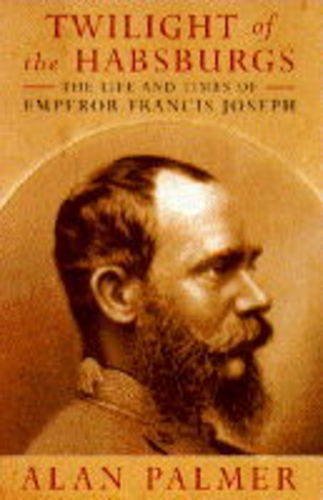
A while ago I read the biography of the Emperor Twilight of the Habsburgs: The Life and times of Emperor Francis Joseph  by Alan Palmer - an Orielensis and noted writer of accessible accounts of nineteenth and early twentieth century figures - and what emerged was Francis Joseph's dry sense of humour. He is often presented as a rather arid, duty-obsessed figure in contrast to his beautiful and beguiling wife or his flamboyant son, but what Palmer brings out is a very Habsburg sense of the comic aspects of public life that is often missed in other accounts, or when presented in print can look cold or intimidating. In this book one senses the twinkle in the Imperial eye.


Image: Amazon


The Arms of the Austrian Empire and Kingdom of Hungary 

Image: Wikimedia


Saturday, 30 January 2016

A new book on the Holy Roman Empire


A friend and regular reader of this blog has sent me the link to a review of The Holy Roman Empire: A Thousand Years of Europe’s History by Peter H. Wilson (Allen Lane, pp.1008, £35, ISBN: 9781846143182) in The Spectator.


Image: Amazon

The review can be read at http://www.spectator.co.uk/2016/01/the-holy-roman-empire-has-been-much-maligned/

This looks to be a very useful and impressive work of scholarship.


Saturday, 20 June 2015

Recents posts


Two recent posts worth drawing the attention of readers to on the blogs which I try to find time to read are, firstly, from The Mad Monarchist. This looks at the Austrian Imperial family and their fortunes, not least the possibilities of restoration to the throne, in the years before the Second World War and their situation afterwards. An informative and interesting piece it can be read at The House of Hapsburg in World War II

Secondly, the ever trenchant Rorate Coeli has an interview with Alice von Hilderbrand about her late husband's dismay at what happened during Vartican II. Whether you agree with it all or partially or not at all, it is an interesting piece about how one should, or might, understand the pontificate of Pope Paul VI. It can be read at 50 Years Ago: Dietrich von Hildebrand Confronts Pope Paul VI


Thursday, 27 February 2014

The troubled history of the Ukraine


Events over recent days leading to those last Saturday in Kiev have kept the Ukraine and its people in my thoughts and prayers. The situation is clearly still very unclear with the Russian response raising very considerable concerns and the internal politics of the Ukraineappears highly charged and dominateded by colourful, if not necessarily reliable, politicians with an uneven track record. I liked the linein The Times the other day that Yulia Tymoschenko has never met a rabble she has not tried to rouse.

The history of the Ukraine in the last century has been a troubled one to say the least, indeed a terrible one at times, with Soviet oppression and then famine, Second World War invasion and atrocities, restored Soviet rule and, since 1991, a fraught politics.

Some time ago I started, and indeed read much of, Timothy Snyder's The Red Prince, the strange and eventful story of Archduke Wilhelm of Austria.


 Image: Amazon
A member of the Teschen branch of the Imperial family, whose father, Archduke Karl Stephen was a candidate for the Polish throne in 1916-18, and himself a cousin of King Alfonso XIII and Crwon Prince Rupert of Bavaria, he became interested in and took up in the later stages of the Great War the cause of the Ukrainians. At one point he was considered a likely candidate for the position of King of Ukraine. The book is a fascinating insight into that era and of the Habsburgs in the interwar years and afterwards. A biography well worth reading - and I need to finish doing so rather than skim reading to the end as I did. His death from TB as a prisoner in Russian hands makes for a sombre ending to a colourful life. There is an online biography of the Archduke here.

Thinking about it I am inclined to the opinion that the Ukraine might have fared far,far better under the rule of the Habsburg Archduke turned Ukrainian nationalist than under the regimes which have done so since the early 1920s. Given Archduke Wilhelm's proclivities in later years he was perhaps unlikely personally to have established a new dynasty in Kiev, but doubtless a Habsburg nephew could have been brought in as a successor. 


carolathhabsburg:

Archduke Wilhelm of Austria. Teschen, also known as “The red prince”
He was the youngest son of archduke Karl Stephan of Austria Teschen and wife, Maria Theresa, pss of Tuscany.
He was cousin of King Alfonso XIII of Spain and Crownprince Rupprecht of Bavaria (By father side) .


Archduke Wilhelm circa 1920

Image: marlenemelade.tumblr.com


A further thought - the much derided Treaty of Brest Litovsk of March 1918 created the independent Ukraine and stripped Russia of her western territories. The Germans and Austrians envisaged awhole new series of realms with Kings of Finland, Lithuania, Poland and the Ukraine and a Duchy of Courland for the Balts linked to the German Empire. Abrogated in 1918 and in 1922 and its effective creations in the Baltic states annexed by the Soviets in 1939-40, so that only an independent Finland survived.

Territories after the Treaty

The Treaty of Brest Litovsk

Image: web1.caryacademy.org
 
Nevertheless the post-1991 map of eastern Europe with the restored Baltic states , Belarus and the Ukraine looks very like the arrangement made at Brest Litovsk. Are we so sure it was wrong, or unrealistic, or unhistorical given the westward and southwards expansion of Russia under the Empress Catherine II had happened as recently as the late eighteenth century?


Friday, 21 October 2011

Bl. Emperor Charles


Today is the centenary of the wedding of the Archduke Charles to Princess Zita of Bourbon-Parma, the future Emperor Charles and Empress Zita, and now the day appointed as that of his commemoration as a beatus.


http://www.emperorcharles.org/images/JPG%20800/cd%201/04--Engagement%20and%20Wedding/Cat%20No%2070--The%20Newlyweds%20at%20the%20Reception--Postcard,%20Mimosa.jpg

The future Empress and Empress on their wedding day October 21 1911

http://www.emperorcharles.org/images/JPG%20800/cd%201/04--Engagement%20and%20Wedding/Cat%20No%2069--Wedding%20Party%20on%20the%20Balcony%20of%20Villa%20Schwarzau-.jpg

The Emperor Francis Joseph with the Archduke and Archduchess and other family members on the balcony at the Villa Schwarzau.
Archduke Francis Ferdinand can be seen to the rear on the left.


In addition to the continuing cause for the Emperor's canonisation the cause of the Empress has also been introduced and the websites for these can be found at Emperor Charles League of Prayer and at Empress Zita cause.

It is worth reflecting that no other head of state from the twentieth century has been raised to the altars of the church, and one has to go back along way to find one, even canonizations centuries later such as that of the thirteenth century King Ferdinand III of Castile in 1671, let alone one within the lifetime of their children.

The story of the Empress and Empress is a tragedy not only in political and international terms for their peoples, but also a personal one, the piecemeal wearing down of a high-minded, devout, decent young man, devoted husband and father leading to a premature death at the age of 34. What redeems it is his personal holiness, as set out in the readings of the Novena for his cause which I have been saying, or in the various biographies of him.

Thursday, 13 October 2011

Novena for the canonization of Emperor Charles


As I did last year I have started the Novena for the canonization of the Emperor Charles of Austria in the lead up to his feast day on October 21st. The text of the Novena, with its reflections on his life, can be found here. The website for his cause is that of the Emperor Charles League of Prayer

http://www.emperorcharles.org/images/JPG%20800/cd%202/07--The%20New%20Emperor/Cat%20No%20114--His%20Majesty%20Kaiser%20Karl%20I--Photograph,%20Atelier%20.jpg

Bl. Emperor Charles

Image: Emperor Charles League of Prayer


Monday, 18 July 2011

Imperial funeral in Vienna


Last Saturday the funeral of Archduke Otto, the de jure Emperor of Austria and King of Hungary was held in Vienna.

© Sabine Brauer© Thomas Wilhelm Schwarzer, Friedberg in Hessen

Image from Habsburg Monarchy.

There are a set of pictures here, and there is also a video of the funeral procession here.

As the friend who sent me the links wrote:"It all looked rather impressive. I'm glad that he has finally been afforded the dignity and respect he should have been afforded during his lifetime."

There is already along and detailed account of the funeral ceremonies on Wikipedia, which can be studied here. The account in The Daily Telegraph can be read here.

The Daily Mail
has a very handsomely illustrated online feature about the burial in Vienna and in Pannonhalma which can be viewed here, although unlike the author of the article, I would not be so sure that this is the end of the Habsburgs. They have shown themselves remarkably adaptable over many centuries - I am tempted to see them as the most successful family business in European history, as opposed to the dynasties that are tied by history to a particular territory, such as the British and Danish royal houses


http://d.yimg.com/a/p/rids/20110716/i/r2967807063.jpg

The Imperial coffin in St Stephen's Cathedral

http://d.yimg.com/a/p/rids/20110716/i/r216585181.jpg

The procession from the Cathedral to the Capuchin church

http://d.yimg.com/a/p/rids/20110716/i/r2024134275.jpg

The request for admission at the Capuchin church

Images from Yahoo.news

On Sunday after aservice in Budapest his heart was interred at the Archabbey at Pannonhalma in Hungary. There are two reports with pictures about that ceremony here and here.


Tuesday, 5 July 2011

Otto of Austria 1912-2011


The death yesterday of Otto of Austria at the age of 98 is the breaking of a precious living link to the past.


Otto of Austria in 2004

He was, of course, the rightful Emperor Otto I of Austria and King Otto II of Hungary, and indeed, the de jure Holy Roman Emperor Otto V.

The obituary from the Daily Telegraph can be read here, and the Wikipedia biography is here.

The Mad Monarchist has three posts about him: Archduke Otto von Hapsburg 1912-2011, Archduke Otto, RIP and The Passing of an Archduke.

I once had the privilege of hearing Otto of Austria speak at a lecture he gave in Oxford in 1994. Sitting in the Gladstone Room of the Oxford Union I listened to this elderly distingushed looking man talking about pan-Europeanism and a vision for Europe and reflecting to myself, indeed almost pinching myself to believe the fact, that this was the very same man who, as a little boy clutching his parents hands, had attended the funeral of his great great uncle the Emperor Franz Joseph in 1916:

http://www.emperorcharles.org/images/JPG%20800/cd%202/07--The%20New%20Emperor/Cat%20No%20111--Funeral%20Procession%20for%20Emperor%20Franz%20Josef--Pho.jpg

The Crown Prince Otto at the funeral of the Emperor Franz Joseph in November 1916.

The unnamed figure on the left is the Crown Prince of Sweden, later King Gustav VI Adolf who died in 1973.

Image: Emperor Charles League of Prayer

As someone pointed out to me last night he was also the great great nephew of the Emperor Maximilian I of Mexico.

The obituaries bring out just how many of the major events of twentieth century history impacted upon his life. He lived long enough to see not only the freeing of his peoples from communist rule but to witness the beatification of his father in 2004.

In passing I would add that as one thinks about his life let no one fool you that the peoples of Austria-Hungary have been better off since 1918 without the benefits of Imperial rule. They have n't.

May he rest in peace.

Please pray for the repose of the soul of Otto of Austria and also for the Imperial family

Wednesday, 30 March 2011

An Imperial census return


With the census still in mind I am reminded of the story of the Emperor Francis Joseph insisting on filling in his census form himself, and giving as his occupation "Self-employed public servant."

http://www.worldwar1.com/foto/franz5.jpg

The story is sometimes told so as to imply that he was an uninspired man with a form-filling mentality. The truth is different - anyone who read's Alan Palmer's excellent biography of the Emperor realises that in addition to his dedication to his duties as sovereign Francis Joseph had a very dry sense of humour and a taste for irony.

The story also illustrates a particularly Habsburg characteristic, that of dedication to governance with a sense of resignation to doing that which God had called them to do. Practical governmental intelligence and hours of desk work are the hallmark of the dynasty.The dreamers amongst them, or those who became overly philosophical, such as Emperor Joseph II, or more tragically, the Emperor Maximillian of Mexico or Crown Prince Rudolf, were not typical of the dynasty. Doing one's duty by God and those you were called to rule in a slightly prosaic way, relieved by humour and sound common sense made them the most successful of family businesses. With other monarchies the dynasty changed, with the Habsburgs the countries did.

Tuesday, 28 September 2010

The Crown of St Wenceslas


As today is the Feast of St Wenceslas it seems a suitable day on which to post about the Crown that bears his name, although, like that of St Stephen in Hungary is later in date than the actual life of the saint.


Crown

The Wikipedia article about it is here. I am reproducing, with a few adaptations, two passages from that article:

"[The] Crown of Saint Wenceslas is the part of Czech crown jewels (also called the Czech treasure) made in 1347. The eleventh king of Bohemia from the House of Luxembourg, and Holy Roman Emperor Charles IV [Charles I of Bohemia] had it made for his coronation and forthwith he dedicated it to the first patron saint of the country St. Wenceslas and bequeathed it as a state crown for the coronation of future Bohemian kings, his successors to the Bohemian throne. On the orders of Charles IV the new Royal Crown was to be permanently deposited in St. Vitus Cathedral in Prague Castle. It was used last time for the coronation of King Ferdinand V [Emperor Ferdinand I of Austria] in 1836."

"[A]n old Czech legend says that any usurper who places the crown on his head is doomed to die within a year, as the Crown is in personal property of St. Wenceslas and may only be worn by a rightful Bohemian King during his coronation."

Another Wikipedia article on the same set of links states that "[i]t was originally held in Karlstejn Castle, designed in the 14th century by Matthias of Arras. Since 1867 it has been stored in St. Vitus Cathedral of Prague Castle."

Another, independent, account says that Charles ordered a very rich crown to adorn the reliquary containng the skull of his predecessor and Bohemia's patron saint, St. Wenceslas. The crown was to be removed from the reliquary only for the coronation of the kings of Bohemia.

In the cross on the top is set a relic from the Crown of Thorns. The crown is inlaid with ninety one gems (emeralds, sapphires, rubies and amethysts) and twenty pearls and decorated with four large Fleur de Lys.

The Crown is but one example of the flowering of the arts in Bohemia under the Emperor Charles IV - a glittering period in the history of the kingdom which included the building of St Vitus Cathedral in Prague, including the shrine chapel of St Wenceslas, the castle at Karlstejn, and the foundation of the University of Prague - the Charles University. For a biography of the Emperor look here.

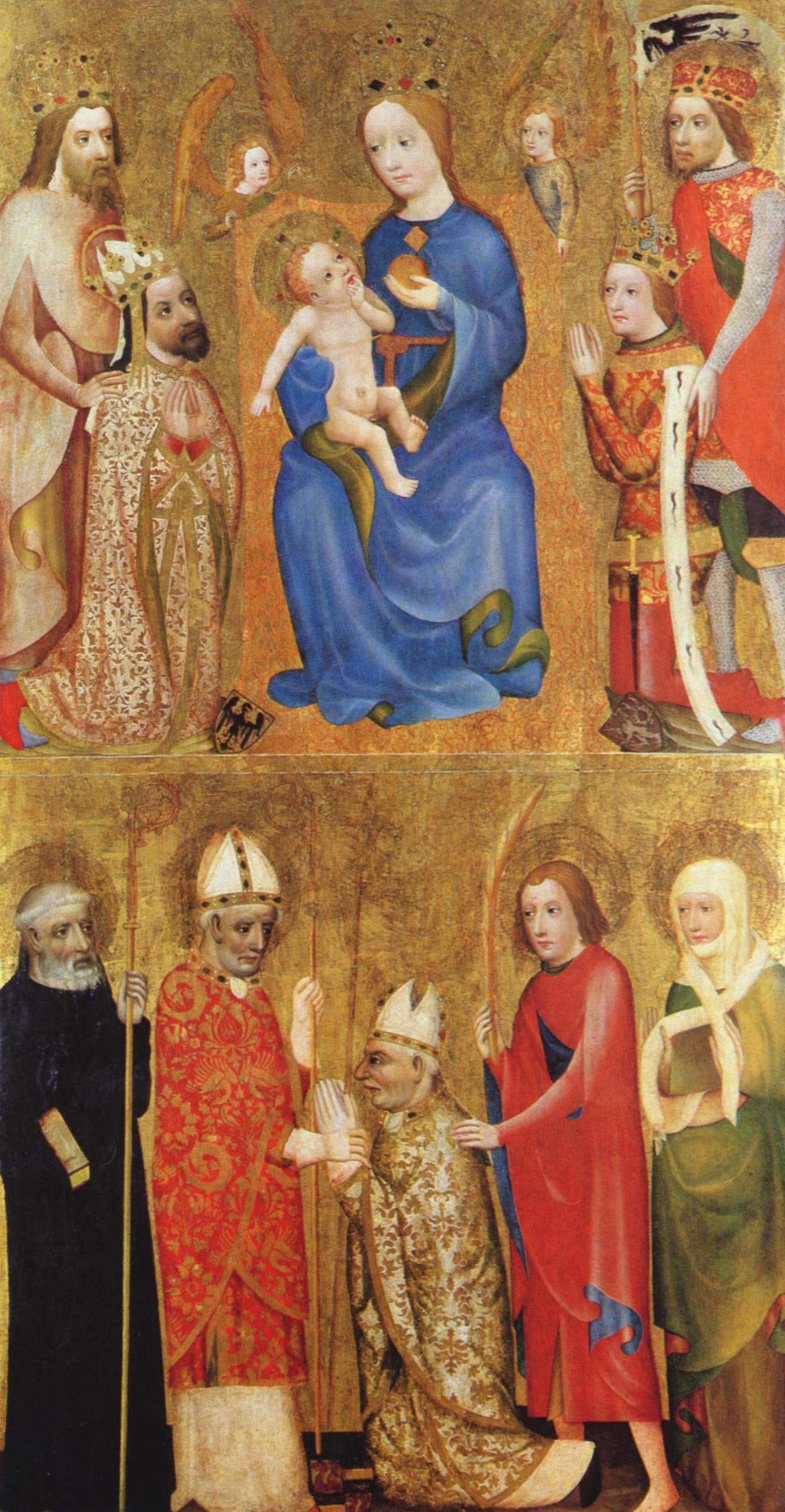
Here Charles as Holy Roman Emperor, and wearing the Imperial crown. In the painting, a votive picture of the Archbishop of Prague, John Ocko of Vlasim, by Theodore of Prague and circa 1370, and now in the National Gallery in Prague, he is depicted with his eldest surviving son and heir, Wenceslas IV, King of the Romans until he was deposed by the Electors in 1400, and of Bohemia until his death in 1419, accompanied by Charlemage and St Wenceslas (wearing the appropriate Ducal cap), kneeling before the Virgin and Child.

File:Meister Theoderich von Prag (Umkreis) 001.jpg


Here is a detail of the Emperor:


At least one later Bohemian monarch was not overly impressed by the crown's appearance - on the eve of her coronation Maria Theresa described it in a letter as looking like a "fool's cap" - in other words a jester's cap.

The last Bohemian coronation was, as mentioned above, in 1836, but in September 1871 the Emperor Francis Joseph informed the Bohemian Diet of his willingness to take the Bohemian Coronation oath. The proposal, presumably as part of a plan to establish a relationship similar to that Austria had estanblished with Hungary by the coronation there in 1867 was abandoned due to protests from the German speaking population of Bohemia, who disliked the idea of rule by the Czechs. It is possible that had the Habsburg Empire survived in 1918 that Bl.Charles I and IV would have overseen some such similar process of devolution within his hereditary lands and that the Bohemian coronation would have been revived.


The term the "Bohemian Crown" applies to the lands dependent upon it rather than to the actual crown, as explained here.


Coat of arms of the Bohemian Crown until 1635. Quarterly of five. 1.The checuered eagle of Moravia. 2 The eagle of Silesia.3 The wall of Upper Lusatia. 4 The eagle of Upper Silesia. 5 The ox of Lower Lusatia. An inescutcheon with the lion of Bohemia. Atop the arms is the Crown of St Wenceslas.

There is an illustrated list of the Dukes and Kings of Bohemia here.


Arms of the Kingdom of
Bohemia


Friday, 6 August 2010

Habsburg Empire - an historian's judgement


This is the last paragraph of T.C.W.Blanning Joseph II (1994), and can be found on pp. 205-6. This is an excellent book, about which I shall write something more in the near future. However I think this passage is worth sharing as it stands:


"The Habsburg Monarchy was not a state, it never became a state and it never could have become a state. The only way forward to political stability, social harmony, economic prosperity and cultural vitality was to recognize that fundamental fact and make a virtue out of necessity. Writing from the vantage point of the closing years of the twentieth century, it is certainly easier to see that a multi-national empire held together by a single dynasty whose justification was the guarantee of mutual recognition of diversity is a more attractive option than the other solutions which have been tried - and are being tried. With chilling foresight, Prince Charles Schwarzenberg in 1891 asked a radical Czech nationalist the following question: "If you and yours hate this state...what will you do with your country, which is too small to stand alone? Will you give it to Germany or to Russia, for you have no other choice if you abandon the Austrian union." One wonders what he would have said to those Slovaks who have successfully destroyed Czechoslovakia or to those national groups which have destroyed Yugoslavia."

Wednesday, 21 July 2010

Empress Maria Theresa

Another book I finished over the weekend was Edward Crankshaw's Maria Theresa, published in 1969. Crankshaw, who had been a journalist, wrote several books on the Habsburgs which are eminently readable. The book is aimed at the general reader, and, if it has a weakness, it is a tendency to write in a slightly sweeping journalistic style rather than the more measured tones of the historian. Nevertheless it is a good biography of the Empress, and was the first full-length one to be written in English for sixty years.
Crankshaw was clearly very fond of the Empress, and with great respect for her achievements. She emerges to the reader as combining not a few of the qualities of Queen Elizabeth I, Queen Victoria and Margaret Thatcher. To follow the methodological approach of Sellers and Yeatman she was a Good Thing - indeed at times a very Good Thing.
The copy I read was the paperback edition of 1982 which lacked illustrations - which gives me the excuse to include a couple of portraits of the Empress.

Maria Theresa in 1762, by Jean-Étienne Liotard.


Tuesday, 20 July 2010

Imperial and Royal Arms


My friend Gyronny Herald is currently publishing the novena to the Bl.Emperor Karl on his blog. As I am currently having something of a Habsburg reading fest, and because I am fascinated by the history of the Arch-House and their Empire, I really cannot resist recycling from the website this wonderful achievement of arms of the Dual Monarchy. Quite, quite wonderful...