Once I was a clever boy learning the arts of Oxford... is a quotation from the verses written by Bishop Richard Fleming (c.1385-1431) for his tomb in Lincoln Cathedral. Fleming, the founder of Lincoln College in Oxford, is the subject of my research for a D. Phil., and, like me, a son of the West Riding. I have remarked in the past that I have a deeply meaningful on-going relationship with a dead fifteenth century bishop... it was Fleming who, in effect, enabled me to come to Oxford and to learn its arts, and for that I am immensely grateful.


Showing posts with label Habsburg Monarchy. Show all posts

Thursday, 8 June 2017

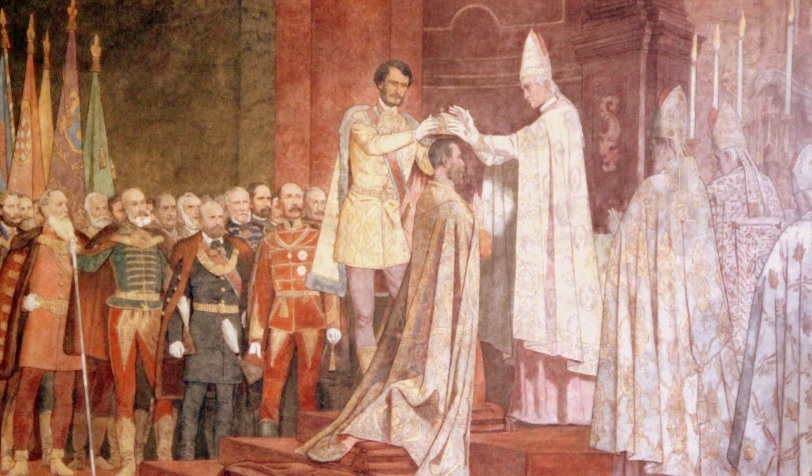
The Coronation of Francis Joseph as King of Hungary in 1867


On June 8th 1867 there took place the coronation in Budapest of Francis Joseph as King of Hungary.

This followed upon the negotiation of the Ausgleich which created the Dual Monarchy of Austria-Hungary and re-configured relationships within the Habsburg empire. The background to this settlement and its details can be read here. There is a fuller account with several maps here

Like all compromises the Ausgleich can be viewed in different ways. It brought stability to the Habsburg Empire, but entrenched Magyar authority over the whole realm of Hungary. Whereas before a single central authority in Vienna could balance - or play off against one another - the various minorities now power lay firmly over the Kingdom in Budapest with the Magyar elite. The possibility of a genuinely federal union based on historic and linguistic or ethnic divisions was pushed into the background. The Austrian half of the empire developed along more modern lines whilst it might well be argued than the Hungarian kingdom which retained a landowning agricultural model. However that agricultural base fed the whole empire so all did reasonably well.

The prosperity of post-1867 Budapest is obvious from the expansion and development of the capital city and its acquisition in these years of expansive and impressive public buildings on each bank of the Danube, including the restoration of the coronation church, the extension to the Royal Palace and most strikingly the enormous Parliament building with its inherent celebration of the realm's historic constitution.

Relations between the two realms were not always smooth and the Hungarian government acted as a brake on Austrian ideas of siding with France in 1870.

By the early twentieth century nationalist pressure groups were stirring - though how much and to what effect can be debated - and a feeling amongst some, notably Archduke Franz Ferdinand - that the Hungarians ought to be brought into line for the wider good of the Habsburg monarchy, meant that trouble was potentially brewing once the Emperor-King Francis Joseph died. having helped put the Dual Monarchy in place the Emperor-King refused to consider amending a project to which he had sworn.Events, of course, conspired to prevent the Archduke from trying to reconfigure it, and it was still in place when King Charles IV was crowned in 1916.

The history of the ceremonial and its significance within the historic Hungarian constituion can be read at Coronation of the Hungarian monarch

 Empress Elisabeth, Part IV

  The coronation of the King by the Prince Primate Archbishop of Esztergom and Count Andrassy

  Image: Pinterest/forum.aleaxanderpalace.org

 Koronázás Budán.jpg

A contemporary print by V.Katzler

The Hungarian King of Arms can be seen in the centre with his tabard and plumed hat.Behind the King and Andrassy is an Eastern-Rite bishop. Queen Elisabeth is on the left

 Image:Wikimedia 

 
File:Kollarz Ferenc I. Ferenc józsef magyar király megkoronázása a budavári plébánia-templomában, junius 8-án 1867.jpg 

A contemporary engraving of the Coronation 

Eastern-Rite bishops can again be seen in the right foreground. The Archbishop of Esztergom is shown here wearing achasuble rather than a cope as in the preceding and subsequent images

Image:Wikimedia
 1867. június 8 Ferenc József koronázása.jpg

  A later painting of the Coronation

Image: Wikimedia

    http://s3-eu-west-1.amazonaws.com/lookandlearn-preview/U/U315/U315618.jpg

 The King ceremonially flourishes the sword in defence of the realm

 Image: Look and Learn from the Illustrtaed London News June 29 1867


Elisabeth met Graaf Andrassy tijdens de kroning als koningin van Hongarije 

Traditionally the Queen of Hungary is touched upon the right shoulder with the Holy Crown as part of her Coronation

Image: Pinterest


The King and Queen receive the acclamation of their people

Image: Wikipedia 


Image result for Francis Joseph coronation 1867 Elisabeth

Queen Elisabeth on the day of the Coronation

Image: Pinterest

The following piece by Stephan Gruber is taken from the website The World of the Habsburgs ( Die Habsburger.net):
 
His spelling still not entirely reliable, the nine-year-old Crown Prince Rudolf gave an account in his school exercise book of the coronation ceremony held in St Matthias’ Cathedral in Budapest. Here, on 8 June 1867, using the Crown of St Stephen, Franz Joseph and Elisabeth were crowned King and Queen of Hungary by Hungarian Prime Minister Count Andrássy and the Primate of the Catholic church:

"In the church there were many magnates and officers, then the music started and the Primate and many Catholic and Greek bishops and very many other priests. Then came Papa and Mama. Mama sat down on a kind of throne, and Papa went to the altar, where a lot of Latin was read out … Afterwards, the drums resounded and Andrássy and the Primate put the crown on Papa’s head. Then the imperial orb and sceptre were placed in Papa’s hands.“

As a result of defeats in Italy in 1859 and against Prussia in 1866, Franz Joseph’s position within the Monarchy had been considerably weakened. This forced the Emperor into a hasty compromise with the representatives of Hungary, something his wife Elisabeth had also strongly favoured. In 1867, Franz Joseph agreed to the Compromise plan, which required the restoration of traditional rights and Hungary’s independence, and which reinstated the old Hungarian constitution dating back to the period before the 1848 Revolution. In personal union, Franz Joseph was now simultaneously King of Hungary and Emperor of Austria, but through the Compromise, the two halves of the Empire were two formally independent states of equal status.

As a coronation gift, the royal couple were given the Baroque palace of Gödöllö. The Swiss envoy did not experience the ceremony in quite the same manner as the young Rudolf, finding it no longer contemporary in all its pageantry: ‘Despite its pomp and veritable magnificence, yet the entire procession gave the detached observer somewhat the impression of a carnival masquerade … This vestige from the Middle Ages simply does not fit with our times.’ The envoy moreover noted the irony of Franz Joseph being crowned by Count Andrássy:

"It gives an extremely strange impression to see the manner in which the man whose death sentence Emperor Franz Joseph had signed in 1849 and whose name was nailed to the gallows in Pest, now, eighteen years later, places the crown on the head of the monarch whose highest confidence he today enjoys.“


The Oath taking ceremony
A photograph that has been enhanced by engraving

Image: Wikiwand

http://l7.alamy.com/zooms/6f1a141b0d3c4650b2dc158071ba31e6/emperor-franz-joseph-of-austria-1830-1916-is-crowned-king-of-hungary-d85d1g.jpg


The King taking the Oath


Image: Alamy

File:Krönung Franz Joseph zum König von Ungarn 1867.jpg

The King rides up the Coronation Hill

Image: Wikimedia

Image result for Coronation of Francis Joseph 1867

King Francis Joseph on horseback again flourishes his sword in sign of defending the realm from the Coronation Hill

Image: Die Welt der Habsburger

Commemorating the coronation of Hungary. Real couple Franz Josef I and Empress Elisabeth of Austria-Hungary.

Statues in the Hungarian Parliament commemorating the Coronation of 1867

Image:Pinterest

All in all a veery impressive day and one which marked and symbolised a significant development in Habsburg and Hungarian history.


Wednesday, 17 May 2017

Empress Maria Theresa


Today is the 300th anniversary of the birth of the future Empress Maria Theresa in 1717.

Image result for empress maria theresa

Empress Maria Theresa
Portrait by Martin van Meytens 1759

Image: Wikipedia


There is an illustrated online biography of the Empress-Queen at Maria Theresa which covers not only the issues she faced and dealt with as ruler of the Habsburg lands but also her complex character - forceful and down-to-earth but also sentimental, not always logical or consistent and not infrequently quixotic, and emphatically feminine ( or should one say feminist today?)


The news service Royal Central had a post about the commemorations of this tercentenary a couple of months ago:

This year marks the 300th anniversary of the birth of one of Austria’s most important figures. A major exhibition open until 29 November will be hosted this year at Schönbrunn Palace and across three sites in Vienna and Lower Austria, entitled “Maria Theresa, Strategist, Mother, Reformer”, to mark the tercentenary of her birth, each of which opens to the public on 15 March. The exhibition will explore the monarch's life and legacy, her political achievements and works, allowing us a rare insight into the many facets of her personality and also the darker periods of her reign.
Such was the power of her personality and legacy that she still can dominate today: she stands in the form of the great monument on the square in Vienna that bears her name, the Maria-Theresien-Platz. This monument does much to symbolise the many ways in which she has come to leave her mark on popular culture, showing her synonymously as both powerful Empress and unmistakable woman, which was part of the cult that Maria Theresa consciously cultivated. And then there is the depiction of her as Austria’s ‘Great Mother’, as a monarch ruling over her subjects as her first children - a remark which Maria Theresa actually made - meaning that in equal reverse, her children were first ruled like subjects, to whom she was devoted but who she nevertheless expected to be compliant when it came to their personal futures, which were decided by way of dynastic marriages to strengthen the Franco-Austrian alliance for the ultimate benefit of the state.  Maria Theresa promoted many reforms during her reign which would help to modernize the state - for which reason she is justly remembered today - although it is important to remember that she rather receives the credit for these as they took place during her reign, although her ministers and co-regent and successor Joseph II were more probably responsible for them.
She was born the eldest surviving child of the Holy Roman Emperor Charles VI and his bride, Elisabeth Christine of Braunschweig-Wolfenbüttel, on 17 May 1717 at the Hofburg Palace, the Imperial residence in Vienna, being christened later that day with the names Maria Theresa Walburga Amalia Christina. Her sex was a source of disappointment at her birth. Charles VI had issued a variation of Leopold I’s Pact of Succession - the so-called Pragmatic Sanction in 1713 - which meant that his children could succeed before the daughters of his elder brother. Charles VI was deeply concerned that the Sanction should be recognised by the European Great Powers, although it was issued during the wait for the longed-for male heir to arrive, as the Sanction pre-dated Maria Theresa’s birth by four years. It seems to have been made as the last strategy at the end of a long-held hope: ultimately, with Maria Theresa’s recognition as his heir, marriage negotiations would eventually follow which would enable the Imperial elective throne of Holy Roman Emperor to be given to her future husband, Francis Stephan of Lorraine in 1745, thus making her Holy Roman Empress herself, albeit by marriage. On the sudden death of Charles VI, Maria Theresa found herself inexperienced and vulnerable to the attacks which soon followed: Shortly afterwards, several of the European powers that had acknowledged the Sanction repudiated their recognition of her rights, notably Prussia, with Frederick II’s invading of Austria’s hereditary territory of Silesia, thereby striking the match for what would become known as the War of the Austrian Succession. The loss of Silesia during this War meant that it would remain a bone of bitter contention, as it belonged to the inherited body of her dominions and was something which - despite the great Austrian victory at the battle of Kolin - was not recovered during the subsequent Seven Years’ War.
Maria Theresa fought in another way too. To achieve the dynastic marriages so desired by the state, she was prepared to make a personal sacrifice by way of her children. Among these were the future Emperors Joseph II, Leopold II, Queen Maria Carolina of Naples and Queen Marie Antoinette of France, who all made dynastic marriages negotiated by Maria Theresa’s State Chancellor, Prince von Kaunitz. The main aim of these state marriages was to support a volte-face in Austrian foreign policy: the rapprochement between the Hapsburg and Bourbon monarchies, underpinned by the 1756 Treaty of Versailles. The Roman Catholic Maria Theresa’s clever embracing of her sex in the form of a ‘Great Mother’ has meant that this is largely as she is remembered today, something which she promoted during her own lifetime.
The Maria-Theresa-Denkmal in Vienna  

Image: Wikimedia
Typical of the time in which she was born, Maria Theresa does, in fact, embody an era’s gradual dawning in transition, viewing reform with a caution which her natural conservatism could never entirely overcome. The many modernising advances introduced during her reign were essentially for the betterment of the state and not because of her philosophical convictions, along the lines of what has become known as 'enlightened absolutism'.  It was her son, Joseph II, who better personified a enlightened attitude in the next generation with the abolition of torture in 1776, for example. 

Arguably the greatest legacy of her reign was the renovation of the Imperial palace of Schönbrunn. A major exhibition in Vienna will be hosted this year at Schönbrunn and across other sites, entitled “Maria Theresa, Strategist, Mother, Reformer”, to mark 300 years since her birth. Her other main residence in Vienna was the Hofburg Palace where she was born and the wing in which she lived – the Leopoldinischer Trakt – is today the Chancellery of the Austrian President. The President’s Salon is presided over by an enormous portrait of Maria Theresia, in her former bedroom: The Empress has her place in Vienna’s future, as well as its past.


To this the Clever Boy would add that she exemplified many of the best qualities of successful female hereditary rulership and of the traditions of her dynasty. Edward Crankshaw's biography, though dating from the 1960s is still very readable, and she displayed an energy and commitment, a confidence and a directness that is striking and engaging. A formidable women in all things.


Monday, 21 November 2016

Emperor Francis Joseph


Today is the centenary of the death of the Empreror Francis Joseph in 1916. He died a few days short of the 68th anniversary of his accession, and his was the third longest reign of a European monarch to date.

His reign and era is often remembered or presented as period of stability, but was frequently one of political turmoil - the crisis of 1848-9 which brought the young Archduke to the Imperial throne in the stead of his uncle the Emperor Ferdinand, the conflicts over Italian unification with both Savoy and France in 1858-9, the war with Prussia and the loss of Venice in 1866 and the negotiation of the compromise with the Hungarians in 1867, as well as the failure of his brother to estanblish his own rule in Mexico and the summer crisis of 1914 that led to the First World War.

Moreover it was a reign marked by terrible personal tragedies for the Emperor and the Imperial family - notably the deaths of the Emperor Maximilian, of Crown Prince Rudolf, of the Empress Elisabeth and finally of the Archduke Franz Ferdinand and his wife at Sarajevo. The Emperor's response to news of his wife's murder in 1898 was " Am I to be spared nothing?" and such it must often have seemed to him.

He also displayed remarkable resiliance and a strong sense of duty to his people and inheritance as Emperor-King of Austria- Hungary, and enjoyed the devotion of the mass of his people.

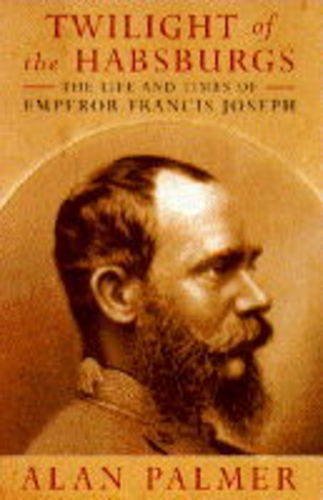
A while ago I read the biography of the Emperor Twilight of the Habsburgs: The Life and times of Emperor Francis Joseph  by Alan Palmer - an Orielensis and noted writer of accessible accounts of nineteenth and early twentieth century figures - and what emerged was Francis Joseph's dry sense of humour. He is often presented as a rather arid, duty-obsessed figure in contrast to his beautiful and beguiling wife or his flamboyant son, but what Palmer brings out is a very Habsburg sense of the comic aspects of public life that is often missed in other accounts, or when presented in print can look cold or intimidating. In this book one senses the twinkle in the Imperial eye.


Image: Amazon


The Arms of the Austrian Empire and Kingdom of Hungary 

Image: Wikimedia


Saturday, 20 June 2015

Recents posts


Two recent posts worth drawing the attention of readers to on the blogs which I try to find time to read are, firstly, from The Mad Monarchist. This looks at the Austrian Imperial family and their fortunes, not least the possibilities of restoration to the throne, in the years before the Second World War and their situation afterwards. An informative and interesting piece it can be read at The House of Hapsburg in World War II

Secondly, the ever trenchant Rorate Coeli has an interview with Alice von Hilderbrand about her late husband's dismay at what happened during Vartican II. Whether you agree with it all or partially or not at all, it is an interesting piece about how one should, or might, understand the pontificate of Pope Paul VI. It can be read at 50 Years Ago: Dietrich von Hildebrand Confronts Pope Paul VI


Thursday, 28 March 2013

Imperial Maundy


The tradition of the mandatum was not confined to English kings - it survived as a practice in the Austrian Empire and in Spain during the reign of King Alfonso XIII.
" In 1850, Franz Joseph participated for the first time as Emperor in the second of the traditional Habsburg expressions of dynastic piety: the Holy Thursday foot-washing ceremony, part of the four-day court observance of Easter. The master of the staff and the court prelates chose twelve poor elderly men, transported them to the Hofburg, and positioned them in the ceremonial hall on a raised dais. There, before an invited audience observing the scene from tribunes, the Emperor served the men a symbolic meal and Archdukes cleared the dishes. As a priest read aloud in Latin the words of the New Testament (John 3:15), “And he began to wash the feet of the disciples,” Franz Joseph knelt and, without rising from his knees, washed the feet of the twelve old men in imitation of Christ. Finally, the Emperor placed a bag of twenty silver coins around the necks of each before the men were led away and returned to their homes in imperial coaches."

The Emperor washing the feet of the poor on Holy Thursday
A lithograph of circa 1910
From Daniel L. Unowsky, The Pomp and Politics of Patriotism: Imperial Celebrations in Habsburg Austria 1848-1916 (West Lafayette, Ind.: Purdue University Press, 2005), p. 29.
Image and text: nobility.org March 7, 2011
1907 newspeper report says that thirty silver coins were given, but I am not sure if that is accurate.
In 1904 the ceremony was attended by Consuelo Duchess of Marlborough (1877-1964) who described it in her memoirs The Glitter and the Gold, published in 1953 and recently reprinted. The Vanderbilt heiress displays in her autobiography both a thoroughgoing pleasure in the privileges of her rank and an American edginess about such privileges, both of which are apparent in her account of the occasion:
[Text to be added]

Thursday, 13 October 2011

Novena for the canonization of Emperor Charles


As I did last year I have started the Novena for the canonization of the Emperor Charles of Austria in the lead up to his feast day on October 21st. The text of the Novena, with its reflections on his life, can be found here. The website for his cause is that of the Emperor Charles League of Prayer

http://www.emperorcharles.org/images/JPG%20800/cd%202/07--The%20New%20Emperor/Cat%20No%20114--His%20Majesty%20Kaiser%20Karl%20I--Photograph,%20Atelier%20.jpg

Bl. Emperor Charles

Image: Emperor Charles League of Prayer


Monday, 18 July 2011

Imperial funeral in Vienna


Last Saturday the funeral of Archduke Otto, the de jure Emperor of Austria and King of Hungary was held in Vienna.

© Sabine Brauer© Thomas Wilhelm Schwarzer, Friedberg in Hessen

Image from Habsburg Monarchy.

There are a set of pictures here, and there is also a video of the funeral procession here.

As the friend who sent me the links wrote:"It all looked rather impressive. I'm glad that he has finally been afforded the dignity and respect he should have been afforded during his lifetime."

There is already along and detailed account of the funeral ceremonies on Wikipedia, which can be studied here. The account in The Daily Telegraph can be read here.

The Daily Mail
has a very handsomely illustrated online feature about the burial in Vienna and in Pannonhalma which can be viewed here, although unlike the author of the article, I would not be so sure that this is the end of the Habsburgs. They have shown themselves remarkably adaptable over many centuries - I am tempted to see them as the most successful family business in European history, as opposed to the dynasties that are tied by history to a particular territory, such as the British and Danish royal houses


http://d.yimg.com/a/p/rids/20110716/i/r2967807063.jpg

The Imperial coffin in St Stephen's Cathedral

http://d.yimg.com/a/p/rids/20110716/i/r216585181.jpg

The procession from the Cathedral to the Capuchin church

http://d.yimg.com/a/p/rids/20110716/i/r2024134275.jpg

The request for admission at the Capuchin church

Images from Yahoo.news

On Sunday after aservice in Budapest his heart was interred at the Archabbey at Pannonhalma in Hungary. There are two reports with pictures about that ceremony here and here.


Tuesday, 5 July 2011

Otto of Austria 1912-2011


The death yesterday of Otto of Austria at the age of 98 is the breaking of a precious living link to the past.


Otto of Austria in 2004

He was, of course, the rightful Emperor Otto I of Austria and King Otto II of Hungary, and indeed, the de jure Holy Roman Emperor Otto V.

The obituary from the Daily Telegraph can be read here, and the Wikipedia biography is here.

The Mad Monarchist has three posts about him: Archduke Otto von Hapsburg 1912-2011, Archduke Otto, RIP and The Passing of an Archduke.

I once had the privilege of hearing Otto of Austria speak at a lecture he gave in Oxford in 1994. Sitting in the Gladstone Room of the Oxford Union I listened to this elderly distingushed looking man talking about pan-Europeanism and a vision for Europe and reflecting to myself, indeed almost pinching myself to believe the fact, that this was the very same man who, as a little boy clutching his parents hands, had attended the funeral of his great great uncle the Emperor Franz Joseph in 1916:

http://www.emperorcharles.org/images/JPG%20800/cd%202/07--The%20New%20Emperor/Cat%20No%20111--Funeral%20Procession%20for%20Emperor%20Franz%20Josef--Pho.jpg

The Crown Prince Otto at the funeral of the Emperor Franz Joseph in November 1916.

The unnamed figure on the left is the Crown Prince of Sweden, later King Gustav VI Adolf who died in 1973.

Image: Emperor Charles League of Prayer

As someone pointed out to me last night he was also the great great nephew of the Emperor Maximilian I of Mexico.

The obituaries bring out just how many of the major events of twentieth century history impacted upon his life. He lived long enough to see not only the freeing of his peoples from communist rule but to witness the beatification of his father in 2004.

In passing I would add that as one thinks about his life let no one fool you that the peoples of Austria-Hungary have been better off since 1918 without the benefits of Imperial rule. They have n't.

May he rest in peace.

Please pray for the repose of the soul of Otto of Austria and also for the Imperial family

Tuesday, 28 June 2011

Sarajevo anniversary


Today is the anniversary of the assassination of Archduke Franz Ferdinand and his wife at Sarajevo in 1914. Please remeber them in your prayers, and pray for the peace of the world and deliverance from radical, purblind, extremists. My post for this day last year can be read at Sarajevo remembered.

The assassination and the circumstances and possibilities - the "what ifs", or to be smart, the "counterfactuals" - and its continuing impact exert a fascination on my mind, and should, I believe, on those of others. For all the work of historians in, quite correctly, discerning trends and patterns there are specific moments when change occurs, events which do, literally, change the world. The Sarajevo assassination is one of them.

Looking at whatI wrote last year the only change I would really make would be to be firmer in my repugnance at the fate of the Archduke and his wife, and the consequent fate of us all - we all live in a world that came into being that sunny summer morning.

Dedijer's book remains the classic account, although it can be supplemented by later books. It was inevitably constrained by its author's background and the times in which he wrote, but it is agreat piece of work. One question I would have asked him, had I the possibility, was how many Bosnians were so taken up with violent revolutionary nationalism. Dedijer writes of all these groups - Pan-Slavs, South Slavs and Pan-Serbs - with precision and knowledge, but I do wonder to what extent they and their more passive supporters were a minority. They appear to share the same profile as other radical nationalist groups who, alas, manage to make the political running.

I have found some more images of that fateful morning, although they are refusing to expand to a larger size. Here then are the Archduke, the Duchess and Gen Potoriek, Govenor of Bosnia,
arriving at the city hall in Sarajevo:


http://www.worldwar1.com/photos/hffarrv.jpg

The Archduke and the Duchess leave the city hall:

http://www.worldwar1.com/photos/hffcar2.jpg

The driver takes the fatal wrong turn on the Appel Quay and the Archducal car wheels can be seen to begin to turn to the right. The assassination happened seconds later:

http://www.smithlifescience.com/SSWWIArchduke.jpg


I also found this picture, which is a reminder of the fact that Europe's reaction was to show solidarity with the Habsburgs in this assault on their Empire and dynasty:


File:Bulla-Ferdinant.jpg

Requiem in the church of St Catherine in St Petersburg for Archduke Franz Ferdinand in 1914.


Wednesday, 30 March 2011

An Imperial census return


With the census still in mind I am reminded of the story of the Emperor Francis Joseph insisting on filling in his census form himself, and giving as his occupation "Self-employed public servant."

http://www.worldwar1.com/foto/franz5.jpg

The story is sometimes told so as to imply that he was an uninspired man with a form-filling mentality. The truth is different - anyone who read's Alan Palmer's excellent biography of the Emperor realises that in addition to his dedication to his duties as sovereign Francis Joseph had a very dry sense of humour and a taste for irony.

The story also illustrates a particularly Habsburg characteristic, that of dedication to governance with a sense of resignation to doing that which God had called them to do. Practical governmental intelligence and hours of desk work are the hallmark of the dynasty.The dreamers amongst them, or those who became overly philosophical, such as Emperor Joseph II, or more tragically, the Emperor Maximillian of Mexico or Crown Prince Rudolf, were not typical of the dynasty. Doing one's duty by God and those you were called to rule in a slightly prosaic way, relieved by humour and sound common sense made them the most successful of family businesses. With other monarchies the dynasty changed, with the Habsburgs the countries did.

Tuesday, 28 September 2010

The Crown of St Wenceslas


As today is the Feast of St Wenceslas it seems a suitable day on which to post about the Crown that bears his name, although, like that of St Stephen in Hungary is later in date than the actual life of the saint.


Crown

The Wikipedia article about it is here. I am reproducing, with a few adaptations, two passages from that article:

"[The] Crown of Saint Wenceslas is the part of Czech crown jewels (also called the Czech treasure) made in 1347. The eleventh king of Bohemia from the House of Luxembourg, and Holy Roman Emperor Charles IV [Charles I of Bohemia] had it made for his coronation and forthwith he dedicated it to the first patron saint of the country St. Wenceslas and bequeathed it as a state crown for the coronation of future Bohemian kings, his successors to the Bohemian throne. On the orders of Charles IV the new Royal Crown was to be permanently deposited in St. Vitus Cathedral in Prague Castle. It was used last time for the coronation of King Ferdinand V [Emperor Ferdinand I of Austria] in 1836."

"[A]n old Czech legend says that any usurper who places the crown on his head is doomed to die within a year, as the Crown is in personal property of St. Wenceslas and may only be worn by a rightful Bohemian King during his coronation."

Another Wikipedia article on the same set of links states that "[i]t was originally held in Karlstejn Castle, designed in the 14th century by Matthias of Arras. Since 1867 it has been stored in St. Vitus Cathedral of Prague Castle."

Another, independent, account says that Charles ordered a very rich crown to adorn the reliquary containng the skull of his predecessor and Bohemia's patron saint, St. Wenceslas. The crown was to be removed from the reliquary only for the coronation of the kings of Bohemia.

In the cross on the top is set a relic from the Crown of Thorns. The crown is inlaid with ninety one gems (emeralds, sapphires, rubies and amethysts) and twenty pearls and decorated with four large Fleur de Lys.

The Crown is but one example of the flowering of the arts in Bohemia under the Emperor Charles IV - a glittering period in the history of the kingdom which included the building of St Vitus Cathedral in Prague, including the shrine chapel of St Wenceslas, the castle at Karlstejn, and the foundation of the University of Prague - the Charles University. For a biography of the Emperor look here.

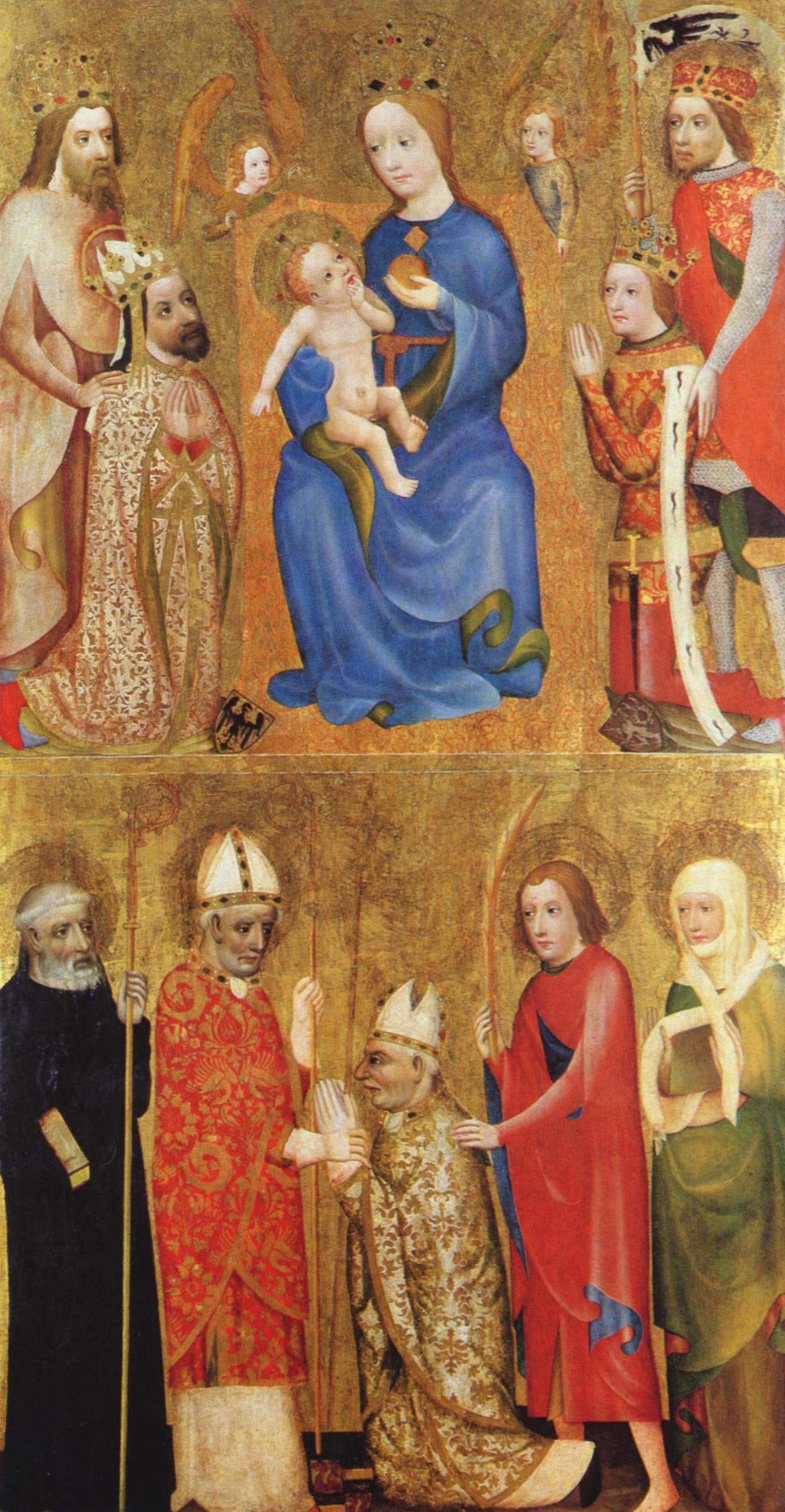
Here Charles as Holy Roman Emperor, and wearing the Imperial crown. In the painting, a votive picture of the Archbishop of Prague, John Ocko of Vlasim, by Theodore of Prague and circa 1370, and now in the National Gallery in Prague, he is depicted with his eldest surviving son and heir, Wenceslas IV, King of the Romans until he was deposed by the Electors in 1400, and of Bohemia until his death in 1419, accompanied by Charlemage and St Wenceslas (wearing the appropriate Ducal cap), kneeling before the Virgin and Child.

File:Meister Theoderich von Prag (Umkreis) 001.jpg


Here is a detail of the Emperor:


At least one later Bohemian monarch was not overly impressed by the crown's appearance - on the eve of her coronation Maria Theresa described it in a letter as looking like a "fool's cap" - in other words a jester's cap.

The last Bohemian coronation was, as mentioned above, in 1836, but in September 1871 the Emperor Francis Joseph informed the Bohemian Diet of his willingness to take the Bohemian Coronation oath. The proposal, presumably as part of a plan to establish a relationship similar to that Austria had estanblished with Hungary by the coronation there in 1867 was abandoned due to protests from the German speaking population of Bohemia, who disliked the idea of rule by the Czechs. It is possible that had the Habsburg Empire survived in 1918 that Bl.Charles I and IV would have overseen some such similar process of devolution within his hereditary lands and that the Bohemian coronation would have been revived.


The term the "Bohemian Crown" applies to the lands dependent upon it rather than to the actual crown, as explained here.


Coat of arms of the Bohemian Crown until 1635. Quarterly of five. 1.The checuered eagle of Moravia. 2 The eagle of Silesia.3 The wall of Upper Lusatia. 4 The eagle of Upper Silesia. 5 The ox of Lower Lusatia. An inescutcheon with the lion of Bohemia. Atop the arms is the Crown of St Wenceslas.

There is an illustrated list of the Dukes and Kings of Bohemia here.


Arms of the Kingdom of
Bohemia


Friday, 6 August 2010

Habsburg Empire - an historian's judgement


This is the last paragraph of T.C.W.Blanning Joseph II (1994), and can be found on pp. 205-6. This is an excellent book, about which I shall write something more in the near future. However I think this passage is worth sharing as it stands:


"The Habsburg Monarchy was not a state, it never became a state and it never could have become a state. The only way forward to political stability, social harmony, economic prosperity and cultural vitality was to recognize that fundamental fact and make a virtue out of necessity. Writing from the vantage point of the closing years of the twentieth century, it is certainly easier to see that a multi-national empire held together by a single dynasty whose justification was the guarantee of mutual recognition of diversity is a more attractive option than the other solutions which have been tried - and are being tried. With chilling foresight, Prince Charles Schwarzenberg in 1891 asked a radical Czech nationalist the following question: "If you and yours hate this state...what will you do with your country, which is too small to stand alone? Will you give it to Germany or to Russia, for you have no other choice if you abandon the Austrian union." One wonders what he would have said to those Slovaks who have successfully destroyed Czechoslovakia or to those national groups which have destroyed Yugoslavia."

Wednesday, 21 July 2010

Empress Maria Theresa

Another book I finished over the weekend was Edward Crankshaw's Maria Theresa, published in 1969. Crankshaw, who had been a journalist, wrote several books on the Habsburgs which are eminently readable. The book is aimed at the general reader, and, if it has a weakness, it is a tendency to write in a slightly sweeping journalistic style rather than the more measured tones of the historian. Nevertheless it is a good biography of the Empress, and was the first full-length one to be written in English for sixty years.
Crankshaw was clearly very fond of the Empress, and with great respect for her achievements. She emerges to the reader as combining not a few of the qualities of Queen Elizabeth I, Queen Victoria and Margaret Thatcher. To follow the methodological approach of Sellers and Yeatman she was a Good Thing - indeed at times a very Good Thing.
The copy I read was the paperback edition of 1982 which lacked illustrations - which gives me the excuse to include a couple of portraits of the Empress.

Maria Theresa in 1762, by Jean-Étienne Liotard.


Tuesday, 20 July 2010

Imperial and Royal Arms


My friend Gyronny Herald is currently publishing the novena to the Bl.Emperor Karl on his blog. As I am currently having something of a Habsburg reading fest, and because I am fascinated by the history of the Arch-House and their Empire, I really cannot resist recycling from the website this wonderful achievement of arms of the Dual Monarchy. Quite, quite wonderful...

Monday, 28 June 2010

Sarajevo remembered


Few events in human history, even allowing for the dangers of post hoc ergo propter hoc reasoning, have had as direct an impact on the lives of everyone ever since as the assassination of Archduke FranzFerdinand and his wife in Sarajevo on this day in 1914.
View Image

The Archduke and Duchess leaving Sarajevo Town Hall

With those two pistol shots the world changed forever, whether we like the fact or not. In those split seconds the modern political world was born. We were and are all affected by what happened that morning. At that moment an older world, founded on traditional perceptions was symbolically as well as literally shot down by the forces of disorder and revolution.Whatever devil's brew of Bosnian history lay behind the actions of the plotters they fell into the dangerous trap of believing that one person can and should be punished for grievances, real or imagined, in the past as much as the present - things for which their victim was hardly responsible. They had the dangerous delusion that the violent overthrow of a traditional order will produce something better. It doesn't. It will almost certainly result in horrors far worse than before.

Whatever the military arguments about Austria's policy in the Balkans and how to respond, the assassination of the heir to the throne of the Dual Monarchy was an assault upon the very principles upon which it was based - Franz Ferdinand may not have been popular with many in Vienna or Budapest, but he was the next in line to the throne which held the whole together. The evidence since 1918 suggests that such a Danubian union was no bad thing.

View Image

The car leaves the Town Hall on its fatal journey

Last year I read David James Smith's One Morning in Sarajevo, which is an eminently readable account of the events. Published in 2008 It is based on established research plus insights he has derived from visits recently to Bosnia, and contact with relatives of some of the conspirators. Written with pace and a feeling for the locations it has something of the sense of a film or television script which engages the reader's attention. In all that it builds upon Vladimir Dedijer's classic and magisterial The Road to Sarajevo of 1967, although Dedijer has far more about the background - I am in the course of reading it at the moment. Smith has, however, been able to use a definitive account of the trial of the conspirators, which was not available in a full edition in the 1960s.

Smith is fair minded and even-handed, though I would be less inclined to the human sympathy he at times shows towards the Young Bosnian terrorists.

What emerges from his interpretation is, amongst others, a group of young radical nationalists engaging in "gesture politics" - the Archduke is coming to Sarajevo - one of us ought to try to kill him - appears to have been part of their reasoning. Princip himself showed no remorse for the death of the Archduke himself and excused his responsibility for the Great War by saying it would have happened anyway. Others were typical of a certain type of political fanatic - family men with settled careers who were driven by political extremism to terror with unimaginable consequences, yet men seemingly rather surprised to be brought to account for what they had done.

What is also terrifying is the way in which a series of misadventures allowed Princip to be where he was and given the opportunity to shoot. The actions leading to the assassination and the events of the day itself, let alone what happened during the next month, open up a whole range of "what ifs" and "if onlys". I am no great believer in 'counter-factual history' per se, but here such thoughts do bring to mind the range of possibilities that might have happened, with very different consequences.

Whether or not a world war would have broken our sooner or later is, in my opinion, open to question - I am not an inevitabilist - and Smith points to indications of a desire on the part of European leaders to defuse international tensions by 1913. Princip's shots were to prove fatal to that hope - they had the effect of bringing the house down, whether or not it was destined to fall. To blame the war on impersonal forces, however much they contributed to the mind-set of the day, is to deny personal responsibilty for individuals' actions, and their consequences - forseen and unforeseen. That applies to the choices made by political and military leaders in the wake of the assassination, but it must also, definitively, apply to the conspirators. Had there been no assassination we cannot be sure there would have been a conflict anyway. There is no escape clause there.

Since Dedijer wrote the union of the South Slavs as Yugoslavia has disintegrated, and Smith highlights this and its consequences. He also informed me of something I did not realise, that the last of the conspirators,Vaso Čubrilović, only died in 1990. Perhaps Smith's most chilling, or shocking, quotation comes from a Muslim Sarajevo taxi driver who when asked by Smith to take him to the conspirator's graves - once a shrine to Slav nationalism, but now largely shunned and neglected - said "Why do you want to go there? If it had n't been for them we'd still have been in Austria and better off." Thus two world wars, the terrible events in Yugoslavia between 1941 and 1945, post war reprisals, years of Tito's rule, the disintegration and fighting of the 1990s and since, the still unresolved questions, the years of human misery of flight and exile, misery and oppression, brutality and murder, not to mention what has happened to Europe and the world - all are somehow put in a context that challenges all of the decisions and choices made since 1914.
View Image
The bodies of the Archduke and Duchess lying in state

As I read these detailed accounts of what happened, so minutely recorded - including a photograph taken only seconds before Princip fired - you can see the car wheels turning to take the car along the original not the revised route, which gave the assassin his chance (and much more interesting than who might or might not have been on the grassy knoll in Dallas in 1963), I felt a mounting, palpable urge to shout out "Don't shoot!" Mentally I did, yet I know, of course, it echoes down a void of almost a century, unheeded.

I would urge anyone interested to read not only Dedijer or Smith but other books on the last years of the Austro-Hungarian Empire - to understand what happened, and indeed what might have happened, is to understand more about the way our civilisation has gone in the last century. To ask questions about what happened, and why, and was it all avoidable is, I have long believed, important. However one interprets those years, whoever you are inclined to support, in the choices being made one sees much more then "mere" political or military history.


The Archduke's funeral procession in Vienna


Pray for the repose of the soul of Archduke Franz Ferdinand and Duchess Sophie, and for all those affected by their deaths, both departed and living - which is, lest we forget, all of us.