Once I was a clever boy learning the arts of Oxford... is a quotation from the verses written by Bishop Richard Fleming (c.1385-1431) for his tomb in Lincoln Cathedral. Fleming, the founder of Lincoln College in Oxford, is the subject of my research for a D. Phil., and, like me, a son of the West Riding. I have remarked in the past that I have a deeply meaningful on-going relationship with a dead fifteenth century bishop... it was Fleming who, in effect, enabled me to come to Oxford and to learn its arts, and for that I am immensely grateful.


Monday, 20 June 2011

St Alban


Today is the feast of St Alban, the protomartyr of Britain, in the current Roman calendar, although his dies natalis was June 22nd.

There is an account of him, and a discussion of the possible dates for his martyrdom in the third century here.

His status as protomartyr ensured the importance of the abbey which was founded over and around his place of martyrdom and burial at what became St Albans. The abbey church, now the Anglican cathedral, is a church which I find immensely moving - not only is it the shrine of St Alban, but as a building has suffered so many mishaps and accidents, as well as the dissolution and reformation, and a heavy handed restoration in the late nineteenth century, but has somehow managed to survive and still be in itself a witness to the enduring faith.


The martyrdom of St Alban by the abbey chronicler Matthew Paris c.1250.
Note the executioner's eyes falling out in retribution for his deed

For many centuries relics believed to be his have been preserved at the church of St Pantaleon in Cologne and in 2002 a scapula from these was presented to St Albans cathedral and placed in a restored shrine on the reconstructed medieval base. Cardinal Gasquet has an interesting article in his Monastic Life in the Middle Ages tracing the development of the original golden shrine which was destroyed in 1539.

Image:St Alban Shrine.jpg

The restored shrine of St Alban

Image:
orthodoxwiki.org

May St Alban continue to pray for us.


Sunday, 19 June 2011

Mass in the Pentecost Octave


Last Thursday I served as thurifer at an Extraordinary Form High Mass for the Octave of Pentecost at St Antony's in Headington. I have adapted these pictures from Joe Shaw's LMS Chairman's blog.
The Mass was to celebrate the fiftieth anniversary of the church in the days following its patronal feast. The celebrant was Fr Aldo Tapparo the parish priest assistedby Br Nicholas Edmunds-Smith CO as deacon, who also preached on the life of St Antony as one led by the Holy Spirit, and Fr Anton Webb CO as sub-deacon, from the Oxford Oratory. The vestments, which are believed to be late nineteenth century southern French in origin, were lent for the occasion by the Oratory. The chant was provided by the Schola Abelis.

After the Mass there was benediction with relic of St Antony and a generous buffet for all involved and it proved to be a genuinely happy occasion.

Fr Aldo has recently completed the redecoration of the church. One feature of this was the installation of the sanctuary lamp. It is late nineteenth century German work. I was delighted to see this in place as I discovered it, along with another one, in the Oxford Fleamarket in 2002 and rescued them - both had been converted into electric hall lights. I purchased them and carried them off in triumph - who else finds two old brass sanctuary lamps on two seperate stall in the same antiques market on the same day? When I was at St Thomas' I used to leend this one to hang in front of the crib at Christmas. After I was received at the Oratory I gave them to the church, and, with my ready approval, the Fathers passed this one on to Fr Aldo and his church.

Thursday, 16 June 2011

Ordinariate Solemn Evensong in Oxford


Last night I attended the Ordinariate Solemn Evensong in Blackfriars here in Oxford. As Mgr Burnham pointed out this was the first specifically Ordinariate liturgy to be celebrated anywhere, as opposed to the Roman Rite which they use for the celebration of Mass.

There was a sizeable congregation drawn from the Oxford and Reading Ordinariate groups, from local Catholic parishes and from Anglicans who were clearly very interested to see what was going on within the Ordinariate. There were also Catholic clergy in choir and the congregation as well as two Knights of Malta. Also present - well it is his current base - was the indefatigable Fr Lawrence Lew O.P. with his camera, and you can see his fine set of pictures here from his Flickr photostream. His article for the New Liturgical Movement with some of the photographs can be read at Solemn Evensong & Benediction in Oxford. On one picture the unwary can indeed catch a glimpse of myself in the congregation. Apart from that the set gives an excellent impression of a service with fine singing and music and with splendid ceremonial.

The liturgy was according to the Book of Divine Worship, as the legitimate approved text, although that will undergo revision. As a result the suffrages sounded a little unfamiliar, but otherwise this was Anglican patrimony in terms of language and form, but with Anglo-Catholic patrimony in terms of ceremonial and vesture ("choreography by Fortescue, but libretto by Cranmer") indicating how the traditions have intersected.

Reflecting the Anglican heritage was the decision to have a votive Evensong of the Holy Spirit, celebrated in red, and evoking the old Pentecost Octave, rather than the green of Week 11 of Ordinary Time.

photo

The Incensation of the High Altar during the Magnificat.

Image: Lawrence Lew on Flickr

This point could be seen further in Benediction, which is not provided for by the BCP, but did become part of the Anglo-Catholic heritage.

photo

Mgr Burnham bestows Benediction of the Blessed Sacrament

Image: Lawrence Lew on Flickr

Afterwards at the reception there was a sense of bridges being built and new links forged, and a sense that the Ordinariate had taken a significant step forward both in numbers and in asserting its identity, as well as demonstrating its liturgical heritage and skills.

The hospitality of the Prior and community of Blackfriars was greatly appreciated as well as the loan of the celebrant's cope, as well as that of other vestments from the Oxford Oratory.


St Richard of Chichester


Today is the feast day of St Richard of Chichester according to the modern Catholic calendar. I published a post St Richard of Chichester about him in connection with his older feast day, April 3rd, earlier this year, and drawing attention to his commemoration by the medieval Dominican house in my home town.

Here is Fr Blake's post for today about him, entited Controversial Bishop, and placing him in the context of the continuing life and practice of the Church.

May St Richard continue to pray for the Church in and the people of Sussex, the members of the University of Oxford, and for us all.


Wednesday, 15 June 2011

Vigil of Pentecost at Oxford Blackfriars


Last Saturday evening, as last year, I attended the Vigil of Pentecost at Blackfriars here in Oxford. 

This was the second year that this occasion has been marked in this particular way. As I said last year in my post about the Vigil it is a welcome return to older practice and it makes for more in the way of celebration and reflection on the gift of the Holy Spirit to the Church. Here are some pictures of this year's celebration from the Dominican website Godzdogz: 


Tuesday, 14 June 2011

King Ludwig II revised


I have revised and extended my post of yesterday on the death of King Ludwig II, so if you have already read it you might like to look at it again.


Monday, 13 June 2011

King Ludwig II of Bavaria


This evening is the 125th anniversary of the death of King Ludwig II of Bavaria.

The story of King Ludwig is well-enough known, but there is a useful illustrated online biography, with references and links,
here. There is a recent illustrated article here about the anniversary.

It appears clear that whatever the problems dormant in him, at his accession he was very popular, and indeed retained the affection of many until his death.

Painting of Ludwig II by Ferdinand von Piloty 1865

King Ludwig II in the uniform of a general and coronation robe.
Ferdinand von Piloty, Munich, 1865.

Image: Herren-Chiemse.de

Whatever explanation there is for the King's eccentric behaviour - and it is not too difficult to see why many Bavarians had their concerns about their King - there is no doubt that his patronage of the arts, both in building, notably Neuschwanstein, Herrenchiemsee and Linderhof, and in music as the admirer and patron of Wagner, he left a spectacular legacy.

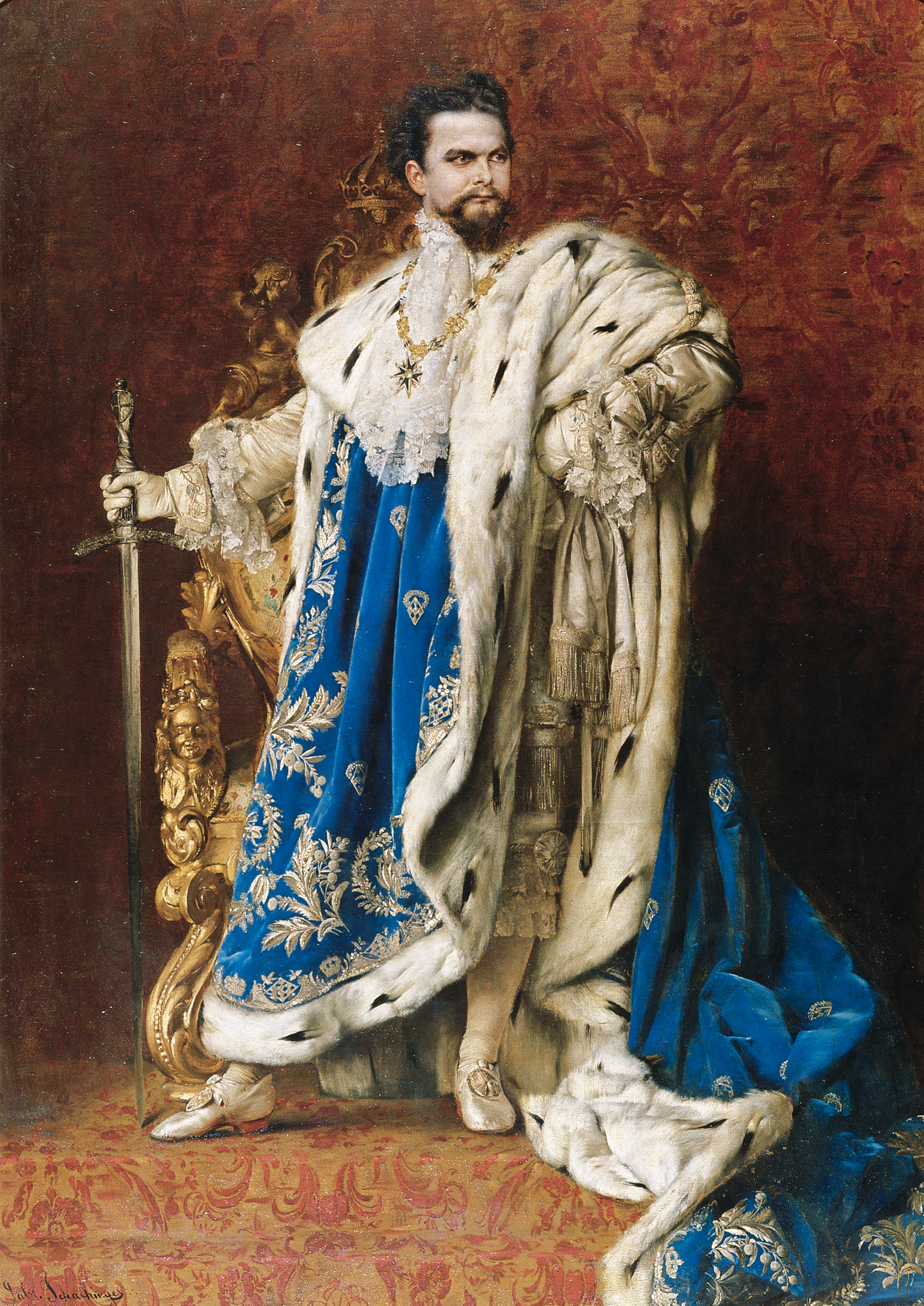
File:Ludwig II portrait by Gabriel Schachinger.jpg


King Ludwig II in the robes of the Order of St George
by Gabriel Schachinger, completed in 1887.
Image: Wikipedia

As a monarch in his era he appears to have retreated from the mundane requirements of office into his own sense of what Kingship was about. Hence the delight in ceremony and the setting for monarchy, but not the practical necessities of sitting at the desk with state papers, or indeed, avoiding near bankruptcy for the dynasty.

He brought energy to realising his vision. Perhaps this was an expression of a frustration at being relatively powerless in what seemed a mundane, modern world.

In some ways he is reminiscent of some modern figures in the world of entertainment who have everything and lose it all in a whirl of indulgence and eccentricity. The phenomenon may not be unique - what marks out "Mad King Ludwig" is who he was, and the wonderful legacy he left to his country and the world.

That said, King Ludwig was not as unusual as a builder as he might appear in some accounts of him. His building enthusiasm is only the ultimate in such activities. Nineteenth century Britain saw the re-medievalisation of the castles at Windsor and Arundel by King George IV and the Duke of Norfolk - the latter also built three future cathedrals. A similar process happened wth the Duke of Rutland at Belvoir, There was also the Marquess of Bute with Cardiff Castle, Castell Goch and the only recently completed Mount Stewart, whilst one of the Dukes of Portand built a great series of undergroud features at Welbeck, and like King Ludwig was a recluse. By contast Queen Victoria's osborne and Balmoral are rather subdued, but monarchs were still builders. So too was the church - think of the Anglican or Episcopalian cathedrals in Truro or Liverpool, Cork or Edinburgh, or the neo-gothic cathedrals of North America or Australia. What marked out King ludwig Ii was the scale in a short time in a relatively small kingdom.

He also is a witness to the appeal of German Romanticism in art and architecture, in word and music, to the middle ages. In that he was by no means unique. Other memebrs of the House of Wittelsbach and rulers like King Frederick William IV of Prussia embraced that in their buildings and ideas.

King Ludwig II, along with Kaiser Wilhelm II, is a reminder also of the vitality, or indeed hyper-vitality, of ideas about Kingship in the German Empire of those years. Not all the royal houses were as prosaic as, for example, the Kings of Wurttemburg.

There is much that is tragic, or at least painfully sad, about his life and death, and one can at least remember him in one's prayers on this anniversary and pray for the repose of his soul.


http://images.munich-highlights.com/200902/kapelle_ludwig.jpg

The memorial chapel erected near where King Ludwig II drowned in Lake Starnberg in 1886.


http://www.hansgruener.de/pictures/kanal_geschichte/geschichte_ludwig_II_lumus_152.jpg

King Ludwig II lying in state in the Hofkappelle Munich in 1886.
He is wearing the robes of the
Order of St Hubert.

Image: hansgreuner.de

In Keble Hall


On Sunday evening I was a guest at dinner in the Hall at Keble College. Designed by William Butterfield and completed in 1878 it was deliberately built to be seven feet longer than the Hall at Christ Church, and like that structure, is on the first floor, and approached by an impressive staircase. It includes a musician's gallery half way along from which the choir sang the college grace at the beginning of dinner.

It underwent a major cleaning and restoration in 2003-4, which revealed the splendour of the stencilled ceiling. This was my first visit to the hall and it is a spectacular piece of Victorian High Church confidence.

photo

The view looking east
Image: Philosopher Queen on Flickr


photo

The view towards High Table

Image: Andrew Harrington on Flickr

Quite apart from all that it was a very convivial evening discussing the history of Pakistan with our host as well as, this being Oxford, plenty of church gossip.