Once I was a clever boy learning the arts of Oxford... is a quotation from the verses written by Bishop Richard Fleming (c.1385-1431) for his tomb in Lincoln Cathedral. Fleming, the founder of Lincoln College in Oxford, is the subject of my research for a D. Phil., and, like me, a son of the West Riding. I have remarked in the past that I have a deeply meaningful on-going relationship with a dead fifteenth century bishop... it was Fleming who, in effect, enabled me to come to Oxford and to learn its arts, and for that I am immensely grateful.


Monday, 15 May 2017

French Inauguration


One does one's best to try to ignore the political antics on the southern side of the Channel but even I managed to take on board something of the Presidential inauguration of M.Macron in Paris

There was the depressing sight of him in a lounge suit rather than the white tie of past inaugurations and the comdedy provided by the BBC when its website referred to the President being presented with a "necklace" which had belonged to Napoleon. What they actually meant but were either too ignorant themselves to know or assumed their public were too ignorant to understand was the Grand Master's Collar of the Legion of Honour...

I came across a set of quotations from M. Macron which are taken from a book by Eric Fottorrino Macron Par Macron which is based around interviews with the new President.

The first to be quoted, and the one that caught my eye is as follows:

“In French politics, this absence is the presence of a King, a King whom, fundamentally, I don’t think the French people wanted dead,” said Macron. “The Revolution dug a deep emotional abyss, one that was imaginary and shared: the King is no more!” According to Macron, since the Revolution France has tried to fill this void, most notably with Napoleon and then Charles de Gaulle, which was only partially successful. “The rest of the time,” said Macron, “French democracy does not manage to fill this void.”

Well we know what the answer is to that do n't we?

There is more from the book at  http://www.gq-magazine.co.uk/article/emmanuel-macron-policies-beliefs-philosophy

All in all, let's face it - no match for le Sacre at Reims.

Vive Le Roi!


Saturday, 13 May 2017

Fatima Centenary


Today is the centenary of the first of the Marian apparitions and locutions at Fátima in Portugal in 1917.

The story of Fátima is well enough known, but for those who do not there is an introduction to the events of the months from May to October 1917 and their aftermath at Our Lady of Fátima

It is intensely moving and one which casts, if one may mix ones images, both light and along shadow across the intervening century and into the future. It is a message both of comfort and of hope and also of danger and warning. In no way has it lost its relevance.


The Fátima Visionaries
Lucia, Francisco and Jacinta in 1917
 
There is something very arresting about the faces of these three children that goes far beyond any matter of unfamiliarity with the camera. It is one of the great photographs of the twentieth century.

Image: Wikipedia


Our Lady of Fátima pray for us!
Lucia, Francisco and Jacinta pray for us!


Friday, 12 May 2017

Feast of SS Nereus and Achilleus and of St Pancras


This morning I went to a Mass celebrated by Fr Antom Webb at the Oxford Oratory to mark the tenth anniversary of his priestly Ordination.

Fr Webb was ordained on feast of SS Nereus and Achilleus in 2007in the Oxford Oratory, of which he was then a member. This is a feast always important to Oratorians and their church in Rome became Cardinal Baronius' basilica. Fr Anton subsequently left the Oratory and now ministers as a Prison Chaplain and Parish priest in the diocese of Northampton. 

If you are wondering who these two saints were here is the Third Reading from this morning's Office of Matins:

The brothers Nereus and Achilleus were eunuchs of Flavia Domitilla and were baptized by St. Peter at the same time as she herself and her mother Plautilla. Because they persuaded Domitilla to consecrate her virginity to God, they were accused of being Christians by Aurelian, who had been betrothed to her, and were sent to the island of Ponza. Soon afterwards, they were scourged in an effort to make them sacrifice to idols, and were taken to Terracina, where, after they had overcome the torture of the rack and flaming torches, they were beheaded. Their bodies were taken to Rome by their disciple Auspicius and buried on the Ardeatine Way. As for Flavia Domitilla, who had received the sacred veil of a virgin from Pope St. Clement, she also was deported to the island of Ponza, and after a long imprisonment was taken to Terracina. There, by the judge's orders, her dwelling was set on fire, and she won a glorious death, along with the virgins Theodora and Euphrosyna, her foster-sisters, on May 7, under Emperor Trajan. Their bodies were buried by the Deacon Caesarius.

There is more about their cult at Saints Nereus and Achilleus

Image result for Nereus and Achilleus

 The Relics of SS Nereus and Achilleus

Image: New Liturgical Movement 

It is also the feast of St Pancras. Of him the Breviary says that he was born of a noble Phrygian family, was baptized in Rome at the age of fourteen. Under the Emperors Diocletian and Maximian, he was arrested; and when he firmly refused to sacrifice to the gods, he was beheaded and so won the glorious crown of martyrdom. His body was buried secretly on the Via Aurelia by the matron Octavilla.

There is more about him at Pancras of Rome which includes folklore about him and other Ice Saints and why his cult developed in England, and there are more general links at St._Pancras

 https://upload.wikimedia.org/wikipedia/commons/thumb/a/a8/1300_Hl._Pankratius_Bodemuseum_anagoria.JPG/220px-1300_Hl._Pankratius_Bodemuseum_anagoria.JPG

 St Pancras - a northern German statue of circa 1300 now in the Bodemuseum

Image:Wikipedia

It was a happy occasion upon which to meet up with Fr Anton and other friends from the Oratory to help him celebrate this anniversary - and to reflect on how quickly time seems to pass...


Coronation Day 1937


Today is the eightieth anniversary of the Coronation of King George VI and Queen Elizabeth in 1937.

Image result for george vi coronation

Image: E-Bay


Portrait of H.M. King George VI in Coronation Robes, 1937 (oil on canvas) Queen Elizabeth's father.

Image:Pinterest/bridgemanart.com

http://68.media.tumblr.com/d9b8053b03e1992ae9b11d97ab9cb1e3/tumblr_o7369qLJrY1r65o3qo1_1280.jpg

Image: Tumblr
Image result for george vi coronation

Image: Daily Mail 

The Daily Express article King George VI's coronation: An event filled with mishaps recounts aspects of the day, and the problems involved in such an immensely complex event that turns very much on the actions of a few central participants.

Image result for george vi coronation

Image:gettyimages 


The information service Royal Central has a post, which I have slightly adapted, about the present Queen's diary for that day:

In a diary entry on 12 May 1937, from the then 11-year-old Princess Elizabeth recorded the experience of watching her father’s coronation at Westminster Abbey.

The diary entry opened with the fact that the day saw the young princess awakened at the early hour of 05:00 by the music of the Royal Marines band outside her window. Following an early breakfast, Princess Elizabeth got dressed in a gown of “silk and cream lace” with “little gold bows all the way down the middle” and “puffed sleeves with one little bow in the centre.”

After kissing “mummy” goodbye, the Princess and her younger sister, Princess Margaret, joined other relatives in a carriage heading towards the Abbey. “At first it was very jolty but we soon got used to it.”

Of the service, Elizabeth wrote of how her father looked “very beautiful in a crimson robe and the Cap of State” as he walked down the long aisle. She also noted that “I thought it all very, very wonderful and I expect the Abbey did, too. The arches and beams at the top were covered with a sort of haze of wonder as Papa was crowned, at least I thought so."

The young princess grew tired during the long service, however, noting afterwards that the “inordinately long” ceremony seemed to drag on for hours. She wrote that "at the end, the service got rather boring as it was all prayers" and that she and her grandmother “smiled at each other” in relief when they saw the word “Finis” on the final page.

Following the Coronation, the Royal Family returned to Buckingham Palace where they appeared on the balcony to greet the gathered crowds. The young princess noted that “millions of people were waiting below” on the Mall.

Following tea at 6 pm the tired Princess climbed into bed with legs that “ached terribly”.


Sunday, 7 May 2017

The Royal Guelphic Order


The latest College of Arms web newsletter has an article about the centenary of the Order of the British Empire which includes interesting material about the Royal Guelphic Order, established by the Prince Regent in 1815. After 1837 it was seen as an Order of the Kingdom of Hanover, where it came to be ranked second in that realm's system of honours. Since 1866 it has survived as a House rather than as a State Order.

 Image result for Royal Guelphic Order

Insignia of a Knight Grand Cross Military Division of the Royal Guelphic Order
Tallinn Museum of Orders

Image: Wikimedia

I was especially interested to see the painting of the Knight in full ceremonial robes, and I have edited the post to concentrate on the Royal Guelphic Order alone.


17. Guelphic Order p. 237 compressed

This pen and ink sketch, tinted with watercolour, shows a member of the Royal Guelphic Order in full regalia. He wears the blue mantle, star (sewn onto the mantle), collar and badge. 

 College of Arms MS 'The Guelphic Order' p. 237

The image is from a volume which belonged to Sir George Nayler, an Officer of Arms from 1792 and Garter King of Arms from 1822. All British orders of chivalry have officers, usually including a King of Arms (who need not be an Officer of Arms of the College of Arms). Nayler was involved with several orders, and was Genealogist of the Order of the Bath from 1792, King of Arms of the Royal Guelphic Order from 1815, and King of Arms of the Order of St Michael and St George from 1818.


18. Guelphic Order p. 206 compressed

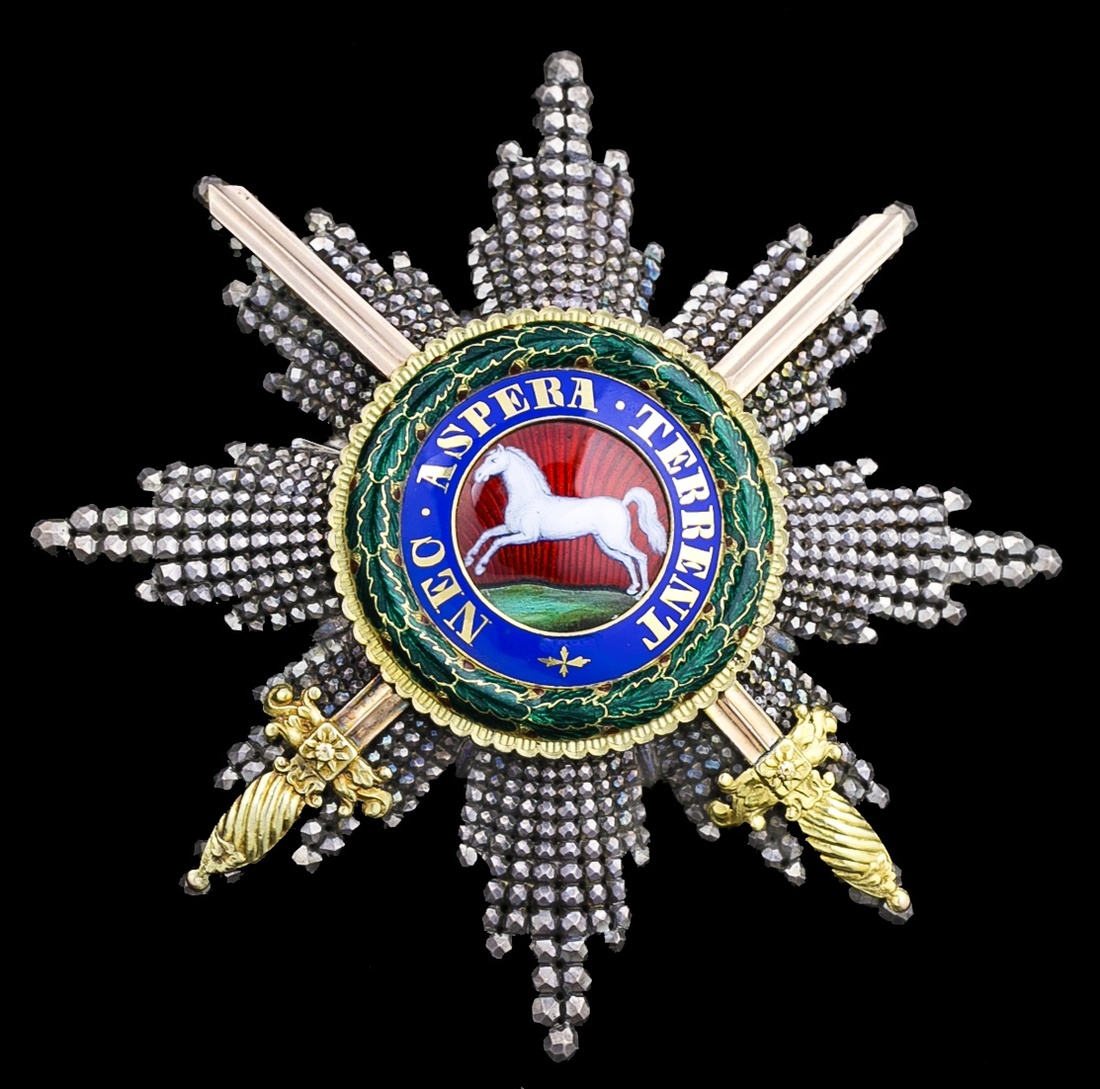
This illustration shows the badge of the Royal Guelphic Order, Military Division (as symbolised by the crossed swords), front and back. The front of the badge depicts the white horse of Hanover inside a blue enamel circle bearing the order's motto, NEC ASPERA TERRENT, and the back bears the cypher GR. The volume containing these images, which is of the nature of a scrapbook on the Order, includes a piece of the blue ribbon from which the badge should be hung, stuck onto the page.

College of Arms MS 'The Guelphic Order' p. 206

19. Guelphic Order p. 24 compressed

This painting is of the ceremonial collar of the Royal Guelphic Order. The collar of the Royal Guelphic Order includes the cypher of the monarch reigning at the time of its foundation (George III), together with lions passant gardant and crowns. The badge is of the Civil Division, being without swords.

College of Arms MS 'The Guelphic Order' p. 24

20. Guelphic Order p. 23 compressed

Signature of George, Prince Regent, approving the badge of the new Royal Guelphic Order in 1815. The volume into which this document is bound was owned by Sir George Nayler, who in 1815 was York Herald and the King of Arms of the Royal Guelphic Order.
College of Arms MS 'The Guelphic Order' p. 23
Images: College of Arms

There is an account of the Order, its original divisions and of its history after 1837, including its re-structuring in 1841 and its survival as a House Order after 1866 at Royal Guelphic Order


There are pictures of some of the insignia at The Royal Guelphic Order. A collar of the Order is, I believe, on display in the KOYLI Museum in Doncaster. 

Grand Cross: Star

Star of a Knight Grand Cross - Military Division
This is an early example

Image:medals.org.uk

Image result for Royal Guelphic Order

 A post-1860 GCH Star of continental manufacture

Image: The Saleroom/Spink

After 1837 and the accession of King Ernest Augustus I to the throne of Hanover the Order became more clearly a Hanoverian one. It was joined in 1839 by a new Order, possibly intended to replicate the part played by the Order of the Garter in England and taking precedence over the Royal Guelphic,  the Order of St. George, and late in 1865, on the eve of the loss of the kingdom the following year, by the Order of Ernst August which ranked third in the hierarchy.

The last British holder of the GCH was Field Marshal HRH Prince George Duke of Cambridge, who died in 1904.

Image result for Royal Guelphic Order 

A star of a Knight Commander - KCH - Military Division

Image:emedals.com 


Thursday, 4 May 2017

A rather Old Rite Bank Holiday


This last few days over the Bank Holiday and since I have been able to enjoy something of a festival of traditional liturgy, or indeed, liturgies.

Last Saturday I was at Blackfriars here in Oxford for a celebration of the Dominican Rite by Fr Oliver Keenan O.P. - a young priest whom I had the privilege of teaching medieval church history in 2013.

On Sunday I travelled with a friend to Reading for Mass at the FSSP church of St William of York, so here was the 1962 Rite celebrated , and when we returned to Oxford we were able to go, as usual to traditional Vespers at the Oxford Oratory.

Monday saw another Dominican Rite Mass, this time at SS Gregory and Augustine, and celebrated by Fr Matthew Jarvis O.P., again a fine young priest from Oxford Blackfriars and whom I know from our membership of the committee of Churches Together in Central Oxford.

Today, Thursday, there was a celebration of a High Mass from the 1962 Missal for the feast of the English Martyrs at the Oxford Oratory - this is, of course in effect 'the Mass the Martyrs died for.' Given that historic claim it is a pity that some of the more vocal enthusiasts for the Traditional  Liturgy were not there. I appreciate that not everyone can get to every such celebration, but I sometimes sense that some do not try as hard as others to support public celebrations of something they hold so dear.


Monday, 1 May 2017

The Acts of St Philip


Traditionally today is the feast of St Philip and St James, although since the 1950s they have moved around the calendar in early May.

Related image


The Crucifixion of St Philip 

Filippino Lippi from 1487-1502 

Cappella Strozzi, Basilica of Santa Maria Novella, Florence

Image: scuolaecclesiamater.org

Many more images of St Philip and St James can be found, with an Italian post at the same website, here

Here, from New Advent, are the texts of  The Acts of Philip  recording his missionary work as an Apostle and his eventual martyrdom- which includes acautionary story about the need to forgive and not curse our enemies.

May


https://upload.wikimedia.org/wikipedia/commons/thumb/d/d9/Fr%C3%A8res_Limbourg_-_Tr%C3%A8s_Riches_Heures_du_duc_de_Berry_-_mois_de_mai_-_Google_Art_Project.jpg/494px-Fr%C3%A8res_Limbourg_-_Tr%C3%A8s_Riches_Heures_du_duc_de_Berry_-_mois_de_mai_-_Google_Art_Project.jpg

Image: Wikimedia 

This calendar page from the Très Riches Heures is attributed to Jean de Limbourg.

Here is the aristocratic world of Maying, of courtship and high society in the early fifteenth century. The occasion is the May jaunt, a pageant celebrating the "joli mois de Mai" in which one had to wear green garments known as livree de mai, or at very least as a sign of festivity a garland or sprig of greenery with one's other attire. Looking at the musicians horns or trumpets and simple trombone it must also have been quite a noisy canter through the countryside.

It is an idyllic scene in a world that was far from idyllic, with France beset by internal strife and in 1415 had experienced the first invasion by King Henry V culminating in the English victory at Agincourt. In August 1417 King Henry was back with a campaign of systematic conquest in Normandy. The life of Paris and northern France as recorded in the Journal of the Bourgeois of Paris was grim and violent due to the collapse of the political consensus and the consequent lapse into violent disorder between Burgundians and Orleanists.

The element of escapism is borne out by the fact that in the background, beyond the woodland, is the Hôtel de Neslé, the Duke of Berry's Paris residence, and which was situated on the left bank of the Seine in the heart of the capital.

It is nonetheless idyllic, reminiscent in its ethos of the eighteenth century French school with painters such as Watteau, and a reminder of what the aristocracy - and their imitators no doubt - sought as their lifestyle. This was what life should be like at this time of year, and there was no reason for the artist not to depict it, even if in reality the young men were off fighting and the young women waiting their return in their family chateaux.