Once I was a clever boy learning the arts of Oxford... is a quotation from the verses written by Bishop Richard Fleming (c.1385-1431) for his tomb in Lincoln Cathedral. Fleming, the founder of Lincoln College in Oxford, is the subject of my research for a D. Phil., and, like me, a son of the West Riding. I have remarked in the past that I have a deeply meaningful on-going relationship with a dead fifteenth century bishop... it was Fleming who, in effect, enabled me to come to Oxford and to learn its arts, and for that I am immensely grateful.


Showing posts with label Order of the British Empire. Show all posts

Sunday, 4 June 2017

The Order of the British Empire


Today is the centenary of the foundation by King George V on June 4 1917 of The Most Excellent Order of the British Empire.

Last month the College of Arms web newsletter had an article about the Order and its insignia which the College introduced follows:

Dr Lynsey Darby, College of Arms Archivist, periodically creates online exhibitions from the College archives, which give a good overview of some of the kinds of archival material held here. The most recent addition is an exhibition on The Order of the British Empire and the Order of the Companions of Honour, to mark the centenary of their foundations, which includes a look at a predecessor Hanoverian order, the Royal Guelphic Order.

I adpted her material about the Royal Guelphic Order to produce a separate post last month, but that material can be seen again in Dr Darby's post.

There is another useful illustrated online introduction to the Order from Wikipedia at Order of the British Empire

Both accounts draw attention to that fact that women were admitted alongside men to the Order, but the use of the style of Dame has an older precedent. During the Civil War King Charles I createdat least one lady baronet, Mary Bolles from the West Riding of Yorkshire, and she was thereafter known as Dame Mary Bolles.

It might also be suggested that the Order had a precedent in the The Most Eminent Order of the Indian Empire, founded in 1878 and reorganised in 1887. This had a similar title, not totally disimilar insignia and the riband was similar in colour to that assigned in 1917, but changed in 1937 for the Order of the British Empire. Both had a similar type of recipient. There is more about that Order at Order of the Indian Empire

Queen Elizabeth II wearing the Girls of Great Britain Tiara 

H.M.The Queen in the her robes as Sovereign of the Order of the British Empire

Image:Pinterest/indypendentroyalty.tumblr.com

The present distinctive rose-pink and grey robes and riband were introduced at the suggestion of Queen Mary who became Grand Master of the Order in 1936 as well as the conjoint portraits of King George V and herself rather than the figure of Britannia on the original insignia.


Sunday, 7 May 2017

The Royal Guelphic Order


The latest College of Arms web newsletter has an article about the centenary of the Order of the British Empire which includes interesting material about the Royal Guelphic Order, established by the Prince Regent in 1815. After 1837 it was seen as an Order of the Kingdom of Hanover, where it came to be ranked second in that realm's system of honours. Since 1866 it has survived as a House rather than as a State Order.

 Image result for Royal Guelphic Order

Insignia of a Knight Grand Cross Military Division of the Royal Guelphic Order
Tallinn Museum of Orders

Image: Wikimedia

I was especially interested to see the painting of the Knight in full ceremonial robes, and I have edited the post to concentrate on the Royal Guelphic Order alone.


17. Guelphic Order p. 237 compressed

This pen and ink sketch, tinted with watercolour, shows a member of the Royal Guelphic Order in full regalia. He wears the blue mantle, star (sewn onto the mantle), collar and badge. 

 College of Arms MS 'The Guelphic Order' p. 237

The image is from a volume which belonged to Sir George Nayler, an Officer of Arms from 1792 and Garter King of Arms from 1822. All British orders of chivalry have officers, usually including a King of Arms (who need not be an Officer of Arms of the College of Arms). Nayler was involved with several orders, and was Genealogist of the Order of the Bath from 1792, King of Arms of the Royal Guelphic Order from 1815, and King of Arms of the Order of St Michael and St George from 1818.


18. Guelphic Order p. 206 compressed

This illustration shows the badge of the Royal Guelphic Order, Military Division (as symbolised by the crossed swords), front and back. The front of the badge depicts the white horse of Hanover inside a blue enamel circle bearing the order's motto, NEC ASPERA TERRENT, and the back bears the cypher GR. The volume containing these images, which is of the nature of a scrapbook on the Order, includes a piece of the blue ribbon from which the badge should be hung, stuck onto the page.

College of Arms MS 'The Guelphic Order' p. 206

19. Guelphic Order p. 24 compressed

This painting is of the ceremonial collar of the Royal Guelphic Order. The collar of the Royal Guelphic Order includes the cypher of the monarch reigning at the time of its foundation (George III), together with lions passant gardant and crowns. The badge is of the Civil Division, being without swords.

College of Arms MS 'The Guelphic Order' p. 24

20. Guelphic Order p. 23 compressed

Signature of George, Prince Regent, approving the badge of the new Royal Guelphic Order in 1815. The volume into which this document is bound was owned by Sir George Nayler, who in 1815 was York Herald and the King of Arms of the Royal Guelphic Order.
College of Arms MS 'The Guelphic Order' p. 23
Images: College of Arms

There is an account of the Order, its original divisions and of its history after 1837, including its re-structuring in 1841 and its survival as a House Order after 1866 at Royal Guelphic Order


There are pictures of some of the insignia at The Royal Guelphic Order. A collar of the Order is, I believe, on display in the KOYLI Museum in Doncaster. 

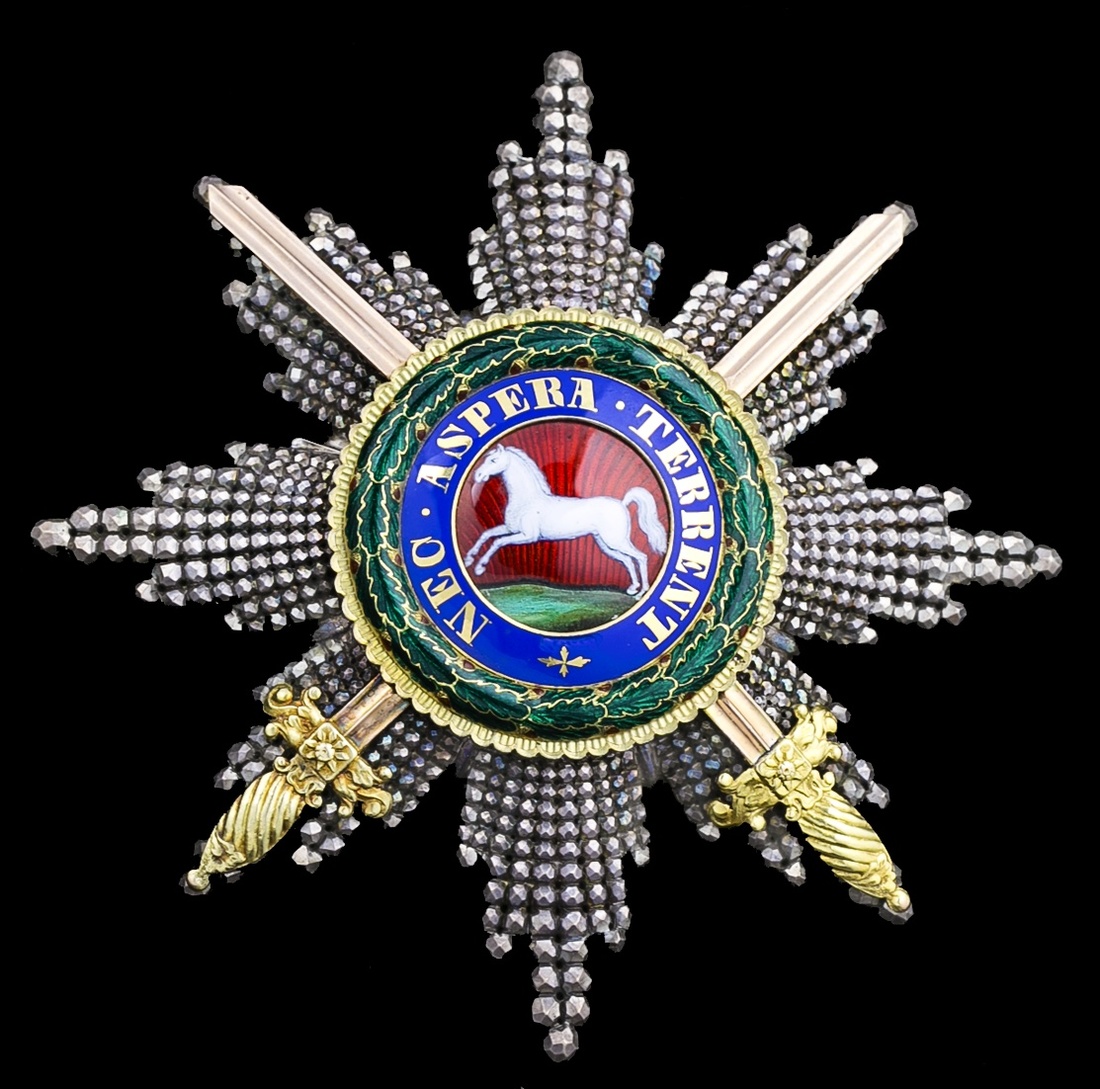
Grand Cross: Star

Star of a Knight Grand Cross - Military Division
This is an early example

Image:medals.org.uk

Image result for Royal Guelphic Order

 A post-1860 GCH Star of continental manufacture

Image: The Saleroom/Spink

After 1837 and the accession of King Ernest Augustus I to the throne of Hanover the Order became more clearly a Hanoverian one. It was joined in 1839 by a new Order, possibly intended to replicate the part played by the Order of the Garter in England and taking precedence over the Royal Guelphic,  the Order of St. George, and late in 1865, on the eve of the loss of the kingdom the following year, by the Order of Ernst August which ranked third in the hierarchy.

The last British holder of the GCH was Field Marshal HRH Prince George Duke of Cambridge, who died in 1904.

Image result for Royal Guelphic Order 

A star of a Knight Commander - KCH - Military Division

Image:emedals.com 


Friday, 9 March 2012

The Queen and the Order of the British Empire


The Daily Telegraph has this rather fine photograph of The Queen at the sevice of the Most Excellent Order of the British Empire which was held in St Paul's Cathedral this week. Her Majesty is wearing her robes as Sovereign of the Order.

The Queen and the Duke of Edinburgh lead a special service of dedication and thanks for the Order of the British Empire at St Paul's Cathedral

The Queen at the service.
Her Majesty is wearing a tiara given to her by Queen Mary, who suggested the present rose-pink colour for the Order in place of the original purple.

Image:Geoff Pugh / Daily Telegraph

The Queen and the Duke of Edinburgh led worshippers at a special service of dedication and thanks for the Order of the British Empire. Around 2,000 people holding the honour filled St Paul's Cathedral where they made an act of personal dedication led by the Bishop of London, Dr Richard Chartres. There are more pictures of the service here.

The Order, which was founded in 1917, has its chapel in the crypt of the cathedral, and the provisoon of uch chapels and the holding of services of the various Orders is an interesting development of the twentieth century. In 1900 there was only the Garter chapel at Windsor, and the ceremonial of procession and installation more fully restored in 1948 at its sixth centenary. The religious ceremonies of the Order of St Patrick had been abandoned at St Patrick's cathedral in Dublin with the dis-establishment of the Church of Ireland in 1869-71, and there were no other chapels functioning.

However in 1905 that of the Order of St Michael and St George was inaugurated by King Edward VII in St Paul's, the Thistle Chapel was built at St Giles Edinburgh in 1911, and the Order of the Bath established (or re-established) in King Henry VII's Chapel at Westminster Abbey in 1913. To this has been added the Chapel of the Order of the British Empire at St Pauls and the use by the Royal Victorian Order of the Queen's Chapel of the Savoy. All these Orders now have annual, bi-annual or trienniel services with the installation of Knights or Knights Grand Cross and the wearing of the appropriate robes and insignia. These are, therefore, all good instances of that recovery - I much prefer to use that term rather than 'invention' - of tradition by the Crown in this country, and defying the levelling tendency, or to 'dumb down.' It conveys a dynamic tradition, of a belief in received practice.