Once I was a clever boy learning the arts of Oxford... is a quotation from the verses written by Bishop Richard Fleming (c.1385-1431) for his tomb in Lincoln Cathedral. Fleming, the founder of Lincoln College in Oxford, is the subject of my research for a D. Phil., and, like me, a son of the West Riding. I have remarked in the past that I have a deeply meaningful on-going relationship with a dead fifteenth century bishop... it was Fleming who, in effect, enabled me to come to Oxford and to learn its arts, and for that I am immensely grateful.


Saturday, 10 January 2015

Archbishop Laud


370 years ago, on January 10th 1645, Archbishop William Laud of Canterbury was beheaded on Tower Hill by the Parliamentarian regime.

Portrait of William Laud

Archbishop William Laud

Image: evelynsdiary.com

There is an online account of his life and trial here, and the excellent account of him and his career by Anthony Milton from the Oxford Dictionary of National Biography can be read at William Laud

As these live show the Reading born Archbishop was intimately associated with Oxford, where he proved to be one of the greatest Chancellors of the University. In 1663 he was buried at St John's, his old college, which he had enriched, notably by the building of Canterbury Quad, and the college still possesses vestments he gave and the scull cap he is said to have worn to the scaffold.

Elsewhere in Oxford the porch and statue of the Virgin and Child at St Mary's and the crucifixion scene in the east window of Lincoln College Chapel (built by his great rival John Williams, Bishop of Lincoln and later Archbishop of York) were both cited as evidence to support the charges brought against him in 1644 at his show-trial. This and his ultimate fate displayed the vicious hatred of his opponents.

High Church rather than the Romaniser he was alleged or believed to be Laud made visible a vision and reality of a Church of England that sought to stand in the tradition of historic Christianity.By his life work ,a nd more importantly perhaps, his martyrdom, he gave an enduring strength to that possibility. It informed the Restoration Church and the High Church party of the period up to the Oxford Movement. that revered Laud, and doubtless could not have come about as it did, if at all, without his example.

He remains a controversial figure - the late Professor Patrick Collinson in 1980 condemned Laud as "the greatest calamity ever visited upon the English Church." Others, myself included, would disagree and see Laud as one of its greatest blessings.

My previous posts about the Archbishop can be read at Archbishop William Laud, at Archbishop William Laud, and at Vilifying and celebrating Archbishop Laud


Tuesday, 6 January 2015

Epiphany publication of the calendar


The New Liturgical Movement has an interesting pair of linked posts about the venerable tradition of formally publishing after the Gospel the date of Easter, and, in the Roman Rite, of other ecclesiastical dates of the coming year at Epiphany, which can be read at Publication of the Date of Easter 2015 on the Day of the Epiphany


The Epiphany of Our Lord


Today is the Epiphany of Our Lord according to the traditional use of the Church.

As I have posted on this day in recent years I, and I think many others, would wish to see a return to the traditional date of January 6th for its observance in the Ordinary Form in England and Wales - and indeed in other countries as well - rather tham transferring it to the Sunday. I do very much hope that the Bishops will resolve to petition ther Holy See for a restoration of the customary dates for Epiphany, Ascension and Corpus Christi in the near future. It is surely not unreasonable to expect the faithful - if such they really are - to go to Mass on a day other than Sunday on three occasions during the year, or if they are in a parochial unit with several churches but only one priest to travel a slight distance - it will certainly not be as far as the Magi travelled.

I was quite happy to observe an anticipated Mass and Vespers of Epiphany in the Ordinary Form last Sunday, though otherwise I said the Office for the Second Sunday after Christmas, but, thanks to the rules governing the Extraordinary Form, I am able to observe this wonderful feast on its proper day, that is today. So, as in previous years, and as I described in my post Epiphanylast year, I am saying the Office for Epiphany, will go to the EF Low Mass at the Oxford Oratory at 12.15 and then, this evening, attend the Sung Mass at SS Gregory and Augustine at 6. Those possibilities do, I realise, make Catholic life in Oxford both richer and easier in practical terms than in many other places, and thanks be to God for that fact.


Adoration of the Magi by Gentile da Fabriano

The Adoration of the Magi

This work in tempera on wood, also called Pala Strozzi, was painted in 1423 by Gentile da Fabriano, and is one of the best known images of the Epiphany. It was commissioned by the wealthy banker and intellectual Palla Strozzi for the family chapel in the church of Santa Trinita.

 Image: uffizi.org

A Happy and Joyful Epiphany to you all.


Monday, 5 January 2015

Buckinghamshire Coin Hoard


Just before Christmas, on December 21st, a metal-detector found a hoard of more than 5000 pristine silver pennies from the reigns of King Aethelred II, 978-1016, and King Cnut, 1016-1035, which had been carefully concealed at Lenborough in Buckinghamshire.

This is clearly a major discovery and is covered widely online. The latest BBC report can be read at Buckinghamshire ancient coin hoard find 'unprecedented'

The Daily Telegraph account can be read at Amateur treasure hunter's £1m find of Anglo Saxon coins and the Daily Mail repoert which is well-illustrated in their style can be seen at Amateur treasure hunter finds £1m hoard of Anglo Saxon coins

The discovery is already written up on Wikipedia, and that can be read at Lenborough Hoard

As with so many other recent discoveries from the Anglo-Saxon period our knowledge continues to expand with new finds and re-shape our understanding of this crucial period in the development of the country.


Preparing the Way of the Lord in Oxford


We are already at Twelfth Night so before we leave the main part of the Christmas season here is a quick glance back to Advent at the Oxford Oratory. I have now managed to download some photographs sent to me by a friend of the Musical Oratory held at St Aloysius in Oxford on the evening of December 17th to reflect upon Advent themes. This year the particular emphasis was on St John the Baptist as the forerunner. The Musical Oratory is a long-standing Oratorian tradition, combining pieces for the choir, congregational singing and readings, together with a sermon, and ending with Benediction.


Lighting the altar candles


Fr Nicholas Edmonds-Smith C.O. preaches the sermon


The altar ready for Benediction


The beginning of Solemn Benediction

Images:Irim Sarwar

This was a beautiful and reflective devotion, helping the congregation to focus on the real themes of Advent rather than just the pre-Christmas shopping.


Thursday, 1 January 2015

The Feast of the Circumcision of Our Lord


Nowadays re-named the Solemnity of Mary, Mother of God, today is traditionally celebrated as the feast of the Circumcision of Our Lord. Both titles refer to the same concept, that is, that Jesus was born to a Jewish mother, the representative of the people of the Old Covenant, and that her son was full heir to the promises and obligations of that tradition. Only from that beginning could He inaugurate the New Covenant with all of mankind.   


The Circumcision of Christ
Michael Pacher, 1430 - 1498
The St Wolfgang Altarpiece, 1479-81

Image:squishyjesus.blogspot.com


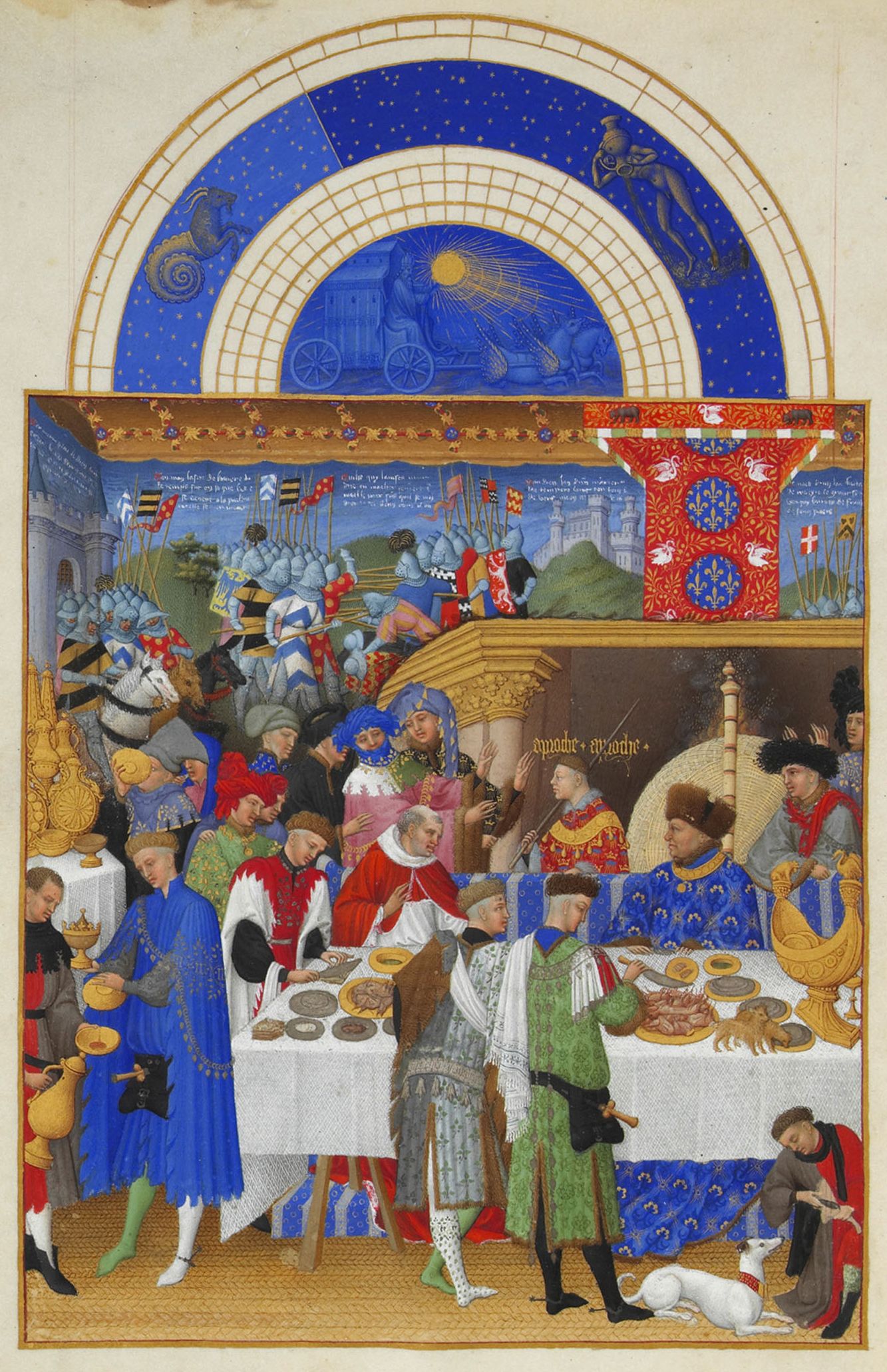
January


Image:Wikipedia

The Duke of Berry (1340-1416), of whom there is an online biography here, is depicted dressed in blue and wearing a livery or chivalric collar and seated to the right, and wearing a handsome fur hat to indicate his status, celebrates the Christmas and Epipany seasons. There appears to be the exchange of gifts - New Year or Epiphany ones - and a cultivated and splendid lifestyle. This is a pattern which would have been replicated or emulated across Europe in royal and aristocratic households.

The importance of the Duke is further indicated by the canopy and cloth of estate with his arms above his head. The tapestries or hangings with their battle scenes which decorate the room are a further sign of wealth. They would have travelled with the household and been hung to decorate whichever residence was in use at the time. What today might appear the rather stark interior of later medieval residences  could have rapidly been transformed by such wallhangings - which also would have provided insulation. A superb contemporary set which depicts the Apocalypse have survived and can be seen at Angers in the castle. In a similar way the trestle table once covered with a fine linen cloth assumes far greater dignity.

The firescreen is also an interesting feature, as is the woven rush matting - rushes on the floor clearly did not mean a strewn hay stack as one might be led to believe, but a fitted covering in such a grand household. Similar floor coverings can be seen today in some National Trust properties such as Hardwick Hall in Derbyshire.

On the left is a sideboard or buffet with a display of gold plate as was expected on such occasions to display princely magnificence, and other splendid plate is in use at the feast, as well as an aquamanile for washing the hands of those dining at the table. The pieces shown are very similar to the relatively few surviving examples from the period in museums and collections such as those of the Oxford and Cambridge colleges. My post The Royal Gold Cup is about another surviving piece, now in the British Museum, of such splendid plate which is specifically linked to the Duke and his nephew King Charles VI.

The whole scene is redolent of courtly life, well mannered, polite, fashionable and stylish - even the greyhound has an air of elegant langour.

The painting is attributed to the artist identified as the 'the courtly painter'. 

The effigy of the Duke in the cathedral of St Etienne in Bourges by Jean de Cambrai shows a great similarity to the figure of him in the illumination:


Tomb of Jean, Duc de Berry

Image:courtauldprints.com


Duc de Berry.jpg

Image:Wikipedia

The Duke was a major player in the French political system both a member of the Royal family, being son of King Charles V, and as a grand seigneur with his appanage of Berry.  That so much of French  politics hinged on the rivalries between Royal Dukes such as Orleans, Burgandy and Berry when King Charles VI was periodically incapacitated by mental illness raised tensions and weakened the ability to respond to the potential threat posed by King Henry V.

Hoever at the beginning of January as the Duke and his court feasted they cannot have imagined the scale of that threat, or of its impact within the coming year.


The Très Riches Heures Calendar pages


I have decided to post again this year, as I did three years ago and last year, the appropriate monthly calendar page from the Très Riches Heures of Jean, Duc de Berry. There is an article about this famous Book of Hours here, which has links to articles on the artists involved. 

The manuscript was begun by the Limbourg brothers Herman (b. 1385), Paul (b.1386 or 7) and Jean (b. 1388) in 1412, but left unfinished when they all died, probably of plague, in February 1416. The Duke died that same year and the Hours were completed by other artists, later in the century, in a recognisably different style. The majority of the calendar pages are by the Limbourgs themselves, and include marvellous views of the ducal and of other royal residences in France. 

What they do not indicate in their idyllic representations - and, given the nature of the book, why should they I might add - is that they were produced against the background of civil conflict between the Armagnacs and the Burgundians, as detailed so graphically in the Journal of the Bourgeois of Paris, and, in 1415, King Henry V's invasion and the French defeat at Agincourt.

That six hundredth anniversary is what prompts me to reissue these posts, particularly as I am involved in planning a projected conference in Oxford this summer on Agincourt - I will post initial details of that and other conferences in the series in a few days time.

I will post each Calendar page separately on the first day of the month with revised notes about the scene and places depicted, and where possible their place in the events of 1415.