Once I was a clever boy learning the arts of Oxford... is a quotation from the verses written by Bishop Richard Fleming (c.1385-1431) for his tomb in Lincoln Cathedral. Fleming, the founder of Lincoln College in Oxford, is the subject of my research for a D. Phil., and, like me, a son of the West Riding. I have remarked in the past that I have a deeply meaningful on-going relationship with a dead fifteenth century bishop... it was Fleming who, in effect, enabled me to come to Oxford and to learn its arts, and for that I am immensely grateful.


Saturday, 4 January 2014

' At Home' with the Oxford Oratory


This afternoon I was one of the many guests invited by the Oxford Oratorians to their annual 'At Home' for friends and supporters. This is always an enjoyable occasion, a chance to meet up with other members of the congregation and to get to know some of them better. The hospitality is always generous and the welcome warm, and there is always a sense of the shared purpose of clergy and parishioners.

I think I have made theis point in previous years, but it is worth making again, that the Oratory parish has a genuine sense of community without the forced aspect of phrases like "Our Parish Community" which one comes accross in some other churches - Catholic and non-Catholic alike. We are, of course, a very diverse group with different emphases and interests, different backgrounds and formation, but we do sense a common identity that is in no way imposed upon us. We do not need to be told we are a community to know and appreciate that we are one.

Congregatio Oratorii Oxon


Friday, 3 January 2014

Catching up with friends


This time of the year can be agood one for seeing old friends, and that s what I have been doing over the last two days.

Yestewrday afternoon I travelled up to London at the invitation of a friend to have a meal with him and others at the southbank complex of the British Film Institute - the website of the BFI can be seen at BFI Southbank . I had not been there before and finding my way through the Southbank sites was a little confusing at first for a country mouse who suddenly found himself in the big city, but was an interesting place to visit and to learn about before the others arrived. We had a very convivial meal in the Benugo cafe bar of the BFI, and a happy exchage of ideas and news about what we are all doing, about the Church (this was an all Catholic occasion), or theatre or people's wedding or job plans. I always enjoy such visits to London with the sense of liveliness and of energy which is integral to the capital city.

Today I met up in Oxford with another old friend from my days at Pusey House. He was back for an overnight stay and we met up for a drink, going to one of our old haunts, the Eagle and Child (aka The Bird and Baby) on St Giles. This was a welcome chance to talk about his wife and baby, thier new house and his teaching post. Once again an opportunity to reaffirm friendship and exchange ideas, aims and hopes.

Both occasions were a good way to start a new year, building on what is already established and energising one for the future.


The Dukays


Over Christmas I managed, at the second attempt, to read the whole of Lajos Zilahy's 1949 novel The Dukays. I had statred it some time ago, got half-way through and was distracted from it, and realised I would have to start again. Given that it is almost 800 pages long, and is a novel that you want to keep reading it is a book for when one has a few days free of other things to worry about.


Image: Amazon

The novel has something of War and Peace, or Gone with the Wind about it combined with much of the ideas in Brideshead Revisited. I do not know how much, if at all, any of those works influenced Zilahy but there are resemblances.

Set in the years before the Great War and in the inter-war years it is the story of the Dukays, a great Hungarian aristocratic family and how they react and adapt to the dissolution of the Habsburg Monarchy and life in the post-Trianon Hungary under Admiral Horthy.

It is a richly textured story, told in different and varying voices and ways, including a skillful pastiche of an inaccurate Court memoir by one of the family. It is more than just a family saga or a history of a class or country - it is a  wide canvas painted with both broad brush strokes and fine detail.

Whether or not one necessarily shares  all of Zilahy's emphases or interpretations it is a book well worth reading, both as a portrait of an age and as an enjoyable and fascinating story.

Lajos Zilahy (1891-1974) was born in Transylvania, went into exile in the USA in 1947 and is considered by many the leading Hungarian writer of his era. There is an online introduction to his life here and his great nephew has a very interesting piece in  Some reminiscences about Lajos Zilahy.

The novel has been reprinted in paperback by Prion in their 'Lost Treasures' series. Though it stands by itself the book is the middle section of a trilogy looking at the history of Hungary through the life of the family - Century in Scarlet looks at the Metternich era and the 1848 Revolution, whilst The Angry Angel continues the story into the Second World War.


Plenary Indulgences


Fr Tim Finigan has started his posts on The Hermeneutic of Continuity this year with an extremely useful guide as to how to obtain Plenary Indulgences, both on a day by day basis and on particular days. For those he provides a list of both fixed days and variable anniversaries. It can be read at Plenary indulgences for particular days.

I missed out on January 1st, but his list gives a quick guide for planning ahead, as well as providing for obtaining a Plenary Indulgence as part of one's regular spiritual discipline. It is the sort of information that would not come amiss in the porch of every church.

Thursday, 2 January 2014

The Sign of Peace


Fr Hunwicke had an interesting post the other day about the position of the Sign of Peace in the Mass and the dating of that useage in the Roman Rite which can be read at  Where should the PAX come?

Quite apart from the intrinsic liturgical and historical interest of what he says in that particular piece it is also good to have Fr John back on line and helping one to think about what goes on at the altar in the light of the Church's history and tradition.


Wednesday, 1 January 2014

January


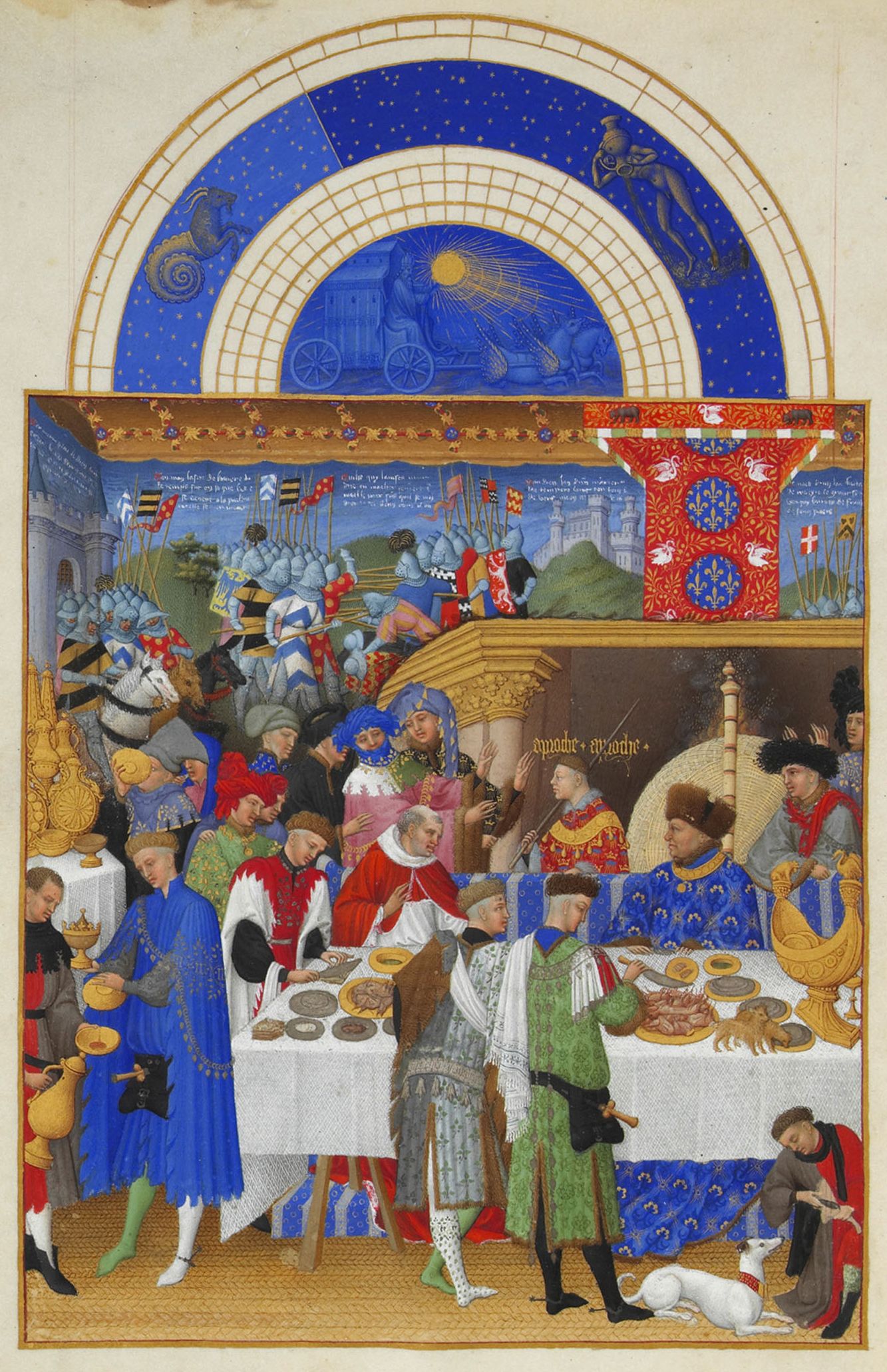
File:Les Très Riches Heures du duc de Berry Janvier.jpg

Image:Wikipedia

The Duke of Berry (1340-1416), of whom there is an online biography here, is depicted dressed in blue and wearing a livery or chivalric collar and seated to the right, and wearing a handsome fur hat to indicate his status, celebrates the Christmas and Epipany seasons. There appears to be the exchange of gifts - New Year or Epiphany ones - and a cultivated and splendid lifestyle. This is a pattern which would have been replicated or emulated across Europe in royal and aristocratic households.

The importance of the Duke is further indicated by the canopy and cloth of estate with his arms above his head. The tapestries or hangings with their battle scenes which decorate the room are a further sign of wealth. They would have travelled with the household and been hung to decorate whichever residence was in use at the time. What today might appear the rather stark interior of later medieval residences  could have rapidly been transformed by such wallhangings - which also would have provided insulation. A superb contemporary set which depicts the Apocalypse have survived and can be seen at Angers in the castle. In a similar way the trestle table once covered with a fine linen cloth assumes far greater dignity.

The firescreen is also an interesting feature, as is the woven rush matting - rushes on the floor clearly did not mean a strewn hay stack as one might be led to believe, but a fitted covering in such a grand household. Similar floor coverings can be seen today in some National Trust properties such as Hardwick Hall in Derbyshire.

On the left is a sideboard or buffet with a display of gold plate as was expected on such occasions to display princely magnificence, and other splendid plate is in use at the feast, as well as an aquamanile for washing the hands of those dining at the table. The pieces shown are very similar to the relatively few surviving examples from the period in museums and collections such as those of the Oxford and Cambridge colleges. My post The Royal Gold Cup is about another surviving piece, now in the British Museum, of such splendid plate which is specifically linked to the Duke and his nephew King Charles VI.


The whole scene is redolent of courtly life, well mannered, polite, fashionable and stylish - even the greyhound has an air of elegant langour.

The painting is attributed to the artist identified as the 'the courtly painter'. 

The effigy of the Duke in the cathedral of St Etienne in Bourges by Jean de Cambrai shows a great similarity to the figure of him in the illumination:


Tomb of Jean, Duc de Berry

Image:courtauldprints.com


Duc de Berry.jpg

Image:Wikipedia


The Très Riches Heures Calendar pages


One minor New Year's resolution for 2014 is to post again this year, as I did two years ago, the appropriate monthly calendar page from the Très Riches Heures of Jean, Duc de Berry. There is an article about this famous Book of Hours here, which has links to articles on the artists involved. 

The manuscript was begun by the Limbourg brothers Herman (b. 1385), Paul (b.1386 or 7) and Jean (b. 1388) in 1412, but left unfinished when they all died, probably of plague, in February 1416. The Duke died that same year and the Hours were completed by other artists, later in the century, in a recognisably different style. The majority of the calendar pages are by the Limbourgs themselves, and include marvellous views of the ducal and of other royal residences in France. 

What they do not indicate in their idyllic representations - and, given the nature of the book, why should they I might add - is that they were produced against the background of civil conflict between the Armagnacs and the Burgundians, as detailed so graphically in the Journal of the Bourgeois of Paris, and, in 1415, King Henry V's invasion and the French defeat at Agincourt. 

I will post each one separately on the first day of the month with some revised notes about the scene and places depicted.

Seeing in the New Year


I think I can say I saw in this New Year in a fairly pious manner. On New year's Eve I attended the 6pm Mass at the Oratory and found myself serving it in the absence of anyone else to do so, and helped set up for the Mass to mark the New Year.

After supper with friends I went back to the Ortaory for a beautiful and meditative Vigil Mass for the Mew Year celebrated by the Provost Fr Daniel. This tradition was establishedin 2000 and has become part of the Oratory calendar. This concluded with Exposition of the Blessed Sacrament and a time of prayer before it. At midnight, with an organ fanfare and the ringing of bells to introduce it, we had Solemn Benediction to consecrate and prepare ourselves for 2014 and whatever it may bring.

Afterwards we celebrated the turn of the year in a more secular way with wine and mince pies in the Parish Centre, wishing one another the best for the coming year.

This morning I was back at church for the 10am Mass for the Solemnity of Mary the Mother of God. This was, as it is always is, well attended and asign of the congregation's committment to the faith in the New Year. After that it was time for coffee with friends from church in a nearby cafe and then lunch with another friend, and a chance to talk about shared interests in the life of the Church and Oxford. Now there is time to relax and do some serious reading, sustained by copious amounts of Earl Grey tea.