Once I was a clever boy learning the arts of Oxford... is a quotation from the verses written by Bishop Richard Fleming (c.1385-1431) for his tomb in Lincoln Cathedral. Fleming, the founder of Lincoln College in Oxford, is the subject of my research for a D. Phil., and, like me, a son of the West Riding. I have remarked in the past that I have a deeply meaningful on-going relationship with a dead fifteenth century bishop... it was Fleming who, in effect, enabled me to come to Oxford and to learn its arts, and for that I am immensely grateful.


Showing posts with label Hungary. Show all posts

Monday, 29 August 2016

Battle of Mohács 1526


Today is the 490th anniversary of the battle of Mohács. This was one of the most significant battles not only in Hungarian history but in that of Europe. If one consequence was the destruction of the medieval kingdom of Hungary and the advance of the Turks into the central Danuble plain where they remained until the end of the seventeenth century, another was the creation in consequence of that union of territories which constituted the birth of what was to become Austria Hungary.

In 1490 the death of King Matthias Corvinus led to the accession of the Polish Jagiellonian King Vladislaus II, under whom the central power of the monarchy in Hungary declined, aristocratic power increased, there was an increasing likelihood that the monarchy might become elctive as was to happen in Poland later on in the century, and meanwhile the Ottomans were gathering strength to the south. The political background is set out in the online account of the Battle of Mohács and in the related article on the leading nobleman John Zápolya.  As that points out it was the birth in 1506 of the future King Louis II that made the survival of the Hungarian Jagiellonians possible. In 1514 the  King Vladislaus II faced a major peasant rebellion led by György Dózsa - this had begun as a crusade against the Turks which then evolved into a jacquerie, which further weakened the realm.

King Louis II succeeded at the age of ten in 1516 to the thrones of both Hungary and Bohemia, and had been crowned in his father's lifetime in the case of each realm. He was taken up by the Emperor Maximilian who arranged adouble marraige, that of King Louis to the Emperor's grandaughter Mary, who was tens months oldere than him, and of Louis' sister Anne to Maximilian's second grandson the Archduke Ferdinand ( eventually the Emperor Ferdinand I ). As a dutiful Habsburg the Emperor did not pass up the chance of prudential and providential marriages for the next generation.

https://upload.wikimedia.org/wikipedia/commons/d/d4/Bernhard_Strigel_-_Emperor_Maximilian_I_with_His_Family_-_Google_Art_Project.jpg 

Emperor Maximilian I and his family in 1515
At the front the future Emperors Ferdinand I and Charles V and on the right King Louis II

Image: Wikimedia

http://media.gettyimages.com/photos/portrait-of-louis-ii-of-hungary-king-of-hungary-bohemia-and-croatia-picture-id164083896

King Louis II

Image:gettyimage.com 

 Image result for Louis II of Hungary

Queen Mary of Austria

Image: Pinterest 

 There is a biography of the young Hungarian king at Louis II of Hungary, who was just 20 when his army was crushed by the Ottomans at Mohács.


https://upload.wikimedia.org/wikipedia/commons/thumb/0/0a/Lajos_II.jpg/220px-Lajos_II.jpg

King Louis II

  A portrait by Titian

Image: Wikimedia

The King, fleeing from the battle was thrown by his horse and drowned. His body was recoverd and removed for burial elsewhere. A small gold hear badge he was wearing was returned to his Queen who wore it until her death in 1558, when her will directed it should be melted down and the proceeds given to the poor.

https://s-media-cache-ak0.pinimg.com/originals/f6/ee/95/f6ee950203042e2eecc204c0a04e32ff.jpg

The recovery of the body of King Louis II as shown in a nineteenth century painting

Image:Pinterest

  Image result for Louis II of Hungary 

King Louis II

Image: Pinterest

Tournament Sallet Made for Louis II, King of Hungary and Bohemia 

Tournament sallet made for King Louis II

Made in Augsburg and attributed to Kolman Helmschmid ~1525.

 Image:pinterest 

“May Allah be merciful to him, and punish those who misled his inexperience,” said Suleiman of his 20-year-old opposite number. “It was not my wish that he should thus be cut off, while he had scarcely tasted the sweets of life and royalty.”

The Sultan was less merciful to his prisoners - two days later came theie execution as recounted at  1526: 2000 Hungarian prisoners after the Battle of Mohacs

Mohács was decisive and disastrous - I gather a Hungarian proverb to set things in context of a disaster or failure is "Things were worse after Mohács." It marks the last of a series of late medieval battles which were major defeats for the Christian side in the conflict with the Ottomans - the Plain of Blackbirds ( Vivovdan) in 1389, Nicopolis in 1396, Varna in 1444, the loss of Constantinople in 1453 and finally Mohács in 1526. John Hunyadi's victory at Belgrade in 1456 merely helped to slow the Ottoman advance.

The death of King Louis marked the end of the legitimate male Jagiellonian line in Hungary and Bohemia. His sister Anne was married to Ferdinand of Austria who succeeded him, but Hungary came to be split between him as King Ferdinand I and John Zápolya who reigned as King John I  and who died in 1540. In 1541 Ottoman control over the centre of the realm. King John I's son succeeded him as a baby and was established as ruler in Transylvania, a position he more or less held with various titles until his death in 1570 - there is an account of him at John Sigismund

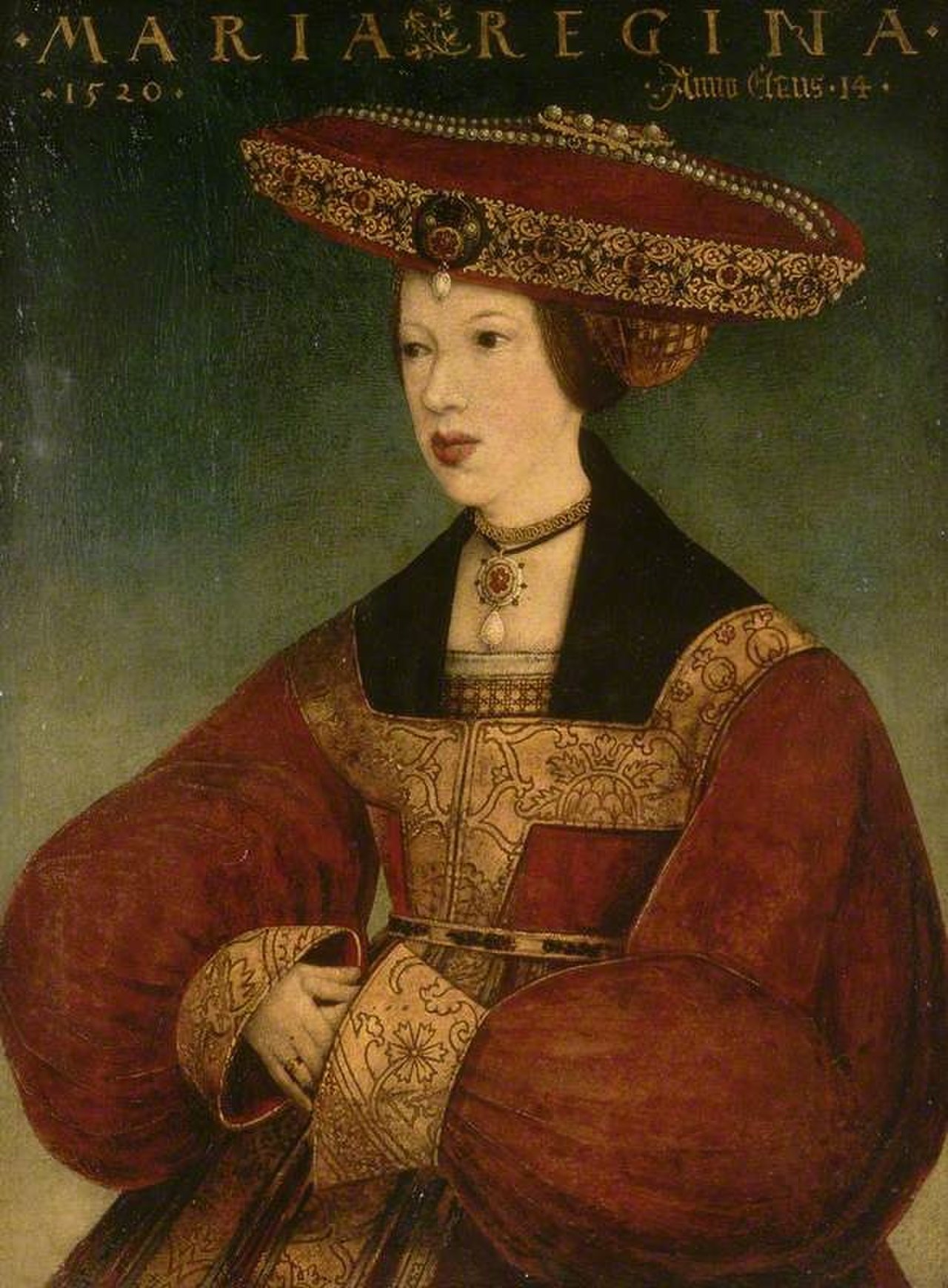
The portraits of King Louis and Queen Mary as well as his tournament sallet are a reminder that the late medieval Hungarian court was very much part of a wider European world, reinforced by Habsburg and Foix links to the west and by the early arrival in Jagiellonian Poland of renaissance culture.

 Queen Mary of Hungary in 1520

Hans Maler zu Schwaz

Image: Wikipedia

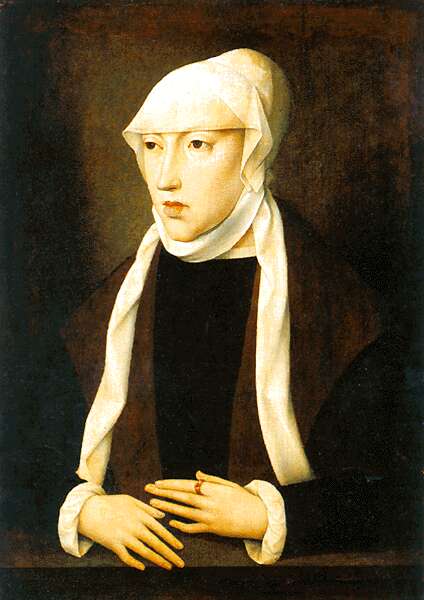
The widowed Queen declined to remarry and mourned her husband until her own death over thirty years later.  After a period as Regent for her brother of his part of Hungary Queen Mary served as Regent of Netherlands for her brother the Emperor Charles V. She appears to have been a capable and intelligent ruler, who then accompanied him in his retirement to Spain in 1556, but was preparing to return to the Netherlands as regent when she died in 1558. There is an illustrated account of her life and role as a patron in Mary of Hungary (governor of the Netherlands)

portrait of a thin woman in brown clothing and a tan head covering

  Queen Mary in 1531 - aged 26

Portrait by the Master of the Life of the Magdalen

 Image: Wikipedia

The ultimate succession in Hungary fell to Anne and Ferdinand - Holy Roman Emperor after his elder brother's abdication in 1556 - and thus the Habsburg Austro - Hungarian monarchy began to be a reality. Anticipated in other dynastic unions over the preceding two centuries it now took on aform it was to develop and expand over almost all the next four centuries.


Friday, 3 January 2014

The Dukays


Over Christmas I managed, at the second attempt, to read the whole of Lajos Zilahy's 1949 novel The Dukays. I had statred it some time ago, got half-way through and was distracted from it, and realised I would have to start again. Given that it is almost 800 pages long, and is a novel that you want to keep reading it is a book for when one has a few days free of other things to worry about.


Image: Amazon

The novel has something of War and Peace, or Gone with the Wind about it combined with much of the ideas in Brideshead Revisited. I do not know how much, if at all, any of those works influenced Zilahy but there are resemblances.

Set in the years before the Great War and in the inter-war years it is the story of the Dukays, a great Hungarian aristocratic family and how they react and adapt to the dissolution of the Habsburg Monarchy and life in the post-Trianon Hungary under Admiral Horthy.

It is a richly textured story, told in different and varying voices and ways, including a skillful pastiche of an inaccurate Court memoir by one of the family. It is more than just a family saga or a history of a class or country - it is a  wide canvas painted with both broad brush strokes and fine detail.

Whether or not one necessarily shares  all of Zilahy's emphases or interpretations it is a book well worth reading, both as a portrait of an age and as an enjoyable and fascinating story.

Lajos Zilahy (1891-1974) was born in Transylvania, went into exile in the USA in 1947 and is considered by many the leading Hungarian writer of his era. There is an online introduction to his life here and his great nephew has a very interesting piece in  Some reminiscences about Lajos Zilahy.

The novel has been reprinted in paperback by Prion in their 'Lost Treasures' series. Though it stands by itself the book is the middle section of a trilogy looking at the history of Hungary through the life of the family - Century in Scarlet looks at the Metternich era and the 1848 Revolution, whilst The Angry Angel continues the story into the Second World War.


Thursday, 5 May 2011

New Hungarian constitution


A friend has told me about the controversy around the new Hungarian constitution, recently voted through in the Budapest parliament. There is an article about it here. Opposition has been voiced from outside the country by those who dislike its traditional stance on life and family issues, or on definitions of nationality, as discussed in this article.

I have looked briefy at the text - there is an English version here.


File:Coat of arms of Hungary.png


In addition to the defence of family life I approve of the references to the Holy Crown and to St Stephen, and to the country's historic place in Europe. The arms with the Holy Crown are enshrined in the constitution. Much of it looks fine to my mind in terms of practical governance.

What I do not like are Fundamental Articles B2 and 3 - that the country is a republic and that the people atre the source of power. This really is Constitution-Lite in that it rejects the millenium-long history of Hungarian Kingship and the institution that embodied the nation. To invoke St Stephen and the Holy Crown, and to appeal to history, but not to proceed to the obvious conclusion is to repeat the mistake of the Horthy regency. The shades of Arpad and Angevin, of Jagellonian and Corvinian as well as Habsburg Kings of Hungary must look down with sad and wondering eyes.

Thursday, 2 September 2010

St Giles by Thomas of Coloswar

Following on from yesterday's post about St Giles here is another late medieval depiction of him. This painting is described as The Death of St Giles, but normally the incident is seen as not being fatal to the Saint, but the means whereby he was drawn to the King's attention. St Giles is usually represented as being wounded in the leg - hence his patronage of cripples - but the Master of St Giles shows him with wound in the hand. This version has a wound to the breast.

I have taken this piece from the Web Gallery of Art pages, and edited it slightly.

The Death of St Giles

Thomas of Coloswar

1427

Tempera on pine wood, 89.5 x 69 cm
Christian Museum, Esztergom, Hungary

Click!

The picture shows one of the panels of the Garamszentbenedek Altarpiece.

Nicholas, a canon of Gyõr, who was also cantor of the royal chapel in Buda Castle, in 1427 commissioned Master Thomas, painter of Coloswar (Kolozsvár) to make a polyptych for the high altar of the Abbey Church at Garamszentbenedek (today Hronsky Benadik, Slovakia). Ending in a pointed arch, the central picture of the polyptych (which consists of nine panels) represents the Crucifixion, the internal wings are decorated with four episodes of the Passion and the external ones with scenes taken from the lives of several saints. (One of the latter has been lost, and so has the predella with the inscription about the donation.) The panel representing St Giles is the top quarter of the external wing on the right, its rounded corner following the line of the arch of the central picture.

The hermit, who lived in a forest, was nurtured by the milk of a tame hind. The king's huntsmen pursued the animal, but when the saint interceded with the hunter he aimed his arrow at the holy man and instead of wounding the deer it pierced St Giles's breast. This moment is recorded in the painting. The saint bears the pain with a meditative, pious countenance. The arrow is depicted in the picture twice, perhaps because a single arrow rushing in the air may have introduced too great a tension and lack of balance into this lyrical scene. The hind taking refuge with the hermit is also characterized by calm stillness. The artist may have used a drawing from a model-book of the period for this work, which is indicated not only by the calmness of the animal as if it were part of a still life, but also by its movement: the model of the animal looks as if it had been drawn with all four legs underneath it, but the painter, adjusting the model to the painting, represented its right foreleg stretched out. Though the hunter s figure is much smaller than that of St Giles, the lines of the rock in the foreground and the light colours of the foliage of the forest seem to lead one's eyes to him. In accordance with the style, which had a predilection for elegant, curving lines, the painter stressed the impressive and buoyant line of the bow, which is beautifully set off by the darkness of the forest.

In the international life of King Sigismund of Luxembourg's court at Buda, Thomas de Coloswar had an opportunity to become familiar with the leading movements in painting of the period. The panel representing St Giles has similarities to Bohemian art. The rocky, wooded landscape - to quote Antal Hekler - "the colour of a fairytale in spite of its awakening realism" reveals features akin to the art of the Master of Trebon and the illuminators working under his influence.

Click!

This painting was the central panel of the Calvary altarpiece at Garamszentbenedek. This altar piece is one of the most significant painting of the period in Hungary; its source can be traced to the court painting in Bohemia, and it is also related to the court painting in Burgundy.

There are more pictures of the altarpiece here.

Now in addition to the fact that the first picture shows St Giles I have the added interest in the picture that the figure of the archer on the right appears to be taken more or less directly from a copy- book drawing now in the collection at the Christ Church Picture Gallery in Oxford, where I do part-time work. That drawing has been attributed to various possible masters and locations, and to a late fourteenth or early fifteenth century date. There is an article about it in 40 Years of Christ Church Picture Gallery, Oxford 2008, pp 64-5.

Monday, 16 August 2010

St Stephen of Hungary


Today is the feast of St Stephen of Hungary - except in Hungary itself where it is celebrated on August 20th
, which is said to be the day of the translation of his remains to Buda. For a variety of reasons I have always found the history of the Apostolic Kingdom of interest, and so I thought I would share some details about St Stephen in life, in death and in tradition.

I have based this post, with some additions and editing, on John Dillon's Medieval Religion discussion group post from last year.

St Stephen (d. 1038). Vaik was the son of the first Christian ruler of Hungary, grand prince Géza, with whom he was baptized at perhaps the age of ten. At his baptism he received the Christian name by which he is known (in Hungarian, István). Géza, who was an innovator in several important respects, saw to it that Stephen married into the ruling family of Bavaria; he also substituted male primogeniture for the seniorate as a principle of succession, thus making Stephen his heir apparent. After Géza's death in 997 Stephen won a succession struggle and proceeded to consolidate his rule over the Magyar clans, taking the title of king in about the year 1001. Traditionally it has been held that in 1000 he received his crown from Pope Sylvester II Stephen also consolidated Christianity in Hungary, ordering the building of churches across the kingdom and the collection of tithes to support their priests, establishing a diocesan structure under an archbishop, and forbidding intermarriage between Christians and others. He was canonized in 1083.

What is said to be St Stephen's right hand is preserved as a relic (the "Holy Right") in a chapel in his mostly nineteenth-century basilica in Budapest. There is a detailed article about the relic and about the Hungarian regalia, which has been associated with St Stephen in national perception for centuries, here. There is a photograph of the reliquary here, and this is the "Holy Right":

http://www.budapest-tourist-guide.com/image-files/holy_right_hand.jpg

There is another photograph of the hand here.

St Stephen. (at right, together with his queen, Bl. Gisela of Hungary) as depicted in fresco in the thirteenth-century Gisela chapel (Gizellakapolna) at Veszprém here (the image is expandable) and here.

Here is St Stephen as depicted in a miniature in the Hungarian Képes Krónika (Chronicon Pictum: before 1360):

I think that is a particularly appealing example of fourteenth century manuscript art, and in its use of the arms of the Kingdom.

St Stephen. as depicted by by János Rozsnyai in the Crucifixion (1445) on the north wall of the sanctuary of the cathedral of Nagyszeben, can be seen here:

To this I would add this picture:

Procession of holy relics to parliament

Procession of the relics of St Stephen to the Parliament building in August 2000.

I will, hopefully, post more about the Holy Crown of St Stephen on August 20th.