Once I was a clever boy learning the arts of Oxford... is a quotation from the verses written by Bishop Richard Fleming (c.1385-1431) for his tomb in Lincoln Cathedral. Fleming, the founder of Lincoln College in Oxford, is the subject of my research for a D. Phil., and, like me, a son of the West Riding. I have remarked in the past that I have a deeply meaningful on-going relationship with a dead fifteenth century bishop... it was Fleming who, in effect, enabled me to come to Oxford and to learn its arts, and for that I am immensely grateful.


Showing posts with label Emperor Maximilian I. Show all posts

Monday, 19 June 2017

Emperor Maximilian of Mexico


150 years ago today the Emperor Maximilian I of Mexico and two of his generals Miguel Miramón and Tomás Mejía were shot by firing squad at Santiago de Querétaro in central Mexico. Their deaths took place in the Cerro de las Campanas  - the Hill of the Bells.

I recently read a story, and which I am not sure if it is true, about an exchange between the Emperor and General Miramón just before they were shot. The Emperor asked if it would be painful. The General replied "I don't know. It's the first time for me too." 

In 1900 diplomatic relations were restored between Austria and Mexico and in 1901 Emperor Francis Joseph paid for a chapel to be erected on the site of his brother's death. There are accounts of that chapel and of the site at Maximilian's memorial at El Cerro de las Campanas and at Emperor Maximilian Memorial Chapel

There are not a few depictions in art and commemorative images, often inaccurate, as well as in photographs of the death of the Emperor and his comapnions, and Édouard Manet painted a series of five pictures of the event, indicative of the impact on public consciousness at the time.

The most certain is this photograph:


The Emperor was shot first, and the two Generals last words were "Viva el Emperador!"

General Mejia is on the left, General Miramón in the centre, the Emperor on the right

Image: Wikipedia

In 1868 the body of the Emperor was returned to Austria and burie din the Imperial vault in the Capuchin church in Vienna.


Emperor Maximilian I of Mexico

One of many images of what was hoped to be

Image:heirstothethrone-project.net

There are a number of biographies of the Emperor and an online one at Maximilian I of Mexico

There is a useful illustrated piece about his relationship with his brother the Emperor Francis Joseph and the divisive matter of the family pact removing Maximilian and his possible heirs from the Austrian succession here.

A monarch of liberal intentions, who was perhaps naive in many ways, and unaware of the vicious and factious nature of Mexican politics he remains a tragic and sad figure.

Inspired with German medievalist Romanticism he lived out achivalric code in a situation that was conducted by anything but that. This can be seen in his refusal to escape, or to countenace shaving off his whiskers to disguise himself as detailed in the account of his life linked to above.

He and his consort are interesting in the number of images that were created in a short perios of him and his Empress Charlotte/Carlota - they had clearly embraced the new technologies as well as traditional paintings to celebrate the monarchical image.

I have posted earlier in the year about Empress Carlota on the anniversary of her death. 

Interest in this brief episode in the history of Mexico remains strong - the Emperor is far better known than the previous Mexican Emperor Agustin I in the 1820s, and his monarchy far better known than that of Brazil which was much more successful and survived from the 1820s to 1888/89.

In having him shot Juarez made Maximilian a martyr - and that was a political mistake. As Joan Haslip points out in her life of him Imperial Adventurer a failed Emperor ejected from Mexico and living out a shadowy exile on the fringes of the Austro-Hungarian court was little threat to Juarez and his successors and would have slipped from public consciousness. The firing squad on the Hill of Bells made the Emperor and his Generals world famous and martyrs for a cause.

With the second, and as with the first, Mexican Empire there is an element of what might-have-been. Had either prospered it is possible that Mexico might have had a less violent and troubled two centuries and that the type of reformist traditionalism Emperor Maximilian embodied and offered would have served it better than so many of the regimes it has witnessed.

Being childless the Emperor had adopted two of the grandsons of the previous Emperor Agustin I of the house of Iturbide as heirs. According to biographers what he really wanted was one of his brother Archduke Karl Ludwig's sons to succeed him - which might indeed have led to avery different fate for Archduke Franz Ferdinand or Archduke Otto and his son Bl.Charles of Austria.

As events turned out it was the Iturbides who inherited what was left of Emperor Maximilian's claim. Their history can be read in The Iturbide Dynasty Genealogy and at House of Iturbide.

The first inheritor of that claim was Agustín de Iturbide y Green, the de jure Emperor Agustin II who became an academic at Georgetown and died 1925. There is more about him at Georgetown University's Imperial Prince 

From him the claim passed to the daughter and then the two grandaughters of his cousin. So technically there were three Empresses of Mexico  - Maria I 1925-49, Maria II 1949-62, and Maria III 1962-99  - and currently there is the son of the last named the titualr Emperor Maximilian II based in Australia.


  Arms of the House of Iturbide granted by Emperor Maximilian I in 1865

Image: Wikipedia

Emperor Maximilian and his Empress were never actually crowned and the actual crown itself was destroyed as is mentioned in Imperial Crown of Mexico but replicas do survive:
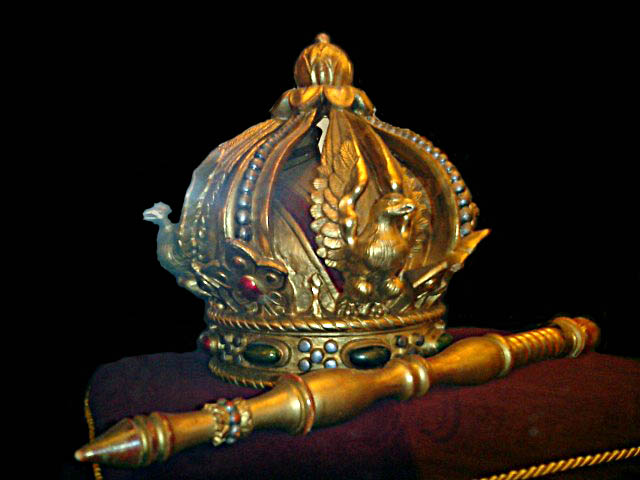
ImperialMexicanCrown1.jpg

Replica of the Imperial Crown of Mexico
Made for the obsequies of Emperor Maximilian I in Vienna and now in the Imperial Furniture collection

Image: Wikipedia


Arms of the Emperor Maximilian I of Mexico

Image: Wikipedia 

Monday, 29 August 2016

Battle of Mohács 1526


Today is the 490th anniversary of the battle of Mohács. This was one of the most significant battles not only in Hungarian history but in that of Europe. If one consequence was the destruction of the medieval kingdom of Hungary and the advance of the Turks into the central Danuble plain where they remained until the end of the seventeenth century, another was the creation in consequence of that union of territories which constituted the birth of what was to become Austria Hungary.

In 1490 the death of King Matthias Corvinus led to the accession of the Polish Jagiellonian King Vladislaus II, under whom the central power of the monarchy in Hungary declined, aristocratic power increased, there was an increasing likelihood that the monarchy might become elctive as was to happen in Poland later on in the century, and meanwhile the Ottomans were gathering strength to the south. The political background is set out in the online account of the Battle of Mohács and in the related article on the leading nobleman John Zápolya.  As that points out it was the birth in 1506 of the future King Louis II that made the survival of the Hungarian Jagiellonians possible. In 1514 the  King Vladislaus II faced a major peasant rebellion led by György Dózsa - this had begun as a crusade against the Turks which then evolved into a jacquerie, which further weakened the realm.

King Louis II succeeded at the age of ten in 1516 to the thrones of both Hungary and Bohemia, and had been crowned in his father's lifetime in the case of each realm. He was taken up by the Emperor Maximilian who arranged adouble marraige, that of King Louis to the Emperor's grandaughter Mary, who was tens months oldere than him, and of Louis' sister Anne to Maximilian's second grandson the Archduke Ferdinand ( eventually the Emperor Ferdinand I ). As a dutiful Habsburg the Emperor did not pass up the chance of prudential and providential marriages for the next generation.

https://upload.wikimedia.org/wikipedia/commons/d/d4/Bernhard_Strigel_-_Emperor_Maximilian_I_with_His_Family_-_Google_Art_Project.jpg 

Emperor Maximilian I and his family in 1515
At the front the future Emperors Ferdinand I and Charles V and on the right King Louis II

Image: Wikimedia

http://media.gettyimages.com/photos/portrait-of-louis-ii-of-hungary-king-of-hungary-bohemia-and-croatia-picture-id164083896

King Louis II

Image:gettyimage.com 

 Image result for Louis II of Hungary

Queen Mary of Austria

Image: Pinterest 

 There is a biography of the young Hungarian king at Louis II of Hungary, who was just 20 when his army was crushed by the Ottomans at Mohács.


https://upload.wikimedia.org/wikipedia/commons/thumb/0/0a/Lajos_II.jpg/220px-Lajos_II.jpg

King Louis II

  A portrait by Titian

Image: Wikimedia

The King, fleeing from the battle was thrown by his horse and drowned. His body was recoverd and removed for burial elsewhere. A small gold hear badge he was wearing was returned to his Queen who wore it until her death in 1558, when her will directed it should be melted down and the proceeds given to the poor.

https://s-media-cache-ak0.pinimg.com/originals/f6/ee/95/f6ee950203042e2eecc204c0a04e32ff.jpg

The recovery of the body of King Louis II as shown in a nineteenth century painting

Image:Pinterest

  Image result for Louis II of Hungary 

King Louis II

Image: Pinterest

Tournament Sallet Made for Louis II, King of Hungary and Bohemia 

Tournament sallet made for King Louis II

Made in Augsburg and attributed to Kolman Helmschmid ~1525.

 Image:pinterest 

“May Allah be merciful to him, and punish those who misled his inexperience,” said Suleiman of his 20-year-old opposite number. “It was not my wish that he should thus be cut off, while he had scarcely tasted the sweets of life and royalty.”

The Sultan was less merciful to his prisoners - two days later came theie execution as recounted at  1526: 2000 Hungarian prisoners after the Battle of Mohacs

Mohács was decisive and disastrous - I gather a Hungarian proverb to set things in context of a disaster or failure is "Things were worse after Mohács." It marks the last of a series of late medieval battles which were major defeats for the Christian side in the conflict with the Ottomans - the Plain of Blackbirds ( Vivovdan) in 1389, Nicopolis in 1396, Varna in 1444, the loss of Constantinople in 1453 and finally Mohács in 1526. John Hunyadi's victory at Belgrade in 1456 merely helped to slow the Ottoman advance.

The death of King Louis marked the end of the legitimate male Jagiellonian line in Hungary and Bohemia. His sister Anne was married to Ferdinand of Austria who succeeded him, but Hungary came to be split between him as King Ferdinand I and John Zápolya who reigned as King John I  and who died in 1540. In 1541 Ottoman control over the centre of the realm. King John I's son succeeded him as a baby and was established as ruler in Transylvania, a position he more or less held with various titles until his death in 1570 - there is an account of him at John Sigismund

The portraits of King Louis and Queen Mary as well as his tournament sallet are a reminder that the late medieval Hungarian court was very much part of a wider European world, reinforced by Habsburg and Foix links to the west and by the early arrival in Jagiellonian Poland of renaissance culture.

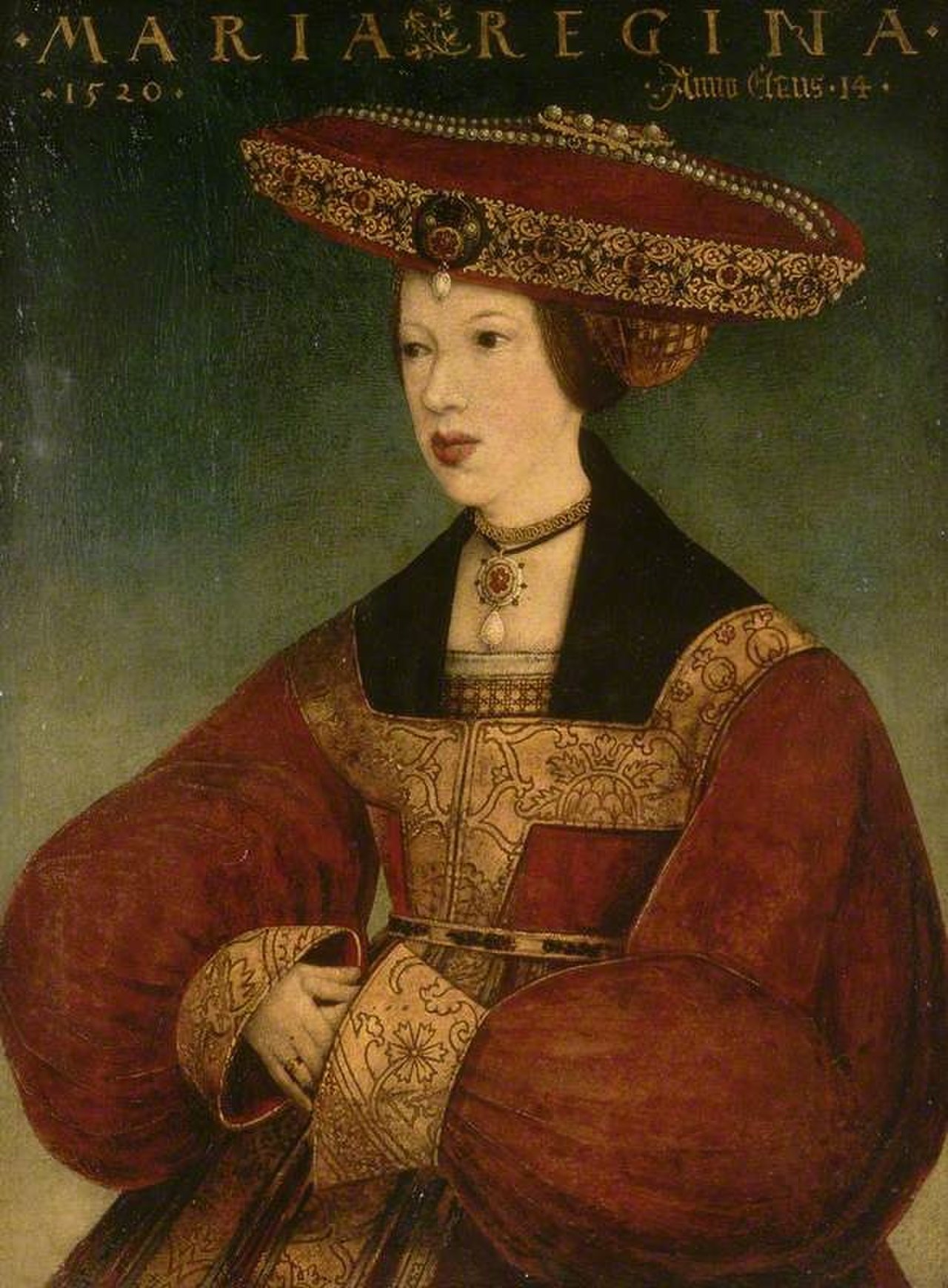
 Queen Mary of Hungary in 1520

Hans Maler zu Schwaz

Image: Wikipedia

The widowed Queen declined to remarry and mourned her husband until her own death over thirty years later.  After a period as Regent for her brother of his part of Hungary Queen Mary served as Regent of Netherlands for her brother the Emperor Charles V. She appears to have been a capable and intelligent ruler, who then accompanied him in his retirement to Spain in 1556, but was preparing to return to the Netherlands as regent when she died in 1558. There is an illustrated account of her life and role as a patron in Mary of Hungary (governor of the Netherlands)

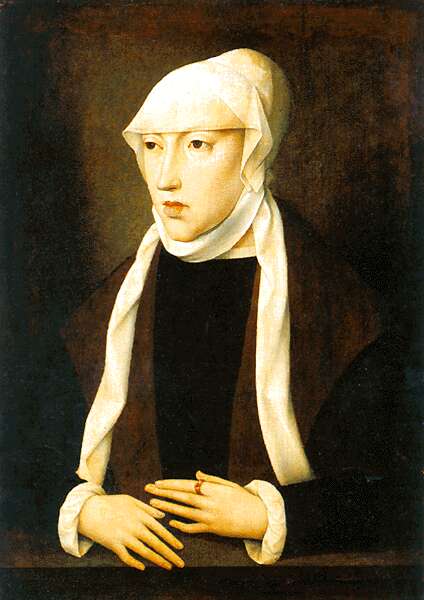
portrait of a thin woman in brown clothing and a tan head covering

  Queen Mary in 1531 - aged 26

Portrait by the Master of the Life of the Magdalen

 Image: Wikipedia

The ultimate succession in Hungary fell to Anne and Ferdinand - Holy Roman Emperor after his elder brother's abdication in 1556 - and thus the Habsburg Austro - Hungarian monarchy began to be a reality. Anticipated in other dynastic unions over the preceding two centuries it now took on aform it was to develop and expand over almost all the next four centuries.


Thursday, 8 March 2012

The Holy Coat of Trier


From April 13 until May 13 the Holy Coat of Trier - believed to be the seamless garment worn by Our Lord and for which the soldiers cast dice (John 19, 23-24) - will be on display at the cathedral in Trier where it has been venerated as a relic since at least the end of the twelfth century. As a relic it was the most prized possession of the Electoral Archbishopric of Trier, a see which claimed a particular status within the Church from its having once been one of the capitals of the Western Roman Empire.

This year's exhibition is to commemorate the first such public display in 1512 at the request of the Emperor Maximilian I.

http://www.argophilia.com/news/wp-content/uploads/2010/12/holy-robe.jpg

Image:argophilia.com

There is an account of the Holy Coat and of another claimant to be the seamless robe -that of Argenteuil in France - as well of Eastern Orthodox claims here and the article from the 1912 Catholic Encyclopedia, which has more details as to the history of the relic, can be read here. An article from the New York Times from the time of the 1891 display, with a description of the Holy Coat can be read here.

http://www.annatextiles.ch/book_rev/rev2003/r2017erha/r2017_206.jpg

The Holy Coat of Trier

Image:annatextiles.ch