Once I was a clever boy learning the arts of Oxford... is a quotation from the verses written by Bishop Richard Fleming (c.1385-1431) for his tomb in Lincoln Cathedral. Fleming, the founder of Lincoln College in Oxford, is the subject of my research for a D. Phil., and, like me, a son of the West Riding. I have remarked in the past that I have a deeply meaningful on-going relationship with a dead fifteenth century bishop... it was Fleming who, in effect, enabled me to come to Oxford and to learn its arts, and for that I am immensely grateful.


Thursday, 6 June 2013

St Norbert


Today is the feast of St Norbert, founder of the Norbertines or Premonstratensian canons who died in 1134. There is an online account of his life here and another one here.

The reading at today's Office of Readings has been compiled using words given in quotation marks  taken from the biography of Saint Norbert, written by a Premonstratensian canon who was a contemporary of the saint. Pope Innocent II’s Apostolic Letter was issued under leaden bulla to Saint Norbert on June 5, 1133:
 
Norbert is deservedly numbered by historians among those who made an effective contribution to the reform movement under Pope Gregory VII. He established a clergy dedicated to the ideals of the Gospel and the apostolic Church. They were chaste and poor. They wore “the clothing and the symbols of the new man; that is to say, they wore the religious habit and exhibited the dignity proper to the priesthood.” Norbert asked them “to live according to the norms of the Scriptures with Christ as their model.” They were “to be clean in all matters pertaining to the altar and divine worship, to correct their faults and failings in their chapter meeting, and to care for and give shelter to the poor.”
  
The priests lived in community, where they continued the work of the apostles. Inspired by the practice of the early Church, Norbert exhorted the faithful to join the monastic life in some capacity. So many men and women responded to the invitation that many asserted that no man since the apostles themselves had inspired so many to embrace the monastic life.
 
When Norbert was appointed an archbishop [of Magdeburg in 1126], he urged his brothers to carry the faith to the lands of the Wends. In his own diocese he tried unsuccessfully to convince the clergy of the need for reform and was confronted with noisy protests both in the street and in the church.
 
One of the principal goals of Norbert’s life was to foster harmony between the Apostolic See and the German empire. At the same time he wanted to maintain Rome’s freedom in the matter of ecclesiastical appointments. Apparently his efforts were so successful that Pope Innocent II thanked him profusely in a letter in which he called him a “devoted son,” and Lothair made him chancellor of the realm.
 
Norbert did all these things with a steadfast faith: “Faith was the outstanding virtue of Norbert’s life, as charity had been the hallmark of Bernard of Clairvaux’s.” Affable and charming, amiable to one and all, “he was at ease in the company of the humble and the great alike.” Finally, he was a most eloquent preacher; after long meditation “he would preach the word of God, and with his fiery eloquence purged vices, refined virtues and filled souls of good will with the warmth of wisdom.” He spent many hours in contemplation of the divine mysteries and fearlessly spread the spiritual insights which were the fruit of his meditation.
Reading that it occurred to me that in not a few ways he can be said to resemble St Philip Neri in his methods of evangelization, and using communities of priests to minister to the faithful, although in medieval England the Premonstratensians teneded to settle in rural and often remote locations rather than as communities to work in the expanding towns of the twelfth century.


File:Norbert xanten.JPG

St Norbert, on the right, receives the rule for the life of canons from St Augustine of Hippo
From a manuscript of the Vita Sancti Norberti dated to 1140 now in Munich

Image: Wikipedia


I used to think of the Premonstratensians as being a matter for medievalists, not realising until recent years that they are very much alive and functioning as an Order, and I know several members of the thriving and successful community at St Philip's Priory in Chelmsford. On my two visits there last year for a profession and an Ordination I was impressed by what they are doing and offering to the Church.
I shall keep them especially in my prayers today.


Wednesday, 5 June 2013

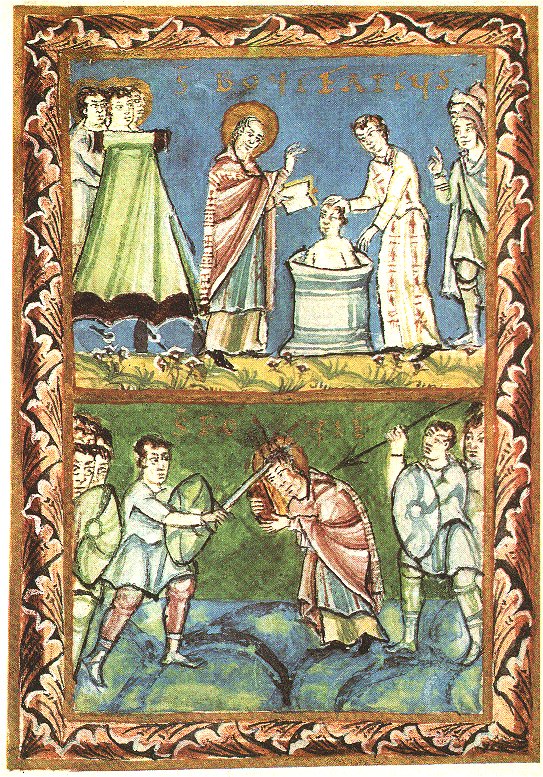
St Boniface


Today is the feast of St Boniface, who was killed by Frisian pagans on this day in 754. Born about 680, traditionally it is said at Crediton in Devon, he became a monk, but his missionary work in converting the Germans east of the Rhine has led him to be called the Apostle of Germany. He has been described as the most influential Englishman in continental terms before the Norman Conquest, and even as the greatest Englishman ever. There is an account of his life and achievements here.


File:St Boniface - Baptising-Martyrdom - Sacramentary of Fulda - 11Century.jpg

St Boniface baptizing and being martyred - from the 11th century Fulda Sacramntary

Image:Wikipedia

The Gospel Book he is said to have held up to ward off the swords of his murderers still survives -  complete with a sword cut in it.

Boniface had established his see at Mainz, and is commemorated in the cathedral by this memorial effigy of 1357:


Germany  Mainz Cathedral St Boniface 1357 

  Germany Mainz Cathedral St Boniface 1357

St Boniface - effigy in Mainz cathedral of 1357

Image: themcs.org

His relics are however buried at the monastic centre established by his follower St Sturmius at Fulda in Hesse. There is an introduction to the history of the town here


File:Catedral de Fulda.jpg

Fulda Cathedral
The abbey church as rebuilt in 1704-12. It became the cathedral of the newly created diocese in 1752.

Image:Wikitravel

There is more about the history and architecture of the abbey and cathedral church here. There is a fine set of illustrations of the cathedral and its furnishings in the 2010 post  The Heart of Catholic Germany (Part I) from the New Liturgical Movement  which includes  views of St Boniface's tomb.

Tuesday, 4 June 2013

Coronation commemoration service


I was not able to watch on television the service commemorating the sixtieth anniversary of the Coronation which was held at Westminster Abbey this morning, so I was dependent upon online reports and photographs of the event. Such a service is without precedent, so its format had to be worked out by the Abbey Chapter to be a reflection on the themes in the rite of Coronation

The most striking image I saw was this one, of St Edward's Crown resting once again on the altar of the Abbey, as it was in 1953:


St Edward's Crown rests on the High Altar of Westminster Abbey

Image: Reuters

This, it seemed to me, was a forceful image of the enduring concept of Christian kingship, be it for this country or any other realm, as well as of the endurance of the English monarchy.


Corpus Christi procession in Oxford


I have copied all the photographs, and added further commentary, from the Oxford Oratory website report of the Corpus Christi procession which took place last Sunday. Once again we were blessed with fine weather for the event, which was revived in 2000 to mark the Jubilee Year. Once again I was a marshal, ensiring the procession kept together - which it did very well; for this task I was vested in a hideous yellow flourescent overjacket...

This year's Corpus Christi Procession saw record numbers attending - this was presumably in response to the Holy Father's call for the Church throughout the world to join with him in Eucharistic adoration that afternoon. 

The Blessed Sacrament was exposed in the Oratory church:

1370250199.jpg

The Procession leaves the Oratory, with Bishop William Kenney, C.P. , the area bishop for this part of the Archdiocese, carrying the Blessed Sacrament, flanked by two deacons from Blackfriars:

1370251165.jpg 

The canopy bearers are undergraduates wearing the formal academic dress of the University of Oxford.

1370251147.jpg

Moving down St Giles':

1370250207.jpg 


1370250215.jpg
1370250225.jpg
1370349994.jpg
1370250257.jpg
1370250279.jpg 

The procession passing Pusey House - as usual there was a graceful ecumenical gesture of Puseyite regulars kneeling to venerate Our Lord  - mind you when I and others were Pusey regulars we used to join in on the procession... and look where that landed us.

The procession was accompanied by the Witney Town Band, who played with great verve - the conductor has adoctorate from Liverpool:

1370250248.jpg

A pause at Blackfriars, where Fr Robert Ombres, O.P. preached about the origins of the Solemnity of Corpus Christi:

1370250289.jpg 

The procession leaving Blackfriars   -  the Blessed Sacrament is borne by the prior of Blackfriars, Fr John O'Connor O.P.: 

1370250297.jpg

Passing the Ashmolean:

1370250318.jpg

And through the city centre:

1370350024.jpg 

1370250326.jpg 

Fr Richard Duffield, C.O., Fr John Baggeley of Corpus Christi Headington, Fr Dominic Jacob, C.O.and Provost Daniel Seward C.O. passing the Oxford Union

1370250336.jpg 

Oh dear, I'm in the photograph in my marshal's yellow jacket

1370272980.jpg 

We went along New Inn Hall Street, past St Peter's College:

1370250347.jpg
1370250360.jpg
1370250370.jpg 

The Blessed Sacrament was now carried by Fr Simon Bishop S.J., the Chaplain to the University:

1370250381.jpg
1370250392.jpg
1370250402.jpg 

Here we are close to the site of the birthplace of St Nicholas Owen S.J., the builder of priest's hiding places in the late sixteenth century:

1370250412.jpg
1370250426.jpg
1370250437.jpg
1370250446.jpg 

Passing by the new buildings of Pembroke College and close to the site of the medieval Blackfriars

Approaching the University Chaplaincy:

1370251524.jpg 

This is a view along Rose Lane, beween Campion Hall and the Chaplaincy:

1370251176.jpg

Benediction at the Chaplaincy:

1370251129.jpg

Following Benediction, given by Bishop Kenney, there were refreshments and a chance to catch up with friends in the Chaplaincy.

After that I and others went off to Headington to a fine dinner party given by one of our friends, and the weather was good enough for fifteen of us to sit around a large table in the garden for a meal featuring duck and pork, and plenty of wine, until it was dark. A good way to round off a splendid day.


Monday, 3 June 2013

Imperial Coronation gloves


With Coronations in mind, and also the Holy Emperor Frederick II, about whom I have been teaching recently, I came across these splendid pictures recently on the internet and thought I would copy them for others to appreciate the craftsmenship involved and the ceremonial that workmanship served to augment.


Gloves of Frederick II

Gloves of Emperor Frederick II

The Insignia of the Holy Roman Empire preserved in the Schatzkammer in the Hofburg in Vienna is a set of various items of clothing collected and made over a period of many years that were used by various Emperors of the empire. The robes and other items were often used only on state occasions such as coronations.

These gloves were made in the early thirteenth century for the coronation of Emperor Frederick II in 1220. As with many of the other sumptuous garments that make up the Insignia of the Holy Roman Empire, the gloves were made in the Royal Workshops of Sicily.

The stitches and techniques involved include underside couching,surface couching and applied pearls, emeralds, rubies, sapphires and enamelled plaques. The materials used include red silk and gold wire embroidery, plus the pearls, saphires, rubies, enamelled plaques. The palms of the gloves are worked in the design of single-headed eagle, using gold thread, in underside couching.


Detail of glove

A detail of one of the gloves


Detail of palm of glove

Detail of the palm of a glove


Image and text sources : medieval.webcon.net.au


Sunday, 2 June 2013

The sixtieth anniversary of the Coronation


Today is the sixtieth anniversary of the coronation of Her Majesty The Queen in 1953.

Although there have been developments, additions and subractions (some good, some regretable) over the centuries this was in essence and in many respects in substance the same as the coronation of King Edgar 980 years earlier in 973 at bath. Indeed the English rite influenced continental rites of coronation in that era.

Dr Eliza Filby had an article in the Daily Telegraph about the Coronation, its planning and about its significance today which can be read here.


The Coronation of Queen Elizabeth II was, above all, a religious occasion. The task of crowning the monarch falls to the First Primate of England

The Enthronement at the Coronation of Queen Elizabeth II

The Queen, vested in the golden Coronation Royal Robe, has the Crown of St Edward on her head and holds the Soverign's Sceptre in her right hand and the Sceptre with the Dove in her left hand  


Image: Getty Images/Daily Telegraph


Anniversary: The Queen celebrates 60 years since her Coronation tomorrow

The Queen supported by the Bishops of Durham and Bath and Wells
processes from the Sanctuary following the ceremony.

 Image ITV/Rex Features/Daily Mail


The Coronation made a great impact on those who witnessed it, especially through the new ly availabel medium of television, and it reamins a potent memory and point of reference. I was rather too young to appreciate what was going on. At the age of twenty two months I was taken by my parents to watch the ceremony on my maternal grandmother's television. Alas I slept throughout the broadcast, though my earliest dateable memory is of my father coming home with a commemorative mug given by the borough council to the children of the town. In one sense I have been catching up or making up ever since for sleeping through such an historic and significant event .  At home we had a splendid book about the Coronation in all its aspects and published by Pitkins, and looking at that was treat and a  stimulus to my interest in monarchy and history. 

I did manage to see the entire broadcast of the Coronation in 1977 when the BBC  marked the beginning of the Silver Jubilee Year by transmitting on New Year's day the recording of the entire ceremonial from 1953 of the Coronation - so then I did watch with mother, and definitely stayed fully awake!


 http://www.robertroope.com/wp-content/uploads/2012/05/1953-Queen-Elizabeth-II-p-014.jpg

Cecil Beaton's classic photograph of the newly crowned Queen

Image:robertroope.com


Saturday, 1 June 2013

The Regency crisis that never really was


My attention was drawn to a somewhat sensationalised account in today's Daily Mail about scheming by a certain Kenneth de Courcey to enable the Duke of Windsor to return as Regent for the ailing King George VI. The article is interesting, if it is accurate - and it does contain errors: Queen Mary was not "German-born" unless Kensington Palace was in Germany in 1867 - in recording tensions in and around the Royal family in the later 1940s, and centred on the Mountbatten family. 

Any possible discussions, as it recounts them, sound like late-night ruminations that were never going to be attempted - other than by someone like de Courcey who would seem to have been the type of social butterfly attracted by and to the erstwhile King Edward VIII. As it was whatever was discussed or thought about - and whether available or not to researchers today - does not seem to have been pursued by the Duke of Windsor himself when he might have. That suggests he realised that, when it came to the point, he had renounced his rights in 1936, and that was that. He, and his wife, might dally with ideas of some sort of return, but that it would not happen was pretty clear to all concerned.

The article, by Christopher Wilson, can be read here.


Evesham Pilgrimage June 15th


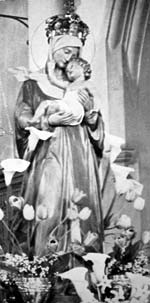
A fortnight today, on June 15th there will be the annual Diocesan Pilgrimage to Evesham in Worcestershire, in honour of Our Lady of Evesham.

Devotion to the Virgin Mary there stems from the tradition of a vision of her given to Eoves the swineheard and then to St Egwin, Bishop of Worcester and founder of the abbey at the beginning of the eighth century - long before Walsingham, let alone more famous shrines which have developed around modern appearances of Our Lady.


http://photos1.blogger.com/x/blogger/4490/2035/320/405247/Our_Lady_of_Evesham_1.jpg 

The modern statue of Our Lady of Evesham in the church

Image: Anglia Catholica


http://www.eveshamjournal.co.uk/resources/images/577828.jpg?type=articleLandscape

The Pilgrimage procession in the abbey grounds

Image:Evesham Journal

The Pilgrimage Mass will be celebrated in the church of St Mary and St Egwin at 1pm. The church is at the northern end of the town centre and very close to the railway station.

 http://www.birminghamdiocese.org.uk/wp-content/uploads/2012/08/EVESHAM.jpg

The church of St Mary and St Egwin
Image.birminghamdiocese.org.uk

I have been on the Pilgrimage once before and would commend it to anyone interested in joining it. Furthermore Evesham is an attractive and historic town, and makes for a very pleasant day out.