Once I was a clever boy learning the arts of Oxford... is a quotation from the verses written by Bishop Richard Fleming (c.1385-1431) for his tomb in Lincoln Cathedral. Fleming, the founder of Lincoln College in Oxford, is the subject of my research for a D. Phil., and, like me, a son of the West Riding. I have remarked in the past that I have a deeply meaningful on-going relationship with a dead fifteenth century bishop... it was Fleming who, in effect, enabled me to come to Oxford and to learn its arts, and for that I am immensely grateful.


Showing posts with label Evesham. Show all posts

Tuesday, 4 August 2015

Battle of Evesham 1265


Today is the 750th anniversary of the battle of Evesham in 1265, when the Royaloist troops led by the Lord Edward, later King Edward I, defeated the baronial army led by Simon de Montfort, who had ruled the realm since the battle of Lewes the previous year - there is an account of that battle at Battle of Lewes - and had kept King Henry III, who was his brother-in-law, as a virtual prisoner. 

There is an online account of the background and to the fighting at Battle of Evesham.
There is also a picec from the Battlefields Trust about the battle at their site Battle of Evesham 
and the current commemorations and celebrations are covered at  Battle of Evesham: Home

 Image: eveshamtown.co.uk 


At the website of the National Archives the post Battle of Evesham, 1265 - The National Archives has an account of the battle, and the death of Simon de Montfort in an extract taken from the chronicle attributed to Arnald FitzThedmar

 King Henry III

Image:fameimages.com
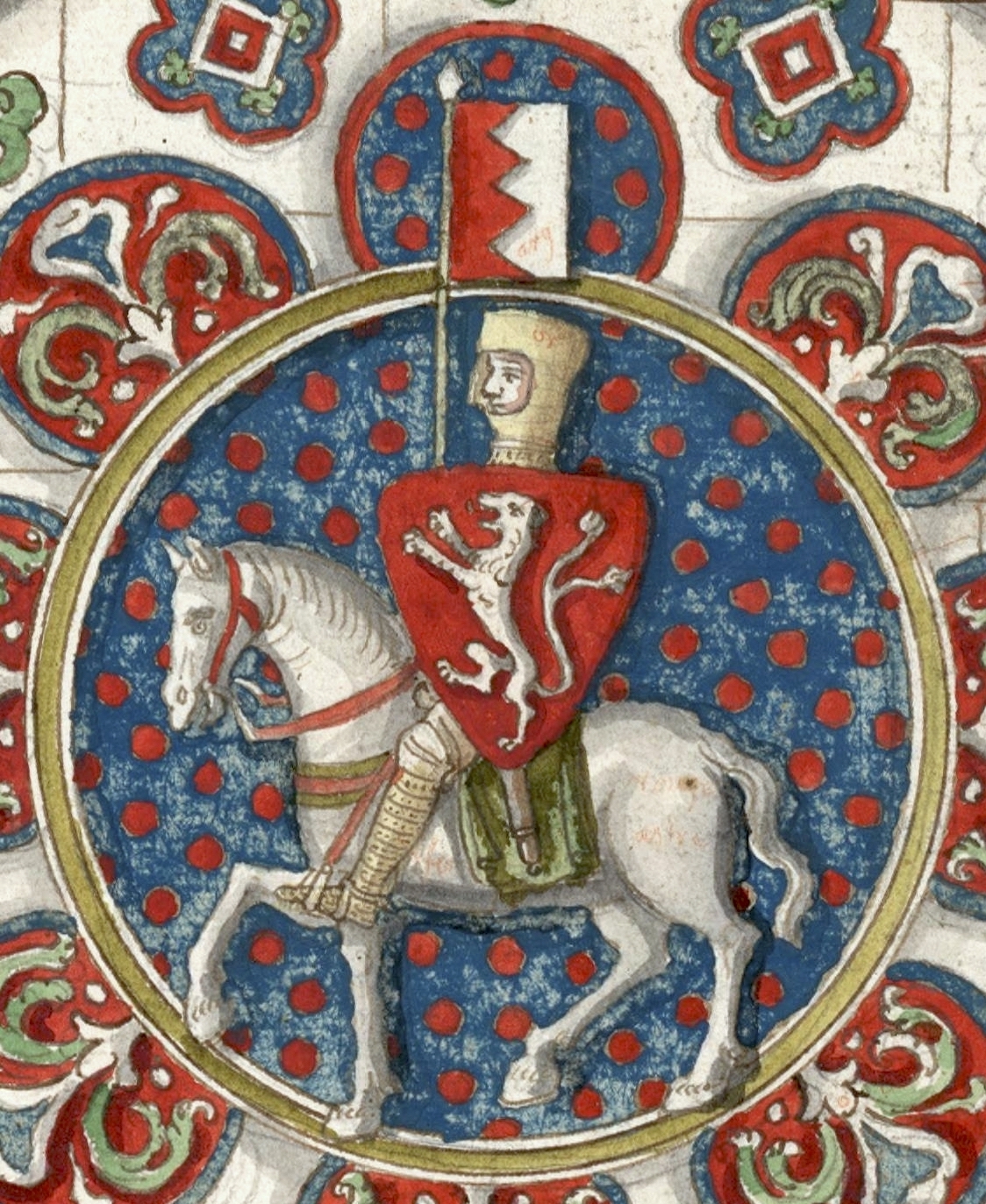
Simon Leicester.jpg

 Simon de Montfort, Earl of Leicester
A drawing of a window at Chartres Cathedral

Image: Wikipedia

There is an online biography of Earl Simon at  Simon de Montfort, 6th Earl of Leicester, and there is the excellent and comprehensive biography by Dr John Maddicott.

My sympathies are with King Henry III and his cause - as I have opined before I think that for the King Earl Simon turned out to be the Brother-in-Law-from-Hell.

For some time after his death there appears to have been at the Earl's burial place (or such of him as was buried at Evesham) in the abbey church a cult of sorts - which clearly did not attract the favour of the King.

File:De montfort evesham.jpg

 The modern memorial to Earl Simon on the site of Evesham Abbey.
This was unveiled and dedicated in 1965

Image: Wikimedia

Despite the major defeat of the baronial party at Evesham agroup held out at Kenilworth against a Royalist siege until the settlement known as the Dictum of Kenilworth in 1267. It was with theassignment of the Leicester estates to King Henry's younger son, Edmund, Earl of Lancaster , that there began that agglomeration of lands which was to create the fourteenth century Earldom and Duchy of Lancaster, which since 1399 has been held by the Sovereign.


Thursday, 5 June 2014

The statue of Eof at Evesham


In my recent post about Harvington Hall I referred to the statue we saw in Evesham of Eof, the swineherd whose vision of Our Lady led to the foundation of the abbey there about 705, and about whom there is an online article here. I have copied and slightly adapted the piece about the statue on the website of Evesham Town Council

The Statue of Eof - the Legend of Evesham


The statue in the Market Place, is a representation of the legend surrounding the origins of the town.  It depicts the swineherd Eof (or Eoves) on his knees covering his face at the apparition of the Virgin Mary, whose face is emering from the canopy of trees.
Eof was an eighth century swineherd employed by Egwin, the third Bishop of Worcester, working in the forest area on the banks of the river, known locally as "homme".  The legend tells us that while Eof was searching for some stray pigs he was confronted by a vision of the Virgin with her two attendants.  Partly in fear and partly in excitement he went to Worcester to tell Bishop Egwin what he had seen.  Egwin came to the same spot and after a period of prayer, the vision appeared to him in the same form, but this time the Virgin spoke to the Bishop, saying "This is the place I have chosen".
Egwin interpreted this message as an indication that the Virgin required a church to be built on the spot in her honour and he set about establishing a monastery dedicated to the Virgin Mary, becoming the first Abbot.  This development led to the town adopting the name of Eoveshomme (Evesham).
Around the base of the statue the River Avon is depicted in the form of ripples of water and fish - but also notice the key.

The key relates to an episode in the life of Egwin (later Saint Egwin) when, because of his strict and uncompromising criticisms of the lack of spirituality in the way the local people were living their lives, the more influential among them started to spread false accusations about him to the Pope and to the King.  Eventually the Pope summoned Egwin to Rome to account for himself.  Egwin left for Rome, but as a sign of his penitence for any offence he may have caused the people, he locked chains around his ankles, dropping the key into the river in Evesham before he left, saying that he would not believe that his sins had been forgiven unless the chains had been removed. 

On arrival at Rome, one of Egwin's attendants went to catch a fish in the River Tiber for their meal and while it was being prepared for cooking, the key to Egwin's chains was found in the belly of the fish  Egwin was exonerated by the Pope and he returned triumphant to resume his position as Abbot of the Abbey he had founded at Evesham. In later centuries the open fetter became part of the armorial bearings of the abbey.

The Statue of Eof was erected as a result of a vote by the local community and is the work of the renowned sculptor John McKenna.  It was financed entirely by local people, either by way of direct donation or fund raising.  It was unveiled on Sunday 15th June 2008.  The statue stands on a stone plinth made from stone from the original Abbey, which was donated by readers of the Cotswold and Vale Magazine.

There are a good selection of photographs and more about the commission from the sculptor's own website here.

Here are two of those images:

evesham sculpture eof bishop virgin mary by John McKenna sculpture studio, Ayrshire Scotland

The vision of Our Lady to Eof

Eof statue Evesham by John Mckenna a4a art foundry sculpture studio, Ayrshire, Scotland


Eof falls backwards on seeing the vision
 
Image:a4a.co.uk

The trees enclose the scene - you have to go and peer into the sculpture to understand the story - a skillful device. In style they are reminiscent of eleventh or twelfth century depictions of woodland. and suggest the work of medieval scriptoria. A fine piece of work and one which shows that contemporary representational sculpture for adevotional purpose of high quality is possible and successful.

One dreadful toponymic pun which I cannot resist is to enquire if the pigs became Eof's ham... apologies for that!


Saturday, 1 June 2013

Evesham Pilgrimage June 15th


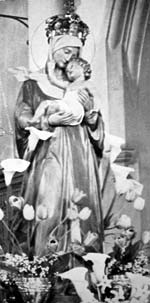
A fortnight today, on June 15th there will be the annual Diocesan Pilgrimage to Evesham in Worcestershire, in honour of Our Lady of Evesham.

Devotion to the Virgin Mary there stems from the tradition of a vision of her given to Eoves the swineheard and then to St Egwin, Bishop of Worcester and founder of the abbey at the beginning of the eighth century - long before Walsingham, let alone more famous shrines which have developed around modern appearances of Our Lady.


http://photos1.blogger.com/x/blogger/4490/2035/320/405247/Our_Lady_of_Evesham_1.jpg 

The modern statue of Our Lady of Evesham in the church

Image: Anglia Catholica


http://www.eveshamjournal.co.uk/resources/images/577828.jpg?type=articleLandscape

The Pilgrimage procession in the abbey grounds

Image:Evesham Journal

The Pilgrimage Mass will be celebrated in the church of St Mary and St Egwin at 1pm. The church is at the northern end of the town centre and very close to the railway station.

 http://www.birminghamdiocese.org.uk/wp-content/uploads/2012/08/EVESHAM.jpg

The church of St Mary and St Egwin
Image.birminghamdiocese.org.uk

I have been on the Pilgrimage once before and would commend it to anyone interested in joining it. Furthermore Evesham is an attractive and historic town, and makes for a very pleasant day out.


Sunday, 30 December 2012

St Egwin and Evesham


Today is, inter alia, the feast day of St Egwin of Evesham, who died circa 717. Also known as Ecgwine and also Egwine (In Latin, Ecgwinus and Egwinus) he was recorded as Bishop of Worcester from the years 692 to 717 in rewritten charters whose degree of fidelity to their lost originals is hard to gauge. There is also a largely fictional, early eleventh-century Vita by Byrhtferth, a monk of Ramsey (BHL 2432; the ancestor of a varied hagiographic progeny over the next several centuries), and also in the twelfth-century chronicle of John of Worcester.

St Egwin is considered the founder of the abbey at Evesham in Worcestershire, where his miracle-working remains were housed in a shrine completed in the later twelfth century by Adam of Evesham (Adam de Senlis). Liturgical calendars from the eleventh century onward give today as that of his laying to rest.

St Egwin is always associated with the story of the vision revealed to him and previously to the swineherd Eoves of Our Lady of Evesham  - centuries before that at Walsingham to Richeldis and to so many subsequent visons.

Michael Lapidge's biography of the saint, of whom very little is known with any certainty, in the Oxford DNB can be read here.


http://www.richardiiiworcs.co.uk/images/worcester/1003202.jpg

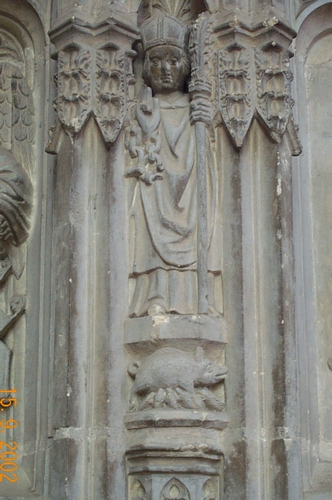
This statue of a bishop on the early sixteenth-century (1502-1504) chantry of Prince Arthur in Worcester cathedral is thought to represent Ecgwine (standing above the swine of Evesham's legendary etymon, the swineherd Eof or Eoves).


Image: richardiiiworcs.co.uk 


The Victoria County History account of the abbey of St Mary the Virgin and St Egwin at Evesham can be read here.

Amongst the manuscripts which survive from the abbey there is the mid-thirteenth-century Evesham Psalter of circa 1246 (London, British Library, MS Addit. 44874, fol. 6r). Here is a view of the Crucifixion illumination in the volume:


 http://campus.udayton.edu/mary/images/lent51.jpg

Image: campus.udayton.edu.com


There is, alas, not much left of the abbey buildings other than its early sixteenth-century detached belltower, the doorway of the chapter house, and from the enclosure, part of a Norman gateway and the originally early fifteenth-century abbey almonry which is now the very interesting museum for the abbey site and the town.


The mostly nineteenth-century church of St Egwin at Norton near Evesham preserves a lectern said to have been unearthed in 1813 in the churchyard of Evesham Abbey:


http://www.richardiiiworcs.co.uk/images/lectern.jpg

Image; richardiiiworcs.co.uk


There is a detailed account of the lectern, with more illustrations of the sculpture, which can be read here.


Adapted and extended from a post by John Dillon on the Medieval Religion discussion group.

Thursday, 3 June 2010

Evesham Pilgrimage


The annual Birmingham Diocesan Pilgrimage to Evesham will take place on Saturday June 12th.


The Mass will be at 1pm in the abbey grounds.

The principal celebrant will be the Abbot of Downside, Dom Aiden Bellinger.

After Mass there will be a procession with the statue of Our Lady of Evesham to the historic church of St Lawrence, where Benediction and Blessing of the Sick will take place at 4pm

Confessions will be available in the church of Our Lady and St Egwin from 10 until 12 in the morning.

I regret that I shall be unable to attend this year, but if you are free I would recommend going. The Pilgrimage is both prayerful and friendly, and Evesham a place of devotion to Our Lady since the beginning of the eighth century. There is something about its history here.

Wednesday, 24 March 2010

Evesham Abbey


I have always enjoyed my visits to Evesham, both as a historian and as a pilgrim. The great Benedictine abbey originated with the vision of Eoves, the swineherd who was to give his name to the town, who had a vision of Our Lady there about 705 - one of the earliest recorded examples. The vision was also granted to St Egwin, Bishop of Worcester, who went on to found the abbey as the Virgin had chosen the place. The continuous history of the abbey can be traced from the tenth century monastic revival down to its dissolution early in 1540 - one of the very last houses to be suppressed. Even then, in a sense, it continued - one of the monks, John Feckenham, was to be Abbot of Queen Mary I's revived foundation at Westminster, the last of whose monks transferred his rights to the English exile monks who established Dieulard, which was to return to England later and to settle at Ampleforth.

The scale of destruction at Evesham is shocking and moving, with the bell tower and a few fragments alone surviving to indicate the site of the abbey, although the Almonry Museum has excellent, if tantalising, displays of finds and manuscripts, as well as a rather splendid model reconstruction.

View Image

Now my old Oriel friend David Kendrick, a native of Evesham and who works for the Worcestershire Museums service, has published a substantial booklet on his interpretation of the architecture and setting of the abbey. David has considerable experience of such studies having worked on such major medieval monastic churches as Tewkesbury and Dorchester. I hope his book, which I have not yet seen, will increase awareness of the history of the site and its potential for further research. He has published the book himself and to order it click here.