Once I was a clever boy learning the arts of Oxford... is a quotation from the verses written by Bishop Richard Fleming (c.1385-1431) for his tomb in Lincoln Cathedral. Fleming, the founder of Lincoln College in Oxford, is the subject of my research for a D. Phil., and, like me, a son of the West Riding. I have remarked in the past that I have a deeply meaningful on-going relationship with a dead fifteenth century bishop... it was Fleming who, in effect, enabled me to come to Oxford and to learn its arts, and for that I am immensely grateful.


Showing posts with label Evesham Abbey. Show all posts

Tuesday, 20 May 2025

Marian pilgrimage - Our Lady of Evesham


The Pilgrimage now crosses the country to the valleys of the rivers Avon and Severn. The first shrine on the itinerary is that of Our Lady of Evesham, which has a strong claim to being one of the very earliest Marian shines in England and indeed in western Europe.

Glastonbury claims, arguably justly - and not simply on a legendary basis - a much earlier origin, but that is shrouded in mists and mysticism, not emerging fully into the historical record before the seventh century.  Evesham enters history with a foundation story involving Eoves’ encounter with Our Lady and his bringing St Egwin to his meeting with the Virgin    This narrative is strikingly similar to later stories of Marian apparitions and can be located in time and place. Evesham may be more recent than Glastonbury in its origin but it is more than three and a half centuries earlier than Walsingham.

My post about the shrine from last year, which requires the reader to navigate back to my first post about the shrine from 2020, which includes more about the history of the devotion and the abbey. These links can be accessed from Marian Pilgrimage - Our Lady of Evesham


May Our Lady of Evesham pray for Pope Leo XIV

Tuesday, 4 August 2015

Battle of Evesham 1265


Today is the 750th anniversary of the battle of Evesham in 1265, when the Royaloist troops led by the Lord Edward, later King Edward I, defeated the baronial army led by Simon de Montfort, who had ruled the realm since the battle of Lewes the previous year - there is an account of that battle at Battle of Lewes - and had kept King Henry III, who was his brother-in-law, as a virtual prisoner. 

There is an online account of the background and to the fighting at Battle of Evesham.
There is also a picec from the Battlefields Trust about the battle at their site Battle of Evesham 
and the current commemorations and celebrations are covered at  Battle of Evesham: Home

 Image: eveshamtown.co.uk 


At the website of the National Archives the post Battle of Evesham, 1265 - The National Archives has an account of the battle, and the death of Simon de Montfort in an extract taken from the chronicle attributed to Arnald FitzThedmar

 King Henry III

Image:fameimages.com

Simon Leicester.jpg

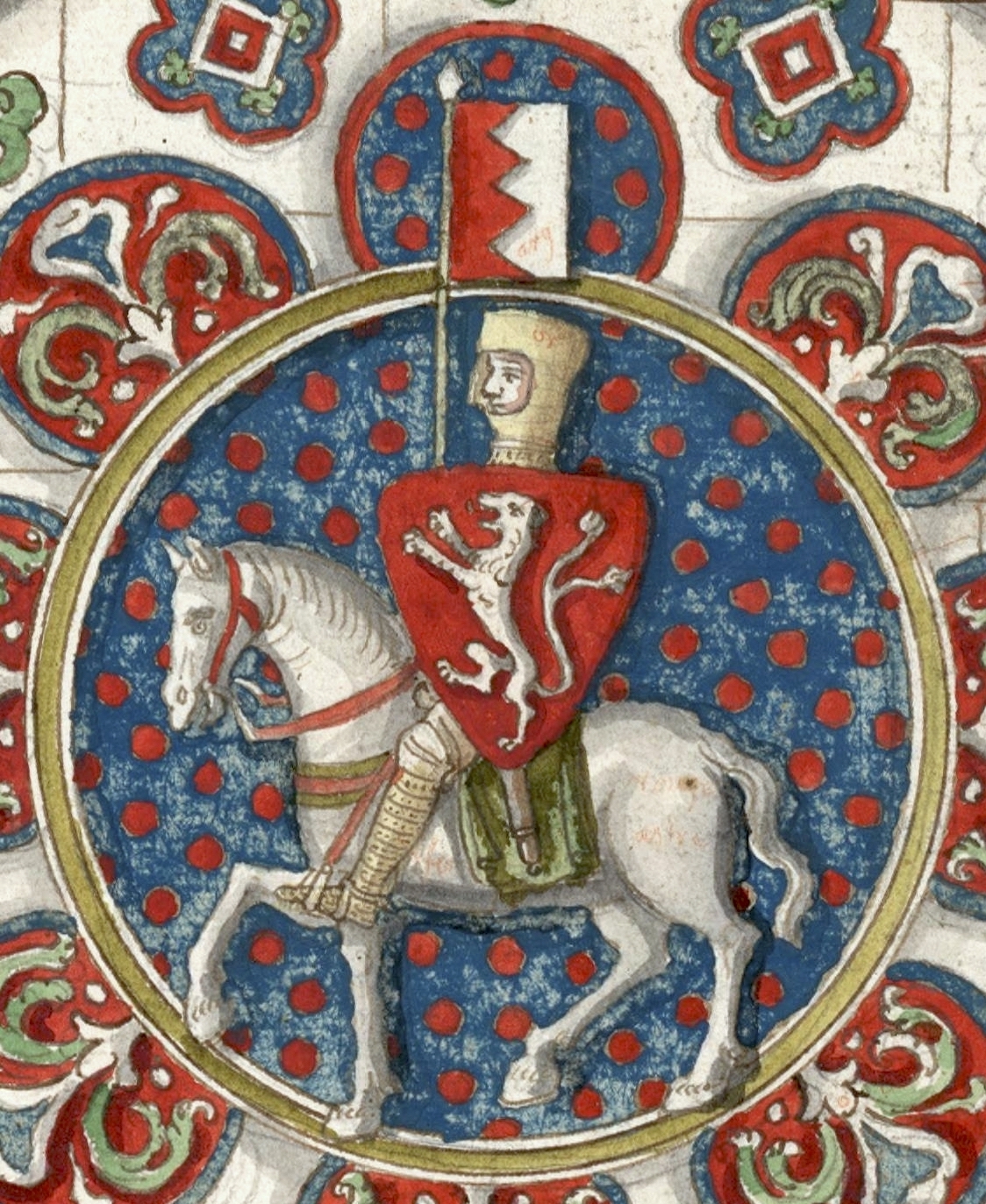
 Simon de Montfort, Earl of Leicester
A drawing of a window at Chartres Cathedral

Image: Wikipedia

There is an online biography of Earl Simon at  Simon de Montfort, 6th Earl of Leicester, and there is the excellent and comprehensive biography by Dr John Maddicott.

My sympathies are with King Henry III and his cause - as I have opined before I think that for the King Earl Simon turned out to be the Brother-in-Law-from-Hell.

For some time after his death there appears to have been at the Earl's burial place (or such of him as was buried at Evesham) in the abbey church a cult of sorts - which clearly did not attract the favour of the King.

File:De montfort evesham.jpg

 The modern memorial to Earl Simon on the site of Evesham Abbey.
This was unveiled and dedicated in 1965

Image: Wikimedia

Despite the major defeat of the baronial party at Evesham agroup held out at Kenilworth against a Royalist siege until the settlement known as the Dictum of Kenilworth in 1267. It was with theassignment of the Leicester estates to King Henry's younger son, Edmund, Earl of Lancaster , that there began that agglomeration of lands which was to create the fourteenth century Earldom and Duchy of Lancaster, which since 1399 has been held by the Sovereign.


Friday, 30 January 2015

The Suppression of Evesham abbey


Today is the 475th anniversary of the dissolution of the great Benedictine abbey of Evesham, the last monastic house to be suppressed under King Henry VIII.

There is an online history of the abbey which can be viewed at Evesham Abbey.

The detailed Victoria County History for Worcestershire account of the monastery can be read at Abbey of Evesham  and the Catholic Encyclopaedia article can be seen at Evesham Abbey

Two posts on the blog A Clerk of Oxford  give a good idea of the charm of the town, the remains of the abbey, the two historic churches and the museum, and many illustrations, notably of the fine nineteenth and twentieth century stained glass in the churches. They can be seen at A Trip to Evesham: Pigs, Fish, Angels, and the Dissolution of the Monasteries and at Medieval People in Modern Stained Glass: Evesham Edition

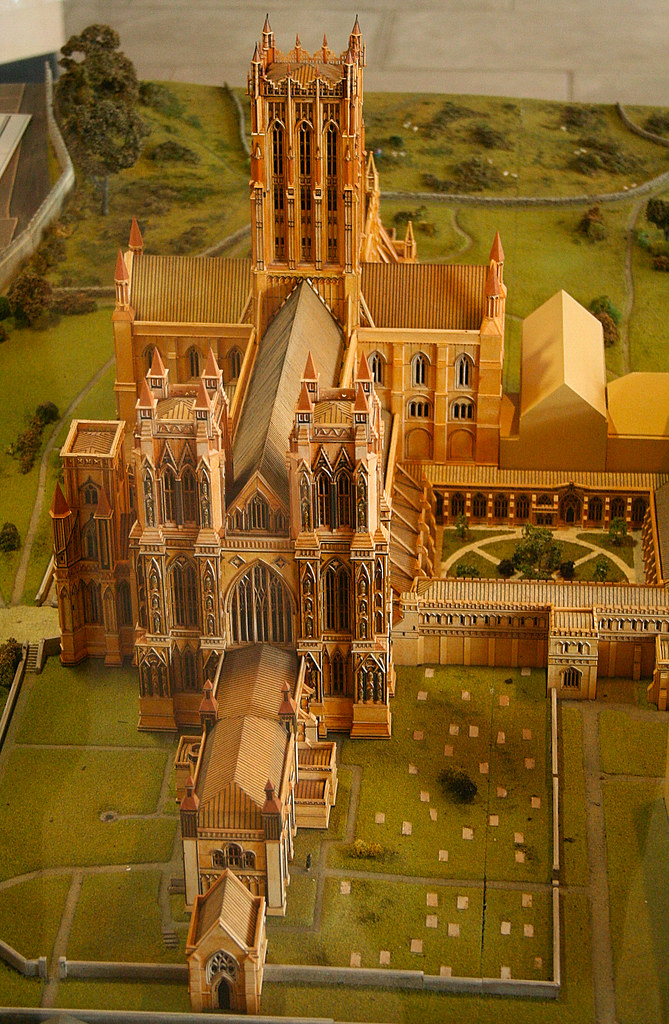
In the Almonry museum at Evesham - one of the few buildings to survive from the complex - there is a model showing what the abbey may have looked like in 1540.


 Evesham Abbey as it may have appeared in 1540
The bell tower is centre right, adjacent to the two surviving parish churches

Image:thealmonry.blogspot.co.uk 
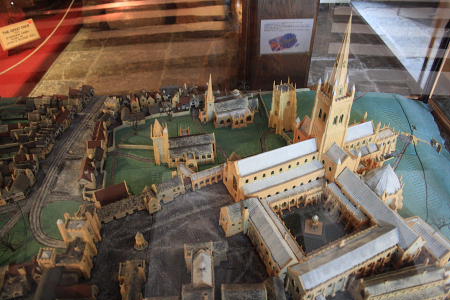
Model of Abbey

The abbey from the south-west

Image:nblazydays.wordpress.com


The bell tower of Evesham Abbey. 
Completed on the eve of the dissolution it is, apart from the doorway of the chapter house and some very low walling, all that survives above ground of the central buildings of the complex.

Image: railbus.co.uk

 
“The sufferings of history, for example, are dulled by repetition and time, but personal accounts bring such events to life. The Dissolution of the Monasteries has become to many yet another ‘statistic’ to be absorbed in a study of a larger-than-life Henry VIII, yet it was an agonising period for the men who devoted their lives to the Church.

“In the first of the STC (short title catalogue) sales in 1973, for example, one item was a 1537 first edition of Matthew’s version of the Bible which belonged to John Alcetur (Alcester), a monk at the great Benedictine Abbey of Evesham. The Abbey, partly owing to its size and partly to the resistance of Abbot Lichfield, was one of the last to be suppressed. Only about twenty Benedictine abbeys and priories survived into the year 1540, and by the end of that year not one remained. Alcester had made extensive annotations in Latin and English, and had covered three blank pages with a musical score, probably of his own composition.

“However, it is his personal record, at the end of the Book of Maccabees, of Henry’s tough measures that makes poignant reading today. He wrote:
. . . the monastery of Evesham was suppressed by Kyng Henry the viii the xxxi yere of his raygne the xxx day of Januer at Evensong tyme the convent beyng in the quere [choir] at thys verse [in the Magnificat] Deposuit potentes and wold not suffur them to make an ende. Phillypp Ballard beyng Abbot at that tyme and xxxv Relygius men at that day alyre in the seyde monastry . . .
“It is thought that within two months of the suppression of the Abbey, Alcester’s Bible was taken from him.” — Roy Hartley Lewis, Antiquarian books: an insider’s account, pp.138-9.

Source: roger-pearse.com

There is more about John Alcester's Bible in M.D.Knowles: 'Notes on a Bible of Evesham Abbey' The English Historical Review 79, No. 313 (1964), 775-778. The Bible itself can be seen in the Almonry Museum at Evesham. 

Dom Richard Lyttleton was sub-sexton at the time of the dissolution, and was, presumably, a member of the family which has played a major part in the history of the county. He lived on through all the successive changes of religious practice of the sixteenth century. Eventually in 1603, Father Augustine Bradshaw reconciled to the Benedictine order 'one Lyttleton, who had formerly been a monk of Evesham, and was now best known by the nickname of 'parson-tinker.' Being reclaimed he went home and 'presently fell blind and so remained almost two years deprived of his benefice and had he not been bedridden had been imprisoned for his conscience and so died with great repentance being near 100 years old.'

Another monk who was doubtless present at that last saying of the Office in the abbey church was Dom John Feckenham (c.1510-1584). Born John Howman he took the name of his home town on entering the abbey. After the dispersal of the community he became rector of Solihull, was imprisoned under King Edward VI, released under Queen Mary I, becoming Dean of St Pauls and in 1556 returned to the Benedictine life as Abbot of the refounded Westminster Abbey. As such he participated in the Coronation of Queen Elizabeth I in 1559. Following the second dissolution of the abbey later that year his life alternated between imprisonment and parole until his death at Wisbech in 1584.

The life of him by C.S.Knighton in the Oxford Dictionary of National Biography can be read here.

Feckenham's Westminster refoundation's last survivor, Dom Siegebert Buckley, transferred in the early years of the seventeenth century, his rights as representative of the whole community to two English benedictine who sought to establish in exile a specifically English house. Armed with his grant they did so, at Dieulard. that community, forced into exile by the French revolution returned to England and established Ampleforth, which in consequence useds the arms of the medieval abbey of Westminster.

Thus a link, tenuous but real, binds the great abbey of Evesham, and all it represented, to the modern Benedictines in Yorkshire and beyond.


Friday, 5 September 2014

English Iconoclasm IV


The fury of English iconolasm came hard upon one of the most prodigious periods of church building in the history of the country. Of the parish churches which ministered to the needs of the faithful virtually none were unaffected by the fifteenth century, If not being rebuilt entirely they were being completed, or extended, or gaining new features, such as clerestories and towers, or chantries, or at very least a few new windows in the latest style. This all reflected the great prosperity of the century. Not until the nineteenth century was there to be such an outburst of church building and improvement. That link is not accidental - the fifteenth and later nineteenth centuries were the two times in English history when wages were consistently ahead of prices. People had money, and they had devotion. 

Parish churches on the whole survived the reformation - the main exceptions were cities which witnessed the union of parishes such as York and Lincoln, and reflecting urban demographic changes.

For great churches - cathedrals, abbeys, collegiate foundations - the future was less certain. Here too there had been considerable building activity, and by 1500 English  architects were displaying not only maturity and confidence, but a renewed inventiveness, as in King Henry VII's Chapel at Westminster. That virtuosity can also be seen in a building linked to it in style if not otherwise, the well chapel at Holywell in North Wales. I cite that both because of its architectural finesse , but also because it is in a fairly remote location, away from the south-east, although it was a popular destination for pilgrims both from the elite and the populace at large - and also because it was sufficiently remote to survive as a place of such pilgrimage through the recusant era.

File:Treffynnon.JPG

St Winefride's Well at Holywell, commissioned by the Abbot of Basingwerk circa 1500

Image: Wikipedia

Monastic building was still extensive and for which we have  evidence at Glastonbury, Evesham, Canterbury, Chester, Westminster and in the complete rebuilding of the cathedral priory at Bath. In my home county of  Yorkshire one can still see evidence of that confidence by the Cistercians at Fountains and Kirkstall, and by the Augustinians at Bolton and Bridlington. I did once hear an archaeologist (one of those amongst that community who do not believe in anything unless they have actually dug it up)  asserting that this was the monasteries spending up the money before they were dissolved...


Model of Glastonbury Abbey

Model of Glastonbury Abbey.
Reconstruction of how the abbey may have appeared in 1539
The easternmost Edgar chapel  and that of Our Lady of Loretto west of the north transept are from the first years of the sixteenth century


Image:skyscrapernews.com/All rights reserved. Copyright Holder - GNU License
 

photo 

Glastonbury Abbey from the west
 Today the shell of the Lady Chapel and Gallilee in the foreground survive as well as the eastern piers of the central tower and some portions of the aisle walls

Image: Canis Major on Flickr 


The view down the nave today

Image:earlybritishkingdoms.com 


 Evesham Abbey as it may have appeared in 1540
The bell tower is centre right, adjacent to the two surviving parish churches

Image:thealmonry.blogspot.co.uk 

 Model of Abbey


The abbey from the south-west
Image:nblazydays.wordpress.com


The bell tower of Evesham Abbey. 
Completed on the eve of the dissolution it is, apart from the doorway of the chapter house and some very low walling all that survives above ground of the central buildings of the complex.

Image: railbus.co.uk


Ariel photograph of Fountains Abbey

Fountains Abbey

  Image:Copyright Dave MacLeod/cisterciansshef.ac.uk

http://www.capper-online.de/Travel/UK2/02_B_Model_Fountains_Abbey.jpg

A reconstruction model of Fountains as seen from the east on the eve of the dissolution of the abbey
 Image:capper-online.de

Of these great churches the cathedrals survived, with the exception of St Mary's cathedral priory in Coventry, about which there is something here. The creation of five new dioceses ensured the survival of the main structure at Bristol, Chester, Gloucester, Peterborough and Oxford, but many others listed as potential diocesan centre - the grand idea seems to have been a diocese for each county, but money constraints doubtless came intp play, leading to the loss of great buildings, including Bury St Edmunds, Colchester and Fountains.

http://www.stedmundsburychronicle.co.uk/Chronicle/1216-1539pics/Abbey1415.jpg 

A reconstruction of Bury St Edmunds in the later middle ages

Image:stedmundsburychronicle.co.uk 


A model in the abbey grounds at Bury St Edmunds showing the abbey in its earlier phase, before the collapse of the west tower in 1431 and its subsequent rebuilding
The present cathedral is the church to the immediate north-west of the abbey in the rear centre

Image:bystargooseandhanglands.blogspot.co.uk 


Bury St Edmunds abbey today
At the rear is the splendid tower from 2000 of the Anglican cathedral

Image:Wikipedia

abbey church

An engraving of an early sixteenth century drawing of Colchester Abbey  

Image:thecolchesterarchaeologist.co.uk 

By sheer good luck, and against the odds, churches such as St Albans survived, to become a cathedral in 1877, and parishes saved all or most of  Tewkesbury (bought at scrap value for £453 by the townspeople), Selby, Sherborne, Dorchester, Bridlington, Cartmel, Romsey, Wymondham, Croyland and others as well as Beverley, Ripon and Southwell collegiate churches.

For those with no potential as a cathedral or as a parish church, or where there were already large churches in a city, such as St Augustine's in Canterbury or St Mary's in York - both major buildings of cathedral size - the prospects were grim.

Overall the loss of buildings, let alone their decoration and furnishings was catastrophic. There are accounts of some being rapidly destroyed by new owners to prevent their return to their rightful possessors, and neglect, decay, casual plundering and vandalism took their inevitable toll.

To be continued


Saturday, 1 June 2013

Evesham Pilgrimage June 15th


A fortnight today, on June 15th there will be the annual Diocesan Pilgrimage to Evesham in Worcestershire, in honour of Our Lady of Evesham.

Devotion to the Virgin Mary there stems from the tradition of a vision of her given to Eoves the swineheard and then to St Egwin, Bishop of Worcester and founder of the abbey at the beginning of the eighth century - long before Walsingham, let alone more famous shrines which have developed around modern appearances of Our Lady.


http://photos1.blogger.com/x/blogger/4490/2035/320/405247/Our_Lady_of_Evesham_1.jpg 

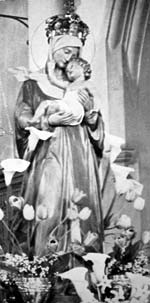
The modern statue of Our Lady of Evesham in the church

Image: Anglia Catholica


http://www.eveshamjournal.co.uk/resources/images/577828.jpg?type=articleLandscape

The Pilgrimage procession in the abbey grounds

Image:Evesham Journal

The Pilgrimage Mass will be celebrated in the church of St Mary and St Egwin at 1pm. The church is at the northern end of the town centre and very close to the railway station.

 http://www.birminghamdiocese.org.uk/wp-content/uploads/2012/08/EVESHAM.jpg

The church of St Mary and St Egwin
Image.birminghamdiocese.org.uk

I have been on the Pilgrimage once before and would commend it to anyone interested in joining it. Furthermore Evesham is an attractive and historic town, and makes for a very pleasant day out.


Sunday, 30 December 2012

St Egwin and Evesham


Today is, inter alia, the feast day of St Egwin of Evesham, who died circa 717. Also known as Ecgwine and also Egwine (In Latin, Ecgwinus and Egwinus) he was recorded as Bishop of Worcester from the years 692 to 717 in rewritten charters whose degree of fidelity to their lost originals is hard to gauge. There is also a largely fictional, early eleventh-century Vita by Byrhtferth, a monk of Ramsey (BHL 2432; the ancestor of a varied hagiographic progeny over the next several centuries), and also in the twelfth-century chronicle of John of Worcester.

St Egwin is considered the founder of the abbey at Evesham in Worcestershire, where his miracle-working remains were housed in a shrine completed in the later twelfth century by Adam of Evesham (Adam de Senlis). Liturgical calendars from the eleventh century onward give today as that of his laying to rest.

St Egwin is always associated with the story of the vision revealed to him and previously to the swineherd Eoves of Our Lady of Evesham  - centuries before that at Walsingham to Richeldis and to so many subsequent visons.

Michael Lapidge's biography of the saint, of whom very little is known with any certainty, in the Oxford DNB can be read here.


http://www.richardiiiworcs.co.uk/images/worcester/1003202.jpg

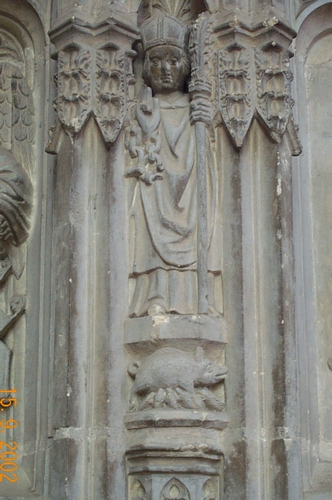
This statue of a bishop on the early sixteenth-century (1502-1504) chantry of Prince Arthur in Worcester cathedral is thought to represent Ecgwine (standing above the swine of Evesham's legendary etymon, the swineherd Eof or Eoves).


Image: richardiiiworcs.co.uk 


The Victoria County History account of the abbey of St Mary the Virgin and St Egwin at Evesham can be read here.

Amongst the manuscripts which survive from the abbey there is the mid-thirteenth-century Evesham Psalter of circa 1246 (London, British Library, MS Addit. 44874, fol. 6r). Here is a view of the Crucifixion illumination in the volume:


 http://campus.udayton.edu/mary/images/lent51.jpg

Image: campus.udayton.edu.com


There is, alas, not much left of the abbey buildings other than its early sixteenth-century detached belltower, the doorway of the chapter house, and from the enclosure, part of a Norman gateway and the originally early fifteenth-century abbey almonry which is now the very interesting museum for the abbey site and the town.


The mostly nineteenth-century church of St Egwin at Norton near Evesham preserves a lectern said to have been unearthed in 1813 in the churchyard of Evesham Abbey:


http://www.richardiiiworcs.co.uk/images/lectern.jpg

Image; richardiiiworcs.co.uk


There is a detailed account of the lectern, with more illustrations of the sculpture, which can be read here.


Adapted and extended from a post by John Dillon on the Medieval Religion discussion group.