Once I was a clever boy learning the arts of Oxford... is a quotation from the verses written by Bishop Richard Fleming (c.1385-1431) for his tomb in Lincoln Cathedral. Fleming, the founder of Lincoln College in Oxford, is the subject of my research for a D. Phil., and, like me, a son of the West Riding. I have remarked in the past that I have a deeply meaningful on-going relationship with a dead fifteenth century bishop... it was Fleming who, in effect, enabled me to come to Oxford and to learn its arts, and for that I am immensely grateful.


Showing posts with label St Boniface. Show all posts

Wednesday, 5 June 2013

St Boniface


Today is the feast of St Boniface, who was killed by Frisian pagans on this day in 754. Born about 680, traditionally it is said at Crediton in Devon, he became a monk, but his missionary work in converting the Germans east of the Rhine has led him to be called the Apostle of Germany. He has been described as the most influential Englishman in continental terms before the Norman Conquest, and even as the greatest Englishman ever. There is an account of his life and achievements here.
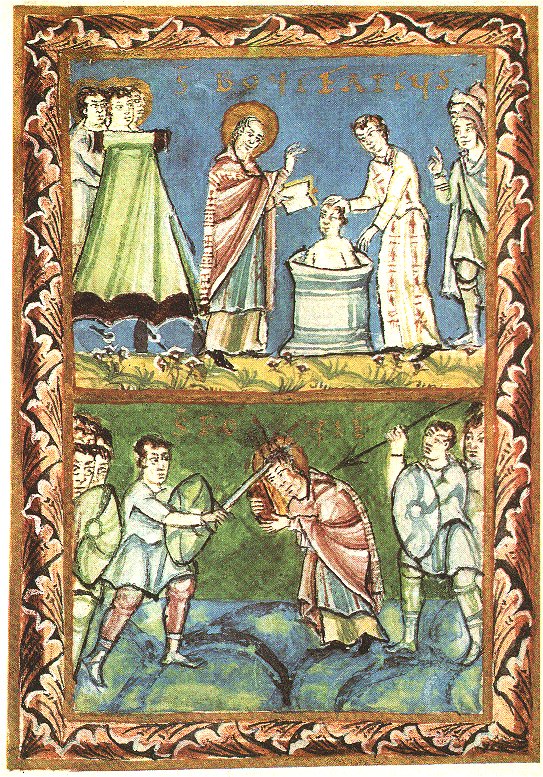

File:St Boniface - Baptising-Martyrdom - Sacramentary of Fulda - 11Century.jpg

St Boniface baptizing and being martyred - from the 11th century Fulda Sacramntary

Image:Wikipedia

The Gospel Book he is said to have held up to ward off the swords of his murderers still survives -  complete with a sword cut in it.

Boniface had established his see at Mainz, and is commemorated in the cathedral by this memorial effigy of 1357:


Germany  Mainz Cathedral St Boniface 1357 

  Germany Mainz Cathedral St Boniface 1357

St Boniface - effigy in Mainz cathedral of 1357

Image: themcs.org

His relics are however buried at the monastic centre established by his follower St Sturmius at Fulda in Hesse. There is an introduction to the history of the town here. 


File:Catedral de Fulda.jpg

Fulda Cathedral
The abbey church as rebuilt in 1704-12. It became the cathedral of the newly created diocese in 1752.

Image:Wikitravel

There is more about the history and architecture of the abbey and cathedral church here. There is a fine set of illustrations of the cathedral and its furnishings in the 2010 post  The Heart of Catholic Germany (Part I) from the New Liturgical Movement  which includes  views of St Boniface's tomb.

Wednesday, 7 November 2012

St Willibrord


Today is the feast day of St Willibrord, the Northumbrian born Apostle of the Frisians, and founder of the see of Utrecht and the abbey of Echternach. Amongst Anglo_Saxon missionaries to the continent he is second only to St Boniface in importance.
There is a full and detailed study by Marios Costambeys in the Oxford DNB which can be read here .
There is also an online life here and there is another which can be read at the biography of St. Willibrord site.
His tomb is at Echternach in Luxemburg, and it is in honour of St Willirord that the remarkable Dancing procession of Echternach  take splace on Whit Tuesday each year.
The Romanesque former abbey church at Echternach, now designated the basilica of St Willibrord, holds his relics.
  • St Willibrord Basilika, Echternach, Luxemburg
  • The basilica of St Willibrord at Echternach
Image: kaarvea on Panoramio
The very handsome nineteenth century church of St Willibrord in Utrecht has been featured by the New Liturgical Movement in an article which can be read here, with a link to an earlier post on NLM about the church and its liturgical life. 
Church of St Willibrord Utrecht
Image: New Liturgical Movement