Once I was a clever boy learning the arts of Oxford... is a quotation from the verses written by Bishop Richard Fleming (c.1385-1431) for his tomb in Lincoln Cathedral. Fleming, the founder of Lincoln College in Oxford, is the subject of my research for a D. Phil., and, like me, a son of the West Riding. I have remarked in the past that I have a deeply meaningful on-going relationship with a dead fifteenth century bishop... it was Fleming who, in effect, enabled me to come to Oxford and to learn its arts, and for that I am immensely grateful.


Showing posts with label Romanovs. Show all posts

Monday, 17 July 2017

Remembering the Tsar in Ekaterinburg


There is an article in The Guardian today about a pilgrimage to the site of the murder of the Russian Imperial family in 1918 and which can be viewed at Thousands of pilgrims walk to commemorate Russian tsar Nicholas II 

There is an online article about the canonization of the Emperor and his immediate family as well as of  other members of the Imperial house at Canonization of the Romanovs

Image result for Nicholas II Icon


A contemporary icon of Emperor Nicholas II

Image: Orthodox Gifts

There are many icons of the Emperor or of him and his family which can be viewed online, 
indicating the extent of devotion to the memory of the Romanovs. 

Image result for Nicholas II Icon

The Imperial Family as Passion Bearers on an icon

Image: Pinterest


Saturday, 17 June 2017

Memories of Imperial Russia in Oxford


The website Royal Central has the following post today which has a special resonance for those of us who live in Oxford:

An Oxford House and Imperial Russia

by Elizabeth Jane Timms

A building in a suburb of Oxford has a remarkably unique history. At first glance, it could be yet another late-Victorian townhouse, although the presence of its distinctive blue double-doors suggests something more unusual. Although now split up into apartments, the building hints at having once been something else, despite having been flats for over 30 years. The building replaced the apothecary and almshouses of the Cutler Boulter Charity on St Clement’s Road. It remained the main dispensary for this East Oxford suburb until 1948 and is, therefore, historically significant to the area. The building had incidentally also been the main A.R.P telephone station for Oxfordshire until 1945. Several years after this, it attracted the interest of the person with whom it is now most closely associated.

Charles Sydney Gibbes with Grand Duchess Anastasia Nikolaevna 
Image: Romanov family Flickr / Wikimedia
Charles Sydney Gibbes, who became a well-recognised figure in Oxford, was originally from Yorkshire and educated at St John’s College, Cambridge. Gibbes initially went to Russia to teach English to the aristocracy but was later summoned to the Russian Imperial Court to be considered as tutor to the daughters of Tsar Nicholas II, the Grand Duchesses Olga, Tatiana, Maria and Anastasia. In 1913, Gibbes became English tutor to the nine-year-old Tsarevich Alexei, the heir-apparent to the throne.
Following the Tsar’s abdication on 2/15 March 1917, the Imperial Family was detained under the Provisional Government, interned as prisoners within their residence of the Alexander Palace at Tsarskoe Selo (Tsar’s Village) outside St. Petersburg. Initially, the Imperial Family was moved to the 'Governor's House' at Tobolsk in Siberia, but in April 1918, orders were issued to move the Tsar and his family again, this time to Ekaterinburg. The Imperial Family was housed at the Ipatiev House (also dubbed the House of Special Purpose) where on the night of 16/17 July 1918, the entire family - together with their faithful retainers, the maid Anna Demidova and the former court physician Dr Botkin - were shot in the cellar of the house by Bolsheviks. Gibbes had not been allowed contact with the Imperial Family and was only able to enter the Ipatiev House later, following the murder, in the subsequent period when Ekaterinburg was briefly under the control of the White Army.
Gibbes returned to England and enrolled in an ordination course at St Stephen’s House in 1928; although, he subsequently decided against a career in the Anglican Church. On his return to Harbin, he was received into the Russian Orthodox Church as a tonsured monk, taking as his new name Father Nicholas, after the murdered Tsar Nicholas II. Gibbes again returned to England, moving to Oxford in 1941, where he established an Orthodox congregation in the medieval chapel at Bartlemas, which borders the recreation grounds of Oriel, Jesus and Lincoln Colleges. It was after the end of the Second World War when Gibbes found himself looking for somewhere permanent to settle that he came across the building in Oxford.
Father Nicholas purchased the house in 1949 and converted one ground-floor room of the house into a chapel dedicated to St Nicholas the Wonderworker, where the Russian Imperial Family was mentioned in the services which were celebrated there. It was within this chapel that Gibbes displayed many of the relics which he had preserved and carried with him across the world. Most poignantly perhaps, was the chandelier of red and white glass tulips which hung originally in the ‘House of Special Purpose’ at Ekaterinburg, which Gibbes had salvaged. Among the icons hung in the chapel were those which had been personally given to Gibbes by the Imperial Family or were those rescued from the dustbins and stoves of the ‘House of Special Purpose.’
Elsewhere, Gibbes carefully preserved his other relics of the Imperial Family, which included a handkerchief, pencil-case and bell owned by the Tsarevich Alexei. There was also a pair of Tsar Nicholas II’s felt boots which were kept near the altar. Gibbes established a library behind the chapel, which contained some exercise books of his Imperial pupils Grand Duchesses Maria and Anastasia, as well as some of his photographs. Other items included a coat-of-arms from the imperial yacht Standart and a collection of sleigh bells.
The house was subsequently split into flats, and the chapel that held such poignant relics of the Imperial Family was also turned into a flat. Nothing remains of Gibbes's time there. Much of his collection was sold to the Wernher Collection at Luton Hoo where a memorial chapel was made to house them, consecrated by Archbishop Anthony of Sourozh. When Luton Hoo became a luxury hotel, the Wernher Collection moved to Greenwich and was managed by English Heritage. The Gibbes collection, however, is now in private hands.
The house was successfully nominated as a heritage asset in 2015. It is also a building of spiritual importance regarding the history of Oxford’s Orthodox communities, as the Russian Orthodox Chapel in Oxford was only established much later and not within Gibbes’s lifetime. Appropriately enough, the chapel today contains an engraving of Gibbes in its main entrance hall, showing him as the white-bearded figure in black that he had familiarly become in 1950s Oxford. Fittingly, the chapel contains also icons of the Russian Imperial Family in its window niches, who were finally recognised - following much debate - as Passion Bearers by the Moscow Patriarchate in 2000.
Gibbes died aged 87 in 1963 and is buried in Headington Cemetery, his gravestone bearing the three staves of the Russian Orthodox Cross. In 2013, a memorial service took place at Headington Cemetery to mark his 137th birthday, attended by the Russian Orthodox Community. The service took place in deep snow; ironically enough, it was a scene that fittingly could have occurred in Russia.


Wednesday, 15 March 2017

Abdication of Emperor Nicholas II


Today is the centenary (NS) of the abdication of the Emperor Nicholas II in 1917.

Having initially abdicated in favour of his son Tsesarevich Alexei in the afternoon late on that day he issued a second abdication on behalf of his son but timed as of his first document. This was because it was feared the outgoing Emperor and his wife would be separated from their invalid son. So instead of being coming Regent the Grand Duke Michael was to succeed his brother as Emperor Michael II. The following day, being awakened to the news he was now Emperor, he met with representatives of the Provisional Government and neither accepting or declining the position, said he would wait for the Constituent Assembly to meet to decide the form of government of Russia. Before it met Kerensky declared the country to be a republic on September 1st, followed by the Bolshevik revolution in October.

The story of the Emperor Nicholas, his Empress Alexandra and the fate of their family is well known - there is an online biography with links at Nicholas II of Russia -  and it is a story full of tragedy and horror.

The tragedy is not just personal, of his family, and dynasty but also of Russia itself. It has elements of Classical tragedy - were the events of the Emperor's reign foreordained by an evil providence, or when and how could things have turned out differently. I do not believe in historical inevitability, and at many points in the last years of Romanov rule different outcomes were possible. 

One obvious question is how might the Duma and the political parties within it have evolved without the disaster of the First World War. Another is whether Russia could have become a constitutional monarchy like those of the rest of Europe - the precise balances of power within such systems being secondary to the basic principle. A further point is whether the Emperor Nicholas could have come to accept and work effectively with such a system and whether Russia could produce a political class to effectively operate and manage a parliamentary system. that, for example, remains a living issue today.

Image result for Nicholas II opening Duma image

  The State Opening of the first Duma in the Winter Palace in 1906

Image:Pinterest 

 http://romanovrussia.com/wp-content/uploads/LargeNIIphoto2.jpg

  The Emperor reading his speech at the State Opening

Image:romanovrussia

Other members of the Imperial Family appear to have been more responsive, and they appear as a wider family to have felt excluded from the centre as the Emperor and Empress, their daughters and frail son became rather isolated from the rest of the Romanovs. Something of that can be seen in the life of the designated successor Grand_Duke_Michael_Alexandrovich_of_Russia.

Much of this does turn on the personality and abilities of Emperor Nicholas II. He often appears limited and unimaginative, blinkered and out of his depth. He had many good personal qualities as a man, husband and father, and whether those qualities in different circumstances could have made him an effective Emperor under whatsoever constitutional dispensation remains a topic for reflection and to which there is no quick answer.

May 4, 1896 the Tsar Nicholas II left the Cathedral of the Assumption, after the Coronation  

Emperor Nicholas II leaves the Cathedral of the Assumption in the Kremlin following his Coronation May 4th 1896 

Image: Pinterest/historyofromanovs.tumblr.com


Sunday, 6 March 2016

Russian Coronations


A friend whom I saw over the weekend when he was back in Oxford has given me the link to a very interesting, illustrated article on the Russian Imperial Coronation ceremony, and in particular the way it evolved to emphasis the quasi-sacerdotal or diaconal position of the Emperor, and the problems ( or indeed lack thereof) occasioned by the series of Empresses in the eighteenth century who acted in an otherwise exclusively male role at their coronations.

It can be viewed at http://www.pravoslavie.ru/english/print80559.htm


                       The Coronation of Emperor Nicholas II and Empress Alexandra in 1896
                                           The Dowager Empress Marie Dagmar is to the left
                                                                    Laurens Tuxen, 1898

Thursday, 21 February 2013

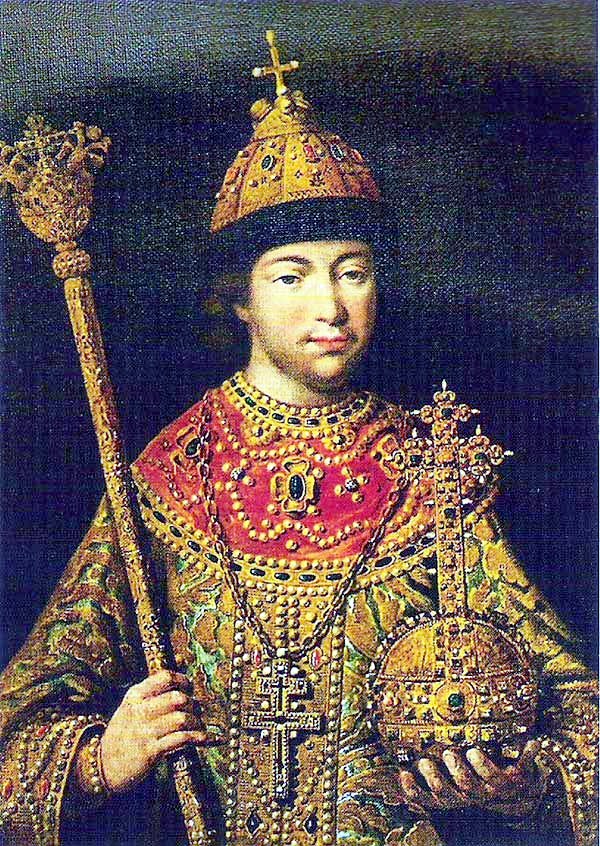
Tsar Michael I of Russia


It was on February 21 1613 that the 16 year old Michael Romanov was unanimously elected by the Zemsky Sobor as the Tsar of Russia. This choice of the young Tsar is seen both as marking the end of the Time of Troubles following the end of the House of Rurik in 1598 and as the beginning of the rule of the Romanov dynasty. It was not until March 24 that a delegation reached Michael and his mother, who were initially reluctant to accept the dignity, and not until July 22 that he was crowned.


File:Tsar Mikhail I -cropped.JPG

Tsar Michael I at the time of his coronation

Image: Wikipedia

There is an introduction to the life of Tsar Michael I here.

In 1913 there were Tercentenary Celebrations of the advent of the Romanovs which tragically proved to be the swansong of the old order in Russia. There is a short account of the celebrations on that February 21st here.


http://24.media.tumblr.com/tumblr_lvvkfiTK6V1r3sn0vo1_500.jpg

Emperor Nicholas II and Empress Alexandra and two of their daughters 
at the Tercentenary Celebrations. The Tsarevich Alexis, carried by a cossack, 
can be seen between his parents.

Image: zolotoivek.tumblr.com