Once I was a clever boy learning the arts of Oxford... is a quotation from the verses written by Bishop Richard Fleming (c.1385-1431) for his tomb in Lincoln Cathedral. Fleming, the founder of Lincoln College in Oxford, is the subject of my research for a D. Phil., and, like me, a son of the West Riding. I have remarked in the past that I have a deeply meaningful on-going relationship with a dead fifteenth century bishop... it was Fleming who, in effect, enabled me to come to Oxford and to learn its arts, and for that I am immensely grateful.


Showing posts with label Russia. Show all posts

Thursday, 21 February 2013

Tsar Michael I of Russia


It was on February 21 1613 that the 16 year old Michael Romanov was unanimously elected by the Zemsky Sobor as the Tsar of Russia. This choice of the young Tsar is seen both as marking the end of the Time of Troubles following the end of the House of Rurik in 1598 and as the beginning of the rule of the Romanov dynasty. It was not until March 24 that a delegation reached Michael and his mother, who were initially reluctant to accept the dignity, and not until July 22 that he was crowned.
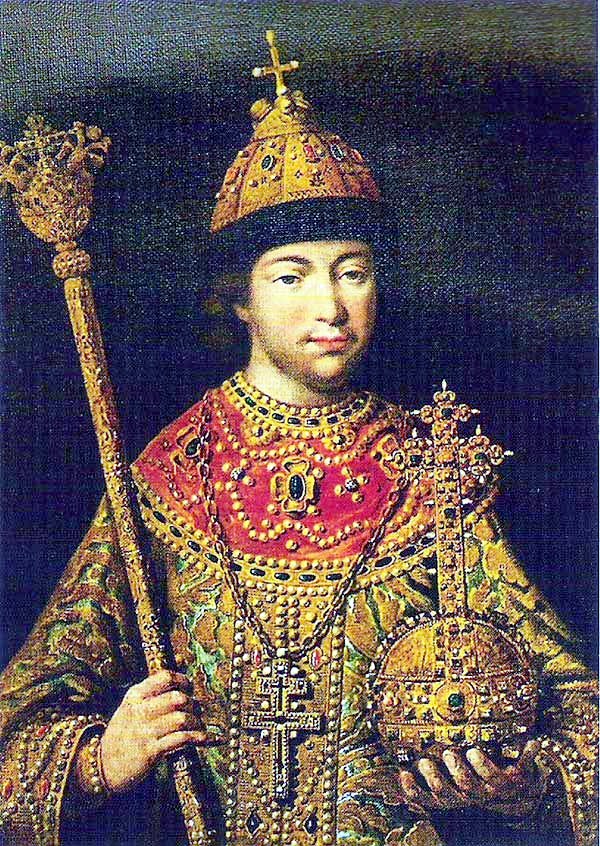

File:Tsar Mikhail I -cropped.JPG

Tsar Michael I at the time of his coronation

Image: Wikipedia

There is an introduction to the life of Tsar Michael I here.

In 1913 there were Tercentenary Celebrations of the advent of the Romanovs which tragically proved to be the swansong of the old order in Russia. There is a short account of the celebrations on that February 21st here.


http://24.media.tumblr.com/tumblr_lvvkfiTK6V1r3sn0vo1_500.jpg

Emperor Nicholas II and Empress Alexandra and two of their daughters 
at the Tercentenary Celebrations. The Tsarevich Alexis, carried by a cossack, 
can be seen between his parents.

Image: zolotoivek.tumblr.com


Friday, 16 November 2012

Former People


The Book of the Week read on Radio 4 this week has been Douglas Smith's Former People: The Final Days of the Russian Aristocracy  published in the UK by Macmillan.


http://www.douglassmith.info/?ACT=34&image=%2Fpublic%2Fuploads%2Fbooks%2Fformer-people-main.png&w=336&method=resize


Image: Douglas Smith website

The book was, obviously, abridged but clearly extremely interesting and well documented from the recollections of those who lived through the events described.

Douglas Smith starts with the point that history is usually written by the victors. Here he looks at the victims as he chronicles the political and social tragedy and disaster that swept across Russia from 1917. This may not be cheerful reading, but it is revealing.

My own strongly Hobbesian and Burkeian sense responded to the depiction of the Russian revolutions and their aftermath in a way which corresponded with Norman Cohn's Pursuit of the Millennium. 

Here, once again, the revolutionaries appropriated to themselves the possessions of the displaced elite, not in a spirit of real redistribution but by simple theft and greed. Life became nasty, brutish and short for everybody, and human misery abounded.

There is an interview with the author and more about the book on his website which can be viewed here.