Once I was a clever boy learning the arts of Oxford... is a quotation from the verses written by Bishop Richard Fleming (c.1385-1431) for his tomb in Lincoln Cathedral. Fleming, the founder of Lincoln College in Oxford, is the subject of my research for a D. Phil., and, like me, a son of the West Riding. I have remarked in the past that I have a deeply meaningful on-going relationship with a dead fifteenth century bishop... it was Fleming who, in effect, enabled me to come to Oxford and to learn its arts, and for that I am immensely grateful.


Showing posts with label Emperor Nicholas II. Show all posts

Monday, 17 July 2017

Remembering the Tsar in Ekaterinburg


There is an article in The Guardian today about a pilgrimage to the site of the murder of the Russian Imperial family in 1918 and which can be viewed at Thousands of pilgrims walk to commemorate Russian tsar Nicholas II 

There is an online article about the canonization of the Emperor and his immediate family as well as of  other members of the Imperial house at Canonization of the Romanovs

Image result for Nicholas II Icon


A contemporary icon of Emperor Nicholas II

Image: Orthodox Gifts

There are many icons of the Emperor or of him and his family which can be viewed online, 
indicating the extent of devotion to the memory of the Romanovs. 

Image result for Nicholas II Icon

The Imperial Family as Passion Bearers on an icon

Image: Pinterest


Wednesday, 15 March 2017

Abdication of Emperor Nicholas II


Today is the centenary (NS) of the abdication of the Emperor Nicholas II in 1917.

Having initially abdicated in favour of his son Tsesarevich Alexei in the afternoon late on that day he issued a second abdication on behalf of his son but timed as of his first document. This was because it was feared the outgoing Emperor and his wife would be separated from their invalid son. So instead of being coming Regent the Grand Duke Michael was to succeed his brother as Emperor Michael II. The following day, being awakened to the news he was now Emperor, he met with representatives of the Provisional Government and neither accepting or declining the position, said he would wait for the Constituent Assembly to meet to decide the form of government of Russia. Before it met Kerensky declared the country to be a republic on September 1st, followed by the Bolshevik revolution in October.

The story of the Emperor Nicholas, his Empress Alexandra and the fate of their family is well known - there is an online biography with links at Nicholas II of Russia -  and it is a story full of tragedy and horror.

The tragedy is not just personal, of his family, and dynasty but also of Russia itself. It has elements of Classical tragedy - were the events of the Emperor's reign foreordained by an evil providence, or when and how could things have turned out differently. I do not believe in historical inevitability, and at many points in the last years of Romanov rule different outcomes were possible. 

One obvious question is how might the Duma and the political parties within it have evolved without the disaster of the First World War. Another is whether Russia could have become a constitutional monarchy like those of the rest of Europe - the precise balances of power within such systems being secondary to the basic principle. A further point is whether the Emperor Nicholas could have come to accept and work effectively with such a system and whether Russia could produce a political class to effectively operate and manage a parliamentary system. that, for example, remains a living issue today.

Image result for Nicholas II opening Duma image

  The State Opening of the first Duma in the Winter Palace in 1906

Image:Pinterest 

 http://romanovrussia.com/wp-content/uploads/LargeNIIphoto2.jpg

  The Emperor reading his speech at the State Opening

Image:romanovrussia

Other members of the Imperial Family appear to have been more responsive, and they appear as a wider family to have felt excluded from the centre as the Emperor and Empress, their daughters and frail son became rather isolated from the rest of the Romanovs. Something of that can be seen in the life of the designated successor Grand_Duke_Michael_Alexandrovich_of_Russia.

Much of this does turn on the personality and abilities of Emperor Nicholas II. He often appears limited and unimaginative, blinkered and out of his depth. He had many good personal qualities as a man, husband and father, and whether those qualities in different circumstances could have made him an effective Emperor under whatsoever constitutional dispensation remains a topic for reflection and to which there is no quick answer.

May 4, 1896 the Tsar Nicholas II left the Cathedral of the Assumption, after the Coronation  

Emperor Nicholas II leaves the Cathedral of the Assumption in the Kremlin following his Coronation May 4th 1896 

Image: Pinterest/historyofromanovs.tumblr.com


Saturday, 4 March 2017

Imperial gifts to British godchildren


The news agency Royal Central has the following story:


A set of silver gilt and cloisonné enamel which stirred interest in the antique world since it was recently consigned as going to auction, sold today for £20,000. This champlevé cutlery set told a story that links the future Tsarina of Russia's visit to the Yorkshire town of Harrogate in 1894, where she had gone to take a cure.


Princess Alix of Hesse and the Tsarevich Nicholas of Russia, an official photograph in Coburg at the time of their engagement, 1894.

Eduard Uhlenhuth [Public domain], via Wikimedia Commons

Princess Alix of Hesse was advised to take a 'cure' in Harrogate in 1894 for sciatica, a complaint from which she had been suffering for some time. One of Queen Victoria's favourite grandchildren, the Queen was present in Coburg in April 1894, for the wedding of Alix's beloved brother, the Hereditary Grand Duke of Hesse, Ernst Ludwig, to Princess Victoria Melita "Ducky" of Edinburgh, daughter of her second son, Prince Alfred, Grand Duke of Saxe-Coburg-Gotha and his wife, Grand Duchess Marie Alexandrovna of Russia. Among the many guests, at what was one of the great gatherings of European royalty in the last years of the 19th century, were Kaiser Wilhelm II of Germany and the Tsarevich Nicholas, the future Tsar Nicholas II of Russia.

The couple became engaged while at Coburg after which the Tsarevich Nicholas returned to Russia and Princess Alix left for England. It was agreed that she would begin to undertake Russian lessons while in Windsor and visit a spa town to use the sulphur baths so as to as to try and alleviate her sciatica. Quite why Harrogate was chosen is not entirely clear; however the Yorkshire town was famous for its healing waters, and its popularity for the visiting aristocracy had grown considerably during this period, also becoming highly fashionable with the British elite. Alix left for Harrogate in late May 1894, accompanied by the Russian lectrice, or 'reader' to her sister, Elisabeth, Grand Duchess Sergei of Russia and her lady-in-waiting, Baroness von Fabrice.

Alix spent her time at Harrogate quietly, using the baths, visiting the surrounding towns, during which she also took her Russian lessons. She stayed at Cathcart House, a 19th-century boarding house which allowed her a certain degree of privacy as she was staying incognito, under the alias of 'Baroness Starckenburg' - Starkenburg being one of her lesser titles as Princess of Hesse, referring to the historical area surrounding Darmstadt, the regional capital. Cathcart House still stands today and is split up into flats - a brown plaque was unveiled in 2007 by the Sanctuary Housing Association to commemorate the house's history and its links with Princess Alix. Despite travelling incognito, her identity was guessed by the townsfolk of Harrogate, and the interest in her, especially in the light of her recent engagement to the Tsarevich, made it difficult for her to go out unobserved.


The brown plaque on Cathcart House, Harrogate, unveiled in 2007*

 Betty Longbottom [CC BY-SA 2.0 (http://creativecommons.org/licenses/by-sa/2.0)%5D, via Wikimedia Commons

During Princess Alix's stay in Harrogate, her landlady Mrs Allen gave birth to twins, a boy and a girl, whose names were chosen by the honoured guest who was to become their godmother - Nicholas and Alix. Princess Alix attended their baptisms in the close-lying St Peter's Church. She bought little gifts in Harrogate for the christening of the babies, but the commitment as godmother was not forgotten, even after her marriage. The following year, she sent two little cutlery sets for the boy and girl for their first birthdays, and it was thought that the gifts for the girl Alix could no longer be traced. Until now.

The cutlery sets were made by Grachev, and each contained a knife, fork, spoon, napkin ring, salt cellar and spoon. The godmother of the two Allen children was now since November 1894, the Tsarina of Russia and the gifts that were sent to the children were fittingly imperial.

Alix took her role as godmother remarkably seriously, and her gifts did not cease as the children grew older. Presents from Russia continued to be sent, with special occasions being remembered, such as confirmations and 21st birthdays. The boy Nicholas's son, Michael Allen, gave the gold Faberge cufflinks that his father had received from the Tsarina in 1910 for his confirmation to the Royal Pump Room Museum in Harrogate, together with the gold pins that he had kept. The gifts continued, even into World War One.

On her return from Harrogate, Princess Alix went first to the house her sister Princess Victoria of Battenberg had rented at Walton-on-Thames, where she was joined by the Tsarevich Nicholas; shortly afterwards, they continued to Windsor Castle as the guests of Queen Victoria. It was an idyllic time for them both, probably the happiest of their lives. The Harrogate visit coincided with the period of her engagement, and both she and Nicholas would reflect on this happy time in their lives, for the rest of their lives.

*The Clever Boy would draw attention to the numerous errors in the plaque - which are to be regretted and should be changed.
He would also add that he recalls in the 1970s seeing on local television in Yorkshire the godson with various items that had been given to him including cufflinks in the form of the Imperial Eagle and a cross on a chain for the neck. He recalled the problem caused when the Princess insisted on adding her and her fiancé 's names to those of the twins after their birth had been registered; I think the Registrar agreed when it was pointed out that this was at the request of the Queen's granddaughter.

Also in the late 1970s I visited the Pateley Bridge Museum in Nidderdale, close to Harrogate. There alongside British coronation and jubilee mugs was a coloured enamel beaker with the monogram and crown of Emperor Nicholas II from his coronation in 1896. Slightly bemused by this I commented on it to a volunteer who told me such beakers did occasionally turn up in Nidderdale. This made the penny ( or kopeck ) drop - an enterprising local dealer must have imported a consignment of such mugs knowing of the local connection with the new Empress. A corner of Yorkshire that is forever Imperial Russia?

Image result for Nicholas II Coronation mug

Enamelled Mug from the celebrations of the Coronation of the Emperor Nicholas II and Empress Alexandra in 1896

Image: Pinterest


Friday, 18 March 2016

Emperor Nicholas II's Royal Victorian Chain


The Special Correspondent sent me the following link about the loan by The Queen to the Kremlin museums of the rediscovered Royal Victorian Chain which King Edward VII had bestowed upon Emperor Nicholas II. The story can be viewed at http://royalcentral.co.uk/uk/thequeen/queen-elizabeths-gift-to-the-moscow-kremlin-museums-57930

The survival of the decoration outside the state collections in post-1917 Russia raises intruiging questions as to who rescued it and how it reappeared.


Thursday, 5 March 2015

The last personal link to the court of Tsar Nicholas II


The Special Correspondent also sent me this link to an obituary of the last survivor of the family of a member of the Emperor Nicholas II and Empress Alexandra's household, which can be read at http://www.angelfire.com/pa/ImperialRussian/blog/index.blog/1464087/last-survivor-who-followed-tsar-nicholas-ii-into-exile-dies/


Thursday, 21 February 2013

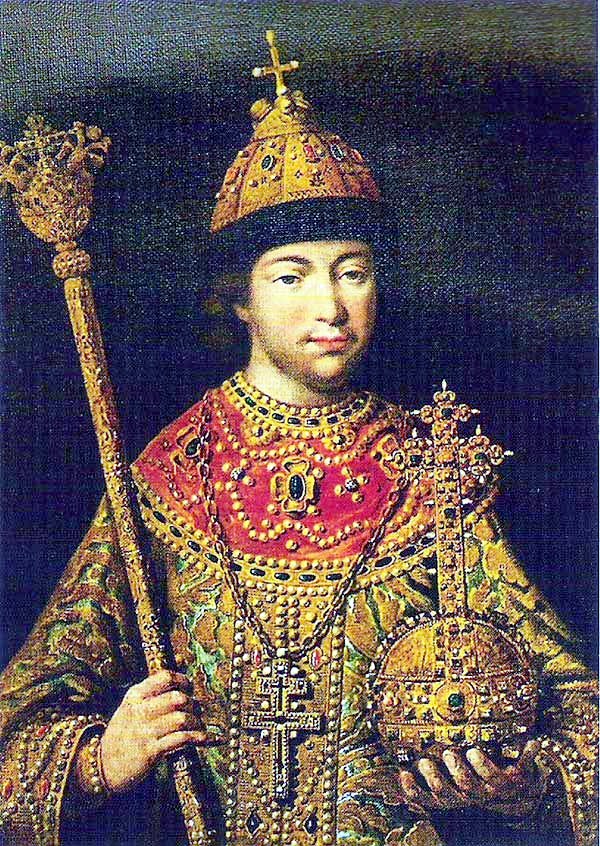
Tsar Michael I of Russia


It was on February 21 1613 that the 16 year old Michael Romanov was unanimously elected by the Zemsky Sobor as the Tsar of Russia. This choice of the young Tsar is seen both as marking the end of the Time of Troubles following the end of the House of Rurik in 1598 and as the beginning of the rule of the Romanov dynasty. It was not until March 24 that a delegation reached Michael and his mother, who were initially reluctant to accept the dignity, and not until July 22 that he was crowned.


File:Tsar Mikhail I -cropped.JPG

Tsar Michael I at the time of his coronation

Image: Wikipedia

There is an introduction to the life of Tsar Michael I here.

In 1913 there were Tercentenary Celebrations of the advent of the Romanovs which tragically proved to be the swansong of the old order in Russia. There is a short account of the celebrations on that February 21st here.


http://24.media.tumblr.com/tumblr_lvvkfiTK6V1r3sn0vo1_500.jpg

Emperor Nicholas II and Empress Alexandra and two of their daughters 
at the Tercentenary Celebrations. The Tsarevich Alexis, carried by a cossack, 
can be seen between his parents.

Image: zolotoivek.tumblr.com