Once I was a clever boy learning the arts of Oxford... is a quotation from the verses written by Bishop Richard Fleming (c.1385-1431) for his tomb in Lincoln Cathedral. Fleming, the founder of Lincoln College in Oxford, is the subject of my research for a D. Phil., and, like me, a son of the West Riding. I have remarked in the past that I have a deeply meaningful on-going relationship with a dead fifteenth century bishop... it was Fleming who, in effect, enabled me to come to Oxford and to learn its arts, and for that I am immensely grateful.


Monday, 8 September 2014

The Birthday of Our Lady


Today is the Feast of the Birthday of Our Lady. 

To celebrate this joyful day I am posting an image of a painting by Jan van Eyck (c.1380/90-1441), and dated to 1438-40, which is now in the Gemäldegalerie in Berlin.

http://upload.wikimedia.org/wikipedia/commons/thumb/b/bb/Jan_van_Eyck_-_The_Madonna_in_the_Church_-_Google_Art_Project.jpg/369px-Jan_van_Eyck_-_The_Madonna_in_the_Church_-_Google_Art_Project.jpg

 Image:Wikipedia

There is an online account of the painting here.

At only 12.2 inches high and 5.5 inches wide it is essentially a miniature.

Apart from its beauty and indeed charm it is of interest as a depiction of the interior of a church in the Low Countries in the early fifteenth century - and church interiors remained popular as a theme with artists there both before and after the reformation. There is a delight in conveying the spatial qualities of the building as well as the play of light through the north porch and windows. Given that this must represent afternoon light is there a hint that time is moving on, and that ?late in time the Redeemer has come to save? Is there something then of later medieval mysticism and expectations of the call to Judgement? That is an idea that has been popular - as in Jan Huizinga's The Waning of the Middle Ages - and it is certainly present in the culture of the times with books of Ars moriendi, cadaver tomnbs and the danse macabre. Against that one should bear in mind the artistic vitality - of which this is but one example - and the general confidence of the fifteenth century in its beliefs and its ability to achieve great things.

Theologically I like the association here of the Child-bearing Virgin with the Church as represented by an ecclesiastical building. Here indeed is Mary as Mother of the Church, Mother of the Church which is the Body of Christ, that Body which she holds. The Virgin Mary is also a type of the Church, and that too is eloquently conveyed in this delicate composition. 

Blessed Mary, Ever Virgin, pray for us 


Friday, 5 September 2014

English Iconoclasm IV


The fury of English iconolasm came hard upon one of the most prodigious periods of church building in the history of the country. Of the parish churches which ministered to the needs of the faithful virtually none were unaffected by the fifteenth century, If not being rebuilt entirely they were being completed, or extended, or gaining new features, such as clerestories and towers, or chantries, or at very least a few new windows in the latest style. This all reflected the great prosperity of the century. Not until the nineteenth century was there to be such an outburst of church building and improvement. That link is not accidental - the fifteenth and later nineteenth centuries were the two times in English history when wages were consistently ahead of prices. People had money, and they had devotion. 

Parish churches on the whole survived the reformation - the main exceptions were cities which witnessed the union of parishes such as York and Lincoln, and reflecting urban demographic changes.

For great churches - cathedrals, abbeys, collegiate foundations - the future was less certain. Here too there had been considerable building activity, and by 1500 English  architects were displaying not only maturity and confidence, but a renewed inventiveness, as in King Henry VII's Chapel at Westminster. That virtuosity can also be seen in a building linked to it in style if not otherwise, the well chapel at Holywell in North Wales. I cite that both because of its architectural finesse , but also because it is in a fairly remote location, away from the south-east, although it was a popular destination for pilgrims both from the elite and the populace at large - and also because it was sufficiently remote to survive as a place of such pilgrimage through the recusant era.

File:Treffynnon.JPG

St Winefride's Well at Holywell, commissioned by the Abbot of Basingwerk circa 1500

Image: Wikipedia

Monastic building was still extensive and for which we have  evidence at Glastonbury, Evesham, Canterbury, Chester, Westminster and in the complete rebuilding of the cathedral priory at Bath. In my home county of  Yorkshire one can still see evidence of that confidence by the Cistercians at Fountains and Kirkstall, and by the Augustinians at Bolton and Bridlington. I did once hear an archaeologist (one of those amongst that community who do not believe in anything unless they have actually dug it up)  asserting that this was the monasteries spending up the money before they were dissolved...


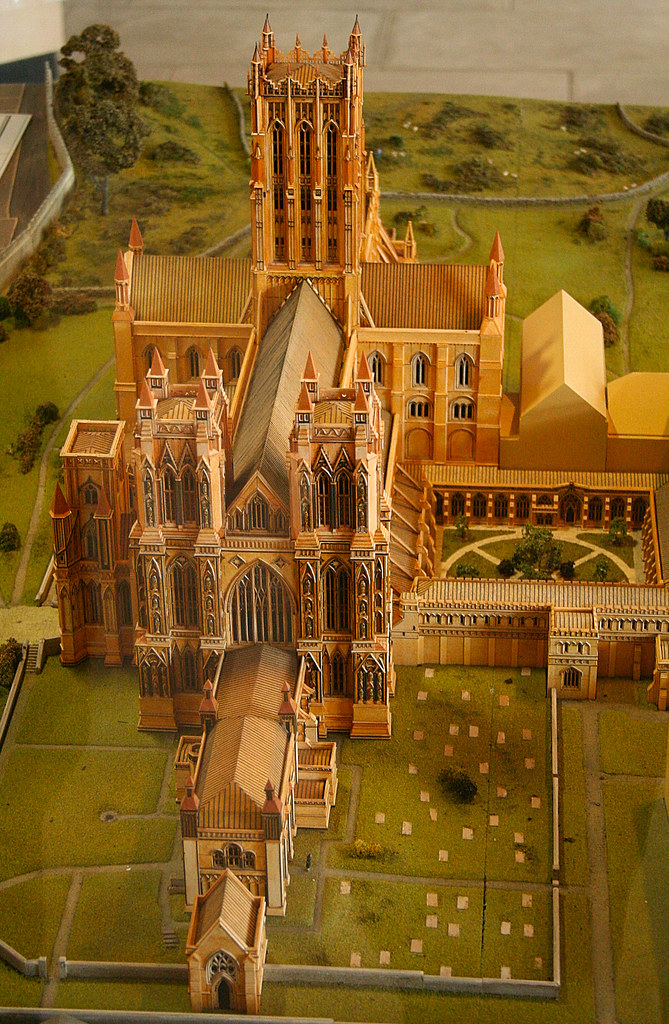
Model of Glastonbury Abbey

Model of Glastonbury Abbey.
Reconstruction of how the abbey may have appeared in 1539
The easternmost Edgar chapel  and that of Our Lady of Loretto west of the north transept are from the first years of the sixteenth century


Image:skyscrapernews.com/All rights reserved. Copyright Holder - GNU License
 

photo 

Glastonbury Abbey from the west
 Today the shell of the Lady Chapel and Gallilee in the foreground survive as well as the eastern piers of the central tower and some portions of the aisle walls

Image: Canis Major on Flickr 


The view down the nave today

Image:earlybritishkingdoms.com 


 Evesham Abbey as it may have appeared in 1540
The bell tower is centre right, adjacent to the two surviving parish churches

Image:thealmonry.blogspot.co.uk 

 Model of Abbey


The abbey from the south-west
Image:nblazydays.wordpress.com


The bell tower of Evesham Abbey. 
Completed on the eve of the dissolution it is, apart from the doorway of the chapter house and some very low walling all that survives above ground of the central buildings of the complex.

Image: railbus.co.uk


Ariel photograph of Fountains Abbey

Fountains Abbey

  Image:Copyright Dave MacLeod/cisterciansshef.ac.uk

http://www.capper-online.de/Travel/UK2/02_B_Model_Fountains_Abbey.jpg

A reconstruction model of Fountains as seen from the east on the eve of the dissolution of the abbey
 Image:capper-online.de

Of these great churches the cathedrals survived, with the exception of St Mary's cathedral priory in Coventry, about which there is something here. The creation of five new dioceses ensured the survival of the main structure at Bristol, Chester, Gloucester, Peterborough and Oxford, but many others listed as potential diocesan centre - the grand idea seems to have been a diocese for each county, but money constraints doubtless came intp play, leading to the loss of great buildings, including Bury St Edmunds, Colchester and Fountains.

http://www.stedmundsburychronicle.co.uk/Chronicle/1216-1539pics/Abbey1415.jpg 

A reconstruction of Bury St Edmunds in the later middle ages

Image:stedmundsburychronicle.co.uk 


A model in the abbey grounds at Bury St Edmunds showing the abbey in its earlier phase, before the collapse of the west tower in 1431 and its subsequent rebuilding
The present cathedral is the church to the immediate north-west of the abbey in the rear centre

Image:bystargooseandhanglands.blogspot.co.uk 


Bury St Edmunds abbey today
At the rear is the splendid tower from 2000 of the Anglican cathedral

Image:Wikipedia

abbey church

An engraving of an early sixteenth century drawing of Colchester Abbey  

Image:thecolchesterarchaeologist.co.uk 

By sheer good luck, and against the odds, churches such as St Albans survived, to become a cathedral in 1877, and parishes saved all or most of  Tewkesbury (bought at scrap value for £453 by the townspeople), Selby, Sherborne, Dorchester, Bridlington, Cartmel, Romsey, Wymondham, Croyland and others as well as Beverley, Ripon and Southwell collegiate churches.

For those with no potential as a cathedral or as a parish church, or where there were already large churches in a city, such as St Augustine's in Canterbury or St Mary's in York - both major buildings of cathedral size - the prospects were grim.

Overall the loss of buildings, let alone their decoration and furnishings was catastrophic. There are accounts of some being rapidly destroyed by new owners to prevent their return to their rightful possessors, and neglect, decay, casual plundering and vandalism took their inevitable toll.

To be continued


Thursday, 4 September 2014

The Translation of St Cuthbert


Today is the feast day appointed for St Cuthbert (c.634-687) in the Ordinary Form. His traditional day, his principal feast indeed, is his dies natalis on March 20th, but that was moved in the revision of the calendar because of the reforming urge to clear Lent of other commemorations. As a result Sepember 4th, his second feast day, that of his Translation, has become his OF commemoration.


St Cuthbert
Twelfth century wall painting in the Galilee Chapel of Durham Cathedral

Image:Wikipedia

There is an online account of St Cuthbert, including both his life and of the survival of his relics and items deposited in his coffin, here.

I am not quite clear if the Translation being commemorated today is that of his relics from Chester-le-Street to Durham in 995 or of his relics into the present cathedral there in 1104, that is 910 years ago. It is, of course, perfectly possible that both events were celebrated on the same date.


The opening of the coffin containing the incorrupt body of St Cuthbert
From a copy of Bede's Life of Cuthbert circa 1180
BL MS 39943

Image: Wikipedia

St Cuthbert pray for us


Tuesday, 2 September 2014

Only one previous owner


A priest friend, noted for his enthusiasm for both fine liturgy and fine cars sent me this little piece last week, and I thought I would share with readers his photographs and his opening enquiry:


I wonder if it possible to buy such vehicles on the second hand car market?


The images are from Cadiz, Valencia and Seville for the Corpus Christi Processions, and the last is of the return to Columbo in Sri Lanka of Cardinal Ranjit after receiving his red hat in Rome.


Monday, 1 September 2014

St Giles in art and devotion


Today is the feast of St Giles, and having been baptised in and spent years around a church dedicated to him, and about hich I wrote this time last year in St Giles in Pontefract. He is a saint for whom I have a particular interest and devotion.

 File:Saint Giles closeup.jpg

St Giles
Altarpiece by The Master of St Giles circa 1500
Detail from the painting in the National Gallery

Image: Wikipedia

There is an online summary of the legends about him here - the time scale and setting are not that well recorded - and also about the widespread devotion to him.

I have posted about him previously in St Giles, in St Giles by Thomas of Coloswar about a medieval Hungarian painting, in St Giles about his depiction in medieval glass in Wells Cathedral and in St Giles and his shrine.

I imagine that it was the placing of that shrine, one of the assembly points for the pilgrimage to Compostella, that led to the diffusion of the cult of St Giles, both along the route to Galicia and on the return to pilgrims' home countries; St Giles entered the bloodstream of the cult of Santiago. That was a cult which was supported by and supported in return the expansion of the Cluniac vision, and coincides at least with the spread of  devotion to St Giles to England after the Norman Conquest, as well as eastwards to Hungary and Poland.

Bty the later middle ages St Giles was accounted one of the Fourtenn Holy Helpers - and was indeed the only non-martyr amongst them - and frequently appears in devotional images in north-western Europe. Thus there is not only the great work - now sadly disassembled  - by the Master of St Giles, but also by artists such as Hans Memling (c1430-1494), about whom there is an online article here.


http://upload.wikimedia.org/wikipedia/commons/1/13/Hans_Memling_005.jpg

St Giles
Figure on the righthand wing of the Passion Altarpiece in Lübeck
Hans Memling 1491

Image; Wikipedia

His cult appears to have rather declined in the post-Tridentine world, yet he remains apopular patron saint of medieval churches in England. These often represent links to his story or patronage - hospital foundations, especially for the lame, or places linked to metal working or in forest areas.


St Giles on the right with St Maurus of Glanfeuil on the left flank St Christopher
The Tripych of William Moreel
Hans Memling 1484
Groeningemuseum Bruges

Image: Wikipedia

St Giles pray for us


September


The painting is attributed to Paul Limbourg and, in part, to the later painter who worked on the manuscript in the 1480s, Jean Colombe.

September is the time of the grape harvest. Five people gather the grapes whilst another man, who looks to be sampling the vine crop, and a woman, apparently pregnant and perhaps stretching after bending to gather the grapes, watch them. The bunches of grapes are put first into baskets and than transferred to paniers which are borne by mules. The paniers are then loaded into larger whicker containers on carts drawn by oxen, presumably to the winepress linked to the château of Saumur in Anjou which forms the backdrop to the scene.The towers are decorated with gilt fleurs de lys, similar to the details shown on English castles in sixteenth century survey drawings for the Duchy of Lancaster.

Once again in the Limbourg's scenes there is the sense of peace and tranquility, of plenty and a confident enjoyment of the good things of life.

Anjou is still a wine producing region and, unlike some others of  the Duc be Berry's residences, the castle is still excellently preserved as can be seen at the link Château de Saumur. The survival of the château and of parts of other ducal residences confirm the accuracy of the depictions by  the Limbourgs. Even if allowance is made for elements of idealisation in the warm sunlight of the artists' creation, and recalling that France in these years of 1412-16 was a very troubled realm, this is nonetheless confirmation of the medieval castle as primarily an aristocratic residence rising out of its agricultural base. Saumur may well be a fortification of considerable strength, but the message conveyed by the artist, and that expected by the patron, is peaceful.

Saturday, 30 August 2014

The benefits of reading crime fiction


I was amused by an apparently true story told by a participant in a discussion about violence and the media on Rradio 4 last night. It came originally from a librarian who told of an elderly lady who early each week borrowed six crime novels and, having read them retuned them the next week and took out six more. This went on for a long period. Suddenly one week she said "I've had enough of murder. I want some romances." The librarian, surprised at this change, enquired as to why this was, and received the reply "Well my husband's died so I no longer need to fantasise about murdering him."

Friday, 29 August 2014

Young Catholic Adults Conference at Douai Abbey 19-21 September


I have offered to publicise this forthcoming event, which looks to offer some very good spiritual fare:

Young Catholic Adults Weekend Retreat and Spiritual Conference 
Douai Abbey, near Reading

Friday 19 - Sunday 21 September 2014 

True Conversion of the Soul

We undertake to convert our hearts to the horizons of grace - Pope Benedict XVI. 

The annual weekend retreat and spiritual conference returns to Douai Abbey this year, in collaboration with the Schola Gregoriana of Cambridge, the Priestly Fraternity of St. Peter, and the Order of Friars Preacher, the Dominicans, as well as an Eastern Rite Catholic chaplain.

This year the organisers are pleased to welcome for the first time the renowned John Pridmore who will be speaking about his experiences as a former gangster and his story of conversion to the life of grace, as recounted in his book From Gangland to Promised Land. This is a great opportunity for those attending to hear him. Having myself heard John Pridmore speak  here in OxfordI would heartily agree - he is an impressive figure. 

Also in store: 
High Mass in the Roman Rite 
Compline in the Dominican Rite 
Marian Procession 
Confessions 
Talks and Sermons 
Rosary with Dominican Blessing 
High Mass in the Dominican Rite 
Vespers in the Dominican Rite 
Eastern Rite ‘Requiem’ (Litiya) 
Adoration 
Benediction 
Scapulars of Mount Carmel 

For more information on booking overnight stays or for whereabouts: www.youngcatholicadults.co.uk


The interior of Douai Abbey Church

Image:bazzermanblogspot.co.uk