Once I was a clever boy learning the arts of Oxford... is a quotation from the verses written by Bishop Richard Fleming (c.1385-1431) for his tomb in Lincoln Cathedral. Fleming, the founder of Lincoln College in Oxford, is the subject of my research for a D. Phil., and, like me, a son of the West Riding. I have remarked in the past that I have a deeply meaningful on-going relationship with a dead fifteenth century bishop... it was Fleming who, in effect, enabled me to come to Oxford and to learn its arts, and for that I am immensely grateful.


Showing posts with label Wilhelm II. Show all posts

Friday, 27 January 2017

The Birth of Kaiser Wilhelm II


158 years ago today there occurred in Berlin the birth of that fascinating and still much misunderstood figure the future Kaiser Wilhelm II.

The other year I read J.G.Röhl's massive Young Wilhelm: The Kaiser's Early Life 1859-1888 - the first part of a three volume biography, and which covers his life down to his accession in 1888. 
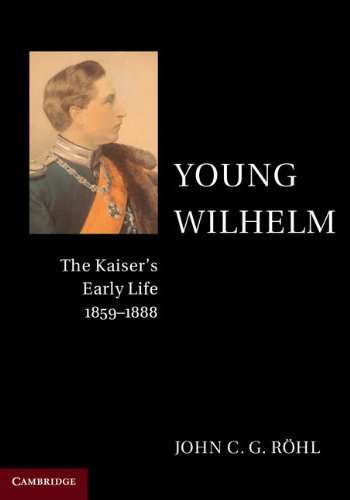
 

Image: Amazon
 
Prof. Röhl has trawled through vast amounts of correspondence and other sources to produce his book, and it is an invaluable source as well as being full of interest and elegant diversions. One surprise was that Wilhem's best friend whilst he was at school in Kassell was not only Jewish but was to turn out to be the grandfather of the historian G.R. Elton.

I have to say that personally I do not agree with Röhl's basic premise about the Kaiser, and would follow much more the line of Christopher Clark in his biography - which should be read as well - but Röhl is necessary and fascinating reading for anyone interested in the Hohenzollerns in that period, in their relations with the British Royal House, or just keen to know more about the era.


Image result for Queen Victoria and Kaiser Wilhelm II


Queen Victoria and Wilhelm in 1864


Image:Pinterest


The book begins with forty pages on the circumstances of the birth of the Prince in 1859 - as a reviewer commented  how many other people get such detailed attention paid to the circumstances of their birth in a biography - but of course the wrenching of the baby's left arm during his delivery led to its permanent damage and is crcial to many arguments (in both senses) about the Kaiser.


Wilhelm II.


Prince Wilhelm of Prussia at the age of 10

His physical handicap of his damaged left arm, and underdeveloped left facial features at that time led to the photograph being suppressed by his father. One copy alone survives.


Image: fkoester.de


His mother's sense of guilt about that developed into a hypercritical attitude to her eldest son who she was determined to mould on what she considered the right lines. Reading the book made me very thankful not to have had a mother anything like the Crown Princess/Empress Frederick. She seems at times quite monstrous, busy bullying her husband and making a favourite of her latest child. On one occasion she complained that young Wilhelm's letter's home were badly written for a boy of his age - he was having to write with only one usable arm and with the paper sliding around on the polished surface of a table... No wonder as a 22 year old he was anxious to marry the placid, indeed boring, Augusta Victoria of Schleswig-Holstein-Sonderburg-Augustenburg just to get away from home.
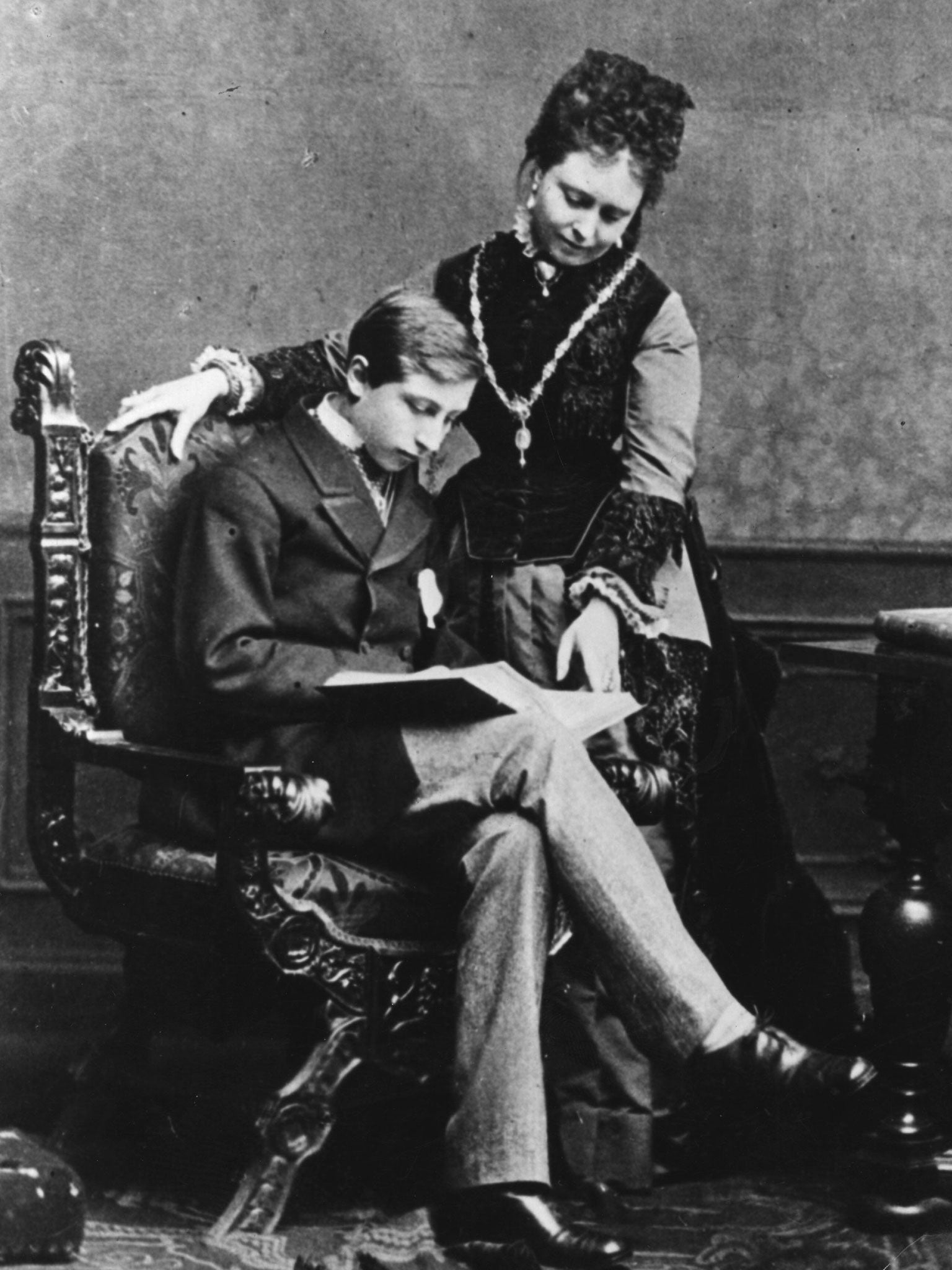
Image result for Queen Victoria and Kaiser Wilhelm II


Crown Princess Victoria and her eldest son


Image: Independent.co.uk

Most British biographies of the Kaiser's mother are sympathetic to her, but in Röhl's pages she emerges as a difficult woman to say the least. She also emerges as an ill one at times - Prof. Röhl shows that she, and certainly her eldest daughter Princess Charlotte, suffered from porphyria, which can be traced back through the Hanoverians to the Stuarts and earlier.

Given his mother's forceful nature ( and peristent and tactless Anglophilia when in Prussia ) it is not, I think, surprising that in the 1880s Wilhelm displayed little love for his mother's home country, or referred to his grandmother as the Empress of Hindoostan. Unlike the implicit tenor of some of  Röhl's comments I do not think however that those ideas counted at all in the years leading up to or in 1914. The impression I formed was one of a young man affected by his disability, destined for a throne, but in many ways engagingly human with the weaknesses anyone in such a position might have to cope with or succumb to. One point that might have been explored my sympatheically were Wilhelm's religious opinions - that seems to have been more important than many might think with hindsight. 

I read the book in hardback and carrying it around Oxford was almost enough to wrench my arm out of its socket. It is now available in paperback together with the other two volumes by Prof. Röhl covering the Kaiser's life from 1888-1900 and 1900-1941.  The problem is finding the time to read them.

Wednesday, 10 September 2014

Demonizing the Kaiser


In my continuing conversations with a friend about the outbreak of the First World War and about the settlement that ended it one of my contributions is to stress how the possibilities of any negotiated settlement rapidly disappeared as all the Great Powers, and the allies they recruited, settled into seeking all out victory and the utter destruction of their opponants.

In Britain one aspect of this was the demonization of the Kaiser. For all his blood ties to the British Royal family he had an uncertain relationship with political and popular opinion here from about 1887 onwards . It was not difficult for some, if not many, to be doubtful or wary, and to be critical of a monarch who had an unfortunate tendency to produce verbose public pronouncements (which his staff then got the press to tone down) and appeared at times outlandish in his uniforms and with his up-swept moustache.

That said, such a picture of him is a caricature, and we can now see that it was in so many ways very unfair to him. Verbose he was, but after sounding forth his ideas he was likely to be reflective and cautious.

However, with the beginning of the war in 1914, such ideas and perceptions helped reinforce collective opposition to Germany - and one of the Kaiser's problems was to be that by appearing to be the voice and spirit of Germany, and with no obvious political figure to shoulder the odium, he was rapidly to become the hate figure. The reality of his actual power and influence was very different, but that did not affect the image he gained. That process was already starting in August 1914 as can be seen from a piece reprinted in The Times. They are giving daily extracts from their editions of a hundred years ago. I noticed from their edition of August 22nd 1914 an account of the German occupation of Brussels.

The correspondent laments the absence of the coloured Prussian uniforms of the past instead of the field grey of the contemporary era and wrote of how there "came the legions of the man who has broken the peace of Europe to gratify belated ambition....truly it was a sight to gladden the eyes of Kaiser Wilhelm."

Note that it is not Germany, nor the German government or the German army that he blames, but the Kaiser personally.

This process gathered pace througout the war, fuelled by cartoonists such as the Dutch Louis Raemaekers, and doubtless impeded the possibility of a negotiated settlement and stability in 1918 - it was seemingly easier to deal with a republic than the man and his dynasty which had been personally accounted responsible for the war - not the politicians, not the military and not the failed diplomacy. Someone must be to blame, and that must be the Kaiser. Hence the cries of "Hang the Kaiser" in 1918-19. To this day in the popular media for some at least it is still a case of  "the Kaiser's war" and such like.


wilhelm2mitsaebel.jpg

Kaiser Wilhelm II - a portrait from the time of the First World War

Image:planetfigure.com

Those who thought that getting rid of the Hohenzollerns and the other German dynasties and bringing in the age of the common man were, of course, to be in for a very nasty shock when they saw what the common man could, and indeed did, turn out to be like. The settled order of German society was swpt away by internal revolution and external pressure, by hyper-inflation and by social upheaval. The nasty and vicious, evil things a traditional order kept under control and at bay were to be given free roam.


Sunday, 16 June 2013

The Prussian Crown of Wilhelm II


Following on from my previous post about the accession of Wilhelm II as Kaiser and King in 1888 here are pictures of the crown he commissioned as King of Prussia. The German Imperial Crown only existed as a model and in heraldric use, and there was no ceremonial investiture with it.

The Kings of Prussia did have a crown, and a coronation rite - notably as used by King Wilhelm I in 1861 at Königsberg - the first coronation of which there are photographs. In 1888 his short lived successor son Frederick III had visions of an Imperial coronation as Emperor Fredertick IV of a renewed Holy Roman Empire, but his failing health and the opposition of this Chancellor Bismarck - who pointed to the new constitutional dispendation of the post 1871 German Empire - prevented that ever being more than an idea.

The new Kaiser-King also thought of a traditional coronation at Königsberg, but Bismarck, who disliked the outward ceremonial of state dissuaded him. However the new monarch did have a new crown made as King of Prussia in 1888.


The Crown of Prussia made for Kaiser Wilhelm II

Image: Wikipedia

The crown  contains a large sapphire, supporting a diamond-studded cross, plus 142 rose-cut diamonds, 18 diamonds and 8 large pearls . It comprises eight half-arches.

Although he never wore it the crown does appear in some portraits and photographs from the early years of his reign.

When the Kaiser abdicated  in 1918 he was permitted to retain the family jewels, which included the Hohenzollern crown. To protect it from theft and destruction, during the Second World War  it was hidden in a wall in the crypt of a church. Following the war it was returned to the Hohenzollern family, and it is now kept at the family residence of Hohenzollern Castle in Swabia.


  King Wilhelm II's  "Hohenzollern House Crown", now at Hohenzollern Castle in Baden-Württemberg.


The older regalia survives in Berlin, and the 1701 crown clearly provided the design for the one made in 1888:


The Prussian Crown Jewels: The crown of King Frederick I - as it is today: a gold frame devoid of diamonds - together with the orb and sceptre, on display at Charlottenburg Palace in Berlin.


Modern model of the original appearance of the diamond-studded crown of King Frederick I of Prussia, now at Charlottenburg Palace in Berlin


Images:forum.alexanderpalace.org


Saturday, 15 June 2013

Kaiser Wilhelm II


Today is the 125th anniversary of the accession of Wilhelm II as German Emperor and King of Prussia in 1888, the third Kaiser to rule in the Year of Three Emperors.
 

Kaiser Wilhelm: Succession law change would have made Kaiser Wilhelm King of England

The young Emperor Wilhelm II
 
Image: ETA/Daily Telegraph

Reading about him, and the pivotal role he played, or is claimed to have played, in the events of the succeeding decades what emerges is a complex man.  He was intelligent and talented, yet also neurotic, and clearly suffered from mood swings. Brash at times, tactful and sensitive at others, and could certainly display charm and humour. In his public speeches and statements he was prone to sweeping rhetorical phrases, not a few of which came back to haunt him. I know various attempts have been made to analyse him in terms of pschology or as a victim of birth trauma, but I wonder if he might have suffered from a form of Asperger's Syndrome - that could account for the retentive memory and some of the social awkwardnesses he manifested. 

The physical disability he had from birth of a withered left arm, usually carefully concealed in pictures and in his daily life, clearly made his life difficult from the earliest days of educating the heir to the Prussian throne to be able to perform his public duties - for example he clearly suffered greatly as a child in being forced to learn to ride - and the conciousness of that disability may well have compounded whatever other difficulties he suffered from.

Through his upbringing and education he had a complicated relationship with his mother and her country - they were too much alike in many ways. To some Germans he was, and is, seen as half English, and not sufficiently Prussian. To the British he was a sometimes popular figure, but more often not popular one, and an object of suspicion with his Naval expansion in the years before 1914, then an object of concentrated venom, and finally, perhaps, a curious survival as the exile of Doorn.
 

 File:Kohner - Kaiser Wilhelm II.jpg

Striking a pose - the young Emperor-King at his most grandiloquent. 
A state portrait of him as King of Prussia in 1890 by Max Koner.
He is wearing the mantle of the Order of the Black Eagle and has his crown as King of Prussia at his side

Image:Wikipedia

The other year I read Giles McDonagh's excellent biography of him The Last Kaiser and I currently have Christopher Clark's biography Kaiser Wilhelm II: A life in Power on order, which promises to be an excellent and well researched study. From what I have seen of it so far it is an insightful study into the Kaiser as monarch, and what his role actually was in government. 


Tuesday, 7 June 2011

Commemorating Kaiser Wilhelm II


Following on from my post Kaiser Wilhelm II the other day I see that the excellent Australian blog Radical Royalist has two posts about the commemoration of the death of Emperor Wilhelm II and his former home at Doorn. They can be read at 70 years today since Kaiser Wilhelm II passed away... and at Huis Doorn: German Monarchists commemorate the Kaiser..., and thanks to the Mad Monarchist for highlighting them.

Saturday, 4 June 2011

Kaiser Wilhelm II


Today is the seventieth anniversary of the death in exile at Doorn of Wilhelm II, German Emperor and King of Prussia.

Anyone who reads about the personalities of his era cannot but be intrigued by him. Vilified and caricatured as he was - and his speeches and distinctive appearance were a gift to opponants - it is clear with hindsight that he was a much more complex and interesting figure than he once appeared. At times bombastic and vainglorious, at others insightful and far-sighted, a man who could be both bullying and selfless, he still arouses strong feelings. He may no longer be the hate figure he became in Britain  during the First World War, but one Bavarian friend was very keen to lay the blame for what happened on the Kaiser himself. Was that, I wondered, because my friend was proud of being Bavarian, and Wilhelm II incarnated  Prussia? I did n't ask, but I suspected it. Clearly for many Germans in 1918 Wilhelm and his Empire along with their other Kings, Grand Dukes and Dukes were easily made into scapegoats. The trouble, as we now know, was not with the old order, but with the fightening possibilities offered by the New Orders which succeeded it.


File:Kohner - Kaiser Wilhelm II.jpg


Wilhelm II 

by Max Koner 1890


This portrait , showing the young ruler at his most flamboyant, depicts him as King of Prussia rather than as German Emperor, with the Priussian crown as his side, and in the insignia of the Order of the Black Eagle 


The Kaiser in exile in 1933


Another German friend made the point that Kaiser Wilhelm's English ancestry meant that for some of his subjects he was not fully German, and it is clear that  his love-hate relationship with his mother and her country was a major factor in both his own life and in his actions as sovereign. 


Continuing interest in him by German monarchists is covered in this article about pilgrimages to his last resting place at Doorn


His life has something of the qualities of classical tragedy - birth and rank, genuine gifts, the effect of historical cirumstance, and a character full of conflicting impulses, gave him a central role in the great drama that erupted in the Great War. His own part in that is receiving significant new attention from historians.

My own sense is that despite his high profile actions and ambitions he did not realise the extent to which the modern state as it had come to function had taken on a life of its own which was increasingly resistant to interventions by the head of state or other figures. Like his fellow monarchs in 1914 he found things, as he himself commented in later years, got away from him. The concert of Europe no longer worked as a family reunion to sort out local difficulties. Nationalisms of all varieties were calling the new and strident tune. The Kaiser and his fellow rulers were drawn into that - how could they not be - but the pressures were too often to drag them down. 

The anniversary has prompted me to start reading Giles MacDonagh's biography of the Emperor  The Last Kaiser: William the Impetuous, which was published in 2000. From an initial skimming and what I have read it appears a well-balanced and humane biography, well researched and eminently readable. I will comment further when I have finished reading it. I also have some links to archive film of his life which I will publish.