Once I was a clever boy learning the arts of Oxford... is a quotation from the verses written by Bishop Richard Fleming (c.1385-1431) for his tomb in Lincoln Cathedral. Fleming, the founder of Lincoln College in Oxford, is the subject of my research for a D. Phil., and, like me, a son of the West Riding. I have remarked in the past that I have a deeply meaningful on-going relationship with a dead fifteenth century bishop... it was Fleming who, in effect, enabled me to come to Oxford and to learn its arts, and for that I am immensely grateful.


Showing posts with label Order of the Black Eagle. Show all posts

Monday, 18 January 2016

Inaugurating the Prussian Kingdom


Today is the 315th anniversary of the coronation of King Frederick I as King in Prussia at Königsberg in 1701.
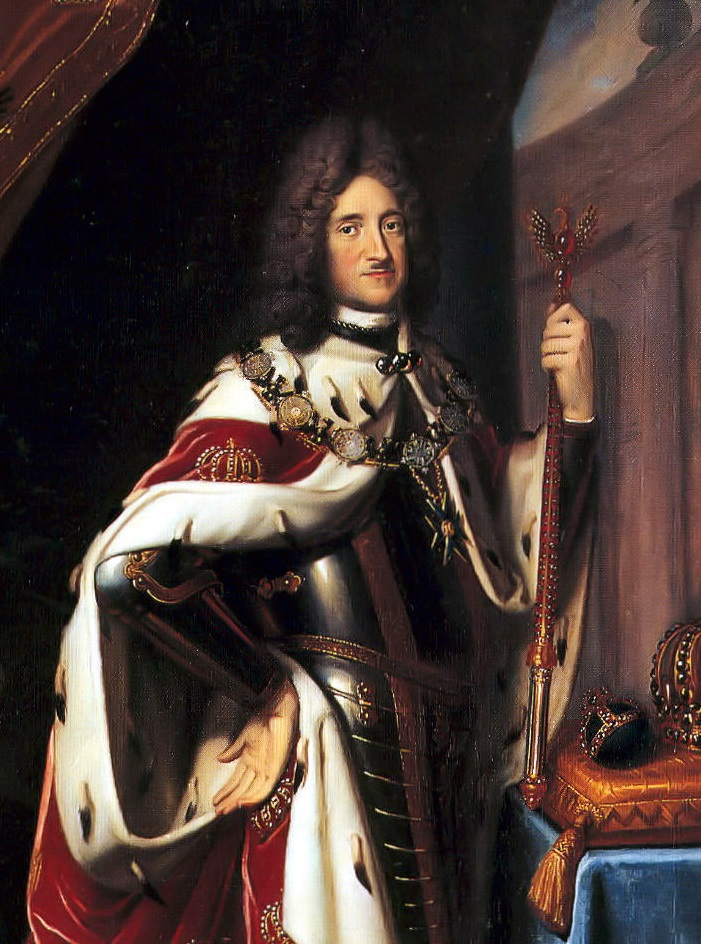
Frederick I of Prussia (cropped).jpg

King Frederick I in his Coronation robes and with the Prussian regalia.
The King is wearing the collar of the Order of the Black Eagle

Image: Wikipedia

Frederick persuaded the Emperor Leopold I to allow Prussia to be elevated to a kingdom. This agreement was ostensibly given in exchange for an alliance against King Louis XIV in the War of the Spanish Succession. Frederick argued that Prussia had never been part of the Holy Roman Empire, and he ruled over it with full sovereignty. Therefore, he said, there was no legal or political barrier to letting him rule it as a kingdom. Frederick was aided in the negotiations by Charles Ancillon.

Frederick crowned himself and his Queen, Sophie Charlotte of Hanover, on 18 January 1701 in Königsberg. Although he did so with the Emperor's consent, and also with formal acknowledgement from Augustus II the Strong, Elector of Saxony, who held the title of King of Poland, the Polish-Lithuanian Diet (Sejm) raised objections, and viewed the coronation as illegal. In fact, according to the terms of the Treaty of Wehlau and Bromberg, the House of Hohenzollern's sovereignty over the Duchy of Prussia was not absolute but contingent on the continuation of the male line (in the absence of which the duchy would revert to the Polish crown). Therefore, out of deference to the region's historic ties to the Polish crown, Frederick made the symbolic concession of calling himself "King in Prussia" instead of "King of Prussia."


His royal status was, in any case, limited to Prussia and did not reduce the rights of the Emperor in the portions of his domains that were still part of the Holy Roman Empire. In other words, whilst he was King in Prussia, he was still only an Elector under the suzerainty of the Holy Roman Emperor in Brandenburg. Legally, the Hohenzollern state was still a personal union between Brandenburg and Prussia. However, by the time Frederick crowned himself as King, the Emperor's authority over Brandenburg (and the rest of the Holy Roman Empire) was only nominal, and in practice it soon came to be treated as part of the Prussian kingdom rather than as a separate entity. His grandson, Frederick the Great, was the first Prussian monarch to formally style himself "King of Prussia" in 1772.
[Adapted from the Wikipedia article on King Frederick I]
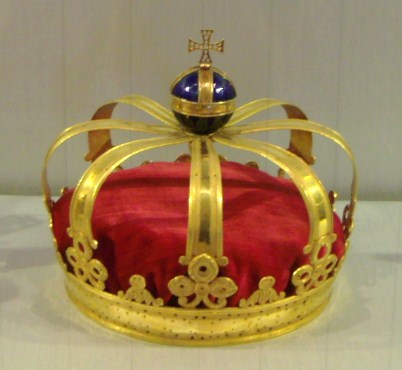

The Crown of King Frederick I

Image: Wikipedia


The Prussian Regalia on display at Charlottenburg Palace
The smaller crown is that made for Queen Sophie Charlotte

Image: Wikipedia

Sir Christopher Clark in his superb The Iron Kingdom describes the ceremonies of the coronation, with its blend of the older ceremony of allegiance whereby the kneeling landholders raised their right arms in a pledge of allegiance - a similar gesture was made at the Dutch enthronement in 2013 - and self -coronation in the so-called "Age of Absolutism".


http://25.media.tumblr.com/tumblr_mc2g49QHul1r4yioeo1_1280.jpg

The Coronation of King Frederick I
A now destroyed (?) painting by Adolph von Menzel of 1885

Image: skyscrapercity.com

The day before the coronation the new King founded the Order of the Black Eagle, which was the premier Chivalric Order of the Hohenzollern monarchy. There is an account of the Order, its insignia and members at Order of the Black Eagle. I have posted about it previously in Order of the Black Eagle of Prussia


The King's successors King Frederick William I and King Frederick II rejected the Baroque court style of King Frederick I, and indeed the only subsequent similar Prussian coronation was that of King William I in October 1861.

Saturday, 15 June 2013

Kaiser Wilhelm II


Today is the 125th anniversary of the accession of Wilhelm II as German Emperor and King of Prussia in 1888, the third Kaiser to rule in the Year of Three Emperors.
 

Kaiser Wilhelm: Succession law change would have made Kaiser Wilhelm King of England

The young Emperor Wilhelm II
 
Image: ETA/Daily Telegraph

Reading about him, and the pivotal role he played, or is claimed to have played, in the events of the succeeding decades what emerges is a complex man.  He was intelligent and talented, yet also neurotic, and clearly suffered from mood swings. Brash at times, tactful and sensitive at others, and could certainly display charm and humour. In his public speeches and statements he was prone to sweeping rhetorical phrases, not a few of which came back to haunt him. I know various attempts have been made to analyse him in terms of pschology or as a victim of birth trauma, but I wonder if he might have suffered from a form of Asperger's Syndrome - that could account for the retentive memory and some of the social awkwardnesses he manifested. 

The physical disability he had from birth of a withered left arm, usually carefully concealed in pictures and in his daily life, clearly made his life difficult from the earliest days of educating the heir to the Prussian throne to be able to perform his public duties - for example he clearly suffered greatly as a child in being forced to learn to ride - and the conciousness of that disability may well have compounded whatever other difficulties he suffered from.

Through his upbringing and education he had a complicated relationship with his mother and her country - they were too much alike in many ways. To some Germans he was, and is, seen as half English, and not sufficiently Prussian. To the British he was a sometimes popular figure, but more often not popular one, and an object of suspicion with his Naval expansion in the years before 1914, then an object of concentrated venom, and finally, perhaps, a curious survival as the exile of Doorn.
 

 File:Kohner - Kaiser Wilhelm II.jpg

Striking a pose - the young Emperor-King at his most grandiloquent. 
A state portrait of him as King of Prussia in 1890 by Max Koner.
He is wearing the mantle of the Order of the Black Eagle and has his crown as King of Prussia at his side

Image:Wikipedia

The other year I read Giles McDonagh's excellent biography of him The Last Kaiser and I currently have Christopher Clark's biography Kaiser Wilhelm II: A life in Power on order, which promises to be an excellent and well researched study. From what I have seen of it so far it is an insightful study into the Kaiser as monarch, and what his role actually was in government. 


Tuesday, 18 October 2011

Prussian Coronation 1861


Today is the 150th anniversary of the Coronation of King William I and Queen Augusta of Prussia at Konigsberg in 1861. The King, who became German Emperor in 1871, was the last Prussian King to have a coronation - his son Frederick III was too ill and died after 99 days as Kaiser and King in 1888, although he envisaged two ceremonies, one as King and another as Deutsches Kaiser, and his son, William II, was dissuaded from holding the ceremony on the grounds of expense - Bismarck was not at all favourable to ceremonial, tending to see it as out of date. It is somewhat surprising, given William II's flamboyant style, that he did not insist on having a coronation.

This was the first coronation of which photographs survive, though I cannot find any online. I have seen one in a book by those eminent historians of photography Helmut and Alison Gernsheim, and there is a photograph of the Crown Princess on the day in Roger Fulford's Dearest Child. I remember seeing a series of paintings of the ceremonies reproduced some years ago in one of Sotheby's Art at Auction year reports.

I did find this picture, a painting by Adolf Menzel from 1861. The arrangement of the cathedral looks similar to that for the Norwegian coronation in 1906, with two facing thrones. The figures in red mantles are Knights of the Order of the Black Eagle:

Adolf Menzel, <I>Coronation of Wilhelm I in Königsberg in the Year 1861</i> (1861)

Original: Stiftung Preußische Schlöser und Gärten Berlin-Brandenburg, Schloß Sanssouci, Potsdam.
© Bildarchiv Preußischer Kulturbesitz

Saturday, 4 June 2011

Kaiser Wilhelm II


Today is the seventieth anniversary of the death in exile at Doorn of Wilhelm II, German Emperor and King of Prussia.

Anyone who reads about the personalities of his era cannot but be intrigued by him. Vilified and caricatured as he was - and his speeches and distinctive appearance were a gift to opponants - it is clear with hindsight that he was a much more complex and interesting figure than he once appeared. At times bombastic and vainglorious, at others insightful and far-sighted, a man who could be both bullying and selfless, he still arouses strong feelings. He may no longer be the hate figure he became in Britain  during the First World War, but one Bavarian friend was very keen to lay the blame for what happened on the Kaiser himself. Was that, I wondered, because my friend was proud of being Bavarian, and Wilhelm II incarnated  Prussia? I did n't ask, but I suspected it. Clearly for many Germans in 1918 Wilhelm and his Empire along with their other Kings, Grand Dukes and Dukes were easily made into scapegoats. The trouble, as we now know, was not with the old order, but with the fightening possibilities offered by the New Orders which succeeded it.


File:Kohner - Kaiser Wilhelm II.jpg


Wilhelm II 

by Max Koner 1890


This portrait , showing the young ruler at his most flamboyant, depicts him as King of Prussia rather than as German Emperor, with the Priussian crown as his side, and in the insignia of the Order of the Black Eagle 


The Kaiser in exile in 1933


Another German friend made the point that Kaiser Wilhelm's English ancestry meant that for some of his subjects he was not fully German, and it is clear that  his love-hate relationship with his mother and her country was a major factor in both his own life and in his actions as sovereign. 


Continuing interest in him by German monarchists is covered in this article about pilgrimages to his last resting place at Doorn


His life has something of the qualities of classical tragedy - birth and rank, genuine gifts, the effect of historical cirumstance, and a character full of conflicting impulses, gave him a central role in the great drama that erupted in the Great War. His own part in that is receiving significant new attention from historians.

My own sense is that despite his high profile actions and ambitions he did not realise the extent to which the modern state as it had come to function had taken on a life of its own which was increasingly resistant to interventions by the head of state or other figures. Like his fellow monarchs in 1914 he found things, as he himself commented in later years, got away from him. The concert of Europe no longer worked as a family reunion to sort out local difficulties. Nationalisms of all varieties were calling the new and strident tune. The Kaiser and his fellow rulers were drawn into that - how could they not be - but the pressures were too often to drag them down. 

The anniversary has prompted me to start reading Giles MacDonagh's biography of the Emperor  The Last Kaiser: William the Impetuous, which was published in 2000. From an initial skimming and what I have read it appears a well-balanced and humane biography, well researched and eminently readable. I will comment further when I have finished reading it. I also have some links to archive film of his life which I will publish.

Tuesday, 18 January 2011

Order of the Black Eagle of Prussia


Regular readers will know that I have an interest in Orders of Chivalry and today is an opportunity to write about one of them - the Order of the Black Eagle of Prussia. Established on January 17th 1701 by King Frederick I, the day before his coronation at Königsberg as the first King in Prussia (the title was changed to King of Prussia by his gransdson in 1772), and it is the premier Order of the Prussian monarchy. As such it was the equivalent of the Orders of the Garter or the Thistle, and like other Orders established before the late eighteenth century comprised only one class.


King Frederick I

He is wearing the collar of the Order of the Black Eagle


There is a good, illustrated, article about the Order here, with links to biographies of recipients. The article does not mention the fact that the orange colour of the riband was a tribute by the King to his mother Louise Henriette of Orange-Nassau. The star of the Order was used on the headgear of Prussian regiments. The Black Eagle itself is derived from the arms of the kingdom.


Black Eagle Order star.jpg

Order of the Black Eagle
Breast star with the motto Suum Cuique ("To each according to his merits") around the central medallion.

I have not so far read Karin Friedrich and Sara Smart (eds.) The Cultivation of Monarchy and the Rise of Berlin: Brandenburg-Prussia 1700 ( Ashgate, 2010) which is a study of the establishment of the new Prussian kingdom by Frederick I. It includes an article on the statutes of the Order.


Wilhelm II, German Emperor and King of Prussia
The riband and star of the Order can be clearly seen

Photo: Mad Monarchist