Once I was a clever boy learning the arts of Oxford... is a quotation from the verses written by Bishop Richard Fleming (c.1385-1431) for his tomb in Lincoln Cathedral. Fleming, the founder of Lincoln College in Oxford, is the subject of my research for a D. Phil., and, like me, a son of the West Riding. I have remarked in the past that I have a deeply meaningful on-going relationship with a dead fifteenth century bishop... it was Fleming who, in effect, enabled me to come to Oxford and to learn its arts, and for that I am immensely grateful.


Showing posts with label King Arthur. Show all posts

Wednesday, 4 September 2024

Seeking Merlin in the Scottish Borders


Both the Scottish newspaper The National and the Ancient Origins website have reports about an excavation at Drumelzier, which lies south-west of Peebles in the Scottish Borders. The archaeological work was to investigate a site which was a reoccupation of a much earlier hill fort, and which was later replaced by a medieval castle.


The time of the reoccupation was that shadowy, but not by any means completely ‘Dark Age’ between the Romano-British and the Anglo-Saxon. That fact surely makes the site analogous to South Cadbury - Camelot - in Somerset. If South Cadbury is associated with the Arthurian legend of Camelot, then Drumelzier and its neighbourhood is associated with stories of Merlin. The Wikipedia entry about the village gives a good introduction and can be seen at Drumelzier

I first became aware of the association of Merlin with the Scottish Borders many years ago whilst reading Count Nikolai Tolstoy’s The Quest for Merlin. Hitherto I had, I think,  associated Merlin only with Wales and Cornwall, not Scotland.

The medieval legend of Merlin’s life is elegantly summarised and splendidly illustrated on the always interesting BL Medieval manuscripts blog at Merlin the magician: from devil’s son to King Arthur’s trusted advisor

The way in which legends have been transmitted over time inevitably results in the stories becoming garbled or confused, yet the fact that they have persisted and can now be related to archaeological evidence does suggest a substratum at least of truth. In one way the element of mystery continues to add to their appeal. How much more we can learn about a time that is obscure and which has left fragments of evidence, we do not yet know. However the search for knowledge of the origins of these stories, be they truth, or the truthes that are myth, engages us and draws us on. - and that, of course, is very much the message of so much of the Arthurian legends.


Monday, 8 August 2016

More from Tintagel


Following on from my post the other day about recent discoveries at Tintagel in Cornwall here is a link to an article entitled  "Tintagel Castle and the legend of King Arthur" from the BBC History Magazine's History Explorer bookazine (sic) King Arthur here.

The Medieval Histories blog/website also has three posts  about the recent discoveries at Tintagel:
Tintagel excavations summer2016

Luxury at Tintagel in the Early Medieval Period

This summer archaeologists have been excavating in Cornwall at Tintagel, the famous site for Arthurian Legend. The results are exhilarating.
Sculpture at Tintagel © EnglishHeritage/Emily Whitfield-Wicks

Tintagel - New Visitor Experience

Since 2010 curators at English Heritage have worked hard to make Tintagel both more informative and welcoming. The question is: have they succeeded? Get an overview fo the debate and  follow the links
tintagel chapel

Tristan and Yseult at Tintagel

Links to the legends of Tristan and Yseult and not Arthur may have been the reason Richard I chose to built a castle there in 1225

Wednesday, 3 August 2016

An Arthurian age site revealed at Tintagel


The discovery at Tintagel, traditionally identified as the birthplace of King Arthur, of significant evidence for it having been a fifth or sixth century centre for a regional ruler is described in an article
"Royal palace discovered in area believed to be birthplace of King Arthur" published in the Daily Telegraph and which can be read here


Monday, 2 April 2012

Arthur Prince of Wales


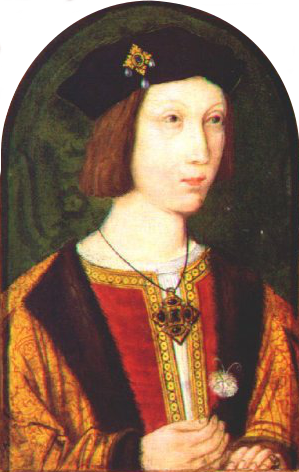
Today is the anniversary of the death at Ludlow Castle in 1502, 510 years ago, of Arthur Prince of Wales, the eldest son and heir of King Henry VII.

File:Arthur2.png

Arthur Prince of Wales

Image: Wikipedia from a private collection


Although the Prince, who was fifteen remains a somewhat anonymous figure, his death was to prove one of the most momentous or portentious in English history. As a result the succession passed to his brother, the future King Henry VIII, and even more significantly, led to that King's marriage to Arthur's widow, Catherine of Aragon.

There is an online life of the Prince here and the Oxford DNB life by Rosemary Horrox can be read here.

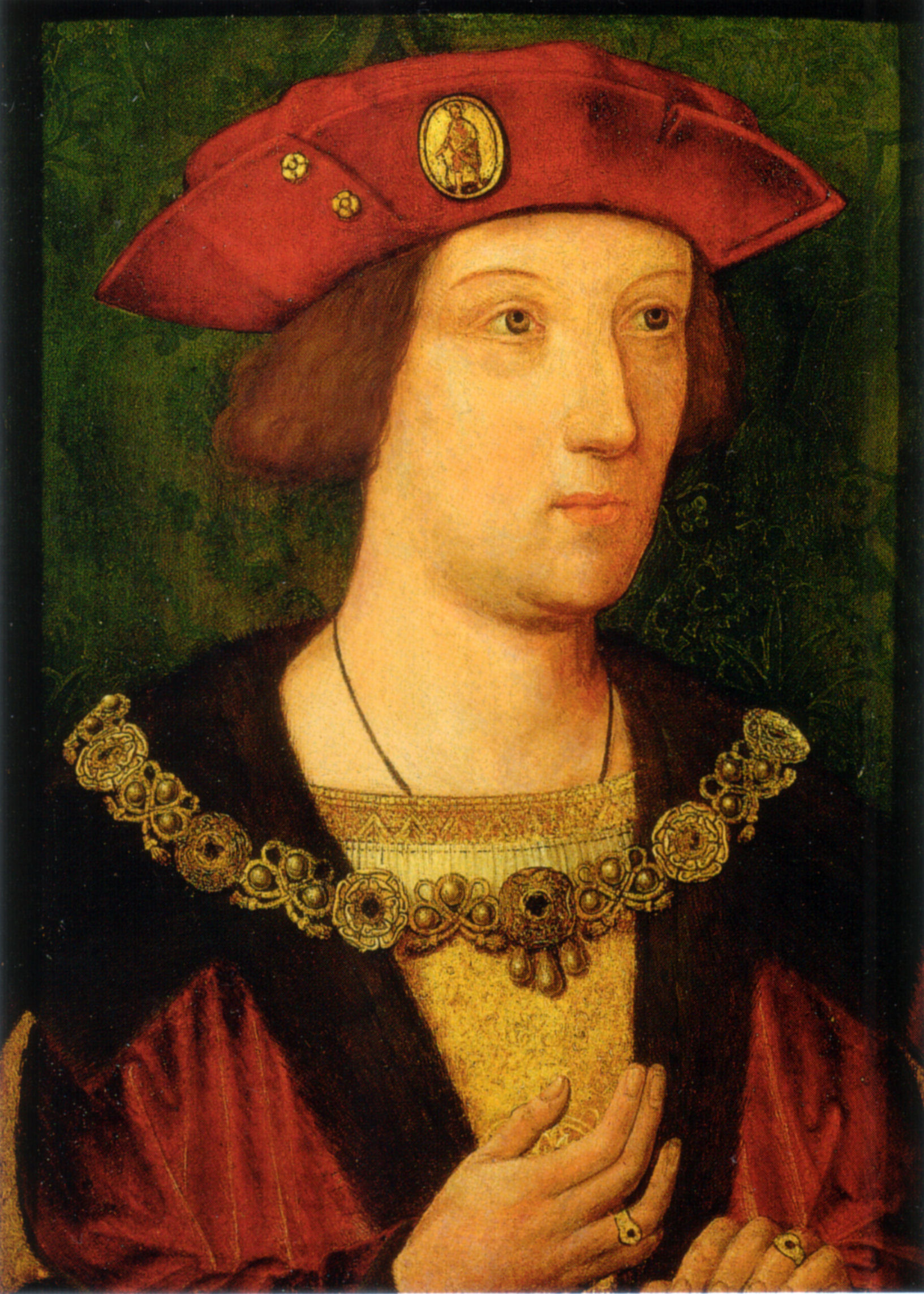
From his surviving portraits the Prince sometimes appears, like his younger brother, to have taken after his mother's family in his appearance and as an adult King Henry VIII looks to have resembled King Edward IV. However in thos portrait there is also a resemblance to King Henry VI:

File:Arthur Prince of Wales c 1500.jpg

Prince Arthur circa 1500

Image:Wikipedia from the Royal Collection

To stand in Prince Arthur's chantry at Worcester, its elegrant limestone gothic cage surrounding the plain marble tomb-chest, is to feel very close to events which changed this country, and indeed much of the world forever. Nothing sums up more quickly the impact of the changes that ensued than the mustilated figures, including St George, on the reredos of the chapel. Installed to elicit prayers for the Prince they were defaced under his nephew King Edward VI, and when his neice Queen Elizabeth I visited Worcester in 1575 they were plastered over and the blank wall decorated with a painting of the Royal arms. Not until the nineteenth century were the figures revealed in their battered state.

http://www.whub.org.uk/cms/images/prince-arthurs-chantry-worcester-cathedral2.jpg

The interior of the Prince's chantry at Worcester cathedral

Image:whub.org.uk

There is the mildly intriguing question, given the way that the choice of his name associated the Prince with King Arthur, and the bearing of arms attributed to Welsh and British rulers of the past at the Prince's funeral, as well as the general enthusiasm for all things Arthurian at the time, if he had lived and succeeded his father whether he would have been King Arthur I or King Arthur II.


Thursday, 21 October 2010

Arms and the man

Last Tuesday evening was the first meeting this academic year of the Oxford University Heraldry Society. We had a most interesting lecture from Dr Paul Fox of Imperial College in London on the heraldry ascribed to King Arthur and the knights of the Round Table.

Having made the point that heraldry began to develop very much at the same time as the Arthurian romances became popular in the twelfth century he went on to show how the arms of the members of the Round Table were developed and received.

Thus King Arthur's own arms, dervied from an early chronicle reference to him bearing on his shoulders in battle the image of Our Lady , were originaly shown as Gules, the Virgin and Child proper, but then, following King Edward I and Queen Eleanor's visit to Glastonbury for the re-burial of Arthur and Guinevere's remains, and to other places associated with the legend, in 1278 a new coat appeated, Azure, threee crowns or, 2 and I - as in the arms of Sweden. Other versions had an azure shield crowns semee, indicating the kingdoms arthur had conquered. This remained the standard coat for Arthur through the middle ages.

photo
King Arthur from The Nine Heroes tapesteries
France or South Netherlandish, circa 1400-1410. The Cloisters, New York

Image from www.navema.com


King Edward III was also an Arthurian enthusiast like his grandfather, and is known to have visited the site at South Cadbury which John Leland two centuries recorded as the site of Camelot, and which upon ecxcavation has been shown to have been a major centre in the sixth century. Both of these King Edwards held tournaments at which they and their courtiers and guests dressed and jousted as Knights of the Round Table. Edward III's use of lion imagery on such occasions may well have influenced his choice of the name Lionel for his son in 1338, the future Duke of Clarence.

Some men, especially thise who could attempt to claim descent from the paladins retained these Arthurian arms as their own coat armour. Two families adopted Lancelot's arms (Argent, three bendlets rouge), and appear to have resolved the issue of a shared heraldic identity amicably, with one family raising the bendlets to the upper part of the shield to differentiate the arms.

Another added red scimitars to his argent and noir checky coat from the persona of Sir Pallamedes from the legends to stress the idea of eastern exoticism. In connection with this I have included an extract from the Sigillum Secretum website:

Because they are described in the "Tristam und Isult" cycles, the arms of Sir Pallamedes, the Moorish prince who becomes a knight of the Round Table, have received a certain amount of scholarly attention. Chequered in black and white, this highly contrasting design would appear to be nothing more than perhaps the most abstract icon of those dualities already pointed to, such as God and Jacob (Jacquelado is the word for checkered in Spanish), or Church and State. Instead of his coat armour, it is the body of Sir Fierfitz Angevin, the black knight from Eschenbach's "Parzival" that is patterned in a piebald motif. The fact that the poet likens Fierfitz's skin to a parchment with writing is what expands this symbol to its most encompassing parameters.

The OUHS talk opened up a wide range of insights into chivalric court and heraldic culture, and Dr Fox plans to publish a version in the magazine Family History.