Once I was a clever boy learning the arts of Oxford... is a quotation from the verses written by Bishop Richard Fleming (c.1385-1431) for his tomb in Lincoln Cathedral. Fleming, the founder of Lincoln College in Oxford, is the subject of my research for a D. Phil., and, like me, a son of the West Riding. I have remarked in the past that I have a deeply meaningful on-going relationship with a dead fifteenth century bishop... it was Fleming who, in effect, enabled me to come to Oxford and to learn its arts, and for that I am immensely grateful.


Monday, 27 June 2011

Oratorian Martyr


From today's posting on the Oxford Oratory website:

FIRST ORATORIAN BEATIFIED MARTYR

1309189707.jpg

The Congregation for the Causes of Saints today promulgated the Decree of Martyrdom for the Venerable Savio Huix Miralpeix, Bishop of Lérida and formerly of the Oratory of Vic, Catalonia, a martyr of the Spanish Civil War. A date can now be set for his beatification.

The Servant of God, Savio Huix Miralpeix, was born on 22nd December 1877 in Santa Margarita de Vellors in the Diocese of Vic in Catalonia, into a family for whom faith in God and love for the Church were an irrevocable inheritance.

He was ordained priest on 19th September 1903 and four years later entered the Congregation of the Oratory of Vic where for twenty years he gave himself over to an intense ministry of study, preaching and writing, catechising, teaching in the diocesan seminary and promoting associations for Catholic women.

He was the Provost of Vic when, in 1927, he was named Bishop of Ibiza. There he gave an extraordinary stimulus to religious life. Translated to Lérida on 29th January 1935 he continued his zealous apostolic work until 21st July 1936 when Republican forces broke into the Episcopal palace and Mgr Miralpeix, reluctantly and in order to safeguard his associates, took refuge with friends.

Seeing the dangers to which his helpers were exposed, on the night of 23rd he left his hideout and presented himself to the police, revealing his true identity. He was imprisoned at once, together with other prisoners with whom he shared both sufferings and also the joy of secret prayers and Masses, right up to the last moving Holy Communion which proved to be their Viaticum.

At 4.30 on the morning of 5th August they were all of them taken to the local cemetery and shot. The bishop asked that he might be the last to be killed so as to give absolution and comfort to his companions in martyrdom. Before his arrest he entrusted his pectoral cross to a friend, asking him to take it to the Holy Father, for whom he was offering his life and assuring him of his loyalty.

Saturday, 25 June 2011

Celebrating Corpus Christi in Oxford


On Thursday I observed Corpus Christi in the Extraordinary Form, as I prefer to do. I went to the Low Mass offered at the Oratory at lunchtime and made my communion there, and then late afternoon went up to SS Gregory and Augustine to help do some practical sacristy jobs in preparation for the visit of the Archbishop of Birmingham to bless the redecorated reredos on Sunday. I was asked to serve at their Mass, which I did, despite a rhumatic knee (now recovered), and here are pictures of the Mass from Joe Shaw's LMS Chairman blog. We were rather short of servers, but the three of us managed to support Fr Saward.

2011 06 23_0274


2011 06 23_0285

Mass was followed by a procesion inside the church and Benediction.

There are more pictures here.

Order of the Star of India


Today is the 150th anniversary of the foundation of The Most Exalted Order of the Star of India by Queen Victoria in 1861. There is an illustrated account of the Order and its history here. The last surviving member died in 2009.

The Order, designed to be awarded to Hindus, Muslims and Christians, is an interesting example of mid-Victorian inter-faith dialogue. Hence it avoided the use of the cross or terminology such as Knight Grand Cross in favour of Knight Grand Commander, and used as its motto the phrase "Heaven's Light Our Guide."


The Mantle of a GCSI


The star of the Order on the mantle
Images: Wikipedia

It is also interesting in that from the beginning women were admitted as KSI or later GCSI - something that was not possible in this country until the Order of the British Empire was created in 1917, and for the older Orders not until the reign of the present Queen.

http://www.columbia.edu/itc/mealac/pritchett/00routesdata/1800_1899/britishrule/victoria/iln1861.jpg


http://www.columbia.edu/itc/mealac/pritchett/00routesdata/1800_1899/britishrule/victoria/queen1861.jpg

Two contemporary views of Queen Victoria presiding over the first Chapter of the Order in 1861

Image: Columbia.edu

The insignia was particularly handsome, and the Prince Consort is often claimed to have had a hand in its design. The links with roses clearly derive from the Orders of the Garter and St Patrick. These alternate with the lotus flower to symbolise India. I have read, though I am not sure if the story is true, that some of the insignia which had been returned to the Crown was destroyed as superfluous in the 1950s. If so it was a very regretable decision.


 Magnificent Collar and Badge of the Most Exalted Order of the Star of India


This is the magnificent Collar and Badge of the Most Exalted Order of the Star of India, Knight Grand Commander (GCSI), awarded to General His Highness Al-Haj Sir Sadiq Muhammad Khan, Abassi, Bahadur, Nawab of Bahawalpur.

On his accession in 1907, he reigned under a Council of Regency until he came of age and was invested with limited administrative powers in 1922; he became President of the Council of Regency in May 1923, and almost a year later was invested with full ruling powers at Bahawalpur by His Excellency the Marquess of Reading, Viceroy of India.

He acceded to the Dominion of Pakistan in 1947 and merged his state into the province of West Pakistan in 1955.

At the ages of seven, His Highness Al-Haj Sir Sadiq Muhammad Khan attended the Delhi Durbar 1911, where he commanded his state troops. He also attended the coronations of both King George VI 1937 and Queen Elizabeth II 1953. He served in the Great War and the Third Afghan War 1919; was ADC to the Prince of Wales 1921-22; and again served in the Second World War. General His Highness Al-Haj Sir Sadiq Muhammad Khan, Abassi, Bahadur, Nawab of Bahawalpur died in London in 1966.

The estimate for this collar when it was sold was £20,000-25,000.

Illustration and information from Spink.com

Friday, 24 June 2011

Coughton Court


Last Saturday I went on an excusion with the Brothers of the External Oratory in Oxford and organised by our prefect Fr Jerome Bertram to Coughton Court in Warwickshire. This was my first visit to this great recusant house ansd the whole day was both very enjoyable and informative.

CoughtonCourt (pronounced Coaton) has been the home of the Throckmorton family since 1409, although since 1946 the house has been vested in the National Trust. The Throckmortons and their house have survived the Wars of the Roses, the various stages of the English reformation, the Throckmorton plot involving a cadet member of the family, the Gunpowder Plot, the Civil War, the revolution of 1688 when the chapel was sacked by the mob, the civil disabilities laid on Catholics post-1688, and, following Catholic emancipation (the family produced the first Catholic MP after that legislation, winning one of the Berkshire seats in 1832), the agricultural depression of the nineteenth century, death duties, two world wars and everything else the twentieth or any other centory could throw up, and are able to boast of a continuity of occupancy and faith for over six centuries.

In particular the family are famous for their links to other notable Midland recusant families, such as the Catesbys and the Treshams, as well as Sir Walter Raleigh, and the family and the house feature in the story of the Gunpowder Plot. There is an article about some of its historyhere.

The oldest part of the presnt house is the gatehouse built by Sir George Throckmorton in the second decade of the sixteenth century . Successive rebuildings and repairs have produced a house with features of a wide range of styles right down to the saloon from just before the Great War.

I like this image!
Coughton Court gatehouse

The gatehouse from the courtyard

Image:Geograph.org.uk

Amongst the many interesting relics in the house there is the remarkable Tabula Elienis, a painted cloth dating from 1596. So called from its picture of Ely cathedral and similarity to another example there, it depicts English kings and monnks, as well as the arms of recusant families, and appears to be a depiction of recusant heritage and identity. It is displayed in the tower room where the wives of some of those involved in the Gunpowder Plot awaited news of their husbands in 1605.

photo

The Tabula Eliensis

Image:Keybuk photostream

Another room had a fascinating display of treasures including what is believed to be the chesmise worn by mary Queen of Scots at here execution in 1587. Apparently it bore blood stains until relativelty recently. One thing which struck me as being in support of the tradition is that its length would fit with the fact that Queen Mary was a tall woman. In the same room were mementoes of her descendants the Jacobite Kings James III and VIII, Charles III and Henry IX and I.

photo

Chemise worn by Mary Queen of Scots at her execution
Image: Felicityfaery photostrean on Flickr


In the same room, but rather difficult to appreciate because of the necessarily low light levels and the case in which it was displayed, was a cope which is associated through its pomegranete motifs with Queen Catherine of Aragon. This photograph gives a better idea of the vestments which has been restored in recent years. It is, I think, Sarum blue rather than purple, and is a very fine piece of early sixteenth century work.

photo

The Catherine of Aragon cope


Image: The Photostation.net


In the same room were a selection on manuscripts on display, including a late medieval priest's manual in which the clause giving the Pope's name could be seen to have been blotted or smudged out from the canon of the Mass as directed by King Henry VIII in the 1530s.


Elsewhere I was interested to see the possessions of a female members of the Throckmorton family who had been a lady-in-waiting to the Empress Elisabeth of Austria, including photographs of the Empress and the young Crown Prince Rudolf and the insignia of the Orders of the Starry Cross and of St Elizabeth.


We did not really have enough time to explore fully the gardens which have been developed by the family in the last fifteen years, but as well as the nineteenth century Catholic church built by the family we also looked in the late medieval parish church which adjoins the house, and contains many Throckmorton tombs. Like the gateway to the house it is a reminder of the prosperity of late medieval midland England.


The tombs include those of Sir George, the builder of the gatehouse, and his wife, of the last Abbess of Denny in Cambridgeshire, who, as a member of the family, returned to Coughton with two of her nuns to live out their lives, and, presumably, their vocations there. There is also the handsome tomb of Sir John Throckmorton(d.1580) and his wife Marjorie. A younger son he was alawyer and judge, apparently dismissed not long before his death by Queen Elizabeth I for his recusant sympathies. He lived at feckenham in Worcestershire, and his son Sir Francis gave the family name to the throckmorton Plot of 1583. I particularly liked this panel on the tomb base showing the sons as mourners and presumably including the conspirator Francis:


photo


The mourners on the tomb base.

Image: Walwyn on Flick


photo


The interior of the church.

Sir John Throckmorton's canopied tomb is to the right of the altar.

The one in the foreground was intended for one of his ancestors who died on pilgrimage to the Holy Land in 1518.

The tracery lights contain late medieval stained glass.

Image: Roy Reed on Flickr


Wednesday, 22 June 2011

Norwegian Coronation 1906


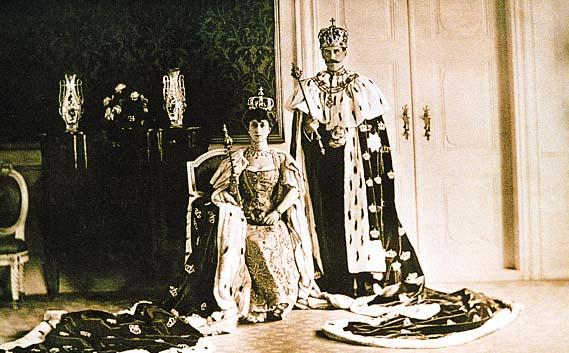
Today is also the 105th anniversary of the coronation in Trondheim cathedral of King Haakon VII and Queen Maud as King and Queen of Norway in 1906. This followed from the dissolution of the union with Sweden in 1905 and the selection of Prince Carl of Denmark and his wife Princess Maud, daughter of King Edward VII as King and Queen. The new King assumed the name Haakon, the same name as the last independent King of Norway six centuries earlier.


King Haakon VII and Queen Maud following their Coronation in 1906.

There are some fine photographs of the Coronation - the first anywhere at which the ceremonies inside the cathedral were to be photographed - and of the ceremonies around it here, as well as articles about the history of the Norwegian coronation. There is a link to archive film here.


Here are two other photographs I found of the ceremonial inside the cathedral:


photo

In this photograph the King is at the bottom left, and the Queen to the right. Her brother the Prince of Wales, the future King George V, can be clearly seen in the centre in front of the group of foreign representitives

photo


Regrettably, very regrettably in my opinion, in 1908 the Norwegian parliament removed the clause from the Constitution making coronation at Trondheim mandatory.

The argument was that in a democratic age the rite of coronation marked the King out as having a superior authority. True - he does. In consequence the Coronation was no longer required, although not abolished. It perhaps an early example of Scandinavian secularism, rather like the decision in Sweden in 1907 not to have a coronation for King Gustav V on the grounds of expense. In Norway at the accession of King Olav V in 1957 he was able to arrange a service of Benediction at Trondheim, and I understand that that in 1991 was a more elaborate occasion. There is a good article about the history of the Norwegian coronation and the modern benediction rite here.

There is an article about the Norwegian regalia - which is kept at Trondheim, expressing the concept that the King holds the Kingdom from St Olav - here, and one about the King's crown, made for King Carl Johan, here.

http://i30.photobucket.com/albums/c303/FredrikBergow/Kroner/Norgeskongekrone.jpg

The Crown of the King of Norway


http://i30.photobucket.com/albums/c303/FredrikBergow/Kroner/Norgesdronningkrone.jpg
The Crown of the Queen of Norway

photo

The Crown of the Crown Prince of Norway

Coronation of King George V


Today is the centenary of the coronation of King George V and Queen Mary in 1911. There is an article with links about it here.

Amongsty other points of interest is the fact that this was the first British coronation ceremony, as opposed to the procession, to be recorded by photographs. This photograph shows the beginning of the ceremony in Westminster abbey.

The coronation of King George V, Westminster Abbey, 22 June 1911.

Copyright: Heritage Images


Image and video hosting by TinyPic

The King and Queen

Copyright: lamodeillustree.livejournal.com


It was King George who resumed the practice of being crowned with St Edward's Crown, rather than the lighter Imperial State Crown used by Queen Victoria and King Edward VII, although he quicly exchanged it for the Imperal crown. In 1937 and 1953 the monarch was to wear St Edward's Crown right up to the communion, only assuming the Imperial Stae Crown at the Recess for the procession out of the abbey and back to the palace. It was the King who ordered that St Edwar's Crown be permanently set with precious and semi-precious stones, rather than the previous practice of hiring gems for the Coronation and then replacing them with paste.


http://i29.photobucket.com/albums/c280/Royal-Britain/St-Edwards-Crown.jpg

St Edward's Crown

It was only fairly recently that I discovered that it was King George V who from the 1913 State Opening of Parliament actually wore the Imperial State Crown with his robes of state, and this has remained the practice. at Queen Victoria's few post 1861 State Openings and those of King Edward VII the crown was carried on its cushion, although the Sovereign wore the robes.

The 1911 Coronation was, I think, the only time that Queen Mary's crown was used with its arches. Like Queen Alexandra's 1902 crown, but unlike those of 1831 for Queen Adelaide and 1937 for Queen Elizabeth, it has eight half arches rather than the more traditional four. In design it is very like the Crown of India, which was also made by Garrards that year - but I will say more about that in December.

http://i30.photobucket.com/albums/c303/FredrikBergow/Kroner/England-dronningMaryskrone.jpg

Queen Mary's Crown

The crown contains some 2,200 diamonds and in 1911 it contained the Koh-i-Noor diamond as well as Cullinan III and Cullinan IV (the Cullinan diamond had been presented to King Edward VII and after cutting the largest piece was set in the sceptre and the second largest in the Imperial Stae Crown, displacing to the back of the circlet the Stuart Sapphire). In 1914 they were replaced by crystal models.

Unlike many earlier coronation crowns, it was specially constructed so that its arches could be removed, allowing it to be worn as a circlet, and it was in that way that Queen Mary wore it for State Openings and at the Coronation of King George VI in 1937. At her funeral in 1953 I understand that her crown did not rest on her coffin, unlike the practice at the funeral of Queen Elizabeth in 2002.

As the Queen Consort's crown has been seen as an ornament rather than regalia Queen Mary presented her crown to King George V for the use of future Queens consort. However a new crown, based on a circlet made for Queen Victoria, and incorporating the Koh-i-Noor was used to make the 1937 crown for Queen Elizabeth, allowing Queen Mary to wear her crown as a circlet at that Coronation.

Tuesday, 21 June 2011

Further reflections on the Royal Wedding - the popular response


Today being the birthday of the Duke of Cambridge seems an appropriate one on which, apart from expressing best wishes to His Royal Highness, to try to finish my reflections on his wedding to the Duchess.

http://d.yimg.com/a/p/afp/20110622/capt.photo_1308756560291-1-0.jpg

In this post I want to comment on the popular response. Quite obviously from the crowds in London and the worldwide television audience there were a very great number of people watching because they wanted to. So much for the argument which one has heard before every major royal celebration for a generation and more - "People aren't interested anymore."

In a very British way we prepared in a very understated way for the celebrations. One or two shops started having commemoratives in their windows, then a few more ,and a few more, and Union flags started appearing. Slightly sheepishly people began to prepare to celebrate, and to admit to being positive about the day.

Nor can interest be dismissed with the jokey "Thanks for the day off" line which appeared. The popular response was extensive and genuine, and more complex than some would have us believe. Of course there is the appeal of pagentry and finery, and there is something of the general well wishing towards any couple entering into marriage, and here was a young couple clearly in love and serious about their committment to one another.

I sensed there was much more than that - a sense of a real wishing well to this couple because they are who they are and represent what they do. People wish them well because they wish the monarchy well. After the difficulties of the 1990s this was an opportunity, indeed
the opportunity, to look to the furture with a renewed belief in the tradition the institution embodies and carries. People were wishing the couple well because they really wanted things to work out well.

Friends who were in London have described that positive good will amongst the crowds, and watching it all on television here in Oxford at our party at the Oratory I sensed that feeling not only of affection for the Duke and Duchess, but also for that which they committing themselves to. At that party there was also that sense of community which such national events bring out.

this was not I suspect confined to subjects of the Crown. One friend in London told me that he was aware of the considerable number of Germans around who seemed very interested in the wedding. He, I am sure rightly, explained this as an awareness (sensed rather than expressed) on their part of what they are lacking in their own national life.

Another friend summed up the mood with his reaction to the day - "Who would not want to live under such a system?"


Exactly.


St Aloysius Gonzaga


Today, being the feast of St Aloysius Gonzaga, is the patronal festival for the Oxford Oratory parish.

http://www.traditioninaction.org/SOD/SODimages/006Gonzaga.jpg

St Aloysius as a boy

Image: Breviary.net

St Aloysius (1568-1591) is not perhaps the easiest company amongst the saints. An aristocrat who renounced his inheritance to join the Jesuits, and who, having lived a life of mortification and penance dies as aresult of nursing plague victims at the age of 23 he can appear uncomfortably demanding. Much of the later artwork depicting him has a somewhat sickly quality which gets in the way of understanding him as a human being. The contemporary portraits suggest aclear sighted young man with the very considerable sense of purpose he demonstrated in life.

He stands somewhat in the same tradition as St Louis of Toulouse or the later fourteenth century Peter of Luxembourg, all of them noted for their royal or aristocratic background, life of mortification, service of the poor and the Church, and early deaths.

http://gonzaga.ie/images/stories/history/gonzlui1.jpg

St Aloysius as a teenage layman
Image: Gonzaga College

There is another account of his life and devotions to him here.

A year or two ago the preacher on St Aloysius day at the Oratory, Fr Brendan O'Callaghan SJ, the Master of Campion Hall, made the point that in order to understand St Aloysius and his choice of austerities it is important to realise that this came from his own self-knowledge of the temptations his birth and position offered.

File:The Vocation of Saint Aloysius Gonzaga.PNG

The Vocation of St Aloysius
Painting c.1650
Image: Wikipedia

May St Aloysius pray for us all