Once I was a clever boy learning the arts of Oxford... is a quotation from the verses written by Bishop Richard Fleming (c.1385-1431) for his tomb in Lincoln Cathedral. Fleming, the founder of Lincoln College in Oxford, is the subject of my research for a D. Phil., and, like me, a son of the West Riding. I have remarked in the past that I have a deeply meaningful on-going relationship with a dead fifteenth century bishop... it was Fleming who, in effect, enabled me to come to Oxford and to learn its arts, and for that I am immensely grateful.


Showing posts with label Swedish Monarchy. Show all posts

Saturday, 13 August 2016

Scandinavian Monarchies in WWII


Recently the Mad Monarchist posted an interesting piece about World War II and the Scandinavian Monarchies which draws several themes together. 

I am not quite sure if I agree with the Mad Monarchist in his tendency to see decline in the story he unfolds. Thus in Sweden the constitutional changes ( whether you agree with them or not ) consolidated into law in 1974 were ones which had developed over the preceding three-quart-rs of a century and Swedish commentastors conside rthe monarchy there more popular than in the past. I recall both before and when the present King came to the throne in 1973 journalist were inclined to write off the Swedish monarchy as finished in an age of social democracy. In reality a young King and Queen and their family held the attentuion and loyalty of the majority,and if you follow theses things at all it is clear the Swedish monarchy is no stanger to public splendour and ceremonial  - barely a bicycle in sight. It was back in 1907 that, very regretably, and on the grounds of cost, that the Swedish royal house, abandoned the coronation ritual; such a change is not recent.

Similarly in Norway the coronation ceremony has not been obligatory soon after 1906. I greatly regret that, but the more muted inaguration of King Olav V in 1957 was followed by a more elaborate ceremony in 1991 for King Harald V according to Norwegian friends.

Denmark gave up the coronation in 1863, but the monarchy retains apublic ceremonial face which is impressive.

In both Denmark and Sweden the condtitutional clashes over the King's powers were made manifest in the First World War or its aftermath, not the Second.

The article is also interesting in bringing out the differences between the the kingdoms, perhaps exacerbated for the Danes and Norwegians by Swedish neutality in the years cafter 1940.


Wednesday, 18 May 2016

St Eric of Sweden


Today is the feast of St Eric of Sweden, otherwise King Eric IX, and like St Olav of Norway and St Cnut of Denmark, a martyr King who became a patron of the monarchy and nation.

There is an online account of his life at Eric IX of Sweden

http://catholicsaints.info/wp-content/uploads/img-Saint-Eric-of-Sweden.jpg

A later medieval carving of St Eric 

Image:catholicsaints.info.

Last March Medieval Histories, a really excellent online journal from Denmark, and often with fascinating material on medieval Scandinavia, had the following illustrated feature about him:

St. Erik of Sweden – A study of the Bones in his Reliquary 
  Erik theSaint fromSweden being studied

Erik the I of Sweden (c. 1125 - 1160) was a stout man, used to fighting and a great fan of fresh-waterfish. And that he might have died as the legend tells  Read more.


Saturday, 30 April 2016

King of Sweden at 70


Today is the seventieth birthday of the King of Sweden and this is an account of the celebrations from the website Royal Central. I am reproducing it because unless you subscribe to such links the British press give scant coverage to such events abroad.


                    H.M. The King of Sweden
                      Image:hellomagazine.com

At 08:00 the final day of a week-long birthday celebration for The King began with 43 Swedish flags being raised on Skeppsbron accompanied by a soundtrack of the Life Guards Music Corps. A traditional Te Deum thanksgiving service in the Royal Chapel at the Royal Palace of Stockholm followed at 10:00. At 10:25 the Swedish Navy’s Music Corps marched and performed a musical program in the Outer Courtyard and at 11:30 a changing of the guards ceremony was carried out by the Royal Guards. The presentations were open to members of the Swedish public and there was an opportunity for children to present flowers to The King before a twenty-one-gun salute was fired from Skeppsholmen.

The King and his family are scheduled to appear on the Lejonbacken Terrace for a choral tribute later today before The King and Queen travel by carriage in a royal procession from Mynttorget to Stockholm City Hall via Vasabron and Tegelbacken where they will attend a lunch arranged by the city of Stockholm.

A reception will be held at the Royal Palace this afternoon and will be attended by members of the Riksdag, the Cabinet and the county governors. The day’s birthday celebrations will conclude this evening with a royal banquet in the Hall of State at the Royal Palace. 

The week so far:

Official royal birthday celebrations began on Monday 25 April with a performance of ‘An Evening about the Baltic Sea – Hopefulness and Threats’ at the Royal Dramatic Theatre. The evening included short talks and discussions from well-known speakers and experts on the Baltic Sea and was attended by The King and Queen as well as Prince Carl Philip and Prince Daniel. The Swedish Navy’s Music Corps performed at the joint venture put on by the Royal Swedish Academy of Sciences, the Royal Society of Naval Sciences, the Royal Dramatic Theatre, the Royal Swedish Academy of War Sciences and the Royal Swedish Academy of Agriculture and Forestry.

On Tuesday 26 April, The King and Queen attended a birthday concert put on at the Royal Chapel at the Royal Palace by the Armed Forces Music Corps’. Hosted by Horace Engdahl the concert saw performances by Court Singer Karl-Magnus Fredriksson, the Swedish Navy's Music Corps (conducted by Andreas Hanson) and St Jakob's Chamber Choir (conducted by Gary Graden).

On Thursday 28 April a reception was held in Princess Sibylla’s Apartments to allow authorities, organisations and institutions an opportunity to congratulate The King on his birthday.

On Friday 29 April a reception was held at the Royal Palace for representatives of governmental authorities and NGO organisations which allowed them an opportunity to offer their congratulations to His Majesty The King. This was followed in the afternoon by a presentation in the Golden Foyer at the Royal Opera of a new cooperation between the royal artistic and humanistic academies—the Bernadotte Programme. The evening saw a concert at the Nordic Museum with performances from the Royal Opera and the Stockholm Concert Hall.

HM King Carl XVI Gustaf was born at Haga Palace at 10:20 on Tuesday 30 April 1946 to parents Prince Gustaf Adolf, Duke of Västerbotten and Princess Sibylla of Saxe-Coburg and Gotha, Sweden’s future King Carl XVI Gustaf was the fifth child and first son, joining older sisters Margaretha, Birgitta, Désirée and Christina.

He became King of Sweden at 27 years old following the death of his grandfather in Helsingborg on 15 September 1973. His father had tragically died in airplane crash in 1947.  He took the royal oath in front of the Swedish Government in the Cabinet Meeting Room on Wednesday, 19 September before appearing in front of the Riksdag, the diplomatic corps and the Royal Court in the Hall of State at the Royal Palace of Stockholm.

He met Miss Silvia Renate Sommerlath at the 1972 Olympic Games in Munich where she was working as an interpreter and hostess for the games. Their engagement was announced on 12 March 1976 at the Royal Palace of Stockholm and they were married in Stockholm Cathedral on Saturday 19 June 1976.

The King and Queen have three children (Crown Princess Victoria, born 14 July 1977, Prince Carl Philip, born 13 May 1979, and Princess Madeleine, born 10 June 1982) and five grandchildren (Princess Estelle, born 23 February 2012, Princess Leonore, born 20 February 2014, Prince Nicolas, born 15 June 2015, Prince Oscar, born 2 March 2016 and Prince Alexander, born 19 April 2016).
Quite apart from wishing His Majesty well on his birthday I like to reflect that when he succeeded to the throne in 1973 the media commentators were writing off the Swedish monarchy - the age difference between the King and his grandfather, the social democratic culture of the country, its 'progressive' nature and the proposed revision of the Instrument of Government ( not in fact as we were told a 'new constitution' and introduced in 1974 ) - all presaged the end of the monarchy.  Well not so far, and with his Queen at his side and with his children and grandchildren King Carl XVI Gustaf can be seen as a successful contemporary exponent of the art of kingship. Moreover, for all the talk of Scandinavian monarchies being low key, as the report above makes clear the Swedish Crown is suitably ceremonious as and when it celebrates.

Greater coat of arms of Sweden (without ermine mantling).svg 

The Royal Arms of Sweden 

Image:Wikipedia

Thursday, 21 May 2015

St Eric of Sweden


Last Monday, May 18th, was the feast of St Eric, King of Sweden, who was killed at Uppsala on that day in 1160. There is an account of his life and cult here, a site which, amongst other things, explains the questions around the numbering of the Swedish Kings Eric.

I was alerted to this feast day by a post by Matt Heintzelman on the Medieval Religion discussion group.

This was followed by another post on the site from John Dillon, as follows:

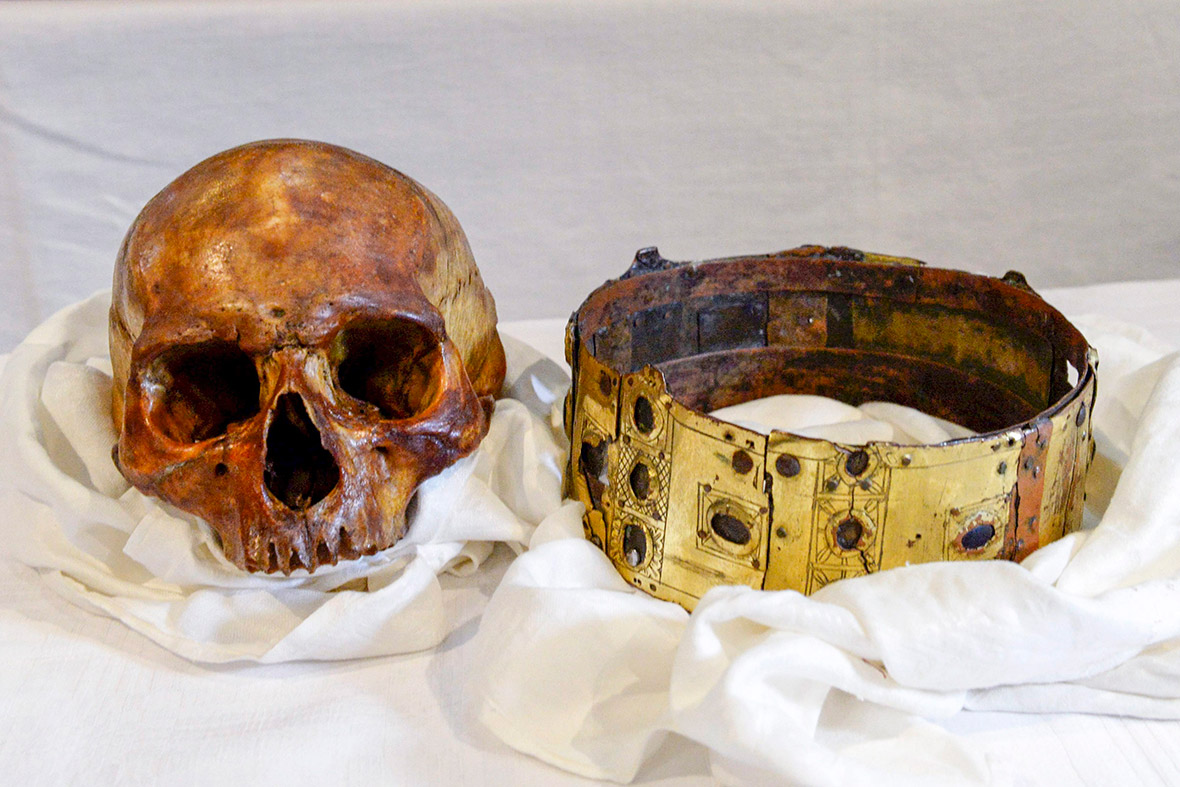
St. Erik's skull and his twelfth-century burial crown (ordinarily both reside in his later sixteenth-century reliquary in the cathedral of Uppsala):

http://d.ibtimes.co.uk/en/full/1375459/viking-skull.jpg

Image: dd.ibyimes.co.uk


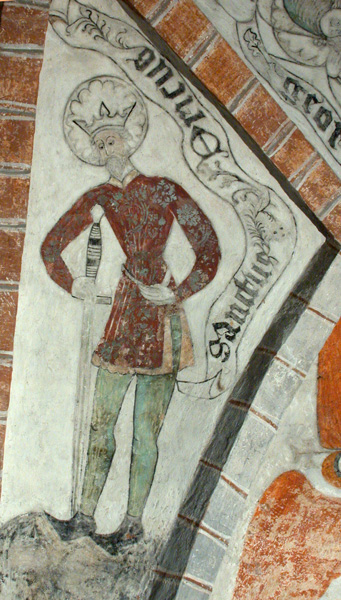
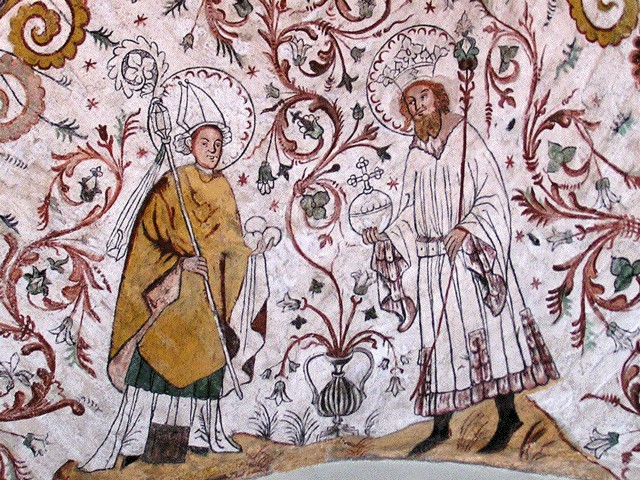
Some medieval images of Erik of Sweden:

a) Eric in a fourteenth(?)-century sculpture in the late medieval parish church of Gamla Uppsala:

http://upload.wikimedia.org/wikipedia/commons/b/b8/Gamla_Uppsala_kyrka-Statue1.jpg


[ZIMG_3268.JPG]


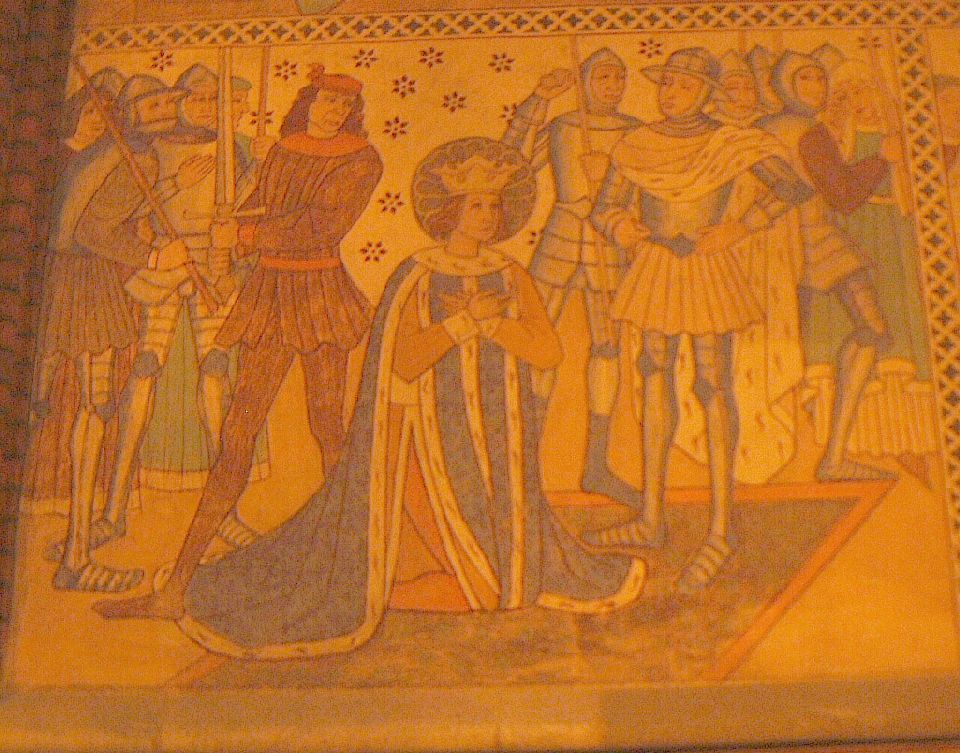
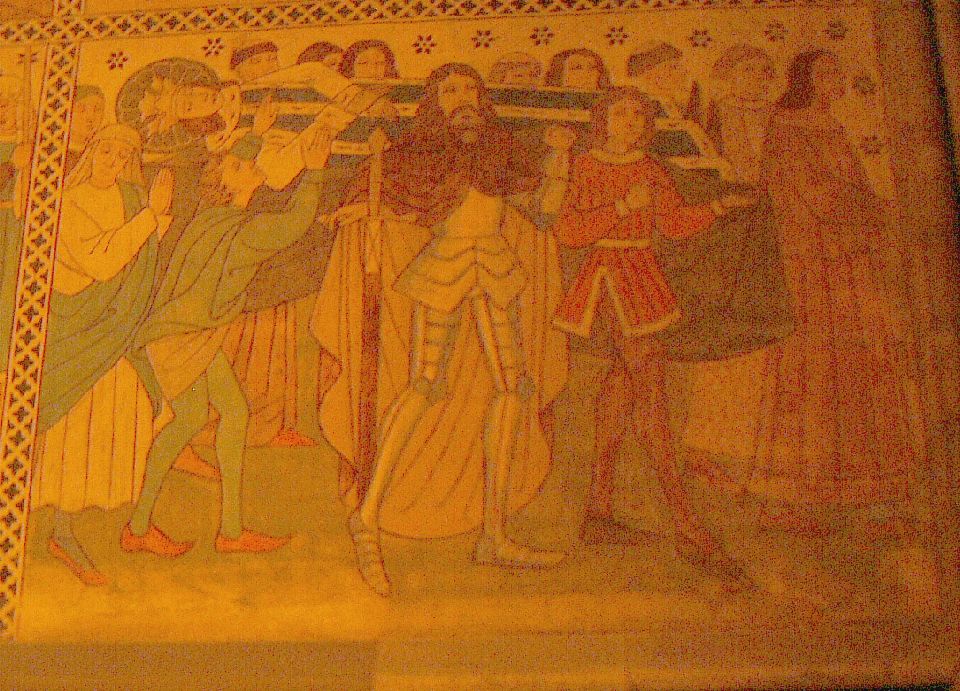
b) Eric in two fifteenth(?)-century mural paintings in Uppsala's cathedral:

c) Eric in a sculpture in Stockholms Medeltidsmuseum (Museum of Medieval Stockholm):

http://www.histdoc.net/pic/erik.jpg


d) Eric (at right in the first view) in a vault painting of ca. 1450 in Överselö kyrka in Strängnäs township (Södermanlands län):

http://upload.wikimedia.org/wikipedia/commons/a/a3/Overselo_L1valv4a.jpg


 http://upload.wikimedia.org/wikipedia/commons/b/b5/Erik_Overselo.gif


e) Eric in a fifteenth-century mural painting in Brunnby kyrka in Höganäs (Skåne län): 

https://www.heiligenlexikon.de/Fotos/Erik_von_Schweden2.jpg


f) Eric in a statue of circa 1500 in Hälsinglands Museum, Hudiksvall (Gävleborgs län):

http://www.himlenarhar.se/content/uploads/2014/04/erikskulptur1-halsingland-400.jpg


I suspect that St Eric is less well known in the English speaking world than St Olaf of Norwat or St Cnut of Denmark, or St Magnus of Orkney amongst the various Scandinavian martyred monarchs  and rulers, but he was clearly seen in the middle ages as a pattern for Swedish Kings and, as the pictures show, an inspiration for Swedish artists and those who commissioned their work. His story and cult also has some resemblances to that of St Wenceslas in Bohemia.


Sunday, 15 September 2013

The fortieth anniversary of the accession of the King of Sweden


Today is the fortieth anniversary of the accession to the throne of the King of Sweden in 1973, and there are celebrations being organised in Stockholm to mark the occasion, as can be seen here.

 http://theroyalcorrespondent.files.wordpress.com/2011/12/hmkcg.jpg

H.M.The King of Sweden
 Image;royalcorrespondent.com

There is an online biography of King Carl XVI Gustaf here.

I recall his accession following the death of his grandfather King Gustaf VI Adolf, who was almost 91 when he died. The age disparity between the two Kings, the trend of Swedish Social Democracy and plans to alter the constitution all led commentators to speculate as to the survival of the monarchy in Sweden.  Forty years later, supported by Queen Silvia and with a popular Royal family, notably the Crown Princess, and as evidenced by the reaction to her wedding and that of her sister Princess Madeleine earlier this year, those queries have been answers in a way that might have surprised some in 1973.


http://svspb.net/images/foto/kf/s/silvia-carl-xvi-gustaf-2.jpg
 
The King and Queen of Sweden on their wedding day in 1976

Image:svspb.net
King Gustaf VI Adolf, of whom there is an online biography here, followed his father in moving with the political and constitutional changes that adapted the government of Sweden from the letter of the 1809 agreements towards a parliamentary system, notably after 1917. In a sense King Gustaf can be seen as moving the monarchy from a more Germanic tradition towards the model in Denmark and Norway.  

King Gustav VI Adolf, born in 1882, was a link to a pre-Great War world - he represented his father at the funeral  in 1916 of the Emperor Francis Joseph, and held a number of Prussian and pre-1918 German Orders as well as Russian Imperial ones, as is shown in the biographical link above.

The new constitutional arrangements for Sweden, a process which began at least as early as 1971 when the Riksdag became unicameral, and which were introduced in 1974 removed the remaininf formal political powers of the monarch. This was essentially a formal legal codification as a fundamental law of the de facto adaptations of the Instrument of Government of 1809 which had developed under the previous two Kings. The Swedish urge to write it formally into law is at varaince with the unwrittend tendencies of the British constitution, and whether not requiring the King to sign new laws into being is a good idea is, I think, open to question. However these changes do need to be seen in the context od the history of the Swedish monarchy and people, as can be seen in the following online articles  on the Swedish Monarchy  and on the Swedish Constitution.
As these both show they are variants on the pre-existing arrangements, and the monarch retains an important ceremonial and formal role in the country. The change to the succession law in 1980, establishing absolute as aopposed to agnatic primogeniture was something about which the King expressed concern, but other realms have now followed the Swedish initiative. Interestingly the constitutional arrangements still debar Roman Catholics from the throne - and that despite the disestablishment of the Church of Sweden in 1999.
What does appear is the continuing popularity of the monarchy - one Swedish academic has argued that removing the formal political powers has made it more so -  and that when allegations about past events in the King's private life emerged the other year most Swedes were happy to take the view that it was simply a purely private matter and in the past. In what is often seen as a very egalitarian society, the ceremonial and splendour surrounding the Crown of Sweden at, for example, the two recent royal weddings, indicates a desire to maintain and celebrate the national heritage and identity around the person and office of the monarch.

File:Royal Monogram of King Carl XVI Gustaf of Sweden.svg 

Image: Wikipedia


Friday, 25 June 2010

Swedish Royal Wedding

The wedding last weekend of the Crown Princess of Sweden appears, from what I have seen and read to have been a splendid occasion. There is official coverage on the Swedish Monarchy website, and on the Radical Royalist site.

As in this country it gave an opportunity for the mean-spirited and such like minorities to mutter republican ideas and grumble about the cost, all of which seems to have been rather confounded by a successful and joyful wedding. Some of the coverage in the lead up to the wedding touched on this as in a rather predictable Royal wedding triggers Swedish monarchy debate - Washington Times but the general health of the Swedish monarchy as an institution appears good, as in the articles on this site Official Gateway to Sweden, The and in this article analysing the place of the monarchy in Swedish society The monarchy gives Sweden political innocence.

This is interesting in the light of the new Constitution of 1974 which removed all direct exercise of prerogative power from the monarch and the 1980 legislation which gave complet parity in the succession to women - hence the Crown Princess has a younger brother Prince Carl-Philip, who was briefly Crown Prince from his birth in 1979 until the following year. Whatever one might think of these pieces of legislation they do not appear to have weakened the monarchy - indeed giving women equal inheritance rights was seen as strenthening it by the centre-right government in 1980.

I am old enough to recall the idea being circulated around 1973 when King Gustav VI Adolf died that the age disparity between him and his grandson, the present King Carl XVI Gustav was such that the monarchy would wither between the old age of one monarch and the youth of his successor. That does not seem to have happened - the monarchy appears youthful, glamourous and popular. The instant pundits were wrong again it would appear.


From a British standpoint it was, in my opinion, sad that on the official group photograph the Earl and Countess of Wessex were not included, and seem to be excluded along with members of non-regnant houses, such as Romania and Serbia, or the Liechtensteins. Whatever the reasons the presence of the Queen's youngest son and his wife seems rather less high profile than the representation of the other reigning dynasties. This looks rather like the public tendency of the House of Windsor to keep other reigning, never mind non-regmant, dynasties at something like arms-length on occasions other than when they choose their presence - as in the Garter procession with other monarchs to mark the Queen's Jubilee in 2002, or at the wedding of the Prince and Princess of Wales in 1981. This seems to go back to King George V's choices in 1917 about his name and foreign titles, and one that seems very different to those meetings of the "Royal Mob" in the days of Queen Victoria and King Edward VII. Other royal houses seem much more comfortable displaying monarchical solidarity.