Once I was a clever boy learning the arts of Oxford... is a quotation from the verses written by Bishop Richard Fleming (c.1385-1431) for his tomb in Lincoln Cathedral. Fleming, the founder of Lincoln College in Oxford, is the subject of my research for a D. Phil., and, like me, a son of the West Riding. I have remarked in the past that I have a deeply meaningful on-going relationship with a dead fifteenth century bishop... it was Fleming who, in effect, enabled me to come to Oxford and to learn its arts, and for that I am immensely grateful.


Showing posts with label Swedish churches. Show all posts

Thursday, 24 March 2016

St Catherine of Sweden


Today is normally given as the feast of St Catherine of Sweden, the daughter of St Bridget.

John Dillon posted the following on the Medieval Religion discussion group:

Catherine of Sweden (also Catherine of Vadstena; d. 1381) was the daughter of Ulf Gudmarsson, lord of Ulvåsa and of his wife Birgitta Birgersdotter of Finsta (better known today as St. Bridget of Sweden).  At the age of thirteen she was married to a young nobleman; their union was never consummated (later it was said that both had taken a vow of chastity).  When after a few years he died Catherine was in Rome with her mother, whose work she supported and whose ascetic lifestyle she imitated.  Catherine remained with Birgitta until the latter's death in 1373.  In 1374 she brought Birgitta's body to the latter's foundation at Vadstena, where Birgitta was interred and Catherine became abbess.  She spent the remainder of her life there and at Rome, working for her mother's canonization and directing the nascent Order of the Most Holy Saviour (the Bridgettines).  Her own cult was confirmed Papally in 1484.  Today is her dies natalis and her day of commemoration in the Roman Martyrology.  One of her attributes is a stag that is said to have protected her virginity by scaring off an intended attacker who had been lying in wait for her in a vineyard as she walked to Rome's basilica di San Sebastiano fuori le Mura.

Some period-pertinent images of St. Catherine of Sweden:

a) as portrayed in an oakwood statue in a later fifteenth-century altarpiece (c. 1476-1500) from Blidsberg, a locality of Ulricehamns kommun (Västra Götalands län), now in Västergötlands museum, Skara:

 http://medeltidbild.historiska.se/medeltidbild/mbbilder/bilder/95/9528428.jpg

 http://medeltidbild.historiska.se/medeltidbild/mbbilder/bilder/95/9528428.jpg

b) as portrayed (at left; at right, St. Erasmus of Formiae) in a wooden statue in a later fifteenth-century altarpiece (c. 1476-1500) in Önums kyrka, Önum, a locality of Vara kommun (Västra Götalands län):

http://medeltidbild.historiska.se/medeltidbild/mbbilder/bilder/92/9206124.jpg


c) as depicted (at far right; at left, St. Helen of Skövde; at centre, St. Birgitta of Sweden) in a late fifteenth-century mural painting in Götene kyrka, Götene (Västra Götalands län):

 https://blogger.googleusercontent.com/img/b/R29vZ2xl/AVvXsEgEHSFDEoNTTzF2fFyAVO545wsAAw3MSbkF1PxmLkhAER0N-mn0Vi0O3tf3N6GI-rADHpKfXcKDgdJm64bGC9c1xFA7WIt2uvIAmYoIxgzm4TmHiwVzri9cn_p1sNTmE-GL_UWtA9Hs0TL8/s1600/Sankta+helena+pilgrim.jpg

The painting in situ:

 http://imengine.hall.infomaker.io/imengine/image.php?uuid=d5aaaef6-973d-4d79-83ee-41e9f235a27d&type=preview&source=false&function=hardcrop&width=1200&height=800&q=80
 

d) as depicted (at right; at left, St. Birgitta of Sweden) in a painted panel of an altarpiece of c.1500 in Högsby kyrka, Högsby (Kalmar län):
http://medeltidbild.historiska.se/medeltidbild/visa/foto.asp?imageId=9518015

 http://medeltidbild.historiska.se/medeltidbild/mbbilder/bilder/95/9518015.jpg


e) as depicted in a vault painting of c.1500 in Tolfta kyrka in Tolfta, a locality of Tierps kommun (Uppsala län):

 http://medeltidbild.historiska.se/medeltidbild/mbbilder/bilder/94/9435023.jpg


f) as portrayed in a wooden statue of c.1500 in Nordingrå kyrka in Nordingrå, a locality of Kramfors kommun (Västernorrlands län):


http://medeltidbild.historiska.se/medeltidbild/mbbilder/bilder/90/9020533.jpg

Detail view:


http://medeltidbild.historiska.se/medeltidbild/mbbilder/bilder/90/9020536.jpg


g) as depicted (at left, flanking the BVM; at right, St. Birgitta of Sweden) in a painted panel of an earlier fifteenth-century altarpiece in St. Nykolai kyrka, Arboga (Västmanlands län):
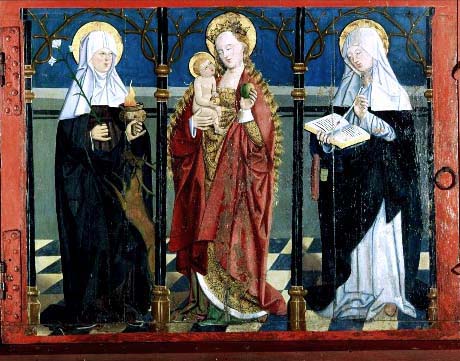

http://medeltidbild.historiska.se/medeltidbild/mbbilder/bilder/93/9332811.jpg


Detail view (Catherine):


http://medeltidbild.historiska.se/medeltidbild/mbbilder/bilder/93/9332821.jpg


h) as portrayed (at left in the centre compartment; at right, St. Lawrence of Rome) by Håkan Gulleson in an earlier fifteenth-century altarpiece statue in Trönö gamla kyrka in Trönö, a locality of Söderhamns kommun (Gävleborgs län):


https://blogger.googleusercontent.com/img/b/R29vZ2xl/AVvXsEhJ8KhjdDQyxPv9MPevHQ1C7VrI-ltmTnCCsqjw80zdF1yfZfl8B0DGNv1kB2zUytZbR9qtk5hrGDo-ID0jMMjuzqOgm4l9EkywLgF1s2OjwnhEQQBqBayia0vaP9XsCm-e8xReUat2teQ/s1600/Tr%C3%B6n%C3%B6+112+A.jpg


Detail view (Catherine):


Anders Fröjmark subsequently added the following comments:

The history of the feast days of St. Katherine of Vadstena is rather complicated. It is thought that she was originally celebrated on March 24 in Vadstena Abbey. An office exists, but there are to my knowledge no extant medieval manuscripts which give positive evidence of this feast day. On August 8, 1482, a papal bull allowed the cult in Denmark, Sweden, and Norway, and held out the prospect of canonization. Six years later, a new bull authorized a solemn translation of her relics. This was celebrated in a magnificent manner in Vadstena on August 1, 1489, one of the greatest religious manifestations in late medieval Sweden. After that, her Translatio was the main yearly feast day, but celebrated not on August 1, but on August 2. In 1513, Leo X had the feast moved to June 25. These two feast days may be found in late medieval calendars from Sweden.

Unfortunately, the canonization of St. Katherine, which from the bulls and from a printed Summarium by Johannes Franciscus de Pavinis in the early 1480s would seem to be impending, has since been totally forgotten by the Papacy.

Thursday, 21 May 2015

St Eric of Sweden


Last Monday, May 18th, was the feast of St Eric, King of Sweden, who was killed at Uppsala on that day in 1160. There is an account of his life and cult here, a site which, amongst other things, explains the questions around the numbering of the Swedish Kings Eric.

I was alerted to this feast day by a post by Matt Heintzelman on the Medieval Religion discussion group.

This was followed by another post on the site from John Dillon, as follows:

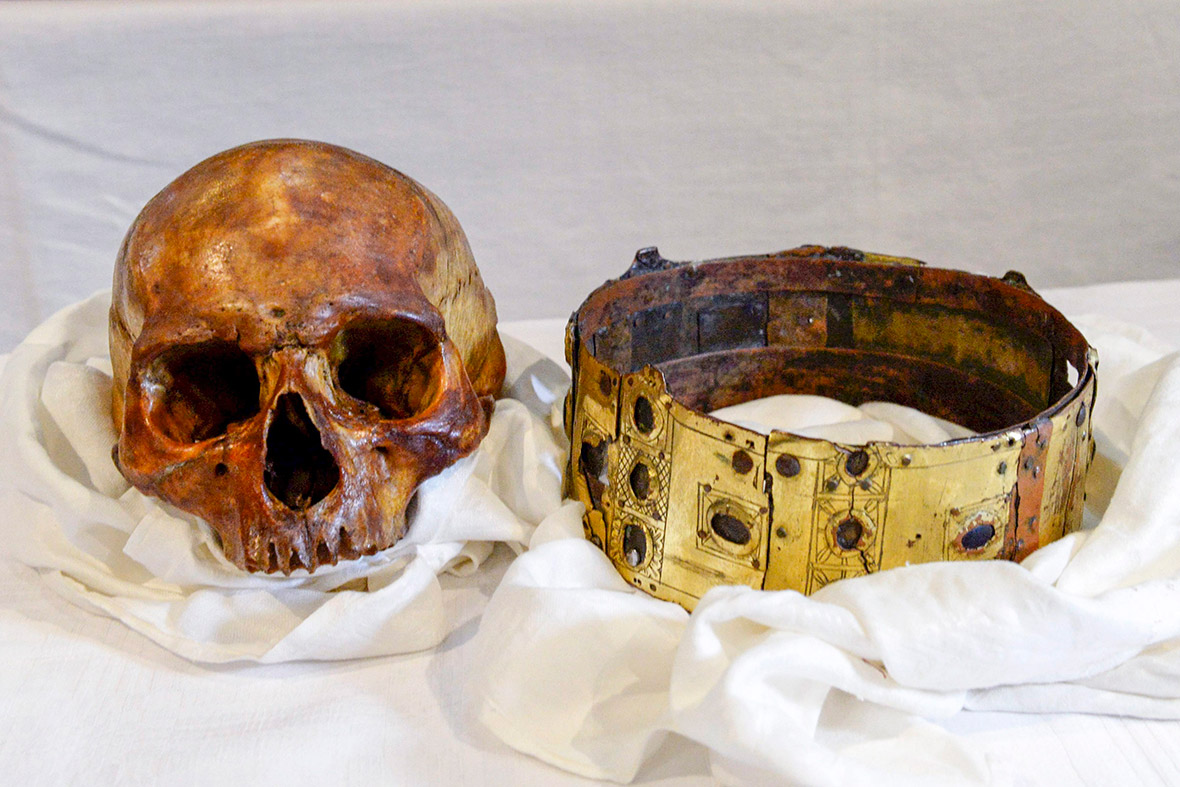
St. Erik's skull and his twelfth-century burial crown (ordinarily both reside in his later sixteenth-century reliquary in the cathedral of Uppsala):

http://d.ibtimes.co.uk/en/full/1375459/viking-skull.jpg

Image: dd.ibyimes.co.uk


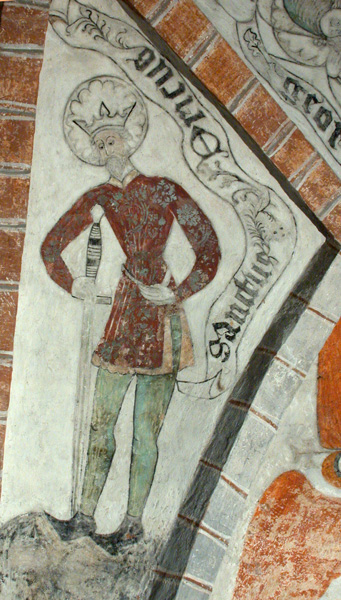
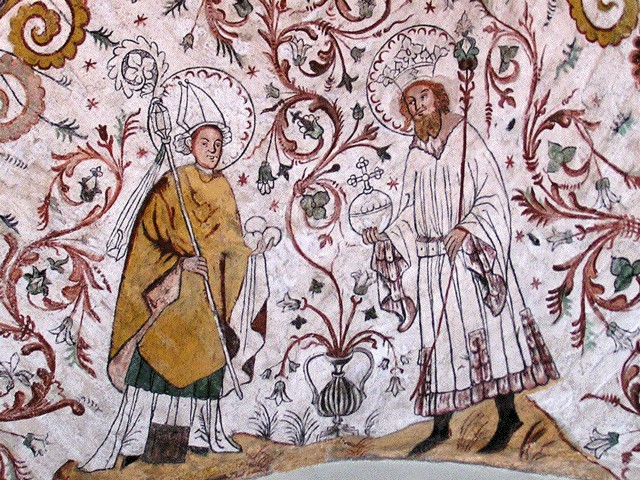
Some medieval images of Erik of Sweden:

a) Eric in a fourteenth(?)-century sculpture in the late medieval parish church of Gamla Uppsala:

http://upload.wikimedia.org/wikipedia/commons/b/b8/Gamla_Uppsala_kyrka-Statue1.jpg


[ZIMG_3268.JPG]


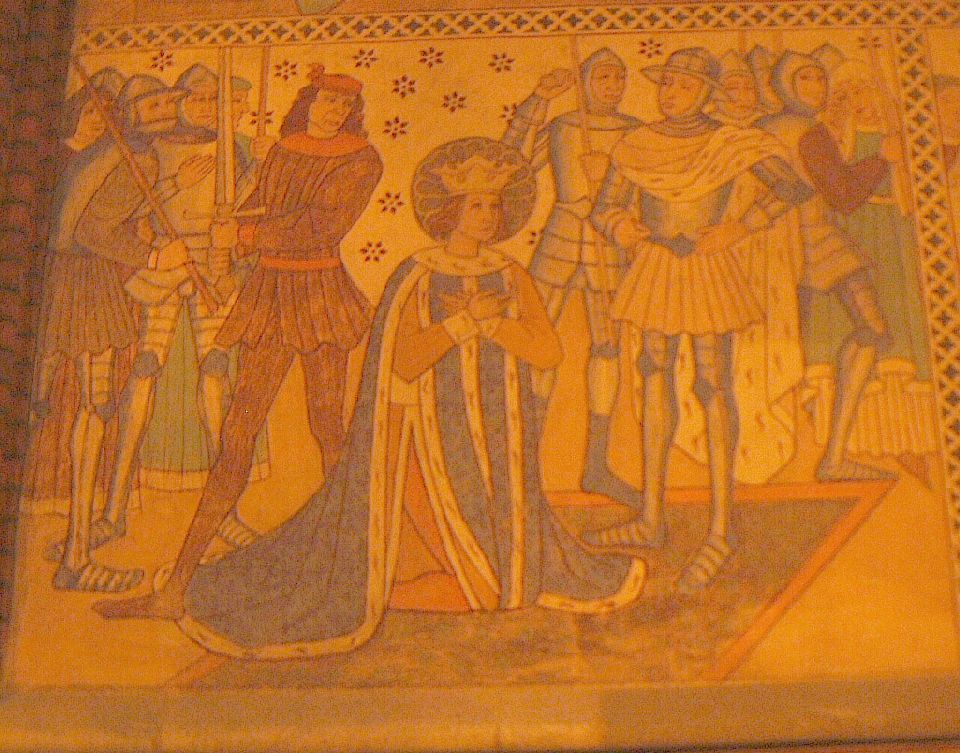
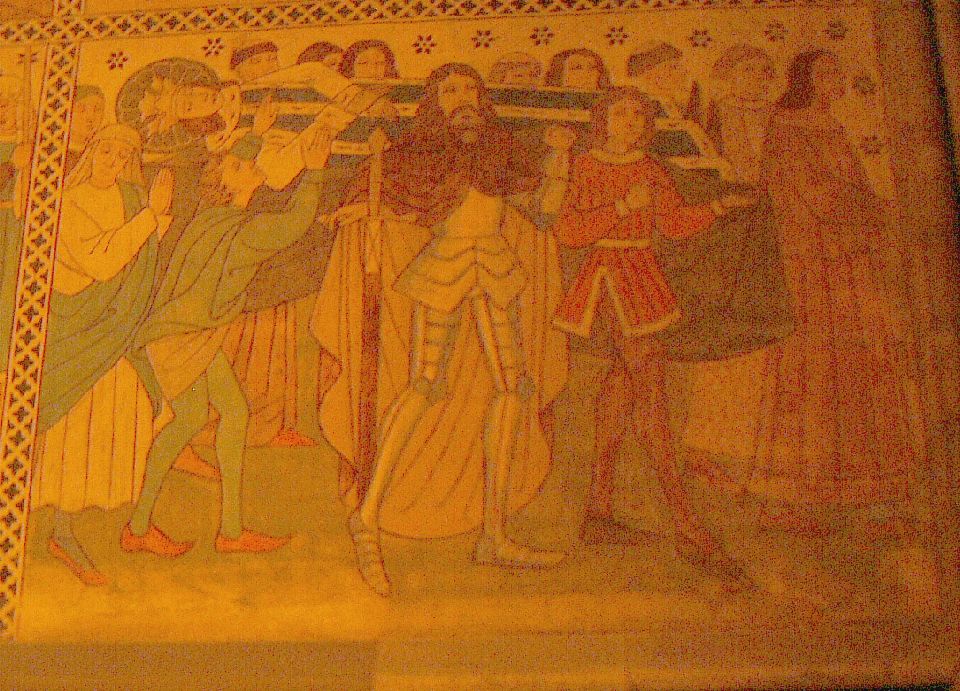
b) Eric in two fifteenth(?)-century mural paintings in Uppsala's cathedral:

c) Eric in a sculpture in Stockholms Medeltidsmuseum (Museum of Medieval Stockholm):

http://www.histdoc.net/pic/erik.jpg


d) Eric (at right in the first view) in a vault painting of ca. 1450 in Överselö kyrka in Strängnäs township (Södermanlands län):

http://upload.wikimedia.org/wikipedia/commons/a/a3/Overselo_L1valv4a.jpg


 http://upload.wikimedia.org/wikipedia/commons/b/b5/Erik_Overselo.gif


e) Eric in a fifteenth-century mural painting in Brunnby kyrka in Höganäs (Skåne län): 

https://www.heiligenlexikon.de/Fotos/Erik_von_Schweden2.jpg


f) Eric in a statue of circa 1500 in Hälsinglands Museum, Hudiksvall (Gävleborgs län):

http://www.himlenarhar.se/content/uploads/2014/04/erikskulptur1-halsingland-400.jpg


I suspect that St Eric is less well known in the English speaking world than St Olaf of Norwat or St Cnut of Denmark, or St Magnus of Orkney amongst the various Scandinavian martyred monarchs  and rulers, but he was clearly seen in the middle ages as a pattern for Swedish Kings and, as the pictures show, an inspiration for Swedish artists and those who commissioned their work. His story and cult also has some resemblances to that of St Wenceslas in Bohemia.


Wednesday, 15 February 2012

Medieval Navarrese and Scandinavian churches


The Medieval Religion discussion group has pointed me to two very interesting websites.

The first is about Romanesque architecture and sculpture in Navarre. Entitled Arte Románico en Navarra it is in Spanish but easily understood and can be accessed here. There is also an index page here so that one can click on the individual recorridos.

It is not only an indication of the fine things to be found in this part of Spain but areminfder of the flow of Romanesque art along the routes of the camino to Santiago and in particular the spread of Cluniac ideas in the eleventh and twelfth centuries as pilgrimage and the reconquista developed.
From Scandinavia there is an excellent web site with a great series of images of churches and monastic remains in Sweden and Denmark, as well as some other examples, including some in Scotland and Spain- and well worth exploring by clicking on the links on the sidebar. It is entitled Medeltidmed fokus på Skåne och Stockholmsområdet and can be found here. The text is in Swedish but comprehensible I think as to dates, places and patrons.

The churches illustrated are a reminder of how fully later medieval Scandinavia was integrated into the culture of medieval Christendom. Lutheranism did not prove so destructive of the artistic heritage of preceding centuries as did Calvinism or the various strands of reformist religion in England. In particular parish churches often preserved under whitewash whole cycles of paintings illustrative of late medieval folk piety.

Both sites are well worth looking at,or - putting it another way -jolly good timewasters.