Once I was a clever boy learning the arts of Oxford... is a quotation from the verses written by Bishop Richard Fleming (c.1385-1431) for his tomb in Lincoln Cathedral. Fleming, the founder of Lincoln College in Oxford, is the subject of my research for a D. Phil., and, like me, a son of the West Riding. I have remarked in the past that I have a deeply meaningful on-going relationship with a dead fifteenth century bishop... it was Fleming who, in effect, enabled me to come to Oxford and to learn its arts, and for that I am immensely grateful.


Showing posts with label St Olaf. Show all posts

Wednesday, 29 July 2015

St Olaf's Day


Apart from being the feast of St Martha today is also the feast of St Olaf (Olav) of Norway, the patron saint of the realm and 'perpetual King of Norway.'

My previous posts about him can be seen at St Olaf's day, St Eystein and St Olav

The detailed and informative Wikipedia article about him appears to have been updated and in its present form can be viewed at Olaf II of Norway

This is therefore a day upon which I remember and pray for my own Norwegian friends, and for the King and people of Norway.

May St Olav continue to intercede for them.


Wednesday, 15 April 2015

A day in the City of London


Yesterday I joined other members of Oxford University Heraldry Society on a visit to London.

I took the train to Paddington, and was struck once again on the journey by the ugliness of electrification - it does nothing at all for the landscape. The third rail method is far more desirable on visual grounds.

Having got that off my chest, back to the day in London. We met at All Hallows-by-the-Tower (sometimes known in the past as All Hallows Barking because the advowson belonged to the Essex abbey)

http://www.lgq.org.uk/Crawl09/AH1.jpg

All Hallows-by-the-Tower

Image: lqg.org.uk

It is one of eight City churches that survived the Great Fire of 1666, but it was bombed in the Second World War and subsequently restored in that somewhat peculiar way that was adopted for many of the City churches in that instead of reconstructing the church as it had been the architects were given something of a free hand and allowed in part to produce an adaptation of the previous work. The spire is, for example, a post WWII addition - and works well. I am less sure about the design of the east window. Nevertheless it is a handsome building, rich in historic associations.

It is claimed as the oldest church in London, and in the crypt, is a pavement of Roman date from the second century:

Roman pavement in the crypt

Image:britainexpress.com

The crypt has a fascinating display of Roman and Anglo-Saxon remains from the site and others in the City as well as a model of Roman London.


 Image:britainexpress.com 

At the west end is the oldest surviving piece of church building in London, a Saxon arch dated to about 675 or possibly a bit later. Built of stone and Roman tiles it is an impressive link to the early history of Christian London.

Richard II altar in the crypt

An altar in the crypt from the Holy Land from the Crusader era

Image:britainexpress.com 
Under the patronage of King Edward I it became a noted Marian shrine, and particularly enjoyed the patronage of the Yorkist kings, and was rebuilt in the reign of King Edward IV, and hence the style adopted for the modern rebuilding.

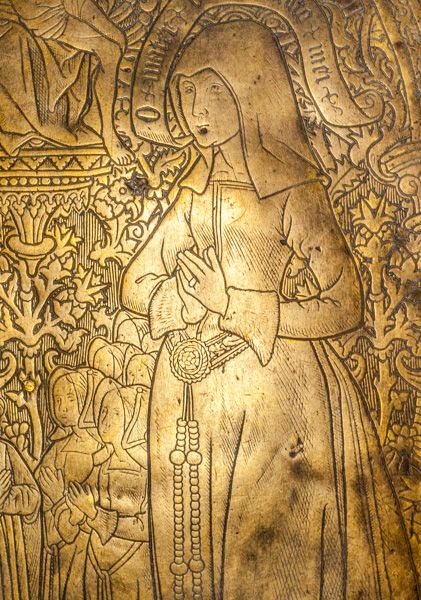
Evyngar memorial brass, 1533

Evyngar brass 1533

Image:britainexpress.com

Being close to the site of the scaffold on Tower Hill it was occasionally the burial place of victims of the headsman, including, briefly, St John Fisher and until his removal to Oxford at the Restoration of Archbishop William Laud. It has strong American associations being the place of baptism of William
Penn and where John Quincy Adams was married whilst serving as US Ambassador to the Court of St James.

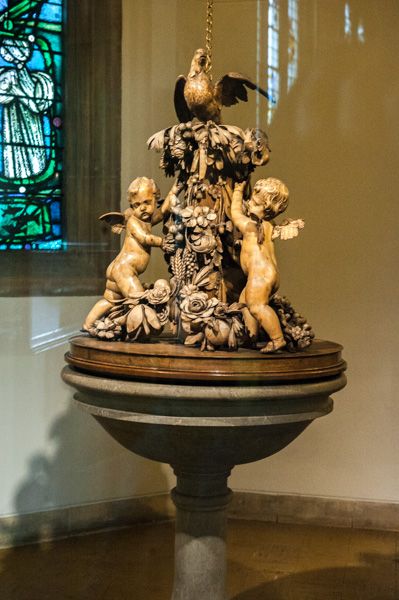
The Grinling Gibbons font cover

 The font cover by Grinling Gibbons

Image:britainexpress.com

The modern stained glass is rich in armorials - hence our visit from the  OU Heraldry Society.

There is more about the church and its history at the online article All Hallows-by-the-Tower

A short taxi ride took us to Armoury House, the home of the Honourable Artillery Company. Their website can be seen at Honourable Artillery Company and there is another history and account of them at  Honourable Artillery Company

They are the oldest Regiment in the British Army, originating as Guild of St George, and apparently drawing upon earlier antecedents, chartered by King Henry VIII in August 1537. Because of their similar date of foundation they maintain fraternal links with the Papal Swiss Guard.
In addition to being a Territorial or Reserve Regiment, who also who fire gun salutes at the Tower of London on appropriate occasions, and a force of Special Constables in the City of London, they also maintain the ceremonial Company of Pikemen and Musketeers, established in 1925  who parade in seventeenth century style armour and uniform on appropriate occasions and a Light Cavalry who provide ceremonial escorts at events such as the Lord Mayor's parade.

HAC shortarms crest.gif

Crest and Motto of the Honourable Artillery Company

Image: Wikipedia

We lunched in the Long Room, part of the oldest part of the complex and built in 1735. After lunch we toured other rooms and the museum and some of us were shown the armoury with the Pikemen and Musketeers armour hanging up ready for their next appearance.

Having finished our tout i walked with another OUHS member back into the City. I had thought of exploring places I had not visited hitherto and he kindly guided me, the country mouse, so to speak. Working our way past the Bank of England, Royal Exchange and Mansion House we went through the impressive Victorian survival of Leadenhall Market to look at the remains of the church of
All Saints or All Hallows Staining. The parish was amalgamated with St Olave Hart Street and the church other than the medieval tower demolished in 1870.

File:City parish churches, All Hallows Staining (remains of) - geograph.org.uk - 559736.jpg

All Hallows Staining

Image: Wikimedia Commons 

The suffix means that the church was built of stone and is apparently a record of the time when other churches with the same dedication were still constructed of timber. There is a history of the church at All Hallows Staining , and there is another one here.

 ANTIQUE PRINT: ALLHALLOWS STAINING, MARK LANE.

 The church in 1831

Image: ashrare.com 

My friend then took me on to St Olave Hart Street

File:St Olave's Church, Hart Street - City Of London..jpg

The tower of St Olave Hart Street

Image: Wikimedia commons

The is another of the medieval churches that survived the Great Fire, but not the aerial bombardment of 1941. The church of the Clothworkers it has been handsomely, and not too drastically restored. It contains the grave and monument of Samuel Pepys, whose burial took place there in 1703. The striking gateway through which he and Mrs Pepys went to church dates from 1658 and leads into Seething Lane where the Pepys' lived.

As the only surviving church in London dedicated to the patron saint of Norway King Haakon VII laid one of the foundation stones of the rebuilding, and this forms part of the low screen separating the chancel from the nave.

There is an illustrated account of this delightful church with links at St Olave Hart Street and there are more pictures of details and features here.

Before I got the tube back to Paddington from Tower Hill I looked at the subsantial piece of Roman city wall that stands by the entrance to the station, complete with a statue of the Emperor Trajan. This has endured for upwards of nineteen centuries close to the heart of the City - an amazing survival and one that has witnessed so much of the history of London and of England. 


Emporer Trajan and the Old Roman Wall, Tower Hill, London, England

The Emperor Trajan and London Wall

  Image;beenthere-donethat.org.uk


Tuesday, 29 July 2014

St Olav


In addition to today being the feast of St Martha it is also the feast day of St Olav, King of Norway, who was killed in battle on this day in 1029. He is the patron saint of Norway, and in medieval constitutional theory the eternal or perpetual King of Norway. Thus it is his crown which is the crown of the kingdom - although it is in actual fact a handsome nineteenth century piece - and Trondheim, the burial place of St Olav, became the traditional place for the crown to be kept and for the King's coronation.

There is an illustrated online account of St Olav here. I have posted about him before in St Olaf's day in 2011 and in St Eystein, in 2012. 

Here is a picture of  the striking life sizestatue of St Olav in the entrance to the church dedicated to him and which is the Norwegian church in London:

Norwegian Church and Seamen's Mission 

Image:londontown.com

 I posted about the church in Rotherhithe in A corner of London that is forever Norway earlier this year.

 This is therefore a day upon which to remember and pray for my own Norwegian friends, and for the King and people of Norway. May St Olav continue to intercede for them.

Thursday, 26 January 2012

St Eystein


Continuing the Scandinavian theme today is the feast of, amongst others, St Eystein of Nidaros (d. 1188). Eystein (also spelled Øystein; latinized as Augustinus) Erlendsson, was a member of a well connected noble family in Norway, and was perhaps educated in Paris and had been chaplain and steward to King Inge Krokrygg before the latter appointed him Archbishop of Nidaros (today's Trondheim) in 1158 or 1159, an action confirmed by Pope Alexander III in 1161 when Eystein was in Rome. Eystein promoted the adoption of canonical life by Norwegian parish priests, officiated at Norway's first royal coronation (that of Magnus Erlingsson, a minor), and fostered the cult of King St. Olaf (buried in Eystein's cathedral), whose liturgical Office he wrote and whose Miracula he expanded. During the years 1181-83, when King Magnus had been dislodged from his throne in a civil war, Eystein was an exile in England. Trondheim has remained the site for Norwegian coronations and inaugurations, and the items of the regalia are preserved there.

Miracles were reported early at Eystein's tomb and he was proclaimed a saint at a Norwegian synod in 1229. Attempts in the Middle Ages to have him canonized papally were unsuccessful. Eystein entered the Roman Martyrology in 2001 with the designation of Sanctus. The present seminary in Oslo is under his patronage

Apart from the Passio sancti Olavi (BHL 6233, 6323; part of Olav's Office), Eystein's chief monument today consists of the chapter house and the lower portions of the transepts of the since much added to and rebuilt Nidaros Cathedral in Trondheim.


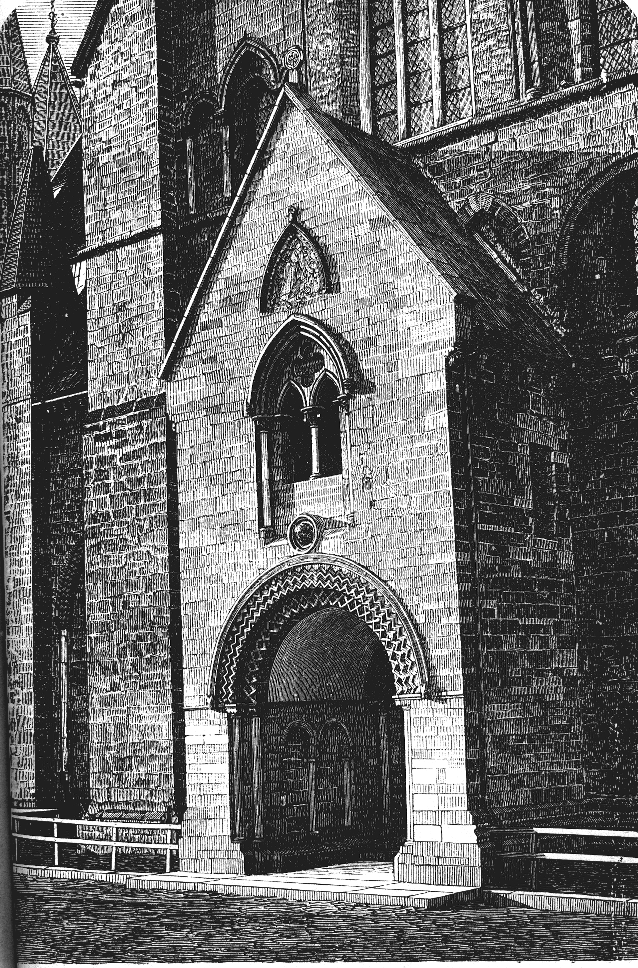
The porch of the north transept of Trondheim cathedral.
A view from 1885

Image: Wikimedia

This view of the cathedral from 1857 shows the north transept and, next to the choir, the chapter house (the latter with a neo-romanesque apse added in the nineteenth century) :

http://upload.wikimedia.org/wikipedia/commons/d/db/Nidarosdom_1857.jpg

Image: John Dillon

The subsequent restoration and rebuilding work has transformed the building as can be seen in these illustrated online articles about Trondheim cathedral here and here and one about the west front can be seen here.

In the Victoria and Albert Museum there is a late fourteenth-century walrus ivory crozier head with traces of gilding which is of Norwegian origin and portrays King St. Olaf on one side and, on the other a bishop whom the V&A cautiously says "probably represents St Augustine" without further indicating whether the Augustine in question were he of Hippo or he of Nidaros. In view of his promotion of St Olaf's cult, Augustine / Eystein of Nidaros would be a good guess:


St Augustine/Eystein


St Olav

Images :Victoria and Albert Museum website

Quite apart from its indication of the cult of St Olav and St Eystein this crozier is also a reminder of the elegant sophistication of late medieval Norwegian art.

Adapted from John Dillon's post for today on the Medieval Religion discussion group

Friday, 29 July 2011

St Olaf's day


A year ago I wrote about the cult of St Olaf or Olav, the patron saint of Norway in my post St Olaf. Readers may be interested to look at these medieval depictions of the saint, and also seek his intercession for all those caught up in the tragic events of a week ago in Norway

Thursday, 29 July 2010

St Olaf


Today is the feast day of St Olaf, the patron saint of Norway.

It is a good occasion upon which to send my greetings to my Norwegian friends and an opportunity to share the notes on St Olaf from John Dillon on the Medieval Religion discussion list. As with the recent post on another Scandinavian saint, St Bridget,I have not bothered converting the links. They include some wonderful images of medieval art - Norway has preserved some superb examples of English inspired or influenced high medieval art, of the sort that was lost in England itself in the sixteenth and seventeenth centuries.


Olav, king and saint

St Olaf, from a frontal c.1320-30 now in Trondheim cathedral

Olaf of Norway (d. 1030). Olaf II Haraldsson became king of Norway in 1015, reconquered areas that had been under the control of Danes and Swedes, and effected, partly by force, the conversion to Christianity of his then still largely pagan country. A rebellion forced him from his throne in 1028; he died two years later trying to regain it. Olaf was buried at what much later became Trondheim. His son Magnus promoted his veneration as a saint and built a chapel at his grave. In 1075 that chapel was replaced by a cathedral (now the cathedral of Nidaros). The later twelfth-century archbishop of Nidaros, St. Eystein (also spelled Øystein; latinized as Augustinus) wrote the Passio preserved in O.'s Office (BHL 6322, 6324). A paper on it by Eyolf Østrem is here:
http://hem.passagen.se/obrecht/leeds99.htm

Olaf's mid-thirteenth-century statue at Tyldal kirke in Østerdalen:
http://home.broadpark.no/~jantaule/helgener/helgener.htm
http://aomoi.net/blog/arkiv/960
An English-language site on the much rebuilt cathedral of Nidaros:
http://www.nidarosdomen.no/english/nidaroscathedral/
Olaf's spring in the cathedral:
http://www.trondheim.com/content.ap?thisId=1117611476
An illustrated, English-language page on the cathedral's early fourteenth-century St Olav altar frontal (thanks again to John Shinners for sharing this with the list two years ago):
http://www.niku.no/olavsfro/english/1_olavs.htm

Some Olaf -related visuals outside of Norway:
a) Olaf in the mid-fifteenth-century vault paintings in Överselö kyrka in Strängnäs kommun (Södermanlands län):
http://tinyurl.com/2tl5qx
b) Olaf on the fifteenth-century rood screen at St Michael, Barton Turf (Norfolk):
http://tinyurl.com/5vaj5w
c) An English-language page on, and some views of, the originally mostly fifteenth-century St Olave's church in Chester (restored, 1859):
http://tinyurl.com/ks27ee
http://tinyurl.com/nu5znz
http://www.flickr.com/photos/clivester/3356470592/sizes/l/
and here is another image of Olaf from Chester cathedral:
http://www.flickr.com/photos/22274117@N08/3019188421/
d) An English-language page on, and some views of, the originally late medieval St. Olav's church in Tallinn:
http://en.wikipedia.org/wiki/St._Olaf%27s_church,_Tallinn\
http://pilt.delfi.ee/en/show_original/7634059/
http://tinyurl.com/25xcgsj
http://tinyurl.com/25jnpsc
http://tinyurl.com/23pccaz
Many views of the church are here (follow the sequence of thumbnails near the bottom):
http://fotoalbum.ee/photos/katikrt/61605311/