Once I was a clever boy learning the arts of Oxford... is a quotation from the verses written by Bishop Richard Fleming (c.1385-1431) for his tomb in Lincoln Cathedral. Fleming, the founder of Lincoln College in Oxford, is the subject of my research for a D. Phil., and, like me, a son of the West Riding. I have remarked in the past that I have a deeply meaningful on-going relationship with a dead fifteenth century bishop... it was Fleming who, in effect, enabled me to come to Oxford and to learn its arts, and for that I am immensely grateful.


Showing posts with label Norwegian medieval art. Show all posts

Thursday, 26 January 2012

St Eystein


Continuing the Scandinavian theme today is the feast of, amongst others, St Eystein of Nidaros (d. 1188). Eystein (also spelled Øystein; latinized as Augustinus) Erlendsson, was a member of a well connected noble family in Norway, and was perhaps educated in Paris and had been chaplain and steward to King Inge Krokrygg before the latter appointed him Archbishop of Nidaros (today's Trondheim) in 1158 or 1159, an action confirmed by Pope Alexander III in 1161 when Eystein was in Rome. Eystein promoted the adoption of canonical life by Norwegian parish priests, officiated at Norway's first royal coronation (that of Magnus Erlingsson, a minor), and fostered the cult of King St. Olaf (buried in Eystein's cathedral), whose liturgical Office he wrote and whose Miracula he expanded. During the years 1181-83, when King Magnus had been dislodged from his throne in a civil war, Eystein was an exile in England. Trondheim has remained the site for Norwegian coronations and inaugurations, and the items of the regalia are preserved there.

Miracles were reported early at Eystein's tomb and he was proclaimed a saint at a Norwegian synod in 1229. Attempts in the Middle Ages to have him canonized papally were unsuccessful. Eystein entered the Roman Martyrology in 2001 with the designation of Sanctus. The present seminary in Oslo is under his patronage

Apart from the Passio sancti Olavi (BHL 6233, 6323; part of Olav's Office), Eystein's chief monument today consists of the chapter house and the lower portions of the transepts of the since much added to and rebuilt Nidaros Cathedral in Trondheim.
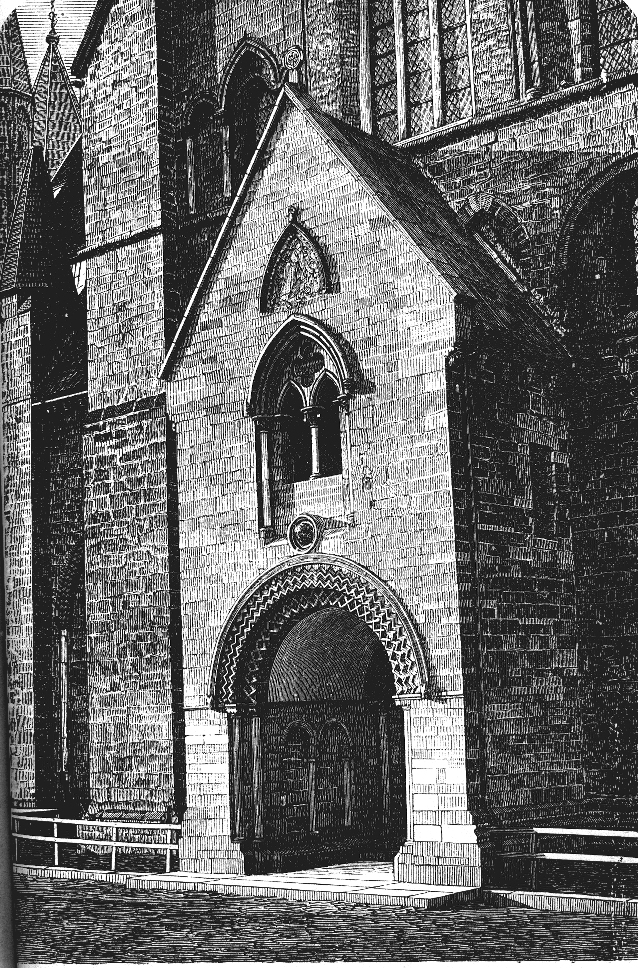

The porch of the north transept of Trondheim cathedral.
A view from 1885

Image: Wikimedia

This view of the cathedral from 1857 shows the north transept and, next to the choir, the chapter house (the latter with a neo-romanesque apse added in the nineteenth century) :

http://upload.wikimedia.org/wikipedia/commons/d/db/Nidarosdom_1857.jpg

Image: John Dillon

The subsequent restoration and rebuilding work has transformed the building as can be seen in these illustrated online articles about Trondheim cathedral here and here and one about the west front can be seen here.

In the Victoria and Albert Museum there is a late fourteenth-century walrus ivory crozier head with traces of gilding which is of Norwegian origin and portrays King St. Olaf on one side and, on the other a bishop whom the V&A cautiously says "probably represents St Augustine" without further indicating whether the Augustine in question were he of Hippo or he of Nidaros. In view of his promotion of St Olaf's cult, Augustine / Eystein of Nidaros would be a good guess:


St Augustine/Eystein


St Olav

Images :Victoria and Albert Museum website

Quite apart from its indication of the cult of St Olav and St Eystein this crozier is also a reminder of the elegant sophistication of late medieval Norwegian art.

Adapted from John Dillon's post for today on the Medieval Religion discussion group

Friday, 29 July 2011

St Olaf's day


A year ago I wrote about the cult of St Olaf or Olav, the patron saint of Norway in my post St Olaf. Readers may be interested to look at these medieval depictions of the saint, and also seek his intercession for all those caught up in the tragic events of a week ago in Norway

Thursday, 29 July 2010

St Olaf


Today is the feast day of St Olaf, the patron saint of Norway.

It is a good occasion upon which to send my greetings to my Norwegian friends and an opportunity to share the notes on St Olaf from John Dillon on the Medieval Religion discussion list. As with the recent post on another Scandinavian saint, St Bridget,I have not bothered converting the links. They include some wonderful images of medieval art - Norway has preserved some superb examples of English inspired or influenced high medieval art, of the sort that was lost in England itself in the sixteenth and seventeenth centuries.


Olav, king and saint

St Olaf, from a frontal c.1320-30 now in Trondheim cathedral

Olaf of Norway (d. 1030). Olaf II Haraldsson became king of Norway in 1015, reconquered areas that had been under the control of Danes and Swedes, and effected, partly by force, the conversion to Christianity of his then still largely pagan country. A rebellion forced him from his throne in 1028; he died two years later trying to regain it. Olaf was buried at what much later became Trondheim. His son Magnus promoted his veneration as a saint and built a chapel at his grave. In 1075 that chapel was replaced by a cathedral (now the cathedral of Nidaros). The later twelfth-century archbishop of Nidaros, St. Eystein (also spelled Øystein; latinized as Augustinus) wrote the Passio preserved in O.'s Office (BHL 6322, 6324). A paper on it by Eyolf Østrem is here:
http://hem.passagen.se/obrecht/leeds99.htm

Olaf's mid-thirteenth-century statue at Tyldal kirke in Østerdalen:
http://home.broadpark.no/~jantaule/helgener/helgener.htm
http://aomoi.net/blog/arkiv/960
An English-language site on the much rebuilt cathedral of Nidaros:
http://www.nidarosdomen.no/english/nidaroscathedral/
Olaf's spring in the cathedral:
http://www.trondheim.com/content.ap?thisId=1117611476
An illustrated, English-language page on the cathedral's early fourteenth-century St Olav altar frontal (thanks again to John Shinners for sharing this with the list two years ago):
http://www.niku.no/olavsfro/english/1_olavs.htm

Some Olaf -related visuals outside of Norway:
a) Olaf in the mid-fifteenth-century vault paintings in Överselö kyrka in Strängnäs kommun (Södermanlands län):
http://tinyurl.com/2tl5qx
b) Olaf on the fifteenth-century rood screen at St Michael, Barton Turf (Norfolk):
http://tinyurl.com/5vaj5w
c) An English-language page on, and some views of, the originally mostly fifteenth-century St Olave's church in Chester (restored, 1859):
http://tinyurl.com/ks27ee
http://tinyurl.com/nu5znz
http://www.flickr.com/photos/clivester/3356470592/sizes/l/
and here is another image of Olaf from Chester cathedral:
http://www.flickr.com/photos/22274117@N08/3019188421/
d) An English-language page on, and some views of, the originally late medieval St. Olav's church in Tallinn:
http://en.wikipedia.org/wiki/St._Olaf%27s_church,_Tallinn\
http://pilt.delfi.ee/en/show_original/7634059/
http://tinyurl.com/25xcgsj
http://tinyurl.com/25jnpsc
http://tinyurl.com/23pccaz
Many views of the church are here (follow the sequence of thumbnails near the bottom):
http://fotoalbum.ee/photos/katikrt/61605311/