Once I was a clever boy learning the arts of Oxford... is a quotation from the verses written by Bishop Richard Fleming (c.1385-1431) for his tomb in Lincoln Cathedral. Fleming, the founder of Lincoln College in Oxford, is the subject of my research for a D. Phil., and, like me, a son of the West Riding. I have remarked in the past that I have a deeply meaningful on-going relationship with a dead fifteenth century bishop... it was Fleming who, in effect, enabled me to come to Oxford and to learn its arts, and for that I am immensely grateful.


Showing posts with label Order of the Holy Ghost. Show all posts

Saturday, 23 August 2014

The birth of King Louis XVI


Today is the 260th anniversary of the birth at Versailles of the future King Louis XVI in 1754. He was the third son of Louis, Dauphin of France and Maria Josepha of Saxony, but the eldest one to survive childhood. His father died in 1765 and his mother in 1767, which brought him to prominance as Dauphin and heir, but at an early age. This was followed by his succession to the throne aged 19 in 1774.


File:Louis16-1775.jpg 

King Louis XVI at the age of 20

Image:Wikipedia

There is an online biography here, which gives some pointers both to his genuine mental abilities and also his profound shyness as a youth and young man, and also to the influence of tutors which may not have proved altogether helpful advice in the face of the mounting catastrophe he had to face after 1789.


The young King Louis XVI

Image:eponymousflower.blogspot

If in some ways he was perhaps a late developer  he was a man who was well intentioned, the promoter of humane values in his kingdom, and not opposed to reform. He was undoubtedly a good man, kind and caring for his family and for his subjects.

It is perhaps unclear how well he was prepared for his task, which was becoming ever more difficult with the need for reform, yet the system was too complex, with its inbuilt checks and balances, jealously defended by sectional and regional interests, to be other than tinkered with safely. The case for putting the Monarchy in the forefront of reform and seizing the advantage was a good one - attempted by his grandfather and his ministers in 1770, but then abandoned. Whether such a policy was possible is one question. Another is whether it could have actually worked in France in the ways that similar reforms were working in other European monarchies in the 1780s, including Austria, Spain and, indeed, after 1783, Britain.

King Louis XVI is sometimes derided for his hobby of making and repairing locks. However locks are complex mechanisms, requiring skill and attention. The King's tragedy, and that of his realm, was not that he could not solve or repair the complex mechanism of making the governance of the realm work, but that seemingly no-one could without smashing the whole to pieces.

With the often doubtful benefits of hindsight he has attracted criticism from both left for being incapable of seizing the initaitive for reform - or indeed for simply being King, and struggling to maintain his position - and from the right for irresolution and vacillation. Neither seem fair to a man placed in an uneviable position by events.


King Louis XVI receives the homage of the Knights of the Order of the Saint-Esprit after his coronation at reims in 1775

Image:forum.alexanderpalace.org 

Like King Charles I in England he attained full maturity and nobility in the way he faced his death.

A blood relic of the King has recently been analysed as can be seen from the article which can be viewed  here.


Saturday, 2 August 2014

King Henri III of France


425 years ago today at the chateau at Saint-Cloud King Henri III of France was assassinated by Jacques Clément. The King was the last of the Valois line, and the succession passed, not without dispute in the vexed Wars of Religion, to his cousin and brother-in-law King Henri IV.

 File:Henri III 1578 by Etienne Dumonstier.jpg

King Henri III
Portrait by Etienne Dumonstier after 1578

Image:Wikipedia

There is a biography of King Henri III, who was born in 1551 and had been the elected King of Poland-Lithuania in 1573- 4 until he succeeded his brother King Charles IX as King of France on the latter's death in 1574, here

Having succeeded to both the Polish and French thrones on the feast of Pentecost he established in 1578 what became the premier chivalric Order of the French Crown, the Order of the Holy Ghost or Saint-Esprit. There is an illustrated account of the Order here.

Like his elder brothers and his mother Queen Catherine de' Medici, he reigned over a France bitterly divided by the Wars of Religion, and was forced to seek to negotiate with one or other, or both sides to maintain not only his own position but that of the monarchy.

Given the fraught world of the French Court in his lifetime and the political tensions that surrounded him it is perhaps not surprising that he was a complex man. The impression is of a fey young man, often assumed to be homosexual - although that interpretation has been challenged,as outline in the biographical link above - yet devoted to his wife, Louise of Lorraine. She was in turn devoted to him, and may have miscarried a child in the early years of their marriage. His behaviour does suggest the bisexual world of renaissance court culture. There is a biography of Queen Louise here. He was also notably pious in his practise of Catholicism as well as veing very much a man concerned with his appearance and fashion.

There is a galley of several portraits of the King here and discussion of his costume and appearance in an early portrait from his time as King of France here ( the English is occasionally idiosyncratic, but the content interesting).

Wednesday, 18 May 2011

The Order of SS Cyril and Methodius


In February when I wrote about St Cyril and St Methodius I said I hoped to post something about the Bulgarian monarchy's Order of Chivalry under their patronage. The following piece is largely based upon an online article in connection with the offer for sale of a set of the insignia of the Order.

Today is the anniversary of the foundation of that Order by King Ferdinand I in 1909, following his proclamation of the Kingdom or Tsardom of the Bulgarians the previous year. In February 1910 it was approved by a special act of the 14th Common National Assemby. It was the highest ranking Order of the Kingdom and was conferred on high-ranking Bulgarian statesmen who had already received decorations, and also on foreign Sovereigns or Christian statesmen for services to Bulgaria.

Under its statutes the number of living Bulgarian recipients was not to exceed 15 members. Early members were Ivan Geshov, Vassil Radolavov, Ivan Vasov and there were apparently some 52 foreign members, including Tsar Nicholas II.

The badge of the Order is a 75 mm cross with quatrefoil terminals, enamelled light blue with gold edges. Between the arms of the cross are red enamelled flames each charged with a silver Bourbon fleur-de-lys. The gold circle at the centre bears the motto in blue: Ex Oriente Lux. Beneath the motto is a five-pointed star and two stylised decorations. The two patrons SS Cyril and Methodius are depicted on the central medallion.


On the reverse a similar gold circle bears in blue lettering the date of the Order's foundation: XVIII Majus MDCCCCIX/18 May 1909 and the cypher of King Ferdinand.


The star of the Order derived its design from that of the French The Orderof the Saint-Esprit, and consisted of a silver faceted Maltese cross with arms 75mm long.

Between the arms are flames charged with the silver fleur-de-lys, and in the centre a Seraph, its six wings enamelled in red.

The Order had both a Grand Collar and a Lesser Collar.

The riband of the Order was light orange and 103 mm wide, and worn over the left shoulder.


With the example illustrated is a photograph of King Boris III (1918-43), and this award of the Order dates from his reign.


The insignia was designed by Heyer von Rosenfeld of Rhote and Neffe in Vienna, and was made by Tzermann in Germany.


Wednesday, 26 January 2011

The Order of the Saint-Esprit


My post The Orders worn by King Louis XVI had a problem with one of the illustrations, which I have deleted. The picture of the collars and badges of the Orders of St Michael and of the Saint-Esprit can be found on the website here.

This gives me an opportunity to share some other sources about the Order. There is an illustrated Wikipedia article about it here.

I have also found some more illustrations of the Order's insignia.


The collar and badge


The Badge of the Order is a gold, ball-tipped Maltese Cross, enameled in white and green, with a gold fleur-de-lys between each arm. In the center is St. Michael crushing Lucifer. The badge hangs from a sky blue riband worn over the right shoulder.

The comments above are from my source Laudem Gloriae (November 2008). I think what is shown is the reverse of the sash badge, whose obverse had the Holy Dove on it. It clearly refers to the linked Order of St Michael

In the Hermitage in St Petersburg is the mantle and costume worn by Emperor Alexander I in 1815.

Costume of the Order of the Saint Esprit (Holy Spirit) for the Ceremony of Initiation

On 25 August 1815 three sovereigns of countries belonging to the anti-Napoleonic coalition - Emperor Alexander I of Russia, King Frederick William III of Prussia and Emperor Francis I of Austria - were initiated into the Order. The costume that Alexander I wore for the ceremony retained traditional features dating back to the 16th century. The colours of the costume had a symbolic significance: green stood for "honour, love and gallantry"; orange represented the sun and gold. The decorative edging of the black velvet mantle has a pattern incorporating a motif of tongues of flame, trophies, fleur-de-lis and the letter H (for Henri III) framed by crowns. The largest motif - the trophy - is appliquè work made up of solid metal plates, flat pieces of foil, sequins, silver and gold threads. The brocade doublet and hose are decorated with silver thread embroidery and sequins.

File:Embroidered star of Order of the Holy Spirit (Alexander I of Russia).jpg

Emperor Alexander I's embroidered breast star and riband

Photo: Wikimedia Commons


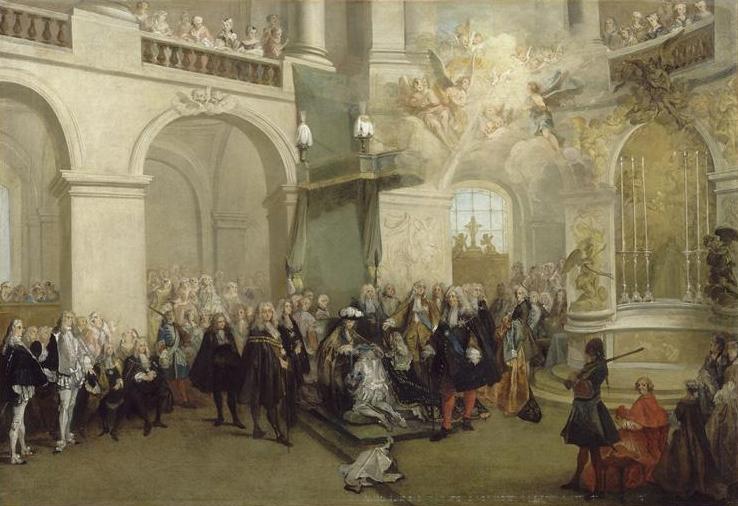
File:La remise de l'Ordre du Saint-Esprit dans la chapelle de Versailles.jpg

An investiture of the Order in the Chapel Royal at Versailles c.1724
by Nicolas Lancret
(1690-1743)


Monday, 24 January 2011

The Orders worn by King Louis XVI


After writing my post last week about King Louis XVI it occurred to me that I could, and indeed should have said something about the Orders the King is wearing in the two portraits I included in my text.

In both paintings the King is wearing the premier Order of the French Crown, the Order of the Saint-Esprit (usually rendered in English as the Order of the Holy Ghost). It was founded in 1578 by KIng Henri III, and superceded the Order of St Michael, created by King Louis XI in 1469, as the most senior Order: thereafter Knights of the Saint-Esprit automatically received the Order of St Michael. There is a website about the Saint- Esprit here It has a few unfortunate mistranslations - such as rendering the 'Order of St Michael' as 'Michaelmas' produced by the automated system used - but is illustrated and informative.

There is another site which deals with all the French royal orders here.

In the portraits the King can clearly be seen wearing the sky blue moiree riband of the Order and the breast star with its motif of the Dove. The riband was the first to be prescribed in the statutes of an order, and is the origin of the term 'cordon bleu' as asign of honour. The Order specifically commemorated King Henri's accession to the thrones of Poland on Whitsunday 1573, and to that of France on Whitsunday 1574, and hence the use of the Dove as a symbol. It also served to recall the account of the Holy Dove bringing the Sainte-Ampoulle at the baptism of Clovis in 496, and the source of the Holy Oil used at the Sacre of the King at Rheims. The design of the breast star and badge of the Order was to be copied and adapted by nmany other orders in Spain, Sicily, Sweden and Great Britain with the badge of the Military Division of the Order of the Bath, with lions and unicorns replacing the fleur-de-lys.

Examples of the black mantles embroidered with flames worn by knights of the Order on ceremonial occasions can be seen in the Louvre. In Bernard Fay's biography
Louis XVI there is a reproduction of a painting of the knights paying homage to the King. It was in his reign, in 1778, that the bicentenary of the Order was celebrated and a commemorative medallion in silver produced by P.A.F. Tardieu.

H
File:Louis16-1775.jpg

King Louis XVI aged 20 in 1775

File:LouisXVI-France1.jpg

King Louis XVI in 1786

In both portraits the king is wearing on his jacket the badge of the Order of the Golden Fleece. I assume this is from the Austrian branch of the Order, through his marriage into the Habsburg dynasty. In the second
por
trait he is wearing with it the French Military Order of St Louis, founded in 1693. The red riband of that order was copied for the Napoloeonic and later Legion d'Honneur.

The chivalric orders of the monarchy were abolished by the revolution, but restored by King Louis XVIII. Amongst the recipients in those years were Britons such as King George IV and the Duke of Wellington. After 1830 the historic Orders were not retained under the Orleanist monarchy, although ocasionally worn and bestowed by the heirs of King Charles X.

In recent decades the Order has been revived, worn and bestowed by the Dukes of Anjou in respect of their claim through descent from King Philip V of Spain. In the photograph below, which shows him and his wife the present Duke of Anjou of that line, Louis Alphonse, who would claim to be
King Louis XX can be seen wearing the riband and star of the Order, as well as a collar of the Order of Malta.
Tke Their Royal Highnesses The Duke and Duche
In
Prince Louis Alphonse and Princess Maria Margarita, Duke and Duchess of Anjou