Once I was a clever boy learning the arts of Oxford... is a quotation from the verses written by Bishop Richard Fleming (c.1385-1431) for his tomb in Lincoln Cathedral. Fleming, the founder of Lincoln College in Oxford, is the subject of my research for a D. Phil., and, like me, a son of the West Riding. I have remarked in the past that I have a deeply meaningful on-going relationship with a dead fifteenth century bishop... it was Fleming who, in effect, enabled me to come to Oxford and to learn its arts, and for that I am immensely grateful.


Showing posts with label Order of St Michael. Show all posts

Thursday, 29 September 2011

St Michael the Archangel


To mark the Feast of St Michael here, courtesy of a post on the Medieval Religion discussion group by that splendid photographer of medieval stained glass the Rev. Gordon Plumb, are three fourteenth century images of the Archangel:

photo

Eaton Bishop, Herefordshire, Parish Church of St Michael,
East window, St Michael the Archangel


photo

Tewkesbury Abbey, Choir Clerestory East Window, 3d-4d, St Michael the Archangel


St Michael is in the place normally occupied in Last Judgement scenes by John the Baptist (who has been moved to the far left among a group of Apostles). Here Michael supports a shield, now filled with fragmentsby a restorer but in a seventeenth century account this was clearly then the "Arma Christi" - the shield of the Passion on which the instruments of the Passion were displayed.

Sarah Brown in her summary of her ongoing research into the glass for her CVMA volume on the glass which she presented in the 2003 history of Tewkesbury Abbey volume, speculates that this reordering of the standard iconography of a Last Judgement scene perhaps reflects a personal devotion on the part of one of those involved in the window's creation to the "Arma Christi". The Arma became linked with protection and indulgences were soon attached to it. According to the Golden Legend it is St Michael who will present the cross, nails and spear and crown of thorns at the Last Judgement, so his carrying this shield here is perhaps appropriate.


photo

Exeter Cathedral, Choir Clerstory, East window,
St Michael the Archangel


This figure of St Michael the archangel was not made originally for the East window. It was painted by an atelier that worked extensively in the West Country, and is best known for the schemes at Doddiscombsleigh and Ashton. This panel was subject to some extensive repairs by Drake, including the lively dragon at St Michael's feet which is entirely his work.


Holy Michael Archangel defend us in the day of battle, be our safeguard against the wickedness and snares of the Devil, and do thou, O Prince of the Heavenly Host, by the power of God, thrust down into Hell Satan and all other evil spirits who wander through the world for the ruin of souls.


Wednesday, 26 January 2011

The Order of the Saint-Esprit


My post The Orders worn by King Louis XVI had a problem with one of the illustrations, which I have deleted. The picture of the collars and badges of the Orders of St Michael and of the Saint-Esprit can be found on the website here.

This gives me an opportunity to share some other sources about the Order. There is an illustrated Wikipedia article about it here.

I have also found some more illustrations of the Order's insignia.


The collar and badge


The Badge of the Order is a gold, ball-tipped Maltese Cross, enameled in white and green, with a gold fleur-de-lys between each arm. In the center is St. Michael crushing Lucifer. The badge hangs from a sky blue riband worn over the right shoulder.

The comments above are from my source Laudem Gloriae (November 2008). I think what is shown is the reverse of the sash badge, whose obverse had the Holy Dove on it. It clearly refers to the linked Order of St Michael

In the Hermitage in St Petersburg is the mantle and costume worn by Emperor Alexander I in 1815.

Costume of the Order of the Saint Esprit (Holy Spirit) for the Ceremony of Initiation

On 25 August 1815 three sovereigns of countries belonging to the anti-Napoleonic coalition - Emperor Alexander I of Russia, King Frederick William III of Prussia and Emperor Francis I of Austria - were initiated into the Order. The costume that Alexander I wore for the ceremony retained traditional features dating back to the 16th century. The colours of the costume had a symbolic significance: green stood for "honour, love and gallantry"; orange represented the sun and gold. The decorative edging of the black velvet mantle has a pattern incorporating a motif of tongues of flame, trophies, fleur-de-lis and the letter H (for Henri III) framed by crowns. The largest motif - the trophy - is appliquè work made up of solid metal plates, flat pieces of foil, sequins, silver and gold threads. The brocade doublet and hose are decorated with silver thread embroidery and sequins.

File:Embroidered star of Order of the Holy Spirit (Alexander I of Russia).jpg

Emperor Alexander I's embroidered breast star and riband

Photo: Wikimedia Commons


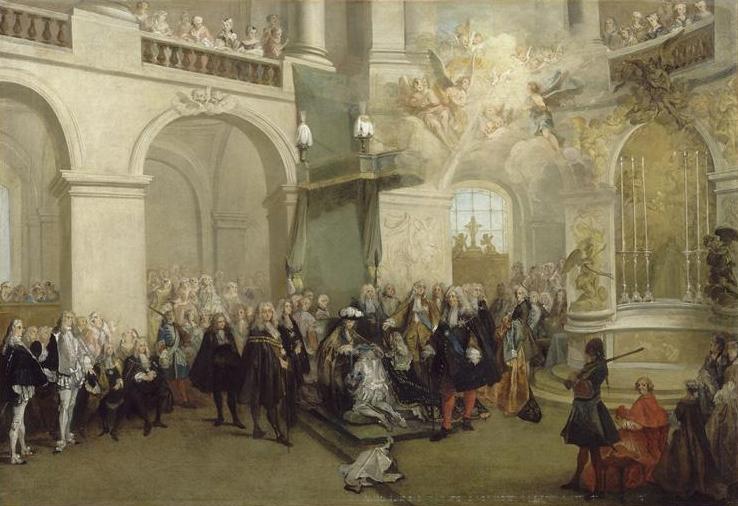
File:La remise de l'Ordre du Saint-Esprit dans la chapelle de Versailles.jpg

An investiture of the Order in the Chapel Royal at Versailles c.1724
by Nicolas Lancret
(1690-1743)


Monday, 24 January 2011

The Orders worn by King Louis XVI


After writing my post last week about King Louis XVI it occurred to me that I could, and indeed should have said something about the Orders the King is wearing in the two portraits I included in my text.

In both paintings the King is wearing the premier Order of the French Crown, the Order of the Saint-Esprit (usually rendered in English as the Order of the Holy Ghost). It was founded in 1578 by KIng Henri III, and superceded the Order of St Michael, created by King Louis XI in 1469, as the most senior Order: thereafter Knights of the Saint-Esprit automatically received the Order of St Michael. There is a website about the Saint- Esprit here It has a few unfortunate mistranslations - such as rendering the 'Order of St Michael' as 'Michaelmas' produced by the automated system used - but is illustrated and informative.

There is another site which deals with all the French royal orders here.

In the portraits the King can clearly be seen wearing the sky blue moiree riband of the Order and the breast star with its motif of the Dove. The riband was the first to be prescribed in the statutes of an order, and is the origin of the term 'cordon bleu' as asign of honour. The Order specifically commemorated King Henri's accession to the thrones of Poland on Whitsunday 1573, and to that of France on Whitsunday 1574, and hence the use of the Dove as a symbol. It also served to recall the account of the Holy Dove bringing the Sainte-Ampoulle at the baptism of Clovis in 496, and the source of the Holy Oil used at the Sacre of the King at Rheims. The design of the breast star and badge of the Order was to be copied and adapted by nmany other orders in Spain, Sicily, Sweden and Great Britain with the badge of the Military Division of the Order of the Bath, with lions and unicorns replacing the fleur-de-lys.

Examples of the black mantles embroidered with flames worn by knights of the Order on ceremonial occasions can be seen in the Louvre. In Bernard Fay's biography
Louis XVI there is a reproduction of a painting of the knights paying homage to the King. It was in his reign, in 1778, that the bicentenary of the Order was celebrated and a commemorative medallion in silver produced by P.A.F. Tardieu.

H
File:Louis16-1775.jpg

King Louis XVI aged 20 in 1775

File:LouisXVI-France1.jpg

King Louis XVI in 1786

In both portraits the king is wearing on his jacket the badge of the Order of the Golden Fleece. I assume this is from the Austrian branch of the Order, through his marriage into the Habsburg dynasty. In the second
por
trait he is wearing with it the French Military Order of St Louis, founded in 1693. The red riband of that order was copied for the Napoloeonic and later Legion d'Honneur.

The chivalric orders of the monarchy were abolished by the revolution, but restored by King Louis XVIII. Amongst the recipients in those years were Britons such as King George IV and the Duke of Wellington. After 1830 the historic Orders were not retained under the Orleanist monarchy, although ocasionally worn and bestowed by the heirs of King Charles X.

In recent decades the Order has been revived, worn and bestowed by the Dukes of Anjou in respect of their claim through descent from King Philip V of Spain. In the photograph below, which shows him and his wife the present Duke of Anjou of that line, Louis Alphonse, who would claim to be
King Louis XX can be seen wearing the riband and star of the Order, as well as a collar of the Order of Malta.
Tke Their Royal Highnesses The Duke and Duche
In
Prince Louis Alphonse and Princess Maria Margarita, Duke and Duchess of Anjou