Once I was a clever boy learning the arts of Oxford... is a quotation from the verses written by Bishop Richard Fleming (c.1385-1431) for his tomb in Lincoln Cathedral. Fleming, the founder of Lincoln College in Oxford, is the subject of my research for a D. Phil., and, like me, a son of the West Riding. I have remarked in the past that I have a deeply meaningful on-going relationship with a dead fifteenth century bishop... it was Fleming who, in effect, enabled me to come to Oxford and to learn its arts, and for that I am immensely grateful.


Showing posts with label King of Hungary. Show all posts

Friday, 30 December 2016

Coronation of King Charles IV of Hungary 1916


Today is the centenary of the coronation of  the Bl. Emperor Charles as King Charles IV of Hungary in 1916. The fact that he had received this sacramental was of enormous spiritual significance to the King and his Queen Zita, and why he refused to renounce his rights in 1921.

The ceremony, central to the traditional Hungarian concept of kingship, was both deemed to be a constitutional requirement and also, it seems, as a means of binding the new King, who had succeeded to the throne in late November, to the existing balance of political power within the realm by the Prime Minister, Count Tisza.

The history of the ceremony can be viewed at Coronation of the Hungarian monarch.

There is an account of the preparations for the 1916 coronation in Miklos Banffy's memoir The Phoenix Land and part of that is reproduced online at Coronation-of-Emperor-Karl with additional material. There is also a detailed description of the day, set within the action of a sprawling novel about a Magyar aristocratic family, in Lajos Zilahy's The Dukays.

https://upload.wikimedia.org/wikipedia/commons/thumb/8/86/Crown%2C_Sword_and_Globus_Cruciger_of_Hungary2.jpg/1200px-Crown%2C_Sword_and_Globus_Cruciger_of_Hungary2.jpg 
 The Holy Crown, Orb, Sceptre and Sword of the Hungarian Regalia

Image: Wikipedia
https://i.pinimg.com/736x/43/67/8b/43678b09850acb793b2b9382c6fa614d--emperor-karl.jpg 

Queen Zita and the Crown Prince travel to the Coronation in the State Coach  

Image: Pinterest

Image result for Coronation of Charles IV of Hungary

The King taking the Coronation oath at the foot of the Holy Trinity pillar outside the Coronation Church of St Matthias

Image: Getty Images

http://www.realnews247.com/karl_I_horseback_coronation.jpg

The King on horseback upon the hill composed of soil from every county in Hungary.
This part of the ceremonial involved the King riding up the hill and brandishing his sword to the four points of the compass to symbolise his defence of the frontiers of the kingdom - indeed the oath speaks of extending them.

Image: Monarchy Forum

https://i.pinimg.com/236x/27/dc/c0/27dcc032e33f0a3cc302654a497579d1.jpg

King Charles IV

Image: Pinterest 

http://faktor.s3.eu-central-1.amazonaws.com/thumbs/2015-12-29/4ebdbf986364cb68ca157abf78ee57b0/web650.jpg

King Charles IV, Queen Zita and Crown Prince Otto.
The King died in 1922, Queen Zita in 1989 and Otto in 2011.

Image: viktor.hu

Image result for Coronation of Charles IV of Hungary

King Charles IV wearing the Holy Crown
and mantle of St Stephen and holding the sceptre.
He was Beatified in 2004

Image:Pinterest

Film of the processions and oath taking can easily be found on YouTube 


Monday, 10 November 2014

The Crusade of Varna


A conversation with one of my students a few weeks ago reminded me that the 570th anniversary of the Crusade of Varna, which culminated in the disastrous defeat of the Polish-Hungarian army at the battle of Varna on November 10th 1444. Amongst the numerous fatalities were the twenty year old King Wladyslaw III of Poland and Hungary amd the Papal Legate, Cardinal Giuliano Cesarini.

The Crusade was an ambitious plan to rescue the remains of the Byzantine Empire from the ever advancing Turks with a Papal fleet to transfer the troops from Varna to relieve Constantinople. Like the other great Crusading venture of the period, that of Nicopolis in 1396 - for which see the accounts at Crusade of Nicopolis and Battle of Nicopolis - it ended in a catastrophe for the Christian army, and in consequence paved the way for the loss of Constantinople in 1453 and eventually the Hungarian disaster at Mohacs in 1526.

In a piece about the recent book by Colin Imber The Crusade of Varna 1443-45 (Crusade Texts in Translation 14, Ashgate) it is said that "[m]ore than any other single event, it was Murad's victory at Varna that secured Ottoman domination of the Balkan Peninsula, with consequences which are still apparent today."

There is an online account of the Crusade at Crusade of Varna and of the battle itself at Battle of Varna.
To help readers unfamiliar with the period and region to understand the tangled diplomacy and politics of the period in central Europe and the Balkans it may be useful to look at the online life of the young Polish King who led the Crusade, King Wladyslaw III, who had become King of Hungary in 1440, which can be seen at Władysław III of Poland, and it may also be helpful to look at the life of his life of his father King Wladyslaw II (Grand Duke Jagiello of Lithuania), who had united Poland and Lithuania by his first marriage to Jadwiga of Poland in 1387, which can be seen at Władysław II Jagiełło. There is an illustrated online chronology of King Wladyslaw III in Polish here.


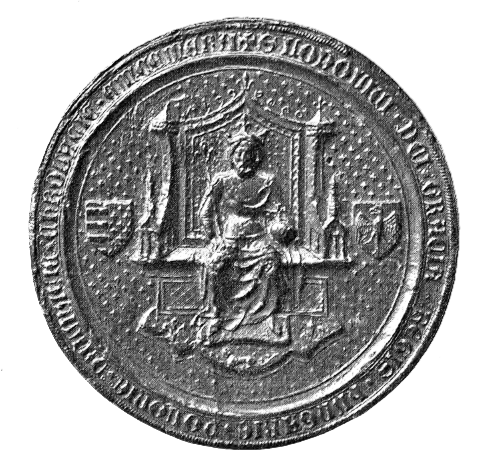
The Seal of King Wladislaw III

Image:ukrmap.su


The cenotaph to King Wladyslaw III erected in 1906 in the Wawel cathedral in Cracow

Image:modernmedievalist.blogspot.co.uk

Before I prepared this post I was unfamiliar with the story of the King's survival at Varna and of his subsequent life and marriage in Portugal, recounted in the online biography above. Such myths of the suvival of a ruler who disappears, such as those of King Harold II in England, of King Sebastian of Portugal or of King Louis XVII in Frances, or of members of the Romanov dynasty in the twentieth century, are a by no means unknown phenomemon, and point to the human desire to hope against the odds, and to create myths around young and romantic royal figures.


Thursday, 12 December 2013

The Order of the Dragon and its curious legacy


Today is the 605th anniversary of the foundation by King Sigismund of Hungary and his Queen Barbara of Cilli of the Order of the Dragon, a chivalric order designed to unite the King's supporters both to his cause and to the defence of Christendom against the Ottoman advance in south-eastern Europe.

Pisanello 024b.jpg 

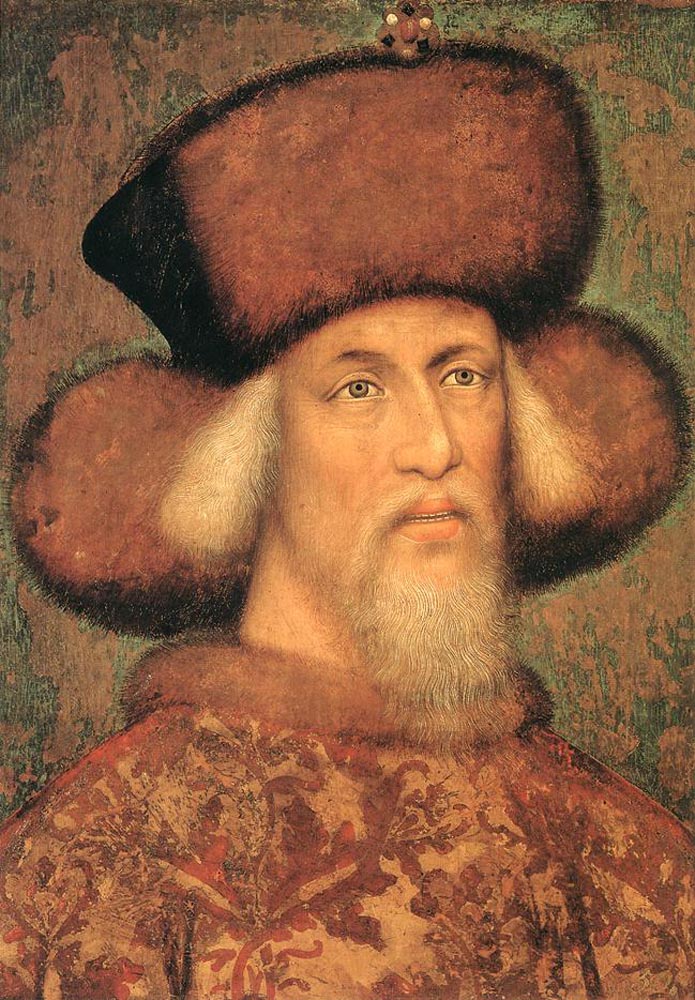
King Sigismund, about 1418
 A portrait traditionally attributed to Pisanello

Image:Wikipedia

There is a good illustrated and referenced online account of the Order here, and there is a short article about it here. There are also online biographies of King Sigismund and Queen Barbara.

When King Sigismund, King of the Romans and Emperor-Elect as well as King of Hungary, came on a state visit to King Henry V in 1416 he was admitted as a Knight of the Garter, and in return made King Henry a Knight of the Dragon - as well as giving a major relic of St George to the chapel at Windsor. This exchange of diplomatic courtesies is still recalled in the Sword of State of the City of York, which is the one which hung over King Sigismund's stall in St George's chapel Windsor, and is ornamented with the emblem of the Order of the Dragon; I posted about this and its history, with illustrations, this time last year in Emperor Sigismund.


Emblem of the Order

Image:rodoslovlje.com

Unlike the Garter, the Annunziata and the Golden Fleece, the Order of the dragon was not to have a continuous history, and seems to have declined in significance after the Emperor-King's death in 1437, and whilst surviving as Hungarian mark of distinction for the rest of the century until perhaps the disatrous battle of Mohacs in 1526, whenit became merely a memory. No attempt to revive it, as happened with some other monarchical Orders of Chivalry, such as the Order of the Elephant in denmark occurred until apparently, a refoundation at the time of the coronation of King Charle sIV in 1916.

There is, however, one curious legacy of the Order. One of the early recipients was Prince Vlad of Wallachia, whose adoption of the device led to his people referring to him in Romanaian as Dracul  (The Dragon), and yes, his son, also called Vlad, acquired the diminutive form of ... Dracula.

I found in the online article on the Order I mentioned above links to two articles about the Order and the origins of the Dracula story from the Journal of Dracula Studies - a publication to get one's teeth into - and they can be viewed and read by clicking of the highlighted numbers in the following references:


  • Rezachevici, Constantin. "From the Order of the Dragon to Dracula." Journal of Dracula Studies 1 (1999): pp 3–7. Transcriptions available online: [2] (RTF-document), [3] (Barcelona-Esoterismo-Esoterisme-Magia).
  • McNally, Raymond T. "In Search of the Lesbian Vampire: Barbara von Cilli, Le Fanu’s “Carmilla” and the Dragon Order." Journal of Dracula Studies 3 (2001). [4]

Sunday, 9 December 2012

Emperor Sigismund


Today is the 575th anniversary of the death of the Holy Roman Emperor Sigismund in 1437. Born in 1368 a younger son of the Emperor Charles IV he became King of Hungary by marriage, King of the Romans and, ultimately, Holy Roman Emperor by election and King of Bohemia by inheritance.


Emperor Sigismund

The painting is attributed to Pisanello and shows Sigismund at about the age of 50, that is about 1418.
He appears to have reqularly worn a hat of this type as he is always depicted wearing one.
Kunsthistorisches Museum Vienna

Image: Wikipedia


There is an illustrtaed online life of him here.  He played amajor part in convening and supporting the Council of Constance in 1414-18, and travelled to Spain, France and Englandin 1416 to secure the adhesion of the Iberian kingdoms to the Council and to negotiate with the government of King Charles VI of France and with King Henry V. Initially this was mediation in the wake of King Henry's success at Agincourt the previous year, but when he came  to England he entered by the Trearty of Canterbury into alliance with King Henry.He was feted in England, and the monarch's exchanged gifts and honours, including Sigismund being made a Knight of the Garter. He gave, inter alia relics of St George to the chapel of the Order at Windsor

One aim of the allaince was to pursue Church reform ahead of the electuion of a new, unquestioned, Pope. However in the autumn of the following year the English King deceided to fall in with other realms and support the elction of anew pope following on from what had been achieved in the way of reform. So it fell to Richard Fleming, by then a leading figure in the English delegation at Constance to tell Sigismund of the change in English policy. In the weeks that followed Cardinal Colonna became Pope Martin V and Richard Fleming entered the Apostolic Household.

In the summer of 1422 Fleming, bu now Bishop of Lincoln, was sent on a diplomatic mission by King henry to woo poloiticala nd miliatry support from the Elector Palatine and the three Archbishop Electors and to attend the Imperial Diet Sigismund had summoned to Nuremburg. It was whilst this was meeting that King Henry V died and Fleming returned home.

A link with Sigismund's visit in 1416 survives in York in the city's Sword of State. Granted the privilege by King Richard II of the sword and a cap of mainatence to indicate its rank as a city and county of the city, the civic authorities were given the sword by Henry Hanslap, a native of York, and canon of Windsor in 1439. Two years earlier when the Emperor Sigismund died his Garter stall at St Georges was dismanted and the sword and helm removed from the chapel, passing to the
Dean and Canons of Windsor. The Dean later gave it to one of his canons,  Hanslap, who then  presented it to his native city in 1439. The sword was redecorated in 1586, as is recorded on the blade, and has been frequently repaired.


http://mek.oszk.hu/02000/02096/html/saxon03.jpg
The Sigismund Sword 
The Dragons refer to the Order of the Dragon, founded by Sigismund as King of Hungary

Image:mek.oszk.hu

http://www.thediamondjubilee.org/sites/www.thediamondjubilee.org/files/styles/lightbox/public/LN-TQ-Apr12-Micklegate.jpg

The Sigismund Sword is presented to The Queen on her visit to York for the Royal Maundy service this year.
The Swordbearer is wearing the other distinctive piece of insignia of the City, the Cap of Maintenance

Image:thediamondjubilee.org

photo

The Sword of State, Cap of Maintenance and Mace

Image: City of York Council photostream on Flickr 


Thursday, 20 September 2012

A Regal Reliquary


Further to my recent post about King Louis I of Hungary I have found pictures of another surviving art work from the court culture of the Anjevin Kings of Hungary. It is the Reliquary shrine donated by his mother Queen Elizabeth to the Convent of the Poor Clares at Óbuda which was was founded in 1334.

Made in Paris in the second quarter of the fourteenth century it is  attributed  to Jean de Touyl. It is now in New York in the Metropolitan Museum of Art, The Cloisters (62.96)

http://home.hu.inter.net/~jekely/cl62.96.L.jpg

The front of the Reliquary

http://home.hu.inter.net/~jekely/cl62.96.AV1.jpg

The rear of the Reliquary

http://home.hu.inter.net/~jekely/zoom3.ms.jpg

Detail of the central panel

Queen Elizabeth, daughter of  King Władysław I the Elbow-high of Poland, was born in 1305, married  King Charles I Robert of Hungary in 1320, the year her father was crowned as King of a reunited Poland, and died in 1380. It was through her that her son inherited the Polish crown in 1370. There is an account of her life which can be read at  Elizabeth of Poland

http://upload.wikimedia.org/wikipedia/commons/thumb/4/4a/El%C5%BCbieta_%C5%81okietk%C3%B3wna_z_dzie%C4%87mi.JPG/476px-El%C5%BCbieta_%C5%81okietk%C3%B3wna_z_dzie%C4%87mi.JPG

Queen Elizabeth with her five sons, Charles (1321), Ladislaus (Belgrade, 1 November 1324 – 24 February 1329), Louis I of Hungary (1326–1382),Andrew, Duke of Calabria (1327–1345) and Stephen, Duke of Slavonia (1332–1354).
The two wearing crowns are presumably King Louis and Andrew as consort of Queen Joanna I of Naples
 Image Wikipedia

Monday, 10 September 2012

King Louis I of Hungary


Today is the 630th anniversary of the death in 1382 of King Louis I of Hungary and Poland, often referred to as King Louis (Lajos) the Great.

There is an illustrated online life with links of the King here  and there is one of his second wife and widow Elizabeth of Bosnia here.


The kingdoms and dependencies ruled by King Louis I after 1370

Image: Wikipedia

As a ruler he can be compared to other mid- to later fourteenth century rulers such as the Holy Roman Emperors Louis IV and Charles IV, King Edward III of England, Louis' own maternal uncle and predecessor King Casimir III the Great of Poland and Queen Margrete I of Denmark and the Union of Kalmar. All of them displayed political and diplomatic skill in advancing their territorial claims and in ruling their various kingdoms, and exercised power with style and patronage of the arts and learning.

The Angevin era  was remembered as something of a golden age and many of the national costumes for the nobility at the 1916 Coronation of Bl. King Charles IV were inspired by the Angevin era of Hungarian history.

On his death the two kingdoms went their separate ways with their inheritance by by the King's two daughters - Hungary passed to to Mary who married Sigismund of Luxemburg and Poland to her younger sister Hedwig (Jadwiga ) whose marriage to, and attendant conversion of, Jagiello of Lithuania inaugurated the Jagellonian line of Polish, and, occasionally, Hungarian Kings.

File:Ludwik Węgierski seal 1370.PNG

Great Seal as used after 1370 with the arms of Hungary and Poland flanking his throne

Image:Wikipedia

Queen Elizabeth's crown is preserved in Zadar:


Image:Wikipedia

As King he is often thought to the first European monarch known to have used Chinese porcelain tableware, as the surviving flagon known as the Fonthill vase, now in Dublin, is thought to have been his his, and thus indicates something of the court culture of these years.

File:Fonthill vase by Barthelemy Remy 1713.jpg

The Fonthill vase before the loss of its mounts, and bearing the Angevin arms

Image: Wikipedia


However the following article on the excellent Medieval Hungary blog questions the traditional link between the vase and King Louis, and associates it rather with the Angevin court in Naples of Queen Joanna II in the early fifteenth century. It shows the vase as it appears today and can be read here.


Another example of the artistic and material culture of the period, or from just before Louis' accession can be found in the British Museum.

Hungarian Crucifix of circa 1330
Image: British Museum website

The cross consists of silver plaques arranged on a wooden core. They are decorated with gilding and translucent enamels. The enamels surrounding the figure of Christ depict Christ in Majesty (at the top), the Virgin and St John the Evangelist (at each side) and the figure of Adam rising from his tomb (at the bottom). On the back are represented the Lamb of God and the four symbols of the Evangelists. Smaller quatrefoils of stylized floral motifs and birds are arranged intermittently along the arms and body of the cross.

The coat of arms of Hungary and the insignia of the Hédervári family appear around the six-sided knop at the foot of the cross. The cross may have been made to commemorate the death of Desso Hédervári whose heroic sacrifice in 1330 saved the life of King Charles I (1288-1342). Desso dressed in the king's armour, allowing Charles to escape a Romanian ambush.

The Italian character of the enamels has led to suggestions that the cross was made by a Sienese goldsmith, Peter Gallicus, who was working at the Hungarian court in the 1330s. The enamels were certainly executed by an artist with a detailed knowledge of Italian techniques.

There is an introduction, together with links, about the sculpture and applied arts of the era here.

.Another remarkable survival from this era was found during excavations in the Royal Castle at Buda, first built in its present form by King Louis' brother Stephen of Slavonia. It is an heraldic Cloth of Estate with the Hungarian Royal Arms. It dates from the later middle ages, and had survived in a waterlogged condition in a blocked well shaft. I have seen photographs of it online, but have so far been unsuccessful in finding them again.

The life and reign of King Louis the Great indicates the significance and sophistication of central Europe in the period and make one realise how interesting, if in the English speaking world unduly neglected, a subject the medieval history of the region is.

Friday, 30 December 2011

Coronation in Budapest


Today is the 95th anniversary of the coronation of the Bl. Emperor Charles as King Charles IV of Hungary in 1916. The fact that he had received this sacramental was of enormous spiritual significance to the King and his Queen Zita, and why he refused to renounce his rights in 1921.

The ceremony, central to the traditional Hungarian concept of kingship, was both deemed to be a constitutional requirement and also. it seem, as a means of binding the new King, who had succeeded to the throne in late November, to the existing balance of political pwer within the realm by the Prime Minister, Count Tisza.

There is an account of the preparations for the coronation in Miklos Banffy's memoir The Phoenix Land and there is a detailed description of the day, set within the action of a sprawling novel about a Magyar aristocratic family, in Lajos Zilahy's The Dukays.

http://www.emperorcharles.org/images/JPG%20800/cd%202/08--The%20Hungarian%20Coronation/Cat%20No%20139-12--King%20Karl%20Taking%20the%20Coronation%20Oath--Magyar.jpg

The King taking the Coronation oath

http://www.emperorcharles.org/images/JPG%20800/cd%202/08--The%20Hungarian%20Coronation/Cat%20No%20139-17--King%20Karl%20on%20the%20Coronation%20Hill--Postcard,%20.jpg

The King on horseback upon the hill composed of soil from every county in Hungary.
This part of the ceremonial involved the King riding up the hill and brandishing his sword to the four points of the compass to symbolise his defence of the frontiers of the kingdom - indeed the oath speaks of extending them.

http://www.emperorcharles.org/images/JPG%20800/cd%202/08--The%20Hungarian%20Coronation/Cat%20No%20140--The%20Hungarian%20Royal%20Family%20Enthroned-Photograph.jpg

King Charles IV, Queen Zita and Crown Prince Otto.
The King died in 1922, Queen Zita in 1989 and Otto in 2011.

http://www.emperorcharles.org/images/JPG%20800/cd%202/08--The%20Hungarian%20Coronation/Cat%20No%20150--King%20Karl%20Wearing%20the%20Crown%20of%20St.%20Stephen--Pos.jpg

King Charles IV wearing the Holy Crown
and mantle of St Stephen and holding the sceptre.

Images: The Emperor Charles League of Prayer