Once I was a clever boy learning the arts of Oxford... is a quotation from the verses written by Bishop Richard Fleming (c.1385-1431) for his tomb in Lincoln Cathedral. Fleming, the founder of Lincoln College in Oxford, is the subject of my research for a D. Phil., and, like me, a son of the West Riding. I have remarked in the past that I have a deeply meaningful on-going relationship with a dead fifteenth century bishop... it was Fleming who, in effect, enabled me to come to Oxford and to learn its arts, and for that I am immensely grateful.


Showing posts with label Diamond Jubilee. Show all posts

Sunday, 9 December 2012

Emperor Sigismund


Today is the 575th anniversary of the death of the Holy Roman Emperor Sigismund in 1437. Born in 1368 a younger son of the Emperor Charles IV he became King of Hungary by marriage, King of the Romans and, ultimately, Holy Roman Emperor by election and King of Bohemia by inheritance.
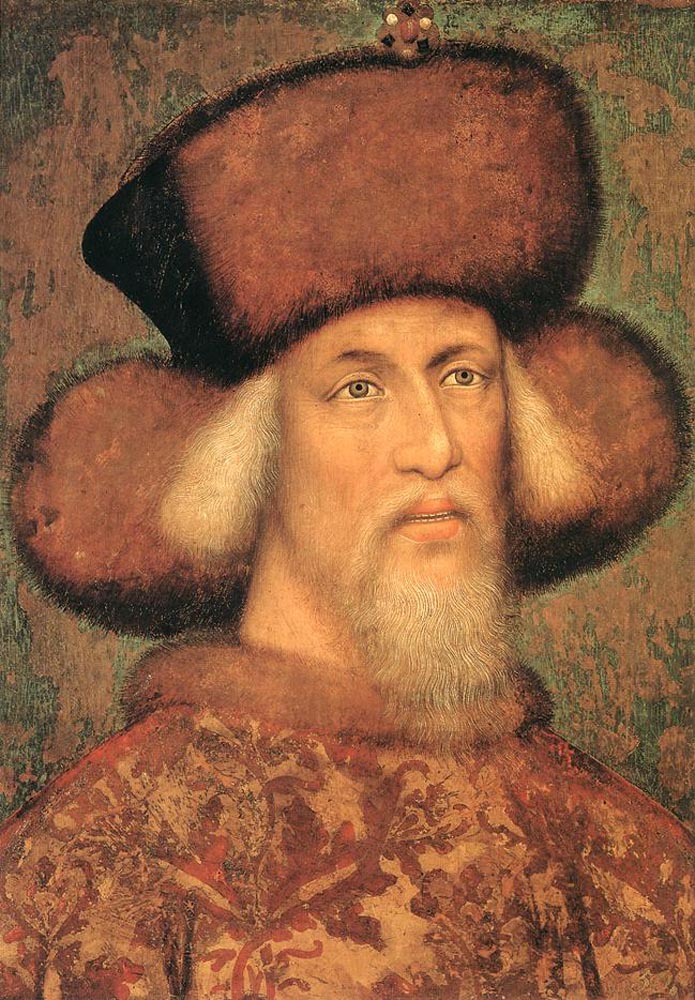


Emperor Sigismund

The painting is attributed to Pisanello and shows Sigismund at about the age of 50, that is about 1418.
He appears to have reqularly worn a hat of this type as he is always depicted wearing one.
Kunsthistorisches Museum Vienna

Image: Wikipedia


There is an illustrtaed online life of him here.  He played amajor part in convening and supporting the Council of Constance in 1414-18, and travelled to Spain, France and Englandin 1416 to secure the adhesion of the Iberian kingdoms to the Council and to negotiate with the government of King Charles VI of France and with King Henry V. Initially this was mediation in the wake of King Henry's success at Agincourt the previous year, but when he came  to England he entered by the Trearty of Canterbury into alliance with King Henry.He was feted in England, and the monarch's exchanged gifts and honours, including Sigismund being made a Knight of the Garter. He gave, inter alia relics of St George to the chapel of the Order at Windsor

One aim of the allaince was to pursue Church reform ahead of the electuion of a new, unquestioned, Pope. However in the autumn of the following year the English King deceided to fall in with other realms and support the elction of anew pope following on from what had been achieved in the way of reform. So it fell to Richard Fleming, by then a leading figure in the English delegation at Constance to tell Sigismund of the change in English policy. In the weeks that followed Cardinal Colonna became Pope Martin V and Richard Fleming entered the Apostolic Household.

In the summer of 1422 Fleming, bu now Bishop of Lincoln, was sent on a diplomatic mission by King henry to woo poloiticala nd miliatry support from the Elector Palatine and the three Archbishop Electors and to attend the Imperial Diet Sigismund had summoned to Nuremburg. It was whilst this was meeting that King Henry V died and Fleming returned home.

A link with Sigismund's visit in 1416 survives in York in the city's Sword of State. Granted the privilege by King Richard II of the sword and a cap of mainatence to indicate its rank as a city and county of the city, the civic authorities were given the sword by Henry Hanslap, a native of York, and canon of Windsor in 1439. Two years earlier when the Emperor Sigismund died his Garter stall at St Georges was dismanted and the sword and helm removed from the chapel, passing to the
Dean and Canons of Windsor. The Dean later gave it to one of his canons,  Hanslap, who then  presented it to his native city in 1439. The sword was redecorated in 1586, as is recorded on the blade, and has been frequently repaired.


http://mek.oszk.hu/02000/02096/html/saxon03.jpg
The Sigismund Sword 
The Dragons refer to the Order of the Dragon, founded by Sigismund as King of Hungary

Image:mek.oszk.hu

http://www.thediamondjubilee.org/sites/www.thediamondjubilee.org/files/styles/lightbox/public/LN-TQ-Apr12-Micklegate.jpg

The Sigismund Sword is presented to The Queen on her visit to York for the Royal Maundy service this year.
The Swordbearer is wearing the other distinctive piece of insignia of the City, the Cap of Maintenance

Image:thediamondjubilee.org

photo

The Sword of State, Cap of Maintenance and Mace

Image: City of York Council photostream on Flickr 


Tuesday, 5 June 2012

Jubilee celebrations - style and substance


The celebrations today in London to mark the Diamond Jubilee all appeared to go very well to this Oxford based television viewer - even the weather just about managed to behave until the conclusion.

Here are a few of my own reflections on today's ceremonial and images.

The form of today's events must refect the Queen's own choices - and may indeed reflect the fact that she and Prince Philip are ten years older.

Unlike the state ceremonial of a Coronation or the State Opening of Parliament Jubilees are not pre-determined in their form - Queen Victoria's two celebrations in 1887 and 1897 were significantly different from each other in charcter and location. In 1977 there were clear links to that of King George V in 1935 - even the commemorative stamps followed the same design - and a very similar format was followed in 2002. This Diamond Jubilee was organised in a rather different way.

The river pageant, a joyeuse entree by water meant that more could be done and seen by people, and afforded th eopportunity to send out more images. This was clearly seen to be the day for the male members of the Royal family to wear service dress and decorations. I rather regret they did not for the service today at St Pauls, as had been the case in 1935, 1977 and 2002.

Similarly I also rather regret the decision not to use the State Coach and other carriages for the journey to St Pauls, which we saw in 1977 and 2002 - but not in 1935. I doubt if this use of cars was conscious restraint as much as a practical decision concerned with the logistics of moving men and horses as well as historic vehicles. Nonetheless I think it did perhaps reduce the splendour of that part of the day.

It fell to the Heralds to provide ceremonial colour alongside the copes of the clergy and the robes of the Lord Mayor.The wearing of morning dress by the Princes made it a more subdued if elegant service - reminiscent of the services to mark the Queen and Prince Philip's wedding anniversary, and this may have been the idea - the service appeared more private and reflective than overtly celebratory.


The scene inside St Paul's Cathedral for the Jubilee thanksgiving service

Image: Daily Telegraph/ Murray Sanders/Daily Mail/PA Wire


The service itself was better than that in 2002 and it seemjed to me taht there were far clearer references to the traditional language of the Book of Common Prayer - 350 years old this year - and perhaps reflecting not only Royal preferences but the influence of the Bishop of London. The sermon was certainly better than Archbishop Coggan's in 1977 and for once Archbishop Williams was clear in what he was saying, although I think he had confused the then Princess Elizabeth's radio broadcast on her 21sth birthday in 1947 from South Africa with her accession in Kenya in 1952.

The television coverage at St Pauls was good, using the architecture to effects, and unlike the 1977 obsession with the camera in the top of the dome.

The Lord Mayor of London was there with the pearl sword, and entertained the Queen at the Mansion House afterwards but I wonder if there was a perhaps a conscious decison to keep "the City" at a distance in the wake of the financial crises. Thus it was not a lunch a Guildhall afterwards, but a return to Westminster for the Queen and the closer members of the Royal family - Guildhall hosted other distinguished visitors, but not before the eyes of the camera. The emphasis on the charitable works of the ancient Companies of London again stressed the links between the Crown and the City, but kept the modern City in the background. in any case  Westminster Hall is a a very suitable historic setting for such a luncheon - carrying on the tradition of Coronation banquets there from 1100 until 1821.

There was the the opportunity for a carriage procession for the return to Buckingham Palace.

 The Queen leaves Westminster Hall at the Palace of Westminster in the 1902 State Landau

The carriage procession in Whitehall
Image:Daily Telegraph/Reuters/Ki Price


The Queen, the Prince of Wales and the Duchess of Cornwall, the Duke and Duchess of Cambridge and Prince Harry. An estimated one and a half million people lined The Mall below. As the Band of the Irish Guards played the National Anthem, a celebratory cascade of rifle fire, the feu de joie, was volleyed, for only the second time during her reign – the first was for her 80th birthday in 2006.

Image: Daily Telegraph/David Jones/PA Wire

Something which was also being made clear was the hierarchy within the Royal family. More so than on previous occasions there was a sharper focus, differentiating the Prince of Wales and the immediate line of succession - who were the only members of the Royal family to appear with the Queen on the Palace balcony - from the other children of the Queen and prince Philip, and with the Royal cousins forming a third group. The Queen was clearly emphasising the future with the next three ion line to the throne - this was dynasty rather than family in its message.


http://i.telegraph.co.uk/multimedia/archive/02240/balcony_2240170c.jpg

Image: Daily Telegraph


Monday, 4 June 2012

A Jubilee beacon at Pontefract


On the BBC News following the Jubilee concert the reports on the celebrations included on eon the beacons lit across the United Kingdom and the Commonwealth to mark the Diamond Jubilee - over 4,000, twice the number the organisers had originally envisaged. The news report featured the beacon on the top of what remains of the keep at Pontefract castle, that is in my home town. It was not just that fact of local pride but the suitability of Pontefract that struck me.

In the sieges of 1644 and 1645 the Royalist garrison of the castle used baconds on the top of the Round Tower - that is the keep - to signal to their fellow Royalists at York and at Sandal castle. In the history of the monarchy it is the last siege of Pontefract in 1648-49 that is most significant as can be seen from my post from last year Post Mortem Patris Pro Filio.

This was just one more of the many links that bind the history of Pontefract, and particularly the castle, into the history of the monarchy, and vice versa. In the middle ages and down to the seventeenth century it was often a violent and sensational story but one that fired my imagination for the history of the period, and for the study of both castles and crowns. As part of the local celebrations of the Silver Jubilee in 1977 I gave a talk on the town's links with the Crown -it was one of those lectures I meant to write up and publish, but never have done.

Pretty awesome


I saw part of the Jubilee Pop Concert on television this evening. Now I must admit that it was not necessarily the type of music I might be too keen on myself, and dare I suggest, maybe not Her Majesty's either, but that is not the point.

The point is that which stared you in the face - here was the Queen Victoria memorial turned into the setting for a pop concert, staged with panache and style for hundreds of thousands of people in the heart of London - and they definitely seemed to be enjoying it. The televison coverage was, unlike the Thames pageant, striking and impressive, using both the immediate setting and some very spectacular aerial views of the capital.

Here one could see virtually all the Royal family, the Archbishop of Canterbury, the Prime Minister and the Chancellor of Oxford University sitting in their own front row seats at a pop concert - not something you see frequently let's be honest. The distinguished guests could sit back and watch a different type of spectacle than that they are usually associated with.

In sum here one saw an institution well over a thousand years old quite able to sit comfortably alongside the inevitably transitory world of popular music. It conveyed a genuine, widespread popular sense of rejoicing around The Queen and her family. No mean achievement, and really, pretty awesome.


Jubilee river pageant


I watched most of the Jubilee River pageant yesterday on television. I think some of the criticism today of the coverage by the BBC can perhaps be expalined by the fact that this was an event they had little expereince of covering, and there was not the imaginative camera work that could convey the sweep of the Thames and the flotilla passing along it. The almost chat-show format was not very good, and again, I think, probably stemmed from not having precedents to draw upon for linking studio and outside  broadcast.

That said the pageant itself appeared very fine, and a spectacle that, despite the weather, drew the crowds, and showed how the river flowing through the heat of the capital could be used to great effect on occasions like this.

http://www.usmagazine.com/uploads/assets/article_photos/river-jubilee-2-467.jpg

Image:usmagazine.com


The Queen and the Duke of Edinburgh watched the river pageant from aboard the Spirit of Chartwell. The royal barge is actually a luxury Thames river cruiser which was refurbished for the Jubilee, incorporating ornate gold prow sculptures and a gold-coloured canopy atop splendid red upholstery. The design was inspired by the idea of a diamond on a red cushion, with the Queen as its centrepiece. The barge was enhanced by hundreds of flowers from the Queen’s garden.

Image: Daily Telegraph/John Stillwell/AFP/Getty Images
 

I had a somehat more particular interest in the decoration of The Spirit of Chartwell - much of it was the work of a colleague at the Christ Church Picture Gallery here in Oxford who is also a tutor in gilding at the City and Guilds College in London. She had gilded the prow of the vessel, the plaques on the side and also made, painted and gilded the four cartouches with the national plant badges affixed to the corners of the canopy on the top deck. Another tutor at City and Guilds and his studens did the gilding of the Gloriana.

http://img.ibtimes.com/www/data/images/full/2012/04/13/261915-a-city-and-guilds-student-works-on-one-of-the-decoration-for-the-diamo.jpg

One of the students putting finishing touches to the gilding of the prow.

Image:ibtimes.com

Splendour: The royal barge 'Spirit of Chartwell' carrying the Queen cruises down the River Thames during the Diamond Jubilee Pageant


The prow of the boat during the pageant
Image: Daily Mail/AFP/Getty Images

There are more illustrations of the pageant in this newspaper report which can be read here.


Celebrating the Jubilee at the Oxford Oratory


Yesterday morning we held our celebration of the Diamond Jubilee at the Oxford Oratory.

The Mass setting was Mozart's Coronation Mass (composed, as I understand it, for the coronation of a statue of Our Lady and not for that of one of the Habsburgs), the offertory anthem was Parry's I Was Glad, composed for the coronation of King Edward VII in 1902, and the organist played Walton's Crown Imperial from 1937 as the voluntary at the conclusion, following the Domine Salvam Fac Reginam - a new setting of the piece by Edward de Rivera, the Director of Music.

There was a really splendid sermon about the Queen and vocation given by the Provost, Fr Daniel Seward, and following the Mass we joined with St Giles church for a joint parish party in their hall across on the other side of Woodstock Road. It was a good occasion to celebrate the ties we all had in common. Over the quiche and sausage rolls, not to mention the meringues, I found myself talking to a French student I know here in Oxford about the relative claims and merits of King Henri VII and King Louis XX to tbe the occupant of the throne of France. Well, I would, would n't I?

There is a report and some pictures of the party as well as the text of Fr Daniel's sermon in the post Diamond Jubilee Celebrations from the Oratory website.

Saturday, 2 June 2012

The Coronation on film


Looking around on the internet for colour pictures of the Coronation I found a number in an article about the issue on DVD of the 1953 documentary film A Queen is Crowned. Written by Christopher Fry and narrated by Sir Lawrence Olivier it has now been restored and reissued to mark the Diamond Jubilee. Although the television coverage of the Coronation was a landmark in broadcasting history it was, inevitably, only in black-and white. This film, however, is in colour and, as I recall it, a stylish record of the day.

Here is a still photograph from the film of the homage of the Archbishop of Canterbury and the Bishops:

Unique: The Queen's 1953 Coronation was the first ever to be televised

Image: Daily Mail/ITV/RexFeatures 


The article about the film, with several other photographs can be read here.


Coronation Day


Today is the anniversary of the Coronation of H M The Queen in 1953.

There will doubtless be specific commemorations next year on the sixtieth anniversary, but in so far as the Coronation and all that it conveys and symbolises lies, as it does, at the very heart of the Monarchy, then it is a very appropriate event to recall this Jubilee weekend. This, and not the lesser doings of day to day governance and the popular interest in the lives of the Royal Family, is what the Monarchy is about - providing a structure of Christian rulership that is mediated by ecclesiastical sanction, fundamental ties of loyalty, the maintenance of the rule of law and the sustaining of the national community in time and space.


http://www.vam.ac.uk/users/sites/default/files/2006al1129_cecil_beaton_coronation_robes1.jpg


The Queen on her Coronation Day.
The defining photograph by Cecil Beaton.

Image: vam.ac.uk


http://news.sky.com/sky-news/content/StaticFile/jpg/2007/Sep/Week2/1585047.jpg

The Duke of Edinburgh pays homage
Image:sky.news.com


Friday, 1 June 2012

Joining in the Jubilee


As the main weekend of Jubilee celebrations has approached it has been impressive to see ever more shops, pubs, houses and public spaces being decked out with Union flags and bunting and stylish shop window displays with books and commemorative items, often with affectionate humour involved in their design and display. 

This suggests a quiet and very typically understated British way of celebrating such events as Jubilees and Royal Weddings - we slightly surpise ourselves at our patriotic display and enthusiasm, but keep it within the best of decorum and dignity - very like the Monarch and Monarchy we are celebrating.

Therein is part of the key - this celebration is about us as well as about Her Majesty, because we sense that somehow we are part of this rather mysterious institution that we periodically realise is not just how to choose a head of state, but incorporates our history and institutions, our identity and personality. The Monarchy is not just a family and a way of governing, it is also us. When we say Britain, or rather  the United Kingdom, is a Monarchy we actually mean something much more than the presence of the Monarch and her family - we are speaking of ourselves as a national community.

No doubt some at least of the bunting and flags will stay in place to encourage UK competitors at the Olympics. However, and I hope the London 2012 people will not be too upset by my saying this, I doubt if people feel for the Olympics what they sense about the Queen and her Jubilee. Yes, we may well, ironically, become couch potatoes and watch the competitions, but, let's be honest, for all the popularist hype, the Olympics are, of their very nature, infinitely more eliteist than the Jubilee - and who had heard of anyone organising a street-party to mark them?

http://aldbourne.net/graphics/community/uploads/union_jack_bunting_500.jpg 
Image:aldbourne.net

Wednesday, 30 May 2012

Queen Victoria goes online


The Bodleian Library has announced a joint venture with the Royal Archives at Windsor to make Queen Victoria's complete journals available online.

There is an account of the project and the material being made available which can be read at HM the Queen launches online resource of all Queen Victoria's Journals. 


Saturday, 19 May 2012

The Queen's Jubilee Lunch


Yesterday the Queen gave a luncheon party to celbrate her Diamond Jubilee for her fellow monarchs, their consorts or represntitives from around the world at Windsor Castle. Such a gathering is almost without precedent. In the evening the Prince of Wales was host for adinner for most of the guests at Buckingham Palace

Sovereign Monarchs Jubilee lunch

The Sovereign Monarchs Jubilee lunch, in the Grand Reception Room at Windsor Castle.
Front row, from left The Emperor of Japan, the Queen of the Netherlands, the Queen of Denmark, the King of the Hellenes, the King of Romania, the Queen, the King of Bulgarians, the Sultan of Brunei, the King of Sweden, the King of Swaziland, and Prince Hans-Adam II of Liechtenstein. Middle row, from left The Prince of Monaco, the Grand Duke of Luxembourg, the King of Lesotho, the King of the Belgians, the King of Norway, the Emir of Qatar, the King of Jordan, the King of Bahrain, and the Yang di-Pertuan Agong of Malaysia. Back row, from left Nasser Mohamed Al-Jaber Al-Sabah of Kuwait, the Crown Prince of Abu Dhabi, the Crown Prince of Yugoslavia, the King of Tonga, the Crown Prince of Thailand, Princess Lalla Meryem of Morocco and Prince Mohammed bin Nawaf bin Abdulaziz Al Saud of Saudi Arabia  
Image: PA/Daily Telegraph

What I was particularly impressed by was the presence of the Kings of Romania, of the Bulgarians and of the Hellenes, and of the Crown Prince of Yugoslavia. Although such unfortunately exiled or dethroned Monarchs have been invited to Royal weddings and to private occasions as relatives it is virtually unprecedented for them to be accorded their rightful dignity as Sovereigns, and indeed the public precedence they enjoy by reason of their length of reign. In this respect the British Establishment has been less generous than other European monarchies in the past, and really ever since 1918. This is a very welcome change.

There were various absentees amongst the non-regnant dynasties, but the pattern does appear to have been adjusted.


Monday, 6 February 2012

February 1952 remembered


Here are two online articles describing the events around the death of King George VI and the accession of Queen Elizabeth II sixty years ago today.

The first is from the Sunday Telegraph and is a series of extracts from autobiographies and memoirs and can be read here.

The other is from today's internet:'The King Is Dead': How Princess Elizabeth and the nation heard of the monarch's passing

Accession Day service


To mark the Diamond Jubilee the Clever Boy betook himself to one of his old haunts, Pusey House, which was marking the day with Sung Evensong as laid down in the Book of Common Prayer for the anniversary of the Monarch's accession.

This was a well attended and suitably splendid occasion in the main chapel of the House and presided over by the Principal, resplendent in his Convocation habit as Bishop of Ebbsfleet. The Te Deum was sung solemnly, complete with a 360 of the thurible on cue at "Thou art the King of Glory..."

The text of the service is a fine example of the tradition of state prayers in the Anglican tradition and expresses in elevated language those human aspirations for good governance that are so well served by monarchy as a system and so lacking in other forms of government.

Afterwards there was a reception under the watchful eye of a portrait of Her Majesty against the backdrop of a draped Union Jack, and the display of a chasuble and stole made from the blue and gold hangings used in Westminster Abbey at the coronation of her parents.

It was a good occasion, in both senses, on which to meet up with old friends from the House, St Barnabas and St Thomas'.

This is the prayer composed for the Jubilee which was used at the service:

God of time and eternity
whose Son reigns as servant, not master;
we give you thanks and praise
that you have blessed this Nation, the Realms and
Territories
with ELIZABETH,
our beloved and glorious Queen.
In this year of Jubilee,
grant her your gifts of love and joy and peace
as she continues in faithful obedience to you, her Lord
and God
and in devoted service to her lands and peoples,
and those of the Commonwealth,
now and all the days of her life;
through Jesus Christ our Lord.
Amen.


Joining a select monarchical club


With her Diamond Jubilee The Queen joins a select monarchical club of monarchs who have reigned for sixty and more years - indeed she has been in relatively select company of her predecessors since her Golden Jubilee having long since passed Queen Elizabeth I, and then, in turn, King Edward III, King Henry III, King James VI and King George III.

How many belong to the 60+ group amongst monarchs? Well it is easy to think of Queen Victoria (63 years 216 days), Emperor Francis Joseph (67 years 355 days) and King Louis XIV ( 72 years 110 days ) , and to think of the King of Thailand who succeeded to the throne in 1946, or famous figures from the distant past such as Pharoah Ramesses II , 1279-1213 BC (66 years and two months).

A quick look on line produces others amongst the sovereigns of Europe and the princes of the Empire and medieval France - including Eleanor of Aquitaine's 66 years and 358 days as Duchess (never mind being Queen of France and then of England...) and includes King James I of Aragon 1213-1276 (62 years 319 days), King Ferdinand III ( I of the Two Sicilies) of Sicily 1759-1825 ( 65 years 90 days) , King Friedrich August I (III) of Saxony 1763-1827 ( 63 years 139 days) and Prince Johann II of Liechtenstein 1858-1929 (70 years 91 days).

Asia and Africa yields even greater examples of longevity, the record being held by the King of Swaziland who reigned from 1899 until 1982. That would, however, have been exceeded by Otto of Austria who, had he been free to exercise his legitimate rights as Emperror Otto I and King Otto II, and had not voluntarily abdicated them due to age, can be deemed to have reigned from his father's death in 1922 until his death last year - over 89 years.

To find a complete list of monarchs with reigns exceeding fify years look at the article here.

The Diamond Jubilee


Today is the sixtieth anniversary of the accession of Her Majesty The Queen to the throne, and an occasion to express loyalty, gratitude and appreciation to her on this very significant anniversary and achievement.


Official Diamond Jubilee portrait of The Queen

The Queen's Diamond Jubilee Message

Today, as I mark 60 years as your Queen, I am writing to thank you for the wonderful support and encouragement that you have given to me and Prince Philip over these years and to tell you how deeply moved we have been to receive so many kind messages about the Diamond Jubilee.

In this special year, as I dedicate myself anew to your service, I hope we will all be reminded of the power of togetherness and the convening strength of family, friendship and good neighbourliness, examples of which I have been fortunate to see throughout my reign and which my family and I look forward to seeing in many forms as we travel throughout the United Kingdom and the wider Commonwealth.


I hope also that this Jubilee year will be a time to give thanks for the great advances that have been made since 1952 and to look forward to the future with clear head and warm heart as we join together in our celebrations.


I send my sincere good wishes to you all.


ELIZABETH R.

Long may she reign!

Image and message text from thre British Monarchy website

Thursday, 24 November 2011

Praying for The Queen


I was pleased to see the following announcement from the Bishops of England and Wales:

The Bishops’ Conference requests that on the Solemnity of the Most Holy Trinity, Sunday 3 June 2012, each parish will celebrate a Mass with prayers to commemorate the Diamond Jubilee of Her Majesty Queen Elizabeth II. During this Mass, the first reading is replaced by 1 Kings 3:11–14 and the Prayer for the Queen, which has been approved by the Bishops, is used after the Post Communion Prayer and before the Final Blessing.

Prayer for the Queen

V. O Lord, save Elizabeth, our Queen.
R. And hear us on the day we call upon you.

V. O Lord, hear my prayer.
R. And let my cry come before you.

V. The Lord be with you.
R. And with your spirit.

Almighty God, we pray,
that your servant Elizabeth, our Queen,
who, by your providence has received the governance of this realm,
may continue to grow in every virtue,
that, imbued with your heavenly grace,
she may be preserved from all that is harmful and evil
and, being blessed with your favour
may, with her consort and the royal family,
come at last into your presence,
through Christ who is the way, the truth and the life
and who lives and reigns with you
in the unity of the Holy Spirit, God,
for ever and ever.
Amen

Image: LMS Chairman blog

As the LMS Chairman has pointed out the Domine salvum /salvam fac* has been prayed for the monarch since at least 1815. It was dropped in 1964, the Bishops requesting that prayers for ther Sovereign be included in the Bidding prayers instead - though one suspects that, as in the Church of England, this is more observed in the breach than in the observance.

Under the Use of Sarum the King's name was entered in the Canon after that of the Pope and Bishop ( given there was a silent recitation of the Canon that could have avoided problems in the Wars of the Roses) and the King's name was prominent in the Canon as translated in the 1549 Prayer Book, but it disappeared in 1552 and subsequent reissues. On the continent the use of the monarch's name in the canon also survived in use. This is surely a point where the Ordinarite can set a good example or maintain the Book of Common Prayer state prayers.

Reviving the Domine salvam fac for the Jubilee is fine, but why should not parishes say it as a devotion every Sunday? Why indeed should not the laity recite it as a private devotion? I do - and have done for a while.

* Salvum for a King, salvam for a Queen