Once I was a clever boy learning the arts of Oxford... is a quotation from the verses written by Bishop Richard Fleming (c.1385-1431) for his tomb in Lincoln Cathedral. Fleming, the founder of Lincoln College in Oxford, is the subject of my research for a D. Phil., and, like me, a son of the West Riding. I have remarked in the past that I have a deeply meaningful on-going relationship with a dead fifteenth century bishop... it was Fleming who, in effect, enabled me to come to Oxford and to learn its arts, and for that I am immensely grateful.


Showing posts with label Bishop Richard Fleming. Show all posts

Wednesday, 8 October 2025

The Rite of Blessing Portable Altars


I chanced upon a video of Cardinal Raymond Burke blessing a number of portable altar stones. As the video says this is a rite rarely seen by the faithful. I had not witnessed it although I had  read a description of the ceremonial. Some years ago I did witness the rite of consecrating a fixed altar by the then Archbishop Nichols at the Oxford Chaplaincy, and the two ceremonies are, naturally, essentially the same, but with some obvious visual and ceremonial differences.

The Catholic Encyclopaedia has an entry about such movable altar stones at CATHOLIC ENCYCLOPEDIA: Portable Altar

Portable alter stones have a long history. The earliest example I have seen is from among the relics of St Cuthbert at Durham Cathedral and is, I assume,  one he travelled with as a bishop and may have had in his last days in his retreat on Inner Farne. An amazing survival and a precious link with a great and saintly figure from the seventh century.

I first looked into this topic in connection with my research into the life of Bishop Richard Fleming. Following his consecration in Florence as a bishop by Pope Martin V in 1420 he obtained an indult for his brother Robert  and his wife to have a portable altar for domestic use. I am tempted to think that maybe one of Richard Fleming’s first episcopal actions was to consecrate such an altar stone for his brother and sister-in-law.

The video with Cardinal Burke can be seen at The Rare Catholic Ritual You’ve Never Seen Before


Sunday, 26 January 2025

Sta Maria Novella in Florence


Recently I came upon a video about the great Dominican church of Sta Maria Novella in Florence. It can be seen at Santa Maria Novella - Florence - Churches and Museums - Virtual Walk 

The Wikipedia account of the church is detailed and can be seen at Santa Maria Novella

Despite its Renaissance facade the building is late medieval Florentine gothic. Inside it is  decorated with many works by major artists of the early generations of later fourteenth and fifteenth century Florence. 

It was at this time that Sta Maria Novella was of great importance not just as the Dominican church in so important a centre as Florence, but as the administrative centre of the Catholic Church. From 1418-20 the newly elected Pope Martin V resided in a hastily constructed palace attached the north east of the church. This was a lengthy pause on his journey to Rome. This Papal building now serves as the provincial police academy. 

One of the people who either lived with the Pope or must have frequented the palace was Richard Fleming, who had been appointed as a Chamberlain to the new Pope immediately upon his election in 1417 at Constance. It was doubtless here that in 1420 Pope Martin “with wonderful piety”, as Fleming was to recall it later when he wrote his own epitaph, consecrated as a bishop on his appointment to the diocese of Lincoln. 

Amongst the paintings in the church is the famous fresco by Andrea di Bonaiuto da Firenze which is sometimes termed The Triumph of the Church but is more accurately The Allegory of the Active and Triumpthant Church and o the Dominican Order. This was painted in 1365-7. It must have been seen by Richard Fleming when he was in residence at Sta Maria Novella.

In addition to the figures mentioned in the main Wikipedia article it includes in the foreground a young man wearing the Garter of a Knight of the Order, and thought to be the earliest representation of the insignia. Given the date of the work the most likely candidate must be Lionel of Antwerp, first Duke of Clarence, who married a Visconti and died soon after in Italy in 1368.

Regular readers of this blog will recognise that part of the painting forms the masthead at the beginning.


Image:  Wikipedia

Friday, 24 January 2025

Robert Waterton


Last Friday was the six hundredth anniversary of the death at his manor house at Methley in the West Riding of Yorkshire of Robert Waterton. His splendid tomb, together with that of his second wife, remains as one of the great treasures of the church at Methley.

<span class=prefix>Sir</span> Robert Waterton
 
The tomb of Robert and Cicely Waterton in Methley Church 

Image: John Kirk on Find a Grave

Waterton, born sometime in the 1360s at Waterton in the north-west of Lincolnshire, was a member of a family whose lives and careers were shaped by service to the house of Lancaster. Although there is some uncertainty about the exact family relationships, and confusion in older works as to the number of Robert’s marriages, such that he has been identified as being both a father and a non-existent son, his life is otherwise well documented in the surviving records of the Crown and the Duchy of Lancaster. 

He seems to have been especially close to the future King Henry IV and in July 1399, together with two hundred foresters, met the returning Duke of Lancaster at Spurn Point, thus participating from the very beginning in the rising which rapidly unseated King Richard II.

Following the accession of King Henry IV Waterton as Steward of the Honour of Pontefract was probably one of the few people who knew with certainty the fate of the former king in Pontefract Castle. He was to be prominent in King Henry’s suppression of revolts against him. and a trusted and close counsellor, serving as Master of the Horse. His effigy suggests he cultivated his beard to resemble that of his master.

Although credited by Shakespeare as being a knight in “Richard II” he never received the accolade and was never more than an esquire, despite his wide ranging influence and responsibilities.Having had custody at Pontefract of the captive boy King James I of Scots he was to serve King Henry V as the custodian, at various times in the next decade in the same castle or his own house at Methley of numerous prisoners taken at Agincourt. These included the most prestigious of all Charles Duke of Orleans, the Duke of Bourbon, Arthur of Richmond, later Constable of France and Duke  of Brittany, and Marshal Boucicault, who died at Methley in 1421. Even though the King worried at times about their security he clearly trusted Waterton, and they maintained a correspondence that survives in part. The Waterton household appears to have been cultivated and affluent in these years, and based in Robert’s newly built Methley Hall. The social standing and cultured chivalric interests of his illustrious ‘guests’ must have made it an interesting community.

Waterton’s second wife, Cecily, was the sister of “my” Bishop Richard Fleming, whose earlier career Waterton clearly assisted. 

In many ways I feel Robert Waterton has been a constant companion to me since I was a schoolboy forming an interest in the later medieval period. It was therefore a privilege to advocate his inclusion, and to write the entry for him in the Oxford Dictionary of National Biography published in 2004.

If you have online access to the ONDB I would recommend you to read my article, although unfortunately it harder to be edited down from what I had originally submitted.

There is an excellent account of him also by Dr Sarah Rose which pay particular attention to his role as a custodian of French prisoners and also the child Richard Duke of York for King Henry V. That can be read at Robert Waterton and Henry V Summary The ... - Lancaster EPrints

Wikipedia has a biography of Waterton which is useful but it perpetuate the mistake but split him into two differentindividuals. It can be seen at Robert Waterton

The church at Methley deserves to be better known for its collection of tombs; in addition to that of Waterton and his wife that is that of their daughter and son-in-law Lord Welles, who by his second marriage was to become the stepfather of Lady Margaret Beaufort, as well as of the Savile family who have owned the estate since the late sixteenth century.

Robert Waterton is a quintessential example of a Lancastrian retainer from the time of John of Gaunt and King Henry IV. In succeeding generations his son-in-law. grandson and great grandson and at least one other relative died violent deaths in the service of the Lancastrian dynasty. Such was the bond of service the Lancastrians could command.

As the inscription on the tomb requests:

Pray for the soul of Robert Waterton & Cecily  his wife,
That God will take to his kingdom their poor & endless life


Friday, 6 January 2017

Surge illuminare


" Surge illuminare"  - Rise your light has come [Isaiah 60 v.1] - is a text traditionally used at the feast of the Epiphany and provided the text for the first sermon preached by Richard Fleming as a member of the English delegation before the Council of Constance on this day seven centuries ago in 1417.

council of constance


Meeting of scholars, bishops, cardinals and Pope John XXIII (antipope) in the cathedral of Constance i.e. before John's deposition in May 1415.


Image:indianapublicmedia.org/Fb78 (wikipedia)

Chronicle of the Council of Constance [1414-1418] by Ulrich Riechental, Fol. 007r, c.1470s

A procession of clergy and religious at the Council of Constance
From the Chronicle of Ulrich von Reichental ( MS of c.1470)

Image: Pinterest


At that stage in the Council celebrating the liturgy and listening to sermons whilst they manoevered behind the scenes appears to have been th emain occupation of the Council Fathers. For Fleming this was his first, but by no means his last as a preacher in the cathedral. 

There is an account of the building in which the Council met and of its subsequent development and history at Konstanz Minster

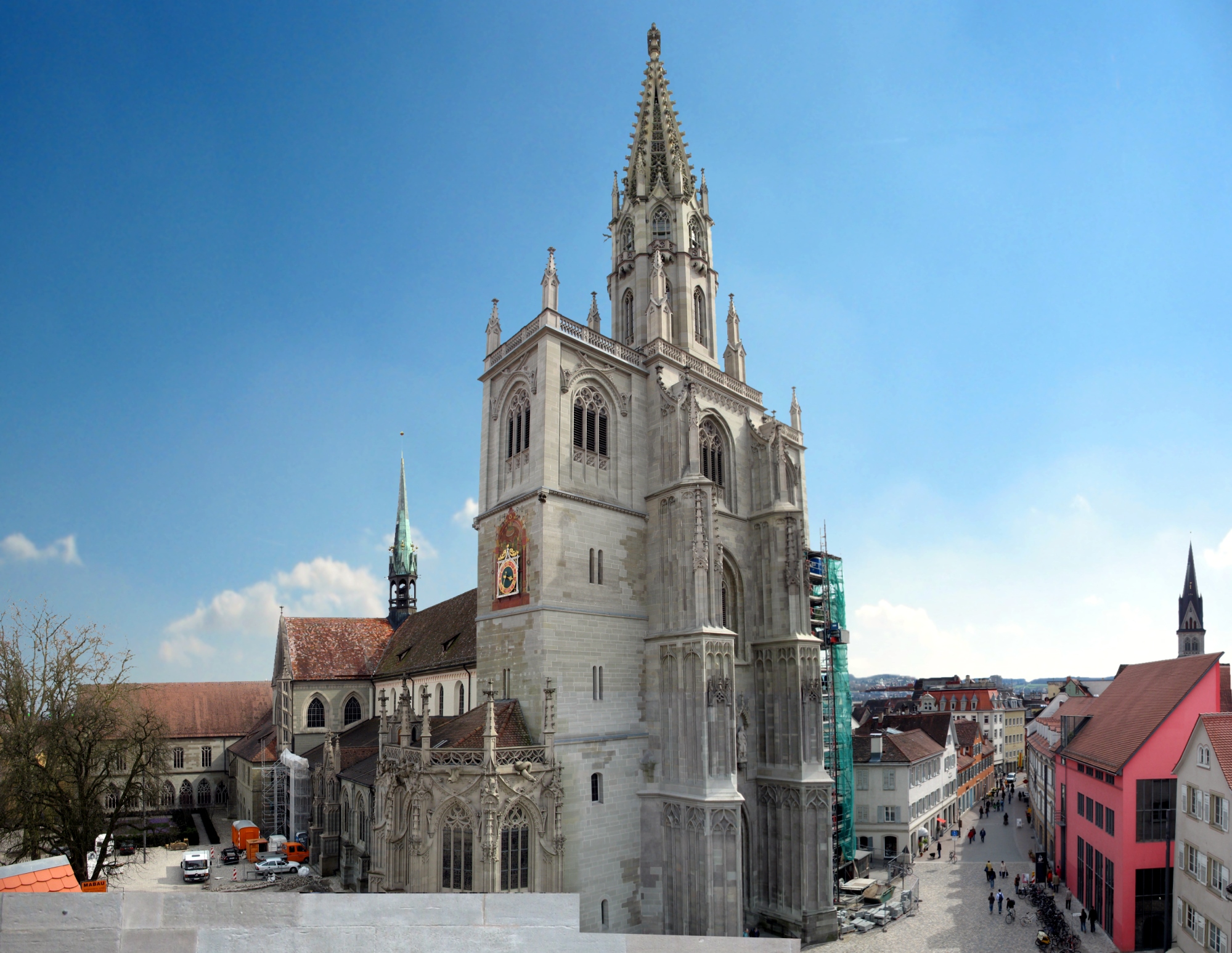
The romanesque nave with its pillars of the basilica was built between 1052 and 1089, is the core  of the cathedral. Over the centuries the cathedral was altered and enhanced. In 1435, the side aisles of the nave were vaulted, followed by the main nave in 1680. In the baroque era, the middle choir was plastered and gilded. In 1856 the western Gothic tower pyramid was built.


 The interior of the cathedral today

Image:stanford.edu 


The west front of Constance Cathedral before the restoration of 1856

Image: Godzdogz 

 https://upload.wikimedia.org/wikipedia/commons/e/ef/MPano_07.jpg

The cathedral today

Image: Wikipedia

Tuesday, 29 July 2014

Motet for St James


The other day Rorate Caeli had a post about a motet written in 1426-28 by Guillaume Dufay in honour of St James the Great and dedicated to one of his friends, then working as chaplain in Bologna. The post, with the text and avideo link can be viewed at In honor of Saint James.

This caught my eye not only as I had written about the cult of St James in my post about the cathedral at Santiago last Friday but because this is music from the world which Bishop Fleming would have known on his visits to the continent and to the Councils of Constance and Pavia-Siena, and at the Papal court.


Wednesday, 19 February 2014

Archbishop Thomas Arundel


Today is the 600th anniversary of the death of Archbishop Thomas Arundel of Canterbury.


  Thomas Arundel (1353–1414) illuminated initial

Archbishop Thomas Arundel
The Archbishop is surrounded by monks of the cathedral priory at Canterbury or members of his archiepiscopal household.
Image: oxforddnb.com


Born in 1352 he studied at Oxford, and lived in Oriel, where he and his father, the Earl of Arundel, built the college chapel as an expression of their thanks. Leaving Oxford he was appointed in 1373 as Bishop of Ely at 21 - his youthfulness led the Pope to comment about him being the youngest episcopal appointment he was aware of - then, in 1388, Archbishop of York. He served as Lord Chancellor and was a significant political figure in the 1390s, until his translation to Canterbury in 1396, exile the following year and return with Henry of Lancaster in 1399, serving again as Chancellor twice under King Henry IV.

An aristocrat to his fingertips he was also able and conscientious as an administrator, and was to prove a resolute defender of the Catholic Church against Lollardy. His death was as a conseqence of a stroke which might have been triggered by his exertions in the preceding weeks in suppressing the Lollard Rising of 1414.

In late 1408 he had caustic things to say about the subject of my research, Richard Fleming and his associates in Oxford whom the Archbishop saw as supporting Lollardy even if only by resisting his authority to visit the University to root out the problem at its source.

The Oxford DNB life of Arundel by Jonathan Hughes can be read here. The 1885 DNB life by James Gairdner can be read at Thomas Arundel, Archbishop of Canterbury and there is another online biographical account, with links to other sites, at Thomas Arundel.

His formal constitutions against the Lollards issued in1408 can be read in translation at Archbishop Thomas Arundel's Constitutions against the Lollards.


The nave of Canterbury Cathedral, completed under Archbishop Arundel about 1405.
His tomb was in the third bay from the east on the north side, just in front of the present pulpit, until it was destroyed by Cranmer in 1540.

Image:paradoxplace.com


The tomb of King Henry IV and Queen Joanna in Canterbury Cathedral.
Archbishop Arundel helped place the King in power and crowned him in 1399, and served him as Chancellor and advisor for much of his reign.

Image:paradoxplace.com

Saturday, 25 January 2014

Bishop Fleming and his church


Today is the anniversary of the death of Bishop Richard Fleming of Lincoln - the original clever boy of this blog's title and the subject of my thesis - and a date on which I make a special effort to remember him. In fact seeing him as a benefactor I remember him daily in my prayers, but today is his obit.

Following his return to the see of Lincoln in 1426 he engaed in a number of charitable acts - founding Lincoln College in Oxford, attempting to establish a collegiate structure for his former parish church in Boston and rebuilding the parish church of the village in which he had been born in 1385. This is Crofton, which lies just east of Wakefield on a hill overlooking the Calder valley and with a view westwards to the Pennines.

Such a rebuilding by a late medieval bishop of the parish church of his native place was not unique - in the East Riding there is the beautiful early perpendicular church at Skirlaugh built by Walter Skirlaw, Bishop of Durham (d.1406), and at Wye in Kent the remains of the collegiate church established by Cardinal Archbishop John Kemp (d.1454) in his birthplace.

Until the seventeenth century there was glass in the church at Crofton showing Fleming preaching - he was, after all a noted homilist and this can be seen as an expression of how he saw himself - and an inscription recording his rebuilding and consecration of the church.


Crofton, All Saints Church

 All Saints Church Crofton

   Image:© Copyright Bill Henderson and licensed for reuse under this Creative Commons Licence.

The church is simple in plan, cruciform with an unaisled nave, transepts and chancel with a central tower and built in the local sandstone - hence its rather soot-blackened exterior today. Inside it has retained no original features beyond the actual structure, but it is spacious and gives an idea of what Bishop Fleming thought appropriate for his villagers, and what he could afford - despite holding one of the greatest bishoprics in England he was short of funds in these years.


photo

The church from the south-east

Image:woodytyke on Flickr

It is not an elaborate or showy building, but practical and serviceable - there has been no need to extend it, and hence it is very much in plan as Bishop Fleming planned and left it. For all that it has lost such personal touches as the glass depiction of him preaching, let alone the furnishings and decoration he would have provided or expected, it is still a point of contact with the clever boy from Crofton who went to Oxford, to the Council of Constance and the Papal household, to the see of Lincoln and, almost, the archbishopric of York  - but all that is for the thesis.

Wednesday, 31 July 2013

A tour of Fifteenth century Oxford

This afternoon I gave a tour of fifteenth century Oxford for a group undertaking a course on the period at Rewley House, the Further Education department of Oxford University.

Beginning from their base at Rewley House I led them on a walk around the colleges founded in that century. The first we saw was St Bernard's. That was founded by Archbishop Chichele of Canterbury in 1438 for Cistercian monks, and designed to supercede Rewley Abbey - now almost entirely obliterated by the railway station and the Said Business School - as a house of studies for the Order. A victim of the dissolution of the monasteries in the later 1530s it was acquired by Sir Thomas White and refounded as St John's College in 1555, and the front quad is substantially pf the fifteenth century.

We then moved on to look at the three colleges founded in the period and with a continuous history to the present. The first both in date and on our walk was Lincoln, founded by "my" Bishop Richard Fleming in 1427, and finally put on a firm basis by Bishop Thomas Rotherham in 1480, just before he was translated to York. The front quad is again substantially fifteenth century, and I was able to point out the rebus of an early benefactor, Bishop Thomas Beckington of Bath and Wells.

We then walked on, passing the Bodleian and Duke Humfrey's Library commemorating his bequest of books to the University in the 1430s, to look at All Souls. This was founded in 1438 by Archbishop Chichele, modelled on New College his own alma mater, and intended as a memorial foundation to pray for the souls of King Henry V, his brother the Duke of Clarence and the English dead from the wars in France.

Our last college stop was Magdalen, founded in 1458 by William Wayneflete, Bishop of Winchester, and whose beautiful buildings speak so eloquently of the elegance and simplicity of late Perpendicular architecture.

When giving such tours it is not always easy to tell how much people are enjoying the walk, but at the end not only did the group make it clear that they had but their course tutor said it was just what they had wanted - and could she book me for next year's course on the early Tudor period to provide a walk through the Oxford of those years. Well I was n't going to refuse was I?

Friday, 25 January 2013

Bishop Fleming, death and burial


According to his Register it was at about two hours after noon on January 25th 1431 that Bishop Richard Fleming died in his castle at Sleaford, part of his episcopal estates. He appears to have suffered a stroke, and would have been about 45 years old. 

He is buried in the north choir aisle of Lincoln cathedral, with a chantry chapel attached to the tomb. The monument is of interest as one of the first transi or cadaver tombs erected in this country, and drawing upon a fashion which had been becoming popular since the 1380s on the continent.

As it is today the monument is not quite as designed by Fleming - he certainly had a hand in its commissioning having written verses for it which indicates a concern for meditation upon the decay of a once handsome man as a corpse. The present appearance is dictated by the restoration in the 1890s by Lincoln College as a tribute to their founder. The original appearance is recorded in the drawings of tombs in the cathedral done shortly before the damage inflicted by the Parliamentarian troops in 1643.


cadaver tomb


Detail of the figures on the tomb of Bishop Fleming in Lincoln cathedral

Image:atlasobscura.com


On this his obit day I always make a particular commemoration of the Bishop in my prayers and invite others to do so.


Sunday, 9 December 2012

Emperor Sigismund


Today is the 575th anniversary of the death of the Holy Roman Emperor Sigismund in 1437. Born in 1368 a younger son of the Emperor Charles IV he became King of Hungary by marriage, King of the Romans and, ultimately, Holy Roman Emperor by election and King of Bohemia by inheritance.


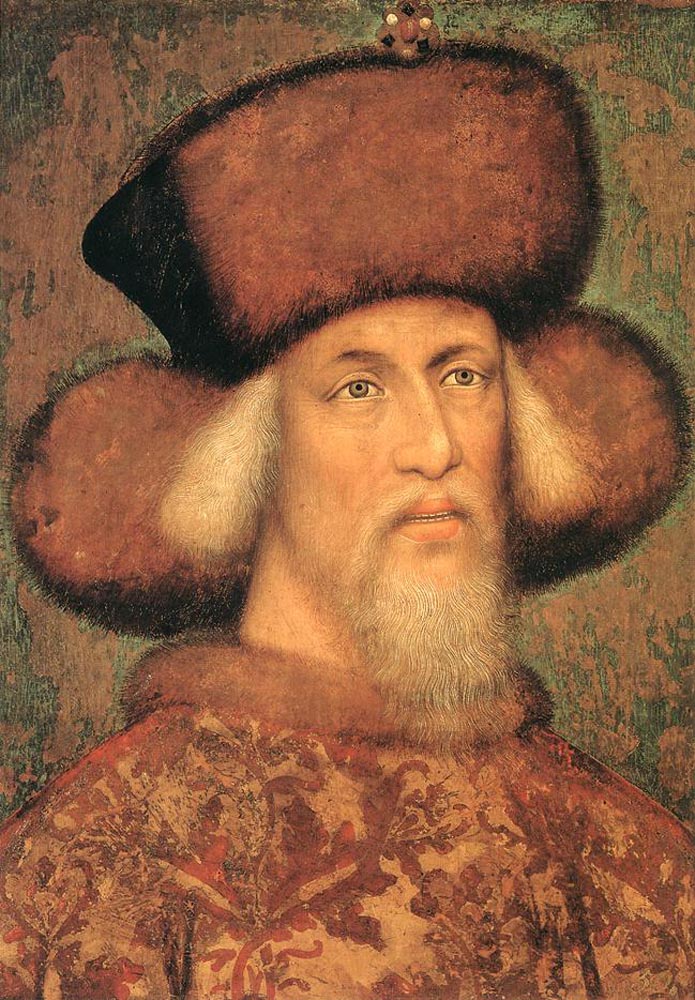
Emperor Sigismund

The painting is attributed to Pisanello and shows Sigismund at about the age of 50, that is about 1418.
He appears to have reqularly worn a hat of this type as he is always depicted wearing one.
Kunsthistorisches Museum Vienna

Image: Wikipedia


There is an illustrtaed online life of him here.  He played amajor part in convening and supporting the Council of Constance in 1414-18, and travelled to Spain, France and Englandin 1416 to secure the adhesion of the Iberian kingdoms to the Council and to negotiate with the government of King Charles VI of France and with King Henry V. Initially this was mediation in the wake of King Henry's success at Agincourt the previous year, but when he came  to England he entered by the Trearty of Canterbury into alliance with King Henry.He was feted in England, and the monarch's exchanged gifts and honours, including Sigismund being made a Knight of the Garter. He gave, inter alia relics of St George to the chapel of the Order at Windsor

One aim of the allaince was to pursue Church reform ahead of the electuion of a new, unquestioned, Pope. However in the autumn of the following year the English King deceided to fall in with other realms and support the elction of anew pope following on from what had been achieved in the way of reform. So it fell to Richard Fleming, by then a leading figure in the English delegation at Constance to tell Sigismund of the change in English policy. In the weeks that followed Cardinal Colonna became Pope Martin V and Richard Fleming entered the Apostolic Household.

In the summer of 1422 Fleming, bu now Bishop of Lincoln, was sent on a diplomatic mission by King henry to woo poloiticala nd miliatry support from the Elector Palatine and the three Archbishop Electors and to attend the Imperial Diet Sigismund had summoned to Nuremburg. It was whilst this was meeting that King Henry V died and Fleming returned home.

A link with Sigismund's visit in 1416 survives in York in the city's Sword of State. Granted the privilege by King Richard II of the sword and a cap of mainatence to indicate its rank as a city and county of the city, the civic authorities were given the sword by Henry Hanslap, a native of York, and canon of Windsor in 1439. Two years earlier when the Emperor Sigismund died his Garter stall at St Georges was dismanted and the sword and helm removed from the chapel, passing to the
Dean and Canons of Windsor. The Dean later gave it to one of his canons,  Hanslap, who then  presented it to his native city in 1439. The sword was redecorated in 1586, as is recorded on the blade, and has been frequently repaired.


http://mek.oszk.hu/02000/02096/html/saxon03.jpg
The Sigismund Sword 
The Dragons refer to the Order of the Dragon, founded by Sigismund as King of Hungary

Image:mek.oszk.hu

http://www.thediamondjubilee.org/sites/www.thediamondjubilee.org/files/styles/lightbox/public/LN-TQ-Apr12-Micklegate.jpg

The Sigismund Sword is presented to The Queen on her visit to York for the Royal Maundy service this year.
The Swordbearer is wearing the other distinctive piece of insignia of the City, the Cap of Maintenance

Image:thediamondjubilee.org

photo

The Sword of State, Cap of Maintenance and Mace

Image: City of York Council photostream on Flickr 


Monday, 26 November 2012

St Catherine and Marshal Boucicaut


Were yesterday not Sunday, and therefore the Solemnity of Christ the King in the modern rite, it would have been the feast of St Catherine of Alexandria. An immensely popular saint in middle ages and in subsequent centuries she was dropped from the Calendar in 1970, but reinstated by Pope John Paul II  in 2002. This may have been an opening towards the Orthodox who have retained great devotion to her.


This illustration of devotion to her is taken from the Book of Hours of Marshal Boucicaut, dating from 1410-15.


Image: Wikipedia

There is an account of the artist, known today as the Master of Boucicaut here  and views of other pages of the manuscrpt can be found online.

The Hours were produced for Jean le Meingre II, known as Marshal Boucicaut following his appointment as Marshal of France in 1391, and who lived from 1366-1421. There is an online life of him here and also an account here.  

Hailed in his lifetime as a paragon of the chivalric code  and life of the military elite he was a crusader and jouster who narrowly survived the disaster of the Battle of Nicopolis in 1396, served as the French Governor of Genoa and was finally defeated and captured at Agincourt on October 25th 1415. He had served as commander of the vanguard in the battle. Taken as a prisoner to England he was to remain one of King Henry V's captives until his death in 1421.


Marshal Boucicaut

Image: Findagrave

I am particularly interested in this phase of his life as he was in the custody of Robert Waterton in Yorkshire for part of this time and it was at Waterton's house at Methley that the Marshal died on June 21 1421. His body was sent back to France for burial at Tours. Part of the house Waterton built survived as part of Methley Hall until its demolition in the early 1960s. Waterton, an emiment and long-serving Lancastrian retainer, was the brother-in-law of Bishop Richard Fleming, and the online Oxford DNB life of him can be read hereMy innate modesty forbids me from drawing attention to the authorship of the biography.

Friday, 31 August 2012

The death and obsequies of King Henry V


Today is the 590th anniversary of the death of King Henry V, King of England, Regent and Heir of France, Duke of Normandy and Lord of Ireland in the chateau of Vincennes outside Paris.

http://upload.wikimedia.org/wikipedia/commons/thumb/1/18/King_Henry_V_from_NPG.jpg/344px-King_Henry_V_from_NPG.jpg

King Henry V

 Image:Wikipidia/National Portrait Gallery


Quite apart from the great and far reaching political, military and diplomatic repercussions of the death of this outstanding monarch this set in motion what must have been the most elaborate funeral ceremonies of any English King, and one which celebrated his achievements in his short but remarkable reign.

Of the four previous English Kings who had died in France three were buried there and only King Henry I in 1135-6 had been brought back for burial at Reading abbey. In addition to this lack of precedent was Henry V's position as Regent and Heir of France and as Duke of Normandy, and his personal prestige as the hero-king of the recent wars. The resulting progress with his body from Vincennes to Westminster was a demonstration of both his achievements and of the Lancastrian monarchy's cult of itself.


The donjon of Vincennes where King Henry V died 

Image: Wikipedia

There is a detailed description of the protracted funeral ceremonies in Christopher Allmand's excellent standard biography Henry V (Yale UP, second edn. 1997) on pp 174-78, which I would recommend reading - along with the rest of the book. The whole account is far too long to reproduce here, but it conveys very well the solemnity and grandeur of the events of that autumn, the long procession of mourners, the constant recitation of Masses of Requiem and of the Office of the Dead.

The King's body was embalmed, and the internal organs buried in the church of Saint-Maur-de-Fosses, and then the coffin, bearing an effigy of the deceased monarch robed and crowned was taken on 14 or 15 September to the French royal necropolis of the Abbey of St Denis. It is not clear whether the route passed through Paris itself - accounts differ. The following day a service for the dead was held in the abbey.


The choir of the abbey of St Denis

Image: columbia.edu.com

From St Denis the cortege went by water along the Seine to Mantes, then entered the capital of his Duchy of Normandy, Rouen on 19 September. Here Henry lay in the cathedral which he had entered in triumph as conqueror in January 1419 after the grim and terrible siege of the city. The following day the body was transferred to the castle and on 24 September Queen Katherine, the late King's brother the Duke of Bedford and more of the household arrived, and it was not until 5 October that the journey was resumed.

photo

The interior of Rouen cathedral.
The architecture of the interior is much as it was in 1422,
whilst the present distinctive skyline of the exterior is later.

Image:maxwellgriffith on Flickr

 
Travelling via Abbeville, Hesdin, Montreuil the cortege arrived at Calais. About October 31 Henry's body reached Dover, and was carried in mournful state  through Canterbury, Ospring, Rochester and  Dartford to reach Soutwark and the end of London Bridge on Thursday November 5. Escorted by an ever increasing number of dignitories, including Bishop Fleming of Lincoln, it passed through London to the west door of St Paul's

File:Old St Paul's Cathedral photographic
 reconstruction.jpg

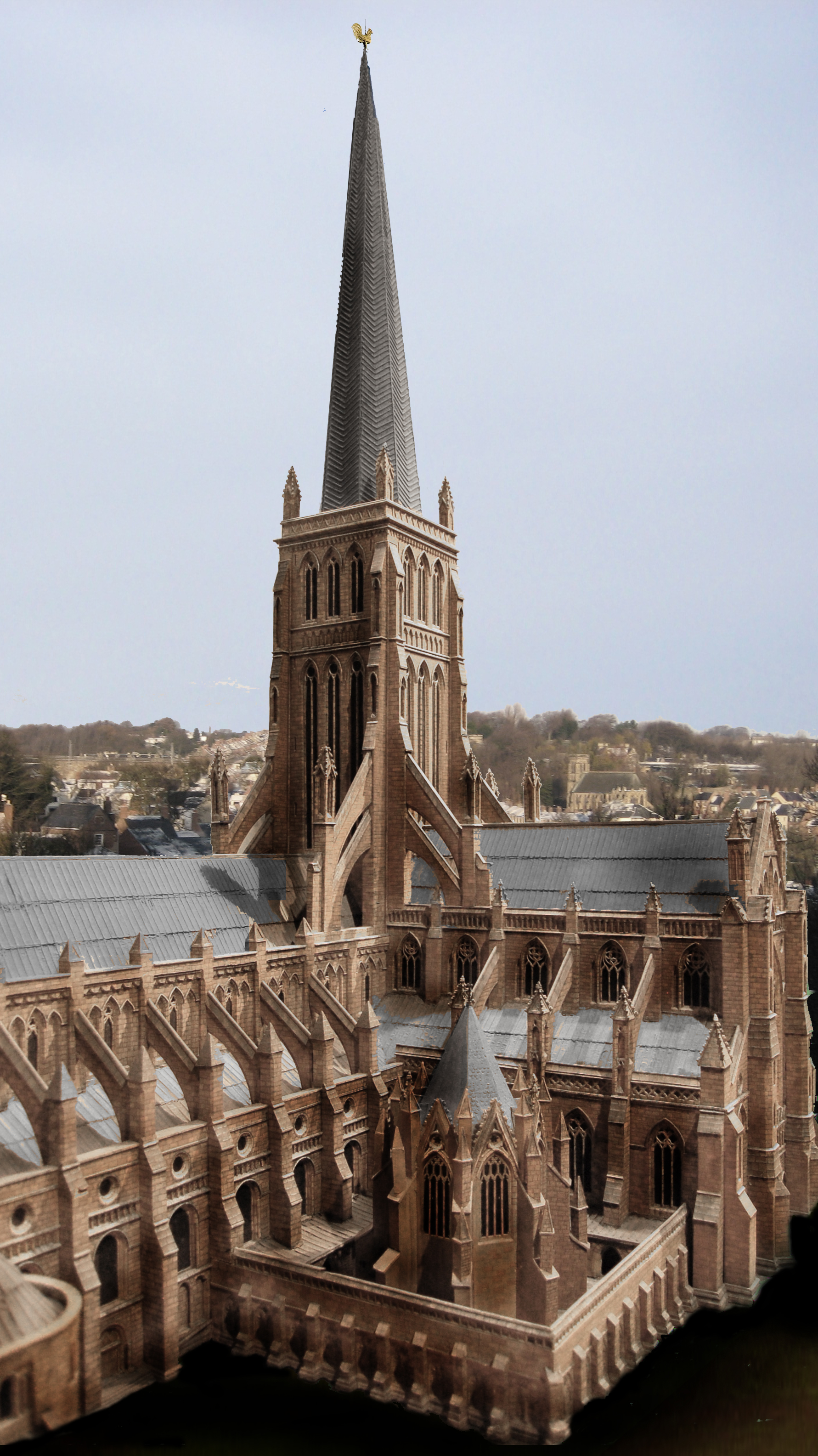
St Paul's cathedral as it might have appeared in 1422
This is a model made in 1908 and now in the London Museum

Image:Wikipedia
Museum+of+London+old+St+Paul+Cathedral

Another view of the model of St Paul's

Image:singaporeaninlondon


On Friday November 6 after more Masses of Requiem there was the last stage of the journey toWestminster Abbey. With the coffin railed in before the altar where he had been crowned nine and a half years earlier Dirige was sung and candles placed about the bier. The Islip Roll, depicting the funeral of Abbot Islip in the abbey on the eve of the reformation gives a very good idea of what would have been erected, with a great hearse decorated with candles over the coffin.

Finally on Saturday November 7 came the burial after another Requiem, and with four horses and their arms led to the altar - presumably represnting England, France, Normandy and Ireland - and a knight wearing the King's coat armour, which was ceremonially offered up.

Henry had directed that a chantry chapel should be raised over his body, at the eastern end of St Edward the Confessor's shrine chapel. This was done by creating a bridge over the ambulatory and erecting the chapel with the King's tomb on top. The tomb lies on the lower level, beneath the arch of the chantry, which is carved with figures of kings and saints. Above him is the Altar of the Annunciation, where Masses were offered for the soul of the King. On the screen walls spanning the ambulatories are sculptures depicting Henry at his coronation and riding armed into battle. The plan is, conciously or not, reminiscent of the plan of barbican gate - can it perhaps be understood as King Henry waiting at the gate of Heaven, and does it perhaps also anticipate the Habsburg ritual of requesting admission, not as monarch but as a penitent sinner, to the Capuchin church in Vienna?

Front of Henry V's Chantry, Westminster. (Decorated English.) Illustration for Knight's Pictorial Gallery of Arts (London Printing and Publishing, c 1860).

The chantry viewed from the Chapel of St Edward

Image: lookand learn.com

The tomb was completed in about 1431. The inscription around the ledge of the tomb platform translates as  Henry V, hammer of the Gauls, lies here. Henry was put in the urn 1422. Virtue conquers all. The fair Catherine finally joined her husband 1437. Flee idleness.

The head of the effigy, sceptre and other regalia were all of silver-gilt, with silver gilt plates covering the figure of the king - an even grander effigy than the gilt bronze effigies of earlier Plantagenets. However, all the silver was stolen in 1546 and the effigy was left as just a plain block of oak for many centuries.

In 1971 a new head, hands and a crown for the effigy were modelled in polyester resin by Louisa Bolt, the features following a contemporary description of the King and the earliest portrait of him. I think that the effigy should be wearing an arched crown, as on the Coronation scene of the King on the side of the chantry, but an open form was chosen for the present head.


CORONATION OF HENRY V. 

The Coronation of King Henry V from the chantry chapel

Image: Project Gutenburg text of E.H. Pearce William de Colchester Abbot of Westmisnter SPCK 1915

 
The saddle, helm and shield, which were part of the King's funeral 'achievements', were for many centuries displayed on the wooden beam above the chantry, but were restored and removed to the Abbey Museum in 1972. The saddle is the earliest surviving example of a new light-weight type, originally covered with blue velvet. The limewood shield has only a small section of crimson velvet remaining on the inner side. The domed helm, about sixteen inches high, is a tilting helm, and would not, therefore, have been worn in battle. A fifteenth century sword, found in the Abbey triforium in 1869, is thought to be part of this funeral armour. There is more about the achievements here. 


Friday, 10 August 2012

The church of St Laurence Ludlow


Amongst the not inconsiderable number of medieval English churches dedicated to St Lawrence ( or St Laurence) that of St Laurence at Ludlow is perhaps outstanding. Built in its present form during the later middle ages it is a commanding landmark in this historic and beautiful town, and more than repays a visit by anyone interested in historic churches. For those of a literary turn of mind it also has the grave of A.E. Housman in the churchyard. In the sixteenth century John Leland described St Laurence's as: Very fayre and large and richly adorned and taken for the fairest in all these quarters, and that statement is still probably true.


The church has fine medieval woodwork and notable medieval glass - that in the Palmer's Chapel narrates the well known story of St Edward the Confessor's meeting with avision of a disguised St John the Evangelist and is a celebration of pilgrimage in the chaple of the local pilgrim guild. The chancel has spectacular figures of the apostles - including a triple tiara wearing St Peter that somehow survived the iconoclasm of the reformation, and the east window has the story of St Laurence. Much restored and although in many essentials a nineteenth century reconstruction like the other windows in the church it does show the splendour of late medieval glazing and the effect it would have created upon the liturgy and worshippers.
  • Stained Glass Window - the Martydom of St Laurence

  • The east window with the story of St Laurence - his martyrdom is in the lowest row of scenes
  • At the top of the window is a representation of the Holy Trinity, and in the twop panels immediately below are King Henry VI and  Thomas Spofford OSB, Bishop of Hereford 1421/2-1448, kneeling in adoration. The Bishop, formerly Abbot of St Mary's York - whither he retired in 1448 - was a friend or aquaintance of Bishop Fleming.
  • Image: davidkennardphotography


    Here is another example of fifteenth century glass from the church - the faces somehow look very familiar:
  • photo

    Image: peet astn's photostream on Flickr

Wednesday, 11 April 2012

Cardinal Henry Beaufort


Today is the 565th anniversary of the death in 1447 at his episcopal palace at Wolvesey Castle in Winchester of Cardinal Henry Beaufort, Bishop of Winchester, and previously of Lincoln, and one of the legitimised children of John of Gaunt and Katherine Swinford. For virtually half a century he had been at the centre of English political, diplomatic and ecclesiastical life.

The Oxford DNB life of him by Gerald Harriss, who has written the standard modern biography, can be read here.

My research on Richard Fleming, himself Bishop of Lincoln from 1420, suggests continuing contact between the two men from their time in Oxford about 1403-4 until Fleming's death in 1431 and that he can be interpreted as belonging to Beaufort's circle.

The tomb effigy in Winchester cathedral of the Cardinal is a seventeenth century restoration, and in addition to other carvings, such as that from Bishop's Waltham illustrated in the Oxford DNB article there is the theory that this portrait, by Jan van Eyck, usually said to be of the Carthusian Cardinal Niccolò Albergati is in fact one of Beaufort and dated to about 1431. It is now in the Kunsthistorisches Museum in Vienna, and the original drawing in Dresden.


The probable portrait of Cardinal Beaufort by Jan van Eyck

Image: Wikipedia

There is more about the portrait here , where it is still described as being of Albergati. It is however very different from the other, more ascetic, images of the Carthusian Cardinal that survive.

In the St Cuthbert Window in York Minster is another depiction of the Cardinal which I have reproduced before. It shows him with the Cardinal's hat for which he had to wait so long:

photo

Cardinal Beaufort of Winchester
York Minster, St Cuthert Window
sVII, 1b-2b

Image: Gordon Plumb on Flickr


Thursday, 29 March 2012

Towton - remembering the dead


In previous posts I have written about the battle of Towton, fought in a snowstorm on Palm Sunday, March 29th 1461, south-west of York and probably the biggest and bloodiest battle fought on English soil. Two years ago I posted Palm Sunday Field 1461 and Towton links, and last year I wrote The Battle of Towton - 550th anniversary.

This year I thought I would post in particular about the graves of some of the dead.

There is an introduction to the battlefield archaeology of the site here, and the excavation of a mass grave discovered at the site of the chantry chapel built by King Richard III in the village of Towton itself is recorded in Blood Red Roses: The Archaeology of a Mass Grave from the Battle of Towton 1461, published by Oxbow here in Oxford.

Apart from this and the large grave in the churchyard at Saxton vide infra there are two monuments in the area of peers who fell in the battle. The first is on the edge of the battelefield in the churchyard at Saxton.

photo
All Saints Church and Lord Dacre's Tomb, Saxton
Ranulph or Ralph Dacre, Lord Dacre, was the second son of Thomas, Lord Dacre, wh had died only three years earlier. His mother was Philippa, a daughter of Ralph Neville, Earl of Westmorland and an elder half-sister of Cecily, Duchess of York, the mother of the victorious King Edward IV.Lord dacre's wife was a FitzHugh of Ravensworth, so he was very much part of northern noble society.
Ranulph was a loyal Lancastrian and at the Battle of Towton, he commanded the Lancastrian left wing. After fighting through the day, he removed his helmet to drink just as the Duke of Norfolk’s men arrived on the field. Moments later, he was killed by an arrow, fired by a youth hiden in some bushes nearby. This is commemorated in the rhyming phrase "The Lord Dacres was slain in the North Acres. He was buried in the churcyard at All Saints Church at Saxton under a table tomb. Legend has it that he was buried upright with his horse. This was apparently confirmed when in the eighteenth century a horse's skull was discovered near the tomb.
A cross on the battlefield has been given his name. It is the scene of a small service each year on Palm Sunday, in memory of those who fell in the battle.
Source: The Richard III Society website: www.richardiii.net
Image and comments (adapted and extended) from uistin on Flickr

Behind the tomb is the long communal grave which was made by William Hungate of Saxton in the early sixteenth century to contain bodies moved from the battlefield. Even today it is of recognisable elevation.

A few miles away in the church at Methley is the tomb of Lionel Lord Welles KG. Like Lord Dacre he was a man in middle age at the time of his death. Legend, again, has it that after his death in the battle his body was concealed in a snow drift, and then brought in a sack by night to Methley.

The Oxford Dictionary of National Biography lives of him and his sons by Michael Hicks can be read here and there is another online account of his life with links here.

In the Waterton chantry in Methley church - incidentally the church is a treasure house of good things to see - is his tomb and that of his first wife. She was born Joan Waterton, and was the neice of Bishop Richard Fleming; the very fine tomb of her parents lies opposite theirs in the same chapel, which appears to be of later date than the tombs. The Welles tomb appears to have been moved from an originally free-standing position to its present place against the south wall.

Lord Welles' effigy is clearly later than 1457 as he is shown wearing the Garter, an honour he only received that yearas shown as KG, but it is unlikely, in the circumstances that the tomb was erected after his death. He clearly planned to be buried there. The effigy is virtually identical to that of Lord Hungerford and Moleyns, who died in 1459, in Salisbury cathedral. Both the effigies of Lord and Lady Welles are of high quality, with the details of the fabric of her dress and mantle and his tabard rendered in fine detail. Both are weasring the Lancastrian collar of SS. Lionel's effigy has undergone repair - his nose is a replacement - and the whole tomb underwent a full restoration in 1988.

Tomb of Lionel, Lord Welles and his wife, Cecilia, Waterton Chapel, Methley Church

The tomb of Lord and Lady Welles in Methley church

Image:leodis.net

After Joan's death he remarried, Margaret, the widowed Duchess of Somerset, who was the mother of Lady Margaret Beaufort. She clearly intended to be buried at Wimborne with her previous husband Duke John. Their tomb can be viewed in my post The tomb of the Duke and Duchess of Somerset at Wimborne Minster.

Of your charity pray for the repose of the souls all who fought and of all who died at Palm Sunday Field


Wednesday, 25 January 2012

Obit of Bishop Richard Fleming


Today is the obit of Bishop Richard Fleming - he died on January 25th 1431 at about two hours after noon aged about 45 and had apparently suffered an apoplectic stroke - and as he is the subject of my research, and indeed who gave the title to this blog, someone to whom I feel a close attachment.

Here are two pictures of his tomb in the Angel choir of Lincoln cathedral:


http://www.knowledgerush.com/wiki_image/c/c7/Flemtomb.JPG

The tomb and its canopy

Image: knowledgerush.com

http://www.lincolnshireguide.net/images/cc-lincoln-cathedral-tomb-of-bishop-fleming-dave-hitchborne.jpg

The tomb chest enclosing the cadaver effigy

Image: lincolnshireguide.net

As I wrote last year on this anniversary day one thing I believe I have established in my research is that the tomb as it now appears is not quite how it was designed, and that it has been altered in well-intentioned but inaccurate restoration as well as losing the top finials of the canopy.

Please join with me in praying for the repose of the soul of Bishop Fleming and perhaps also spare a thought for me that I can successfully complete my research into his life.