Once I was a clever boy learning the arts of Oxford... is a quotation from the verses written by Bishop Richard Fleming (c.1385-1431) for his tomb in Lincoln Cathedral. Fleming, the founder of Lincoln College in Oxford, is the subject of my research for a D. Phil., and, like me, a son of the West Riding. I have remarked in the past that I have a deeply meaningful on-going relationship with a dead fifteenth century bishop... it was Fleming who, in effect, enabled me to come to Oxford and to learn its arts, and for that I am immensely grateful.


Showing posts with label Oriel. Show all posts

Friday, 1 August 2025

St John Henry Newman to be declared a Doctor of the Church


The announcement yesterday from the Vatican that St John Henry Newman is to be declared a Doctor of the Church is very good news indeed.

john-henry-newman

St John Henry Newman by John Everett Millais, 1881

Image:sevenoaksordinariate.wordpress.com

It is all the more appropriate that just as St John Henry was made a Cardinal by Pope Leo XIII at the beginning of his pontificate, so now Pope Leo XIV at the commencement of his has authorised the saint’s status as the thirty eighth Doctor of the Church. 

As an Englishman Newman will join the very select, and very distinguished, company of St Bede the Venerable, the only other Doctor born in these islands. To this pair can be added an adoptive son in St Anselm.

For Oratorians and their congregations he is the first son of St Philip to be given this honour, and Newman exemplified the Oratorian vocation.

For Oxford University he is the first Doctor of the Churxh to have been educated there and to have been for many years a significant contributor to its life and purpose,

For both Trinity College and Oriel College it is an honour, and one that for the latter that happily falls in the seven hundredth anniversary year of its existence.

St John Henry Newman pray for us.

Sunday, 2 February 2025

Candlemas - Oriel and the English Oratory


Today is the Feast of Candlemas, the Presentation of Our Lord in the Temple and the Purification of the Blessed Virgin Mary. It is also the ceremonial conclusion to Christmastide and its imagery of light in midwinter.

Over the years that I have been writing this blog, I have posted nearly every year about Candlemas, about its traditions and depiction over the centuries and also about two special, personal links to the day based on my life in Oxford.

Candlemas is the annual feast of my college Oriel, as it falls only a few days after the anniversary of the establishment of the college or House of Blessed Mary the Virgin in Oxford by King Edward II in January 1326, and is the first feast of Our Lady to occur after that date. This year marks the 699th anniversary of the foundation and next year will see the celebration of the septuacentenary. 

The other link is that today is the 177th anniversary of the establishment of the Oratorians in England by St John Henry Newman in 1848. Not only did he place his new foundation under the patronage of Our Lady but it is surely a conscious homage to his time as a Fellow of Oriel and that was attracted him to the Oratorian pattern of life was it similarity to the Senior Common Room in the college.

So today is an especially good one upon which to pray for Oriel and for the English Oratorians.

Rather than attempt to re-write previous pieces I will give links to my previous posts for this day.

They can be seen at Candlemasfrom 2011, Candlemasfrom 2012, Candlemasfrom 2013, Candlemas Day and Celebrating Candlemas from 2014, CandlemasCandlemas at the Oxford Oratory, and Medieval Images of Candlemas from 2015, Candlemas, from 2016, The Ceremonies of Candlemas from 2021, Candlemas from 2022, Candlemas from 2023, and, with continuing originality, Candlemas from last year.


I regret that in some of the older posts the images will no longer display, due, I assume to copyright reasons, but readers should be able to find the images online from the titles. There are still a fine selection of images of the Presentation and Purification which repay careful study.


May I wish a joyful Candlemas to all my readers and fraternal good wishes to my fellow Orielenses and Oratorians.


Saturday, 21 December 2024

Friends in high places


I was pleasantly surprised yesterday afternoon to see in the list of new life peerage creations on the recommendation of the Leader of the Conservative party the name of Professor Nigel Biggar. 

I first met him in October1993 when as a fresher postgraduate student I went on my first Sunday to the college communion service at 9 am. There I met the chaplain the Rev. Dr Biggar and his wife and I was rapidly drawn into the life of Oriel chapel as a communicant and then as a Bible Clerk, and then Head Bible Clerk. Until Nigel left in 1999 Chapel was a very important part of my Oriel life. Although our churchmanship might have been rather different, we nonetheless were on very friendly terms. He was a very conscientious and popular Chaplain, with a ministry that extended far beyond the regular chapel goers - sports teams would want him to preside at their annual dinners because he was good fun and genuinely interested in the lives and hopes of students.

Since he has returned to Oxford in 2007 he has become well known for taking a decided stand on a number of controversial and important issues about academic freedom, freedom of speech and the validity of historical interpretation as well as about the Just War theory and the ethics of military action. This has not always made him popular in the academic community but he has stood his ground and received considerable acclaim for his constancy. He has set out these ideas in a very readable article in the Daily Telegraph which can be seen at It’s time to come off the fence: I’m a conservative

Although there are some points of detail with which I would venture to disagree with him, on all his fundamental points I would be essentially in agreement with him. When I first met him I think would have seen him as liberal, yet conservative in a non-political sense, which is very much what he describes himself as being at the time. Now we clearly share a veneration for the thought of Edmund Burke as the voice of post-1784, and certainly post-1789, conservatism, and indeed, Conservatism. In some ways I am more conservative or, if you like, traditionalist, yet we share much common ground.

I recall him speaking of his doctoral work on the moral life of individuals in the public and political world, and of his admiration for historical figures who witnessed at great personal cost to their understanding of the truth. In those respects he himself is a living witness to those traditions.


Friday, 18 October 2024

Establishing the Anglo-Saxon defences of Oxford


Archaeological investigations inevitably expand our knowledge of the past and Need us to reassess our understanding of what we think we know about the history of the environment around us. In centre of a city like Oxford the opportunities to carry out such investigations are inevitably limited by the very nature of the city that we know today. Any new building work likely to turn up evidence of past occupation in the city centre and indeed in the historic suburbs.

A very Good instance of this has happened at Oriel with the discovery of the line of the eastern ditch defending the tenth century town as originally laid out. This is often associated with the burh foundations made by Æthelflæd  Lady of the Mercians ( c.870-918 ) the daughter of King Alfred. This town, whose street plan underlies that of much of the present city centre, is where the town, and later city began as a trading community alongside St Frideswide’s religious foundation. Rebuilding of the kitchens at Oriel has revealed the width and depth of the defensive ditch which lies alongside what is now called Magpie Lane*. A century or so later this town was expanded east and south-eastwards along the line of the High Street down towards Magdalen Bridge. As a result the ditch was filled in or gradually accumulated soil and rubbish and disappeared as a consequence. 

The Oxford Mail reported on the discovery in an article which can be seen at Archaeologists solve 125-year-old mystery about origins of Oxford

More or less the same account can also be seen in the Daily Express at Archaeologists discover hidden secret behind one of the UK's prettiest cities

This is an important  insight into the history of the origins and development of the urban community in Oxford. 

Never let be said that Oriel has neglected its responsibilities to record the history of the city and university, even if we had to pull down the kitchens in order to do so.

 * The various names over the centuries of this narrow lane are of interest, and informative, but far too indelicate for a blog like this. The answer can be found in volume i of The History of the University of Oxford - try the map of Oxford in the thirteenth century.


Saturday, 29 October 2016

LMS Dominican Rite Pilgrimage in Oxford


Today was the Latin Mass Society's Oxford Pilgrimage in honour of the four martyrs of 1589 - the two priests Bl. George Nichols and Bl. Richard Yaxley, and the two laymen Bl. Thomas Belson and Bl. Humphrey Pritchard.

The well attended Mass was celebrated at Blackfriars according to the traditional Dominican Rite by Fr Oliver Keenan OP and the sermon was given by Fr Richard Conrad OP who also served as Deacon.

It was a great pleasure to meet up with my old friend, and indeed my sponsor when I was received as a Catholic in 2005, Br.Andrew from the Birmingham Oratory and some friends of his from the congregation there and to have lunch with them afterwards. I was then able to help Andrew show them around Oxford, concentrating especially on the life here of Bl. John Henry Newman. Being an Oriel man I was fortunately able to show them more of the college than they might otherwise have seen and to talk about Newman where he once lived.

Br. Andrew once paid me the compliment - the great compliment - in  saying he thought I was like Newman in my pursuit of truth, indeed Truth, and which I found a very moving observation.

It was also a pleasure to see Fr Hunwicke and talk to him briefly after the Mass. Although we live in the same city our paths cross far too infrequently.


Thursday, 11 August 2016

Bl. John Sandys - an Oriel martyr


Today is the 420th anniversary of the martyrdom of the priest Bl. John Sandys at Gloucester in 1586. An Oriel man born 1550/55 in Cheshire or Lancashire he converted to Catholicism and then trained at Reims for the priesthood.

His ability to celebrate Mass the morning of his execution is an interesting insight into what could happen in an Elizabethan prison, whilst the actual carrying out of his death sentence shocked some at least who did not share his religious convictions.

Stephanie Mann had this post about on her Supremacy and Survival blog him last year:
http://supremacyandsurvival.blogspot.com/2015/08/august-martyrs-blessed-john-sandys.html

There are other accounts of him at Blessed John Sandys from the Duiocese of Shrewsbury website and at John Sandys from the Robinswood Hill Roman Catholic parishes website.


Tuesday, 2 February 2016

Master James of Spain


As today, being Candlemas, is the annual feast day of Oriel it seems a very appropriate day on which to post about Master James of Spain. Who he? Well now...

You know how some friends keep reappearing in your life, often over many years. Even if you do not spend a lot of time with them, or know them that well, they are always there as figures in the landscape. One such for me is Master James of Spain.

I should, perhaps, point out that Master James died in 1331, but I first encountered him in the 1960s in my home town of Pontefract. He is listed, as James of Ispania, as Dean of the College of St Clement in Pontefract castle. He sounded interesting - what was a Spaniard doing in late thirteenth century England as a cleric? Then in the mid 1970s I found him as a canon of York Minster in the volume of York Minster Fasti which described him as an illegitimate son of King Alfonso X of Castile. Even more intriguing.

In October 1993 in my first week or so at at Oriel I read an essay by that great Oriel historian W.A. Pantin in The English Church and the Papacy that informed me that it was this same James of Spain who had given the house La Oriole to the college, and hence its name of Oriel, in 1329.

This led me later to Emden's Biographical Register of the University of Oxford to 1500 which has a biography and again asserts that James was the illegitimate son of King Alfonso X, who is himself a fascinating figure.

When the Obit Roll for the chapel at Oriel was being revised I managed to get James' aunt, Queen Eleanor, the consort of King Edward I, restored to it - in return for the gift of La Oriole the College added both the late Queen and James to those who participated in the spiritual benefits of membership of the foundation. 


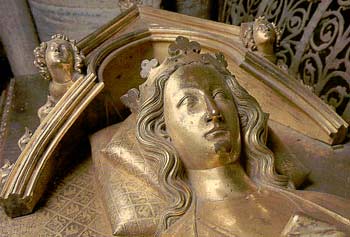
Queen Eleanor of Castile
Tomb effigy in Westminster Abbey

Image: Lady Shirley on Flickr

I did some further research on Master James, and gave atalk to the Oriel history students group, the Pantin Society. In 2005 I wrote up my research for The Oriel Record. Unfortunately it was deemed too long and I was asked to cut it. I did something of a hatchet job on it - but that was too long as well, so my draft article ' Master James of Spain: The Bastard without whom Oriel would not be Oriel' remained just that, an unpublished draft.

As I looked at his career, and what was known of King Alfonso X's illegitimate children, of whom several are known to his modern biographer, but not, significantly, including Master James, and the question as to why he had made his life in England, apart from one recorded visit to Castile as a middle-aged man, I came to the view that his father was King Alfonso and Queen Eleanor's brother, the Infante Henry (1230-1303), who spent a few years in England from 1256 until 1259. There is an online biography of the Infante - whose life is worthy of a medieval Romance, or worse, a modern historical novel, at Henry of Castile the Senator

Following his capture at the battle of Tagliacozzo in 1268 he was a political prisoner in the kingdom of Naples until 1291, despite the efforts of Queen Eleanor, who died in 1290, to obtain his release. Here then is the explanation for her concern for her illegitimate nephew's life in Oxford. La Oriole was one of the finest houses in the town and james cearly enjoyed life there, supported by various benefices and sinecures in governmental posts.
 

 Arms of Infante Henry of Castile.svg
The arms of the Infante Henry the Senator

 Image: Wikipedia


Oriel in 1566
This is the earliest depiction of the college, and shows the buildings on the site of Master James of Spain's house La Oriole, but they were later in date than James' time. The site was completely rebuilt as front Quad in 1620-40.

Image: bodley30.bodley.ox.ac.uk


Oriel at top left, with St Mary's Hall between it and St Mary's church. The original home of the college was in Tackley's Inn, facing the High, and on the right of the picture.

From Ralph Agas' Map of Oxford of 1578

Image:marcus-beale.com

Now, and when I was thinking, at afriend's urging, about finding another publisher for my article draft  Master James turns up again quite by accident on the computer in what may well be the definitive account of his life. I have not so far had the opportunity to look at the book, but it appears to have the same theory as to his father's identity. An online feature entitled Author of 14th-century treatise revealed (Tuesday 4 August 2015) is as follows:

Professor Margaret Bent’s new book, Magister Jacobus de Ispania, Author of the Speculum musicae (Ashgate/RMA Monograph Series) argues that the author of the largest medieval treatise on music was not Jacques de Liège, as previously thought, but ‘Magister Jacobus de Ispania’. Professor Bent draws on new documentary evidence to investigate who this Jacobus might have been, enhancing our understanding of the geography and influences that played into this central document of medieval music theory.


Image: Amazon

So now we finally appear to know what this well connected and cultured gentleman scholar was doing in La Oriole.

Floreat Oriel 


Saturday, 30 January 2016

Friday, 29 January 2016

Cecil Stays Put


I heard on the Radio 4 Midnight News, where it was about fourth in rank as a story, and on the later BBC World Service, where it was equally prominent as a report, that the statue of Cecil Rhodes is staying put on the facade of Oriel  - and quite right too.

I am tempted to opine on the Andy Warhol principle that it is, for fifteen minutes, the most famous statue in the world for the moment.

The BBC News website quotes The Daily Telegraph report as follows:

Still on the subject of educational institutions, the Telegraph reports that a statue of British imperialist Cecil Rhodes at Oxford University will not be removed.

Campaigners wanted the statue taken down because they said it represented racism.

A report prepared for governors of Oriel College warned that £1.5m in donations had already been cancelled - and they risked losing a £100m gift by considering the campaign.

Oriel confirmed in a statement to the Telegraph: "Following careful consideration, the college's governing body has decided that the statue should remain in place."

The Telegraph states: "Oriel's agreement to enter into discussion about the future of the statue triggered a wider row about free speech in universities and whether students need to be protected from offence.

"The college has now been panicked into cancelling the proposed consultation. The plaque on the building where Rhodes lived while a student at Oriel will also stay, but it and the statue will have an accompanying sign providing historical 'context'."

The Telegraph believes Rhodes' opinions reflected the prejudices of his time but intelligent minds are capable of interpreting the past in context.

It comments: "Rhodes will not fall. Oriel College has decided that the controversial statue will stay. It is a pity that it took so long to reach that conclusion and a pity that it required the financial pressure of benefactors.

"But the donors, or potential donors, were overwhelmingly of one entirely rational point of view: the past cannot be rewritten. And it is not the responsibility of Oxford students to try."

Floreat Oriel


Monday, 28 December 2015

Sign up to save Cecil


Following on from the campaign to remove it a friend has forwarded to me the following link to a petition in support of retaining the statue of Cecil Rhodes on the High Street facade of Oriel. I have signed it and urge others to do so.

We do not want to become ( any more than we are already ) the sort of society that seeks to destroy its past by obliterating public statues and images. Should I start complaining about the "Martyr's Memorial" in Oxford  and demand its removal because as a Catholic I feel oppressed or reminded of past oppression every time I walk past it by the figures of Cranmer, Latimer and Ridley?

The petition, with background information, can be accessed at https://www.change.org/p/oriel-college-oriel-college-oxford-university-do-not-remove-the-statue-of-cecil-rhodes?recruiter=449659694&utm_source=share_petition&utm_medium=copylink


Image:www.change.org

Fr Alexander Lucie-Smith has written in The Catholic Herald about the campaign to remove the Rhodes statue in http://www.catholicherald.co.uk/commentandblogs/2015/12/29/rhodes-must-stay-destroying-the-past-is-a-mark-of-tyranny/


Mary Beard was recently quoted in The Daily Telegraph expressing her criticism of the anti-Rhodes campaign and Harry Mount also had an article in The Daily Telegraph commenting on the story, which can be viewed at http://www.telegraph.co.uk/education/educationopinion/12073349/Its-time-to-say-No-to-our-pampered-student-emperors.html


Saturday, 28 November 2015

Commemorating Queen Eleanor of Castile


Today is the 725th anniversary of the death in 1290 at Harby on the borders of Nottinghamshire and Lincolnshire of  Queen Eleanor of Castile, the first wife of King Edward I.


Queen Eleanor of Castile
Tomb effigy in Westminster Abbey

Image: Lady Shirley on Flickr

Recent research has suggested she may not have been as universally popular as later historians have written, but the King mourned her in an impressive and commemorative way.

Her body was embalmed at Lincoln and her internal organs buried in the Angel Choir of the cathedral. The original monument was destroyed when the cathedral was vandalised in 1643, but a nineteenth century reconstruction, based on a seventeenth century drawing of the original, now occupies the site.

 http://www.paradoxplace.com/Photo%20Pages/UK/Britain_Centre/Lincoln_Cathedral/Lincoln_Images/Aug%202007/800/Viscerial-Tomb-Aug07-D7809sAR800.jpg

The viscerial tomb of Queen Eleanor in Lincoln Cathedral 
Between the arms of England are those of the County of Ponthieu, of which she was the heiress and the Kingdom of Castle and Leon

 Image;paradoxplace.com

The places where her body rested on the journey to Westminster were marked by the erection of memorial crosses, of which three survive, at Geddington, Northampton and Waltham. These were close to the monasteries where the Queen's body rested on its jorney to London. These have inspired many later monuments, not least the 'Martyrs Memorial' in Oxford - a nice irony as it is just the type of thing Latimer and Ridley liked to destroy. Originally all of them would have been painted.


The Geddington Cross
The only one known to be on a triangular plan

Image;paradoxplace.com

http://s0.geograph.org.uk/photos/04/19/041979_dae56ccd.jpg


The Northampton  Cross

Image: geograph.org.uk


http://mauriceboddy.org.uk/pictures/Waltham-1%20(263%20x%20500).jpg  

The Waltham Cross

Image: mauriceboddy.org.uk

There is an online account of all the crosses, their fate and what, if anything, remains of the others as well as of copies of them at Eleanor cross.

This pattern of memorial crosses derived from those erected in France to mark where the body of St Louis rested on his corpse's return to St Denis from Tunis.

The last of these crosses was the original Charing Cross - now reproduced in a Victorian reconstruction outside the eponymous station - and thus linked to her burial in Westminster Abbey, where her body rests under the effigy shown above.

 http://www.victorianweb.org/art/architecture/barryem/4.jpg

 The rebuilt Charing Cross of 1863-65 by the stonemason Thomas Earp

Image:victorianweb.org
Her nephew, Master James of Spain - an illegitimate son of her brother - lived in Oxford and was the man who gave the house called 'la Oriole' to the House of Blessed Mary the Virgin in Oxford, thus giving it the name of Oriel, in 1329. A condition of this was that Queen Eleanor was made, in effect, a posthumous honorary Fellow, and was to be prayed for by the College. One of my achievements as a Bible Clerk at Oriel was to get her name restored to the list of Benefactors, whence it had slipped at some time or other.

As to Master James - well I have post coming fairly soon about him, and the lastest theories about his parentage and career.


Saturday, 1 August 2015

A tour of Reformation Oxford


Last Wednesday I gave a tour of Oxford sites associated with the period 1547-1603. This was for a study week based at Rewley House, the University's Continuing Education section, and followed on from the previous two years when the same tutor and in several cases the same students looked at fifteenth century Oxford and at the period 1485-1547. They have booked me for next year for Jacobean and Caroline Oxford - so I must be doing something right.

Ralph Agas' map of the city from 1578 and the Beerblock drawings of the colleges enable one to visualise the city as it was. It is estimated that the population increased by 50% in the period 1558 -1642, and Hollar's map from the 1670s shows the effect of this on the building pattern.

We walked across the site of the Carmelite friary and looked at Worcester College. Originally built as Gloucester College for Benedictine monks and closed at the dissolution of the monasteries it was bought by Sir Thomas White, the founder of St John's College, and became a centre for recusancy. Gloucester Hall as it became known provided accommodation for the Catesby family, one of whose children was born there recusants, the sibling of Robert, the brains ( if that is the right term? ) behind the Gunpowder Plot. Students from the Hall used to slip away to Mass at the recusant centre at the former nunnery at Godstow a couple of miles upstream.

St John's College on St Giles was also founded by Sir Thomas White, using the former Cistercian St Bernard's College. The college still possesses two banners from the chapel consecration at the refoundation. Two of the most famous recusant martyr priests were members of St John's - the former chaplain St Cuthbert Mayne, the protomartyr from 1577, and St Edmund Campion, a Fellow in the 1560s, and Jesuit mission priest active in 1580-81 when he was captured and executed.

Oppsite is the modern home of Blackfriars in Oxford. In the reign of Queen Mary Spanish Dominicans were in Oxford seeking to understand as well as counteract the spread of Protestantism. Amongst these were Bartolome Carranza, later Archbishop of Toledo, who himself fell foul pf the Spanish Inquisition as can be seen here.

Passing the Martyr's Memorial of 1841 - a curiously backhanded compliment to the Oxford Movement - we looked at the site of the Catherine Wheel inn, at the junction of Magdalen St East and Broad St. It was here in 1589 that two Catholic priests and two laymen were arrested. The landlady was imprisoned for life and the four men were executed on the gallows at the end of Holywell St, where there is now a modern memorial. This incident points, I think, to the part played by inns as meeting places for recusants - as in John Gerard's autobiography in Norwich- and as Catholic "safe-houses"

In Broad St there is the site of the burnings of Latimer and Ridley in 1555 and of Cranmer the following year. At the time this was the remains of the city ditch, overlooked by the city wall. I am very skeptical of the claims that the scorching of the former gates of Balliol are from these fires - to do so would have required a pyre big enough to burn down central Oxford ...

Before their execution the three degraded bishops were held in the Bocardo prison which was in and over the Northgate of the city and adjoined the tower of St Michael at the Northgate.

The Bocardo in 1770

Bocado just before its demolition in 1771

Image:oxfordhistory.org.uk

It was from the top of the tower that Cranmer was forced to watch the death of his two colleagues. Whilst all three were held there the previous year they were taken out to watch the restored Corpus Christi procession - which they of course saw as idolatrous, and one of the bishops hid in a shop doorway to avoid witnessing it. A door from Bocado is preserved in the treasury at St Michael's.


Bocado and St Michael's from the south

Image:TheAngus.rpc.ox.ac.uk

In St Michael's - itself a fascinating text book of parish church evolution - we looked at the font. This was brought from the church of St Martin at carfax, of which only the tower survives. the particular interest of it is that Shakespeare may well have stood by it in old St Martin's when his godson, the son of the owner sof the Crown Inn where he stayed on journeys between London and Stratford, was baptised. The Crown still exists as apublic house and I understand there is still a room there with sixteenth century painted decoration similar to that to be seen in Pizza Express in the former Golden Cross Inn.

It was along Cornmarket that Queen Elizabeth I made her entry into the city in 1566. She stayed in Christ Church, where anmongst the loyal addresses was was one delivered by the young Anglican Deacon Edmund Campion. As Alice Hogg points out in her excellent God's Secret Agents the government had already lost the sympathy of many within the University by this date, and mot oxford colleges provided martyrs for the Catholic cause.

The Queen came into Oxford from Woodstock manor, where she had been held under house arrest in the mid-1550s, so it was not perhaps a place of happy memories for her.

Jesus College, founded in 1571, is the only Oxford college founded in her reign. it was sdpecifically designed to be a college for students from Wales, and still keeps St David's day as its principal feastday, although the actual Welsh connectiuon has, I gather, largely disappeared. Over High Table in the Hall is afine portrait of Queen Elizabeth I.

Trinity College was founded in the reign of Queen Mary by Sir Thomas Pope. this was in 1554, and like St John's was part of the attempt to re-Catholicise the country. This is discussed in Eamonn Duffy's recent study Fires of Faith, which shows how much was achieved in a short period. Like St John' s it had been amonastic college, Durham College, for the Benedictines from the northern province. Sir Thomas' letters to his stepson, a very reluctant student at the new college are a reminder that time does not change generationakl conflict within families about future career plans.

We looked at the Bodleian, and how Sir Thomas Bodley (1545-1613) saved the Library from the decay into which the pillaging by the Royal Commissioners under King Edward had reduced it, and how he created the basis upon which it has developed, including the copyright status. His memorial in Merton chapel, where he had once been a Fellow has the delicate touch that the pilasters flanking his bust are composed of two piles of books.

The Bodley Memorial - Photo © Robin Stevens, used under CC BY-NC-ND 2.0 license

The Bodley monument in Merton Chapel
Image: merton.ox.ac.uk

All Souls College survived the threat of dissolution along with the other chantries in 1548

St Mary's University church witnessed the trials and condemnation of the three Anglican bishops burned in the 1550s,a nd they and aselection of Oxford martyrs of all traditions from the 1530s to 1681 are commemorated on a modern plaque in the church. In the chancel - which always strikes me as conveying much of what many churches must have looked like four centuries or so ago, lacking stained glass, whitewashed, stripped of colour and most decoration - is the grave of Amy Robsart, whose mysterious death at Cumnor Place outside Oxford in the autumn of 1560 cast a serious shadow over the ambitions of her husband, Lord Robert Dudley.

It was in the church that Edmund Campion left 400 copies of his Decem Rationes, printed in secret at Stonor for the commencement ceremony on June 27th 1581 - a typical act of bravura. His capture occurred soon after at Lyford Grange where he was on July 14th and15th when he was apprehended.

http://communio.stblogs.org/St%20Edmund%20Campion.jpg

St Edmund Campion1540-1581

Image:communion.stblogs.org

There is a useful set of links about St Edmund at The Jesuit Institute - St Edmund Campion SJ

Facing the church is Oriel, and on the High Street facade a statue of Cardinal Allen (1532-1594), of whom there is an account here.
Allen, an Oriel and St Mary's Hall man founded the seminary at Douai which helped maintain the supply of priests to England, later supplemented by the Jesuits. He was a key figure in maintaing the Catholic community, and, placed alongside Newman one could argue Oriel has produced the two most important post-Reformation Cardinals. Manning would, I think, be a close runner up - but he was a Balliol man...

That more or less concluded the tour - we had already run over time, so there was not the hope of talking about how Magdalen College's records recount changing liturgies and musical accompaniment through the purchase of new part books and such like, or to tell stories of an Edwardian Fellow there, Thomas Bickley profaning the Reserved Sacrament, and after exile under Queen Mary becoming an Elizabethan Warden of Merton and Bishop of Chichester ( 1586-96 ). Incidentally regular readers may recall I was thurifer at a 450th anniversary Requiem for Cardinal Pole in the chapel at Magdalen, his college, in 2008.

Nor was there time to look at a house of about 1600 just off the High Street that is now a Thai restaurant ...

Ah well, such are the historic treasures and associations to be found on a short walk around Oxford.

Thursday, 20 November 2014

Oriel out on the town


Last night I was dining with a friend at my usual Italian restaurant which has recently had large parties of students booking for what can be rather noisy and boisterous dinners. The owner had warned us that another such group was booked in, so we were forewarned. After a while a large party of smartly dressed young people turned up, with the inevitable bustle.

However before they stated a young man stood up and reminded his companions that there were others in the restaurant and to be thoughtful of us. A little after he came to the tables of the other diners to express the hope they would not disturb us. Seeing he was wearing an Oriel tie I said I was certainly not going to object as a fellow Orielensis. It emerged this was a party from Oriel JCR - second year males and first year females. All very courteous of him I thought.

Better was to follow as they ate and drank, and sconce one another for matters, well not quite the things I aim to raise on this blog. Never mind - some time later another student came round to see again if any of the other diners were upset ( they were n't). He was the JCR President - so I identified myself as a former MCR President.

The whole party was full of youthful energy, obviously intelligent, smartly dressed, good humoured - what, in fact, Oxford students ought to be.

When they were leaving the first young man and another came round again to be sure they had not disturbed our meal. My friend ( a town rather than a gown man ) assured them it had not and we thanked them for their concern and politeness and for their courtesy and wished them all well.

My friend was impressed by all this, and for my part it was very good to see the good humour,self deprecation and high spirits - typical of Orielenses. As I told all three they were good ambassadors for the college - a community that works hard and plays hard, but also with style and courtesy.

Floreat Oriel!

Thursday, 13 November 2014

The Canterbury and York Society


Yesterday afternoon I attended the AGM and Annual lecture of the Canterbury and York Society which was held in Oriel. The Society, fouinded in 1904, exists to publish the texts of medieval episcopal registers and related material, and has produced over a hundred such volumes. They have contributed very significantly to our knowledge of the later medieval church, and their subscription and publication rates are very reasonable indeed for what is on offer. Their website can be seen at Canterbury and York Society.

It was a pleasure to put faces to the names of academics whose work I have used in the past and to correspondents on the Medieval Religion Discussuion Group over afternoon tea beforehand - though holding an academic conversation whilst juggling a cup of tea and applying jam and cream to a scone is a delicate art... There were also friends from Oxford there and it was also good to catch up with them.

Following the AGM we had a fascinating lecture by Dr David Robinson, formerly County Archivist in Surrey, who has worked extensively on the Register of Archbishop Melton of York (1317-40), on "Ordination Lists: A Key to the Medieval Clergy?"

In it he drew out evidence from the first half of the fourteenth century as to the numbers involved, how they approached the diocesan to receive Orders, their possible family background, possible education and where they served and were supported, often in their home areas. At this period, with surnames still only in the process of becoming established a place name may well indicate their actual place of origin. Dr Robinson suggested establishing a database for such material and the potentially fruitful possibilities for mapping apparent birthplaces and the parishes that the clergy served.

This was a stimulating lecture, and one which struck me as conveying the normality of the means whereby young men progressed into the Church - it was, it seemed to me, what, when you thought about it, would indeed have happened.

  CYS Banner


Thursday, 16 October 2014

Cardinal William Allen


Reading Fr Hunwicke's blog has reminded me that today is the 420th anniversary of the death in 1594 of the other Oriel Cardinal, and sometime head of its dependent academic Hall, St Mary's, Cardinal William Allen. He was to become the founder of the English College at Douai and later at Rheims, and a key figure in ensuring the survival of Catholicism in Elizabethan England through the missiopnary priest trained there. He was also a not very successful political intriguer in the English Catholic cause in his long years of exile on the continent. Fr Hunwicke's thoughts can be read at Two Williams, one cardinal's hat, one primatial cross

I should add to what Fr Hunwicke says that the scaffolding and polythene have now gone from the front of Oriel and the statue of Cardinal Allen can once more be seen looking out across the High towards St Mary's.


Cardinal William Allen

Image: community.dur.ac.uk

There is an online introduction to his career here, and the life of him by Eamon Duffy in the Oxford Dictionary of National Biography can be read at William Allen

The old Dictionary of National Biography account of his life can be accessed at William Allen,(1532-1594),  and the Catholic Encyclopaedia entry on him is at William Allen.

He is commemorated in the name of Allen Hall, the Westminster Seminary, and their website introduction to him can be read at Cardinal William Allen

  View Image

The arms of Cardinal Allen as depicted in the glass in Oriel Hall

Image: Lawrence Lew on Flickr

Friday, 4 April 2014

The Memorial Service for Provost Nicholson


Last Saturday afternoon I attended the Memorial Service for the Rev. Professor Ernest Nicholson, Provost of Oriel from 1990-2003, which was held in St Mary's, the University Church, and one of the first endowments of Oriel in 1326.

Revd Ernest Nicholson

Rev. Prof. Ernest Nicholson

Image:blog.spc.ox.ac.uk

There was a good congregation, comprising past and present Fellows of the college, former Oriel staff and students as well as friends alongside his family.

The three addresses, by Canon Noel Battye,who had been Chaplain of Pembroke Cambridge when the Provost was Dean of Chapel there, Peter Collett,who was a leading figure in the Oriel appeal under Ernest Nicholson and Canon Prof. John Barton, his successor as Professor of the Interpretation of Holy Scripture at Oriel, looked respectively at him as family man, Provost and scholar. The portrait they gave was, I think, very fair and nuanced, and the key phrase that emerged from all three, and with this I would entirely concur, was Provost Nicholson's kindness. Academia is not necessarily renowned for that, but it was a central feature of his being, and one I certainly remember with regard.

Afterwards there was tea in the Hall of college, and an opportunity to talk to both Mrs Nicholson and old friends. 

An afternoon for remembrance, but not, I think, a sad one - I felt sure it was just the kind of occasion Ernest Nicholson would have enjoyed, old friends united in happy recollection of a life well lived.

My previous posts about him can be seen at Ernest Nicholson and Ernest Nicholson obituary.

Wednesday, 19 February 2014

Archbishop Thomas Arundel


Today is the 600th anniversary of the death of Archbishop Thomas Arundel of Canterbury.


  Thomas Arundel (1353–1414) illuminated initial

Archbishop Thomas Arundel
The Archbishop is surrounded by monks of the cathedral priory at Canterbury or members of his archiepiscopal household.
Image: oxforddnb.com


Born in 1352 he studied at Oxford, and lived in Oriel, where he and his father, the Earl of Arundel, built the college chapel as an expression of their thanks. Leaving Oxford he was appointed in 1373 as Bishop of Ely at 21 - his youthfulness led the Pope to comment about him being the youngest episcopal appointment he was aware of - then, in 1388, Archbishop of York. He served as Lord Chancellor and was a significant political figure in the 1390s, until his translation to Canterbury in 1396, exile the following year and return with Henry of Lancaster in 1399, serving again as Chancellor twice under King Henry IV.

An aristocrat to his fingertips he was also able and conscientious as an administrator, and was to prove a resolute defender of the Catholic Church against Lollardy. His death was as a conseqence of a stroke which might have been triggered by his exertions in the preceding weeks in suppressing the Lollard Rising of 1414.

In late 1408 he had caustic things to say about the subject of my research, Richard Fleming and his associates in Oxford whom the Archbishop saw as supporting Lollardy even if only by resisting his authority to visit the University to root out the problem at its source.

The Oxford DNB life of Arundel by Jonathan Hughes can be read here. The 1885 DNB life by James Gairdner can be read at Thomas Arundel, Archbishop of Canterbury and there is another online biographical account, with links to other sites, at Thomas Arundel.

His formal constitutions against the Lollards issued in1408 can be read in translation at Archbishop Thomas Arundel's Constitutions against the Lollards.


The nave of Canterbury Cathedral, completed under Archbishop Arundel about 1405.
His tomb was in the third bay from the east on the north side, just in front of the present pulpit, until it was destroyed by Cranmer in 1540.

Image:paradoxplace.com


The tomb of King Henry IV and Queen Joanna in Canterbury Cathedral.
Archbishop Arundel helped place the King in power and crowned him in 1399, and served him as Chancellor and advisor for much of his reign.

Image:paradoxplace.com

Monday, 3 February 2014

Celebrating Candlemas


With Candlemas falling at the weekend I, and indeed all the faithful,  had more opportunity than usual to join in celebrations of this lovely feast.

The collects and other prayers as well as the antiphons and other propers are particularly rich and apposite in symbolism - a re-statement of the themes of Christmas and Epiphany at the end of the season of forty days, and full of things to reflect upon.

On Saturday evening I went to the vigil Mass of the Oxford Ordinariate group at Holy Rood. We began with the blessing of candle sin the vestibule - narthex if you will -  of the church and then entered the darkened building in procession as the Newman Consort sang. The Mass was in the Ordinariate Use, which the community here are using at all these Masses until Easter preparatory to an assessment of which forms of the Rite to use on a regular basis.

Talking afterwards some of use reflected whether the ceremonies of Candlemas originate in a dawn
liturgy following a vigil - this would make sense of the bearing of lights, although this was done as a mark of honour at all times in the ancient world. Something I ought to look up in the expert literature.

On Sunday I was at the Oxford Oratory for the 11 am Solemn Mass. This is a special day for the Oratory in that in addition to being Candlemas it is also the anniversary of the foundation in 1848 by Bl. John Henry Newman of the English Oratory. As the Provost, Fr Daniel, and I were agreeing after the Mass it looks as if  Newman chose this feast as it was also the feast day of Oriel, his former college, and he had chosen the Oratorian model as being close in structure to the life of an SCR in an Oxford college.

Following the blessing of the candles we went in procession round the inside of the  church, which was a bit difficult as there was briefly a traffic-jam of the altar party and the faithful at the back of church for a period - the church is not big enough for us all - which is a good sign really.

In the evening we had Solemn Vespers sung by the choir, and more processing - although this time by the officiants and servers only - to have the incensing of the Lady Altar. This was followed by Benediction of the Blessed Sacrament

Afterwards I was talking to two friends who had been to the FSSP Mass at St William of York in Reading in the morning. There they had enjoyed a celebration of Candlemas according to the 1962 Missal with all the ceremonies, including a procession round the outside of the church. As Fr Armand de Malleray had pointed to in his sermon - when the candles had guttered or blown out it was like our difficulties in attempting to live the Christian life, but that the important thing was to continue to do so through the adverse times. A good image of the pilgrim Church. 

All in all this was a very good celebration of Candlemas, rounded off by dinner with a fellow Orielensis and saying the College grace together. 


Friday, 24 January 2014

Ernest Nicholson obituary


Following on from my post Ernest Nicholson earlier this month about the death of the former Provost of Oriel the text of the obituary published in the Daily Telegraph of Prof. Nicholson last Wednesday can be read on the Telegraph website at Ernest Nicholson. I see that the author gives a very similar assessment of him to my own.


Monday, 13 January 2014

Showing Seminarians around Newman's Oxford


This afternoon I spent an enjoyable time giving a guided tour of Newman's Oxford to 19 Seminarians ans their tutors from the St Paul Seminary School of Divinity in the United States. this was, I think, the fourth year I have given such a tour for these groups of young men, and I am always impressed by their quality as candidates for ministry. I gather that their School is the largest such foundation in the US and clearly successful. Its website can be viewed here.

I guided them from the Oratory through Trinity, and Newman's life as an undergraduate in 1817-21, then through the Bodleian to St Mary's where he was Vicar from 1828 until 1843, and where we took the now customary group photo by the pulpit, and then across the High Street to Oriel to see that hall where he took his Fellowship examinations in 1822, and the chapel and the outside of the Senior Common Rooms and Library he used whilst a Fellow until 1845.

Afterwards we returned to the Oratory and then met up at the Eagle and Child, the pub frequented by C.S.Lewis, J.R.R.Tolkien and the Inklings for supper, and an opportunity to relax and talk. 

This is always an enjoyable tour to give and I wish all the seminarians well in their studies and for their future ministry.