Once I was a clever boy learning the arts of Oxford... is a quotation from the verses written by Bishop Richard Fleming (c.1385-1431) for his tomb in Lincoln Cathedral. Fleming, the founder of Lincoln College in Oxford, is the subject of my research for a D. Phil., and, like me, a son of the West Riding. I have remarked in the past that I have a deeply meaningful on-going relationship with a dead fifteenth century bishop... it was Fleming who, in effect, enabled me to come to Oxford and to learn its arts, and for that I am immensely grateful.


Showing posts with label Pontefract Castle. Show all posts

Friday, 14 February 2025

The death of King Richard II in 1400


February 14th is often given as the date of the death of the deposed King Richard II iin Pontefract Castle in 1400.  If that is correct then today is the 625th anniversary of that event. However if his body was publically displayed in St Paul’s in London on February 17th that would surely suggest a slightly earlier date for his death to have occurred to allow for the transportation of his body from Pontefract.

File:Richard II King of England.jpg

King Richard II
From the Westminster Abbey portrait

Image: Wikipedia 

As to what happened in the castle at Pontefract there is little hard evidence. 

The somewhat cryptic references in the Privy Council records to the former monarch in the wake of the failure of the Epiphany Plot to restore him to the throne yield little beyond that there was concern for the security of the prisoner at Pontefract and clearly rumours or reports were circulating. 

Starvation was alleged at the time as the cause of his death. The new government claimed he fell into depression and refused to eat until it was too late. This is not impossible, and might parallel the later instance of the insanity which seemingly gripped the Empress Charlotte of Mexico when in Rome in 1867.

The opponents of King Henry IV, such as Archbishop Scroogein 1405, charged the King with wilfully starving his predecessor to death.. They may, in addition, have had the allegedly similar fate of the Scottish heir, David Duke of Rothesay, in 1402 in mind.

If faced by an emergency one wonders why his keepers would wait a week to a fortnight, or maybe longer assuming that the patron of The Forme of Cury was well nourished, in an age when everyone carried a dagger and a probably a sword, unless they scrupled to spill the blood royal. Smothering as with the Duke of Gloucester in 1397, and quite possibly or probably the Princes in the Tower in 1483 would be quicker and not leave visible wounds.

The tradition of a violent bloody assault on the prisoner is the tradition of the-contemporary French chroniclers. With his marriage to the child Queen Isabel, daughter of King Charles VI there was interest in his fate and hostility to the new King from leading French figures, such as the Duje of Orleans, as well as the m longstanding view of English as regicicdal now reinforced all the more.

Shakespeare used this tradition in his play and by 1634 visitors to Pontefract were shown cuts on a pillar around which his “barbarous murderes” forced their victim to flee as they struck him down. This is the earliest specific reference to such a feature. It may have been in the Round Tower, the keep, clearly visible on the left in the picture below.

A couple of small rooms, one on the ruined entrance level of the Round Tower and the other the base of the adjacent Gascoigne Tower, being still recognisable as rooms have been pointed out on occasion since the early nineteenth century as ‘King Richard’s Cell’ but only I suspect because they were recognisable as rooms of a cell like nature. It is perhaps more likely he was kept in a larger part of the Round Tower, built as recently as 1374-78, and innermost part of the castle, or in part of the main residential apartments on the north east side of the main enclosure.

In 1530 the newly arrested Cardinal Wolsey asked, upon seeing the castle in the distance if he was being taken there to die “like a beast”, which might also refer to the fates of Rivers, Grey and Vaughn in 1483. Shakespeare gives Rivers lines referring to the castle as the scene of the 1409 regicide. Wolsey need not have worried, being lodged overnight at the neighbouring Cluniac priory.

A further weakness in Shakespeare’s version is the absence from the historical record of Sir 
Piers of Exton. The theory to explain him is that  he may be a misreading of Sir Peter Bukton, who is recorded. 

However the dramatic image of a death dealing blow to the royal skull was disproved when the grave at Westminster was opened in 1871. Although possessed of a thin nature the cranium was undamaged.

At the time the Constable of the castle was Sir Thomas Swynford, the new King’s step-brother, and the Steward of the Honour of Pontefract was Robert Waterton, who had been instrumental in meeting Bolingbroke at Spurn.the previous June. I wrote about him in a post last month at Robert Waterton

These were two men with everything to win or lose on the detention or final removal of Richard of Bordeaux.

When there were rumours that he had escaped and lived in Scotland as Thomas Ward until he died in 1419 and was buried in the Dominican house in Stirling one is reminded of the Danish False Okuf of 1402, the careers of Lambert Simnel and Perkin Warbeck, of the various false Kings Sebastian in Portugal after 1578, the false Ivan VI in eighteenth century Russia and of Anna Anderson in the twentieth century. When asked about such rumours in 1404 Waterton categorically assured Parliament that Richard was definitely dead - and left it at that. Interestingly he was to include King Richard II his intentions for those to be prayed for at his chantry at Methleyin his will of 1425. He must surely have known more than most ast o what happened on his watch in 1400.


Pontefract Castle in the 1630s

Image: Wakefield City Museum s/ Blogging 4 History

Ii have not yet read Helen Castor’s widely acclaimed joint biography of King Richard and King Henry The Eagle and the Hart. I have seen  her give excellent online seminars and interviews about her work on the two monarchs.

Last year I read Marie Louise Bruce’s  Usurper King which, despite its slightly sensational title and somewhat uninspired cover, attempts the same type of biography and was, I thought, well worth reading. 

Whatever his strengths and failings, his virtues and vices, and he was a complex man in so many ways, gifted yet flawed, one can at least pray for the repose of the soul of King Richard II. 


Monday, 23 November 2015

St Clement


John Dillon has posted on the Medieval Religion discussion group a selection of images of Pope St Clement I, whose feast is today.


As a saint he was popular in Denmark, and hence dedications to him in the Danelaw and, most famously, St Clement Danes in London. St Clement's in Oxford was presumably the area settled by the Danes before, and perhaps after the St Brice's day massacre here. In my home town of Pontefract the collegiate chapel in the castle is also a probable legacy of Danish settlement - the archaeologists working on the site twenty five or so years ago thought it was situated on the highest natural part of the castle rock, and pre-dated the Norman castle

John Dillon writes as follows:
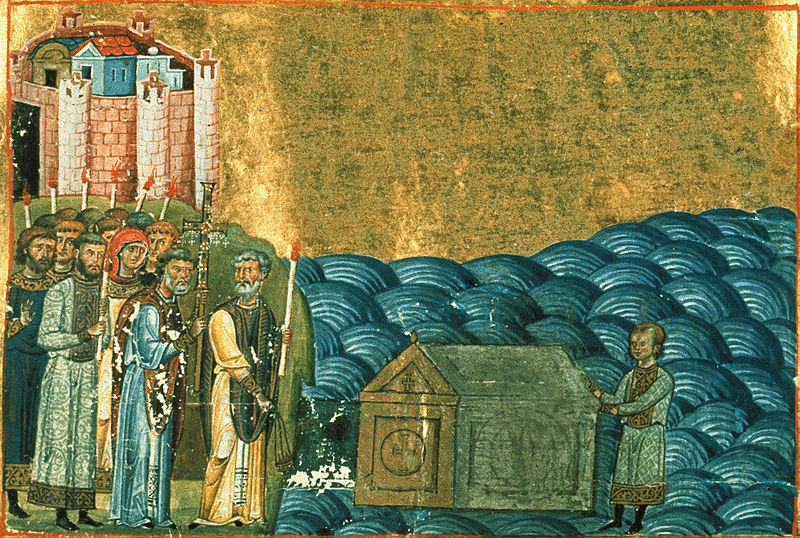
The author of an extant letter to the church of Corinth and the suppositious author of the pseudo-Clementine Recognitions and Homilies, Pope St. Clement I (d. c. 100) occupies either third or fourth place in early lists of the bishops of Rome. Although it now seems unlikely that he was martyred, throughout the Middle Ages he was accorded martyrial status (as he still is in many churches). According to his legendary late antique Passio (BHL 1848; translated into Greek, BHG 349-350), Clement was exiled by the Emperor Trajan to the mines of Crimea, evangelized there with much success (in which effort he was aided by his miraculous discovery of an underground stream from which his parched fellow workers then drank), and for his pains was thrown into the Black Sea weighted down with an anchor. In response to the prayers of his disciples Cornelius and Phoebus, the waters parted and Clement's body was miraculously revealed in a chapel where the faithful could venerate him annually for a week beginning on his _dies natalis_.

Thus far Clement's Passio. In the ninth century, Sts. Constantine / Cyril and Methodius brought to Rome from Constantinople bodily relics believed to be his. These were placed in Rome's basilica di San Clemente. Constantine / Cyril is said to have found or obtained them, together with the fatal anchor, in the Crimea. Here's a view of Constantine / Cyril and Methodius receiving Clement's remains by the Black Sea as depicted in the late tenth- or very early eleventh-century so-called Menologion of Basil II (Città del Vaticano, BAV, cod. Vat. gr. 1613, p. 204):

File:Menologion of Basil 062.jpg


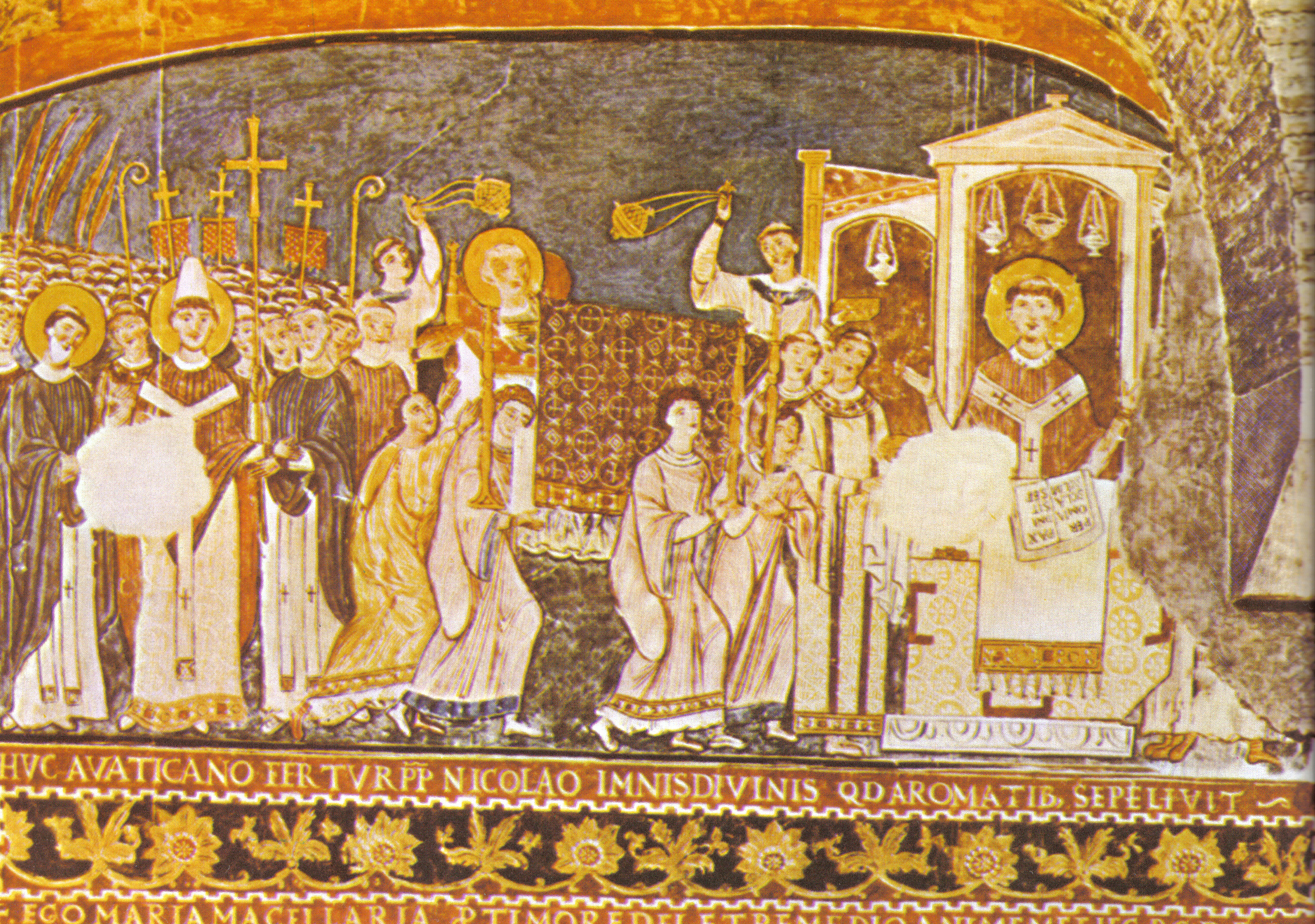
In an eleventh- or early twelfth-century fresco painted in what is now the lower church of San Clemente and depicting its reception of that saint's relics, Constantine/Cyril and Methodius (one nimbed, the other not) are shown at left accompanying the Pope:


Another view, taken from a watercolour of the fresco made shortly after its discovery in the nineteenth century:


A dubious tradition known to the author of the first Vita of St. Genovefa of Paris (BHL 3334; ca. 520) and perpetuated in, e.g., the legendary Passiones of St. Dionysius / Denys of Paris claims an apostolic origin for the church of Paris and for other Gallic churches through evangelization by missionaries whom Clement had sent out from Rome. Modern historical scholarship commonly rejects this notion.

In the (pseudo-)Hieronymian Martyrology and in the ninth-century martyrologies of St. Ado of Vienne and Usuard of Saint-Germain Clement's  dies natalis is given as VIIII Kal. Dec. (23. November). This remained Clement's feast day in the medieval Latin West and is still his feast day in churches whose sanctoral calendars descend from medieval Latin-rite Uses. In the medieval Greek church Clement's feast falls on 25. November in pre-Metaphrastic menologia, in the later tenth-century Metaphrastic Menologion, and in the initially tenth- and eleventh-century Synaxary of Constantinople. This remains his feast day in churches employing the Byzantine Rite.


By way of supplement to Gordon Plumb's recent post (23. Nov.) of links to medieval images of pope St. Clement I in glass, herewith links to some other period-pertinent images of this saint in various media:

a) as depicted (second from left, after St. Martin of Tours) in the heavily restored later sixth-century mosaic procession of male saints (c. 560) in the nave of Ravenna's basilica di Sant' Apollinare Nuovo:


Detail view (courtesy of Genevra Kornbluth):
http://www.kornbluthphoto.com/images/ApNSouth10.jpg

b) as depicted (second from left, after Pope St. Sylvester I) in a later eighth-century fresco ( between 757 and 767) in the nave of Rome's chiesa di Santa Maria Antiqua:


c) as depicted (left margin at bottom) in a ninth-century copy of St. John Damascene's Parallela sacra (Paris, BnF, ms. Grec 923, fol. 309v):
http://gallica.bnf.fr/ark:/12148/btv1b525013124/f622.item.zoom

d) as depicted (at centre, saying Mass) in an eleventh-century fresco in what is now the lower church of Rome's basilica di San Clemente:

 http://www.wga.hu/art/zgothic/mural/11c2/13clemen.jpg

e) as depicted in a mid-eleventh-century mosaic in the cathedral of St. Sophia in Kyiv / Kiev (lower portion restored with oil painting in the nineteenth century):


f) as portrayed in relief (upper register at centre) on the  tympanum (c. 1151-1175) above the west portal of the chiesa abbaziale di San Clemente a Casauria in Castiglione a Casauria (PE) in Abruzzo:


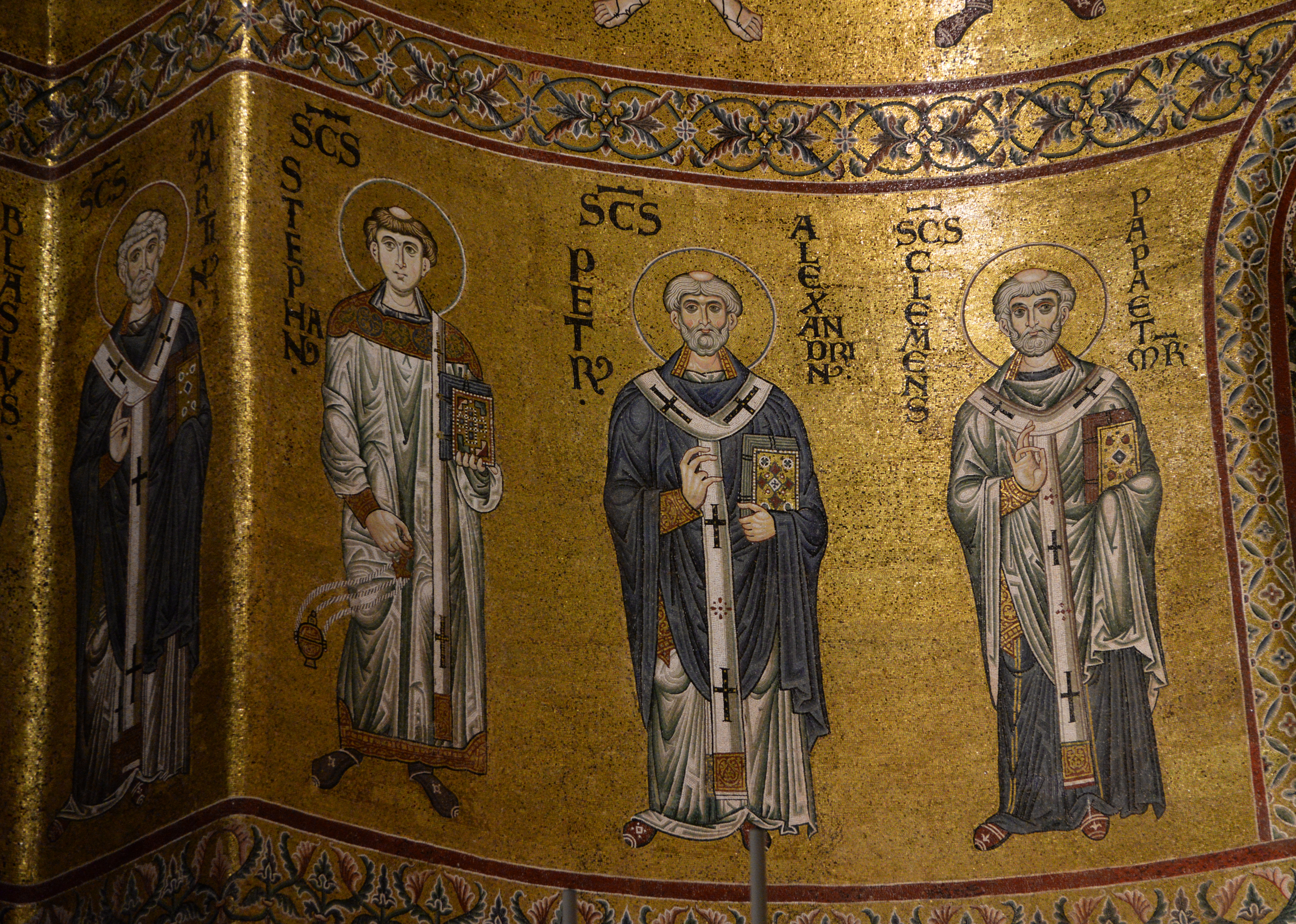
g) as depicted (at far right, after Sts. Martin of Tours, Stephen protomartyr, and Peter of Alexandria) in the late twelfth-century apse mosaics (c. 1182) in Monreale's basilica cattedrale di Santa Maria Nuova:


h) as depicted (at left, receiving the volume from its author-compiler) at the end of brother John Berard's late twelfth-century cartulary chronicle of the abbey of San Clemente a Casauria (1182; Paris, BnF, ms. Latin 5411, fol. 272v):
http://gallica.bnf.fr/ark:/12148/btv1b84526553/f556.item.zoom

i) as depicted (upper register at right; at left, St. Peter) in the very late twelfth- or very early thirteenth-century apse mosaic (c. 1200) of Rome's basilica di San Clemente:


j) as depicted in a thirteenth-century fresco in the rupestrian church of the grotta di San Giovanni at Cafaro, a locality of San Vito dei Normanni (BR) in southern Apulia:


k) as depicted (twice: at left, being baptized by St. Peter; at right, saying Mass) in a panel of the thirteenth-century St. Clement window in the choir of Köln's Basilika St. Kunibert (an earlier to mid-thirteenth-century replacement for a predecessor dedicated to Clement):
http://media.kunst-fuer-alle.de/img/41/g/41_00448697.jpg
Detail views:


l) as depicted (lower register at right; sending St. Dionysius and companions to Gaul) in a mid-thirteenth-century copy of a French-language Life of St. Dionysius of Paris (Paris, BnF, ms. Nouvelle acquisition française 1098, fol. 34r):
http://tinyurl.com/25year8

m) as depicted (upper register) in a panel of a mid-thirteenth-century glass window (c. 1245-1250; w. 201) in Strasbourg's cathédrale Notre-Dame:
http://therosewindow.com/pilot/Strasbourg/w201d-whole.htm

n) as depicted (martyrdom) in a late thirteenth-century copy of French origin of the _Legenda aurea_ (San Marino, CA, Huntington Library, ms. HM 3027, fol. 162v):
http://digitalassets.lib.berkeley.edu/ds/huntington/images//000918A.jpg

o) as depicted in the late thirteenth-century frescoes (c. 1295) by Michael Astrapas and Eutychios in the church of the Peribleptos (now Sv. Kliment Ohridski) in Ohrid:


p) as depicted (martyrdom) in a fourteenth-century glass window panel of French origin in the Burrell Collection, Glasgow:

Stained glass panel 'St. Clement of Rome', French, 14th century </br> © CSG CIC


q) as depicted (martyrdom) in an early fourteenth-century collection of French-language saint's lives (St John's College, Cambridge, MS B.9, fol. 133v):
http://tinyurl.com/2hendw

r) as depicted (at left; at right, St. Astius of Durrës / Durazzo) in the earlier fourteenth-century frescoes (c. 1308-1320) by Michael Astrapas and Eutychios in the church of St. Nicetas the Goth (Sv. Nikita) at Čučer in today's Čučer-Sandevo in the Former Yugoslav Republic of Macedonia:
http://tinyurl.com/ok8rar5

s) as depicted (at the foot of the page; martyrdom) in the early fourteenth-century Queen Mary Psalter (c. 1310-1320; London, BL, Royal MS 2 B VII, fol. 279r):
http://www.bl.uk/manuscripts/Viewer.aspx?ref=royal_ms_2_b_vii_f279r

t) as depicted (at left; at right, St. Meletius of Antioch) in the earlier fourteenth-century frescoes (ca. 1312-1321/1322) of the Paraclis of the Theotokos in the monastery church of the Theotokos at Gračanica in, depending on one's view of the matter, Serbia's province of Kosovo and Metohija or the Republic of Kosovo:
http://tinyurl.com/yekmrox
Detail view (Clement):


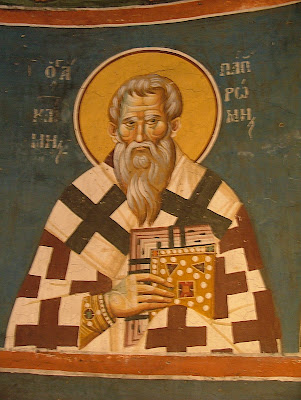
u) as depicted (at left, with St. Hippolytus, Bishop of Pontus  and St. Metrophanes [of Byzantium]) in the earlier fourteenth-century frescoes (c. 1313-1318; conservation work in 1968) by Michael Astrapas and Eutychios in the church of St. George at Staro Nagoričane in the Former Yugoslav Republic of Macedonia:
http://tinyurl.com/3zpcevk

v) as depicted (at left in panel at upper left; at right, the martyrdom of St. Peter of Alexandria) in an earlier fourteenth-century pictorial menologion from Thessaloniki (betw. 1322 and 1340; Oxford, Bodleian Library, MS Gr. th. f. 1, fol. 18v):
http://image.ox.ac.uk/images/bodleian/msgrthf1/18v.jpg

w) as depicted (second from right, sending St. Dionysius and other missionaries to Gaul) in an earlier fourteenth-century copy of theLegenda aurea in its French-language version by Jean de Vignay (ca. 1326-1350; Paris, BnF, ms. Français 185, fol. 204v):
http://tinyurl.com/yfrz7hr

x) as depicted (martyrdom) in an earlier fourteenth-century French-language legendary of Parisian origin with illuminations attributed to the Fauvel Master (ca. 1327; Paris, BnF, ms. Français 183, fol. 74r):
http://tinyurl.com/ylal2j2

y) as depicted (at left; at right, the martyrdom of St. Peter of Alexandria) in the earlier fourteenth-century frescoes (ca. 1335-1350) in the narthex of the church of the Holy Ascension at the Visoki Dečani monastery near Peć in, depending on one's view of the matter, either the Republic of Kosovo or Serbia's province of Kosovo and Metohija:


z) as depicted (martyrdom) in a mid-fourteenth-century copy, from the workshop of Richard and Jeanne de Montbaston, of the Legenda aurea in its French-language version by Jean de Vignay (1348; Paris, BnF, ms. Français 241, fol. 311r):
http://tinyurl.com/28sckhc

aa) as depicted in a cutting from a later fourteenth-century gradual (c. 1370) illuminated by Silvestro dei Gherarducci for the monastery of Santa Maria degli Angeli in Florence (Florence, Biblioteca Laurenziana, Cod. cor. 2; this image from fol. 159r):


bb) as depicted (twice: at left, uncovering the buried stream; at right, martyrdom) in a later fourteenth-century copy of books 11-13 of Vincent of Beauvais' Speculum historiale in its French-language version by Jean de Vignay (ca. 1370-1380; Paris, BnF, ms. Nouvelle acquisition française 15941, fol. 16v):
http://gallica.bnf.fr/ark:/12148/btv1b8449688c/f40.item.zoom

cc) as depicted in a fifteenth-century glass window panel of German origin in the Burrell Collection, Glasgow:
https://www.flickr.com/photos/paullew/8209861563

dd) as portrayed in a fifteenth-century polychromed wooden statue on the high altar of the Sankt Clemens Kirke in Rømø (Tønder Kommune), Syddanmark:


ee) as depicted (at right; baptizing St. Taurinus) in a panel of a mid-fifteenth-century glass window (c. 1450) in Évreux's église Saint-Taurin:


ff) as depicted in grisaille (martyrdom) by Jean le Tavernier in the mid-fifteenth-century Hours of Philip of Burgundy (ca. 1451-1460; Den Haag, KB, ms. 76 F 2, fol. 257r):
http://manuscripts.kb.nl/zoom/BYVANCKB%3Amimi_76f2%3A257r_min

gg) as depicted by Giovanni di Paolo in a mid-fifteenth-century panel painting (c. 1455; from a dismembered altarpiece) in the Musée du Petit Palais, Avignon:


hh) as depicted (lancet at far right; at left and centre, the martyrdom of St. Thomas of Canterbury) in a later fifteenth-century glass window (w. 214) in Paris' église Saint-Séverin:
http://www.flickriver.com/photos/29495960@N00/15021005293/

ii) as depicted (lower register at left; blessing St. Domitilla in prison) in an illumination depicting events from the legendary Passio of Nereus and Achilleus in a later fifteenth-century copy of Vincent of Beauvais' Speculum historiale in its French-language version by Jean de Vignay (1463; Paris, BnF, ms. Français 50, fol. 358v):


jj) as depicted by Peter Hemmel of Andlau in a panel of a later fifteenth-century glass window (1477-1478) in Ravensburg's Liebfrauenkirche:


kk) as depicted (upper register at far left) by Domenico Ghirlandaio in a later fifteenth-century panel painting (c. 1479) of the Madonna and Christ Child with Saints in Lucca's cattedrale di San Martino:


ll) as depicted (uncovering the buried stream) in a later fifteenth-century copy of Vincent of Beauvais' Speculum historiale in its French-language version by Jean de Vignay (c. 1480-1490; Paris, BnF, ms. Français 245, fol. 182v):
http://tinyurl.com/qjp32yd

mm) as depicted (right margin at top) in a hand-coloured woodcut in the Beloit College copy of Hartmann Schedel's late fifteenth-century Weltchronik (Nuremberg Chronicle_; 1493) at fol. CVIIIv:
http://www.beloit.edu/nuremberg/book/6th_age/left_page/12%20%28Folio%20CVIIIv%29.pdf

nn) as depicted by Bernardino Fungai in two late fifteenth- or early sixteenth-century predella panel paintings (c. 1498-1501; from his Coronation of the Virgin altarpiece in Siena's chiesa di Santa Maria dei Servi) in the York Art Gallery, York:
1) Uncovering the buried stream:

St Clement Striking the Rock

2) Martyrdom:

The Martyrdom of St Clement


oo) as depicted in a late fifteenth-or early sixteenth-century vault fresco (c. 1500-1503; restored, 1896-1899) in Skivholme Kirke (Skanderborg Kommune), Midtjylland:


pp) as depicted (at right; at left, St. Christopher) in an early sixteenth-century fresco (c. 1515-1520) in Aarhus Domkirke (dedicated to Clement):


Saturday, 1 August 2015

August


Image:Wikipedia


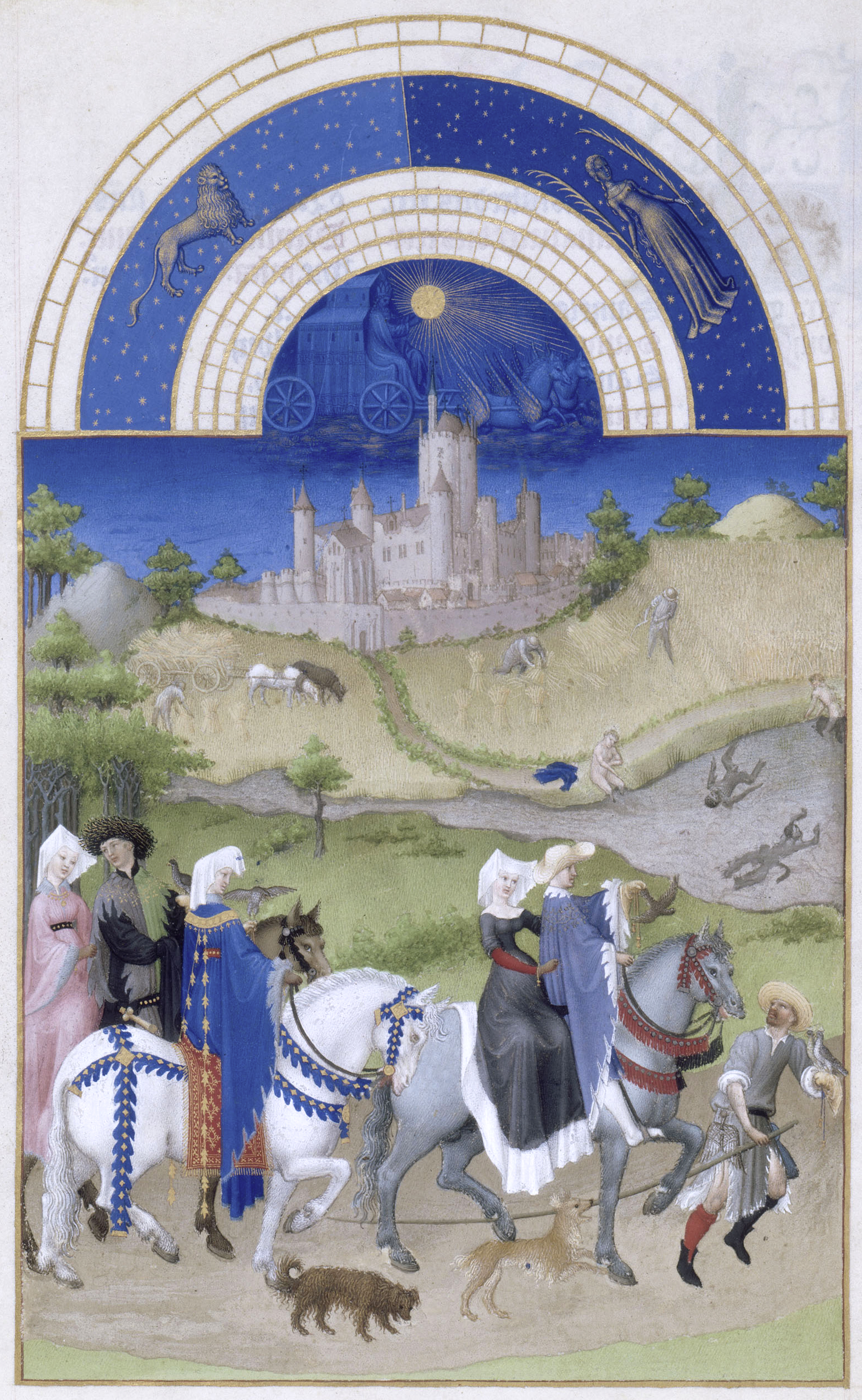
The August illumination in the Très Riches Heures of the Duke of Berry is attributed to Jean Limbourg. In the foreground it depicts an aristocratic falconry party. The young man on the leading horse as well as the huntsman or groom wears a straw hat that looks very contemporary to the modern viewer, and is presumably the type of headgear, "a sorry straw hat", in which Henry Beaufort  Duke of Somerset was recorded as wearing on his head whilst jousting in 1463. Here once again the fashionable members of the aristocratic world of the early fifteenth century are out and about enjoying themselves in traditional country pursuits, and also courtly dalliance.

In the background are a group of bathers enjoying swimming in the warm weather whilst others gather in the harvest. The mood is relaxed and prosperous, suggesting long lazy days for some, and, for those working, warmth and sunshire, and the promise of plenty for the coming autumn.

In the background is the Château d'Étampes. Today, as the link explains, only the keep remains of the castle. This great tower of Étampes is of particular interest to me as it may have inspired the design of Clifford's Tower at York in the thirteenth century, and that in turn may have influenced, in the fourteenth century, the design of the great tower, the so called Round Tower, of the castle in my home town of Pontefract, and that at the nearby castle at Sandal.

In August 1415 King Henry V was in the last stages of preparing to invade France. At the very beginning of the month his whole plan of campaign was threatened by the discovery of the Southampton Plot, about which there is an online account and discussion at here.

With that problem dealt with,  on August 11th the King and his army sailed across the Channel, and began the siege of Harfleur.

Friday, 1 August 2014

August


File:Les Très Riches Heures du duc de Berry aout.jpg

Image:Wikipedia

The August illumination in the Très Riches Heures of the Duke of Berry is attributed to Jean Limbourg. In the foreground it depicts an aristocratic falconry party. The young man on the leading horse as well as the huntsman or groom wears a straw hat that looks very contemporary to the modern viewer, and is presumably the type of headgear, "a sorry straw hat", in which Henry Beaufort  Duke of Somerset was recorded as wearing on his head whilst jousting in 1463. Here once again the fashionable members of the aristocratic world of the early fifteenth century are out and about enjoying themselves in traditional country pursuits, and also courtly dalliance. 

In the background are a group of bathers enjoying swimming in the warm weather whilst others gather in the harvest. The mood is relaxed and prosperous, suggesting long lazy days for some, and, for those working, warmth and sunshire, and the promise of plenty for the coming autumn.

In the background is the Château d'Étampes. Today, as the link explains, only the keep remains of the castle. This great tower of Étampes is of particular interest to me as it may have inspired the design of Clifford's Tower at York in the thirteenth century, and that in turn may have influenced, in the fourteenth century, the design of the great tower, the so called Round Tower, of the castle in my home town of Pontefract, and that at the nearby castle at Sandal.

Saturday, 22 March 2014

The beheading of Thomas of Lancaster in 1322


I have posted before on this anniversary day of his death by beheading at Pontefract in 1322 about Thomas  Earl of Lancaster - or as some came to regard him, St Thomas of Pontefract - and these previous posts can be seen at St Thomas of Pontefract from 2011, and there are three posts from 2012, St Thomas of Pontefract at South NewingtonSt Thomas of Pontefract in the British Museum and St Thomas of Pontefract in the Sellers Hours.

This year I have found another nearly contemporary depiction of his death. It is from Villani's Cronica Nuova and must date from only a generation or so after the event. As such it indicates interest in English political events in Florence at the time - but the downfall of Earl Thomas would have been a major news story given his prominence in English life and his family connections to both the English and French royal houses.

Unfortunately the photograph is in black and white rather than colour. The miniature is in no way, both in its Florentine provenence and its detail, an eye- witness record. King Edward II can be seen observing the execution of his cousin from within Pontefract castle - in reality the execution took place almost a mile away on what became known as St Thomas' Hill and became a place of pilgrimage as the cult of St Thomas of Pontefract developed in the following years. Nonetheless this is an interesting depiction of an event that clearly attracted wide attention in what happened to become my home town.


File:Eduard II mort Tomas Lancaster.jpg

 
Image: Wikimedia


Tuesday, 25 June 2013

Executions at Pontefract


"O Pomfret, Pomfret! O thou bloody prison,
    Fatal and ominous to noble peers!
    Within the guilty closure of thy walls
    Richard the second here was hack'd to death;
    And, for more slander to thy dismal seat,
    We give thee up our guiltless blood to drink."

Shakespeare Richard III Act 3 Scene 3

Thus does the character of Anthony Woodville Earl Rivers apostrophise the castle at Pontefract in Richard III. In the scene he, his nephew Lord Richard Grey and Sir Thomas Vaughan are about to be decapitated on the orders of Richard Duke of Gloucester as part of his seizure of the throne 525 years ago in June 1483. The Pontefract executions occurred on June 25th.

File:Pontefract Castle.jpg

Pontefract Castle circa 1630
Today the castle is little more than foundations

Image: Wakefield MDC Museums

The immediate beginning of these events was the death on April 9th of King Edward IV, and the accession of his twelve year old son King Edward V, who was then at Ludlow. He left there in the company of, amongst others, his mother's brother Lord Rivers, his half brother Lord Richard (second son of Queen Elizabeth's first marriage) and Sir Thomas Vaughan, his father's Treasurer of the Household, on April 24th to travel to London.  

On April 29th they were met at Stony Stratford by Richard Duke of Gloucester, the late King's surviving younger brother, aged 31, and Henry Duke of Buckingham, who was married to Queen Elizabeth and Rivers' sister Catherine, and was 27. The party dined together, but on the following day Rivers, Grey and Vaughan were arrested on a charge of plotting against the Duke of Glouceser and sent north, into Richard's political heartland. Rivers was sent to Sheriff Hutton Castle and Grey to Middleham castle - both of them properties acquired by Duke Richard by his marriage to the daughter of Warwick the Kingmaker. Vaughan was sent to Pontefract, the other castle which served as the base for Gloucester's role as the King's representitive in the north. The boy King was taken to London, lodged in state in the Tower, and plans made for his coronation, but which continued to be postponed.

Gloucester's actions, if not intended from the beginning as a bid for the throne may reflect fears on his part of being excluded by the Woodville-Grey faction from his natural role as the new King's uncle and protector, and an awarenes s of the fates of the two previous Dukes of Gloucester, Thomas and Humphrey, following royal minorities. He may also have considered the Woodvilles responsible in part at least for the downfall and death of his brother George Duke of Clarence in 1477-8, not so much from affection as from fear of a similar fate. Buckingham, if not merely opportunistic, may well have resented being married as a boy to Catherine Woodville. It apears clear that the Woodvilles had never ben popular with at least a significant part of the Yorkist establishment

On June 10th letters were taken north by Sir Richard Ratcliffe, one of the Duke of Gloucester's closest lieutenants to raise an army and on June 13th Lord Hastings, Chamberlain to the King's late father, was seized and beheaded in the Tower of London. On June 22nd the story of the pre-contact of the late King Edward and Lady Eleanor Butler, which would invalidate the marraige of the King to Elizabeth Woodville and hence deprive King Edward V of his right to the throne, was first publicised in London.

 
larger image

Sheriff Hutton Castle in the early eighteenth century
After Samuel and Nathaniel Buck


Image: antique-prints-maps.com


photo

Sheriff Hutton Castle from the north-west

 Image:Nick Garrod on Flickr


On June 23rd Rivers, doubtless hearing the worst made his last will as Sheriff Hutton, though he seems to have had some expectation of  travelling to the south:
"I, Anthony Wodevile, in the castle of Sheriff Hutton, bequeath all my lands that were my father's, to my brother Sir Edward Wodevile, and his heirs male, my heart to be buried (if I die south of Trent) before our lady of Pewe, beside St. Stephen's college at Westminster, also the lands that were my first wife's the Lady Scales, and Thomas Lord Scales's, her brother, to my brother Sir Edward, and his heirs male; but he to whom it should come, before he took possession thereof, to deduct 500 marks to be imployed for the souls of the said lady and her brother, and the souls of all the Scales's blood, &c. and to find a priest for one year to pray for them, his own soul, and all Christian souls, at our lady of Pewe; and another priest to sing at the chapel of the Rodes, in Greenwich, for his own soul, and all christian souls."

He willed the manor of Tirington Hall, in Middleton in Norfolk, the hundred of Frebridge, the manor of Wolverton and advowson, in Norfolk, with the manor of Rokeys in Berkey, in Hertfordshire, to be sold, to establish a hospital at Rochester, for 13 poor folk.
He directed that his apparel for his body was to be sold, with his horse-harness, &c. and with the money resulting therefrom, shirts and smocks to be bought for poor folks.

He appointed the Lady Willoughby, late wife of Sir Jervace Clifton, William Tunstall, Robert Poynts, Richard Hawte, William Catesby, Andrew Dimock, overseers of his will; but it does not appear that it was proved.

He left no children by his two wives, but by a mistress, called Gwentlian, only daughter of Sir William Stradling, third son of Sir William Stradling of Glamorgan , and Isabel, his wife, he had a daughter Margaret, who married Sir Robert Poynts, of Acton Iron in Gloucestershire.
Blomefield Norfolk 1809 vol 9  sub Middleton

That same day or the following he was taken the forty or so miles to Pontefract where he rejoined his nephew and Vaughan. Following an apparently perfunctory semblance of a trial presided over by the Earl of Northumberland the three men were behreaded in the presence of the northern army assembled by Ratcliffe, who seems to have been Gloucester's agent in the whole business. Ratcliffe announced to the ose present that the men were traitors. According to Edward Hall in the following century their bodies were buried naked in the nearby Cluniac monastery of St John - they were not interred as had been victims of the battle of Wakefield in the Dominican hous en the town, as they do not  feature in the comprehensive list of burials there made on the eve of the dissolution.

A hair shirt worn by Rivers was offered up and hung before the statue at the shrine of Our Lady of Doncaster in that town's Carmelite friary - perhaps an attempt to fulfill Rivers' request for his heart to be buried before Our Lady of Pew at Westminster. Aged 40 or 41 at the time of his death from his will Rivers appears pious within the courtly traditions of the era, and he was the most accomplished and cultivated member of his family according to the available evidence. There is an online account of his life here and the study by Michael Hicks in the Oxford DNB is here.

His nephew Lord Richard Grey was perhaps 23 at the time he died, and there is  an online life here.
The Oxford DNB account of him by Rosemary Horrox is here.

Sir Thomas Vaughan was about 73. There is an online article about him here,and the life by Prof. R.A. Griffiths in the Oxford DNB is available hereDuring his lifetime he had prepared a tomb with a monumental  for himself in Westminster abbey, and there is an article about that here.


The brass of Sir Thomas Vaughan in Westminster Abbey 

Image: keithblayney.com

Sir Richard Ratcliffe, who was clearly in charge of events at Pontefract, was to be immortalised in the couplet "The Rat, the Cat and Lovell our Dog rule all England under Richard the Hog" over the next two years before his death at Bosworth along with the King he served - William Catesby (named by Rivers as an executor in his will) was executed after that battle, and Francis Lord Lovell disappeared.
There is an online life of Ratcliffe here, and the life by Rosemary Horrox in the Oxford DNB  can be read here 


A fourth man, Sir Richard Haute, another executor of Rivers, is sometimes said to have been killed at Pontefract, but he was spared, and lived quietly through the next two years and died in 1492. The  article by Peter Fleming in the Oxford DNB about the Haute family can be read here

On the same day as the Pontefract executions the crown was offered to Richard Duke of Gloucester on the basis of his being the next lawful successor to King Edward IV, and he commenced his reign as King Richard III from the next day June 26th.

Thursday, 14 February 2013

The skull of King Richard II


February 14th is often given as the approximate date for the death of King Richard II at Pontefract Castle in 1400. 

This is based on rather cryptic letters from the Council in London enquiring as to whether the ex-King was still alive or if he was dead, and if he was, that his body should be sent put on display. Assuming that the real Richard had not escaped to Scotland as some claimed his embalmed body was sent to London, displayed at St Pauls and then buried, first at King's Langley and then moved to its original intended burial place in Westminster Abbey by King Henry V.

With all the recent interest in the bones of King Richard III I thought this drawing, made in 1871, of the skull of King Richard II might be of interest. There is more about the drawing here. It was made during restoration work at Westminster when the tomb was opened. One thing this nineteenth century examination showed was that death was not caused by a blow to the back of the head, as in Shakespeares's King Richard II. The fact of their being no known historical figure of Sir Piers Exton, who slays the ex-monarch in the play, has led to historians looking to Sir Peter Buckton as the possible assassin but there remains a range of possibilities as to the nature of King Richard's death.
 

Eerie: A sketch of the skull of medieval King Richard II found in the National Portrait Gallery basement

Image:Daily Mail 


Wednesday, 1 August 2012

August


File:Les Très Riches Heures du duc de Berry aout.jpg

Image:Wikipedia

The August illumination in the Très Riches Heures of the Duke of Berry is attributed to Jean Limbourg and shows an aristocratic falconry party. The young man on the leading horse as well as the huntsman or groom wears a straw hat that looks very contemporary to the modern viewer, and is presumably the type of headgear " a sorry straw hat" in which Henry Beaufort  Duke of Somerset was recorded as jousting in in 1463. Here once again the fashionable aristocratic world of the early fifteenth century are out and about enjoying themselves in traditional country pursuits. 

In the background are a group of bathers enjoying swimming in the warm weather whilst others gather in the harvest. The mood is relaxed and prosperous, suggesting long lazy days for some, and for those working warmth and sunshire, and the promise of plenty for the coming autumn.

In the background is the Château d'Étampes. Today, as the link expalins, only the keep remains of the castle. Étampes is of particular interest to me as it may have inspired the design of Clifford's Tower at York in the thirteenth century and that in turn may have influenced, in the fourteenth century, the design of the great tower, the so called Round Tower, of the castle in my home town of Pontefract.


Monday, 4 June 2012

A Jubilee beacon at Pontefract


On the BBC News following the Jubilee concert the reports on the celebrations included on eon the beacons lit across the United Kingdom and the Commonwealth to mark the Diamond Jubilee - over 4,000, twice the number the organisers had originally envisaged. The news report featured the beacon on the top of what remains of the keep at Pontefract castle, that is in my home town. It was not just that fact of local pride but the suitability of Pontefract that struck me.

In the sieges of 1644 and 1645 the Royalist garrison of the castle used baconds on the top of the Round Tower - that is the keep - to signal to their fellow Royalists at York and at Sandal castle. In the history of the monarchy it is the last siege of Pontefract in 1648-49 that is most significant as can be seen from my post from last year Post Mortem Patris Pro Filio.

This was just one more of the many links that bind the history of Pontefract, and particularly the castle, into the history of the monarchy, and vice versa. In the middle ages and down to the seventeenth century it was often a violent and sensational story but one that fired my imagination for the history of the period, and for the study of both castles and crowns. As part of the local celebrations of the Silver Jubilee in 1977 I gave a talk on the town's links with the Crown -it was one of those lectures I meant to write up and publish, but never have done.

Thursday, 22 March 2012

St Thomas of Pontefract in the British Museum


In my post last year on St Thomas of Pontefract I referred to a lead devotional plaque about his life and death which is now in the British Museum. Through the Museum website I have now found a photograph of this remarkable survival.

Devotional panel; lead; openwork; six scenes from life of Thomas, Earl of Lancaster (1277-1322); scenes arranged in two tiers under architectural canopy; tracery contains figure of God seated on rainbow with censing angel on either side; gable surmounted by Crucifixion with two headless saints on pinnacles; single figure in each of four projecting niches,  two on either side; shield with arms of England in centre.

AN755669001

© The Trustees of the British Museum. Department of Prehistory and Europe

Registration number: 1954,0502.1


Of English manufacture and dated to the later fourteenth century, it is described as a devotional panel, and is made from lead. I wonder if originally it would have been painted, or whether it simply had a polished finish, as with modern reproductions of pilgrim badges.

The openwork comprises six scenes from the last days of Thomas, Earl of Lancaster (1278-1322). The scenes are arranged in two tiers under an architectural canopy.

In the upper register the first scene appears to show the King and two bishops; the second is the battle of Boroughbridge and the death of Thomas' ally the Earl of Hereford; the third scene shows Earl Thomas being taken by boat from the battlefield as a captive. In the lower register the first scene shows Thomas being tried in his castle at Pontefract 'on the King's record' - that is to say, the King recounted his cousin's notorious misdemeanours and the jury of peers condemned him prompting the Earl's rejoinder "Shall I die without answer?"; in the second scene he is taken to the place of execution - still known as St Thomas' Hill; in the third scene he is beheaded.

The tracery contains the figure of God seated on rainbow with censing angel on either side. Flanking the gable are figures of St Paul on the left and St Peter on the right. The gable is surmounted by the Crucifixion with two headless saints, presumably Our Lady and St John, on pinnacles; there is a single figure in each of four projecting niches, two on either side; shield with the arms of England in centre.

Dimensions
Height: 165 millimetres
Width: 127 millimetres

Bibliography
Hugh Tait, 'Pilgrim-Signs and Thomas, Earl of Lancaster,' The British Museum Quarterly, Vol XX (1955-56) 40.


This piece may well be similar to the tablet showing Thomas which was set up in St Paul' s in London within a year or so of his death and which the government ordered to be removed. After 1327 the cult spread and a memorial chapel was built on the site of the execution in 1361.

St Thomas of Pontefract at South Newington


Last year on this day I posted St Thomas of Pontefract about the cult that developed around Thomas Earl of Lancaster who was executed for rebellion on this day 690 years ago at Pontefract following his defeat at the battle of Boroughbridge. Devotion to him certainly continued at Pontefract until the sixteenth century. I would point readers back to that post before reading this fresh post about his cult.

In that previous post I illustrated the remains of a wall painting at South Newington in Oxfordshire which depicts the martyrdom of St Thomas of Pontefract and pairs it with that of St Thomas of Canterbury. The pair of paintings are an addition to the cycles that were already in the church, and points to Lancastrian influence in the area after 1326 and the downfall of King Edward II.

http://www.paintedchurch.org/snewttho.jpg

The martyrdom of St Thomas of Pontefract
South Newington church, c.1330

Image:paintedchurch.org

There is an online account of both paintings here, and I highly recommend a visit to this very intersting church and its impressive and substantial remains of medieval wall painting.


Thomas of Lancaster Executed
I have now found on the internet this picture, which appears to be an attempted reconstruction of the painting as it may once have appeared to the parishioners of South Newington.

For some reason the figure of Earl Thomas has been reversed, and the relative postions of the figures would definitely handicap the executioner ("a villein of London"according to a contemporary account.)


Image : Luminarium

Wednesday, 23 November 2011

St Clement and his churches


St Clement, whose feast day falls today, was the third successor of St Peter, and is accorded a place in the Roman Canon. There is an online article about him and his cultus here.

http://www.aug.edu/augusta/iconography/sanClemente/apse.SSright.jpg

St Peter and St Clement
Mosaic circa 1200 San Clemente Rome
Image:www.aug.edu

The New Liturgical Movement has an article about him, with links to a series of their posts about the remarkable, even amongst Roman churches, San Clemente in Rome, which can be read at St. Clement and San Clemente. There is a page about the iconography of the apse here.

San Clemente has been in the care of the Irish Dominicans since 1667, and there is a general introductory article about the basilica here.

Thursday, 10 February 2011

Women in early sixteenth century households


My series of tutorials on sixteenth century women continued today by looking at women in two somewhat different households. The first was that of Thomas More at Chelsea, and in particular his eldest daughter Margaret Roper (1505-1544) and her sister-in-law Anne Cresacre (1511-1577). the other was that of the Dowager Duchess of Norkolk at Horsham St Faith and Lambeth, which produced Katherine Howard (c.1521-1542), Henry VIII's fifth wife.

They are interesting as households in that we have internal evidence of the way they functioned and in the lives of the women formed within them. More was in many ways exceptional in his interests and appreciation of the possibilities of female education. It was a serious, learned,pious household. As a friend once pointed out to me it anticipates the Puritan households of thelater decades of the century and of the next. Indeed another similar one might be the Ferrer household at Little Giddings in the 1630s and 1640s. With its humanist educational ideals it was unusual for its date in England apart from the Court and the circle around Queen Katherine of Aragon and her daughter, Princess Mary.


Portrait of Margaret Roper, from a 1593 copy of a now-lost Hans Holbein portrait of Thomas more and his family.

Image: Wikipedia from the National Portrait Gallery

Margaret Roper is remembered for her fidelity to her father in his last months, and her husband wrote the first English biography of his father-in-law. Anne Cresacre entered the More household in the traditional position of a ward with an estate, and she married John More in 1529. My particular interest in her arises from the fact that her home at Barnburgh near Doncaster in the West Riding of Yorkshire is close to my own home town, and her memorial brass inscription can still be seen in the very fine medieval church there. After the martyrdom of her father-in-law she returned to Barnburgh with her husband and their descendants lived there until the line died out in the nineteenth century.


Anne Cresacre

Drawing by Holbein c.1528

Image: library thinkquest.org from The Royal Collection

The Dowager Duchess of Norfolk's household which produced Katherine Howard was, it emerged, lax in maintaining proper oversight of the younger members, with inevitable consequences. Although not illiterate Katherine appears to have been less well educated than many other women of similar position. She appears to have been vivacious and attractive, but otherwise fatally silly, if not stupid. What might be tolerated in provincial society was not when she was the Queen Consort. The result was her death and those of Thomas Culpepper, her apparent lover, and Francis Dereham, to whom she was technically married when she became the King's wife, and whom she had employed in her household when she was Queen. Again I have a local interest in her story - one of the places she was held to have committed adultery with Culpepper during the royal progress to and from York in 1541 was Pontefract castle.


Queen Katherine Howard

Miniature by Hans Holbein the Younger.
The portrait has been believed to be of her since the eighteenth century, although this has never been definitely authenticated. However the jewellery and the resemblance to another minature in the Royal Collection make it virtually certain. No other true portrait of her is known to exist.

Image: Wikipedia from the collection of the Duke of Buccleugh

Moving on from these biographical studies it was possible to look at the part played by such households in educating women for their responsibilities as mistresses of their own houses, as well as the acquisition of courtly skills for those destined, or who saw themselves as so destined, for noble and royal society. It was all education, as well as an entry into the marriage market, with all the hopes and fears of propertied parents for the future of their lineage and lands. The ladies of the More householdreceived, or had the possibility of, an exceptional education and strong Catholic formation - their descendents were to remain recusant for centuries to come. Katherine Howard learned somethings as a girl that were no help at all; her meteoric career and fall bore witness to the risks involved in the world of the household and, above all, the King's court.