Once I was a clever boy learning the arts of Oxford... is a quotation from the verses written by Bishop Richard Fleming (c.1385-1431) for his tomb in Lincoln Cathedral. Fleming, the founder of Lincoln College in Oxford, is the subject of my research for a D. Phil., and, like me, a son of the West Riding. I have remarked in the past that I have a deeply meaningful on-going relationship with a dead fifteenth century bishop... it was Fleming who, in effect, enabled me to come to Oxford and to learn its arts, and for that I am immensely grateful.


Showing posts with label Papal tiara. Show all posts

Wednesday, 28 May 2025

The Papal Tiara


In my recent article about the Pope inaugurating his Petrine ministry at the Vatican a week last Sunday and his taking possession of the Lateran last Sunday I stated my great regret at the fact that the Popes since Paul VI abandoned wearing the tiara, and gave away the one his old diocese of Milan had given him upon his election. Since 2005, it is no longer used it on their coats of arms; as I pointed out in my note about Papal Heraldry saecular monarchs use a crown on their arms whether they are actually crowned or not, or even if they do not actually have a crown.

The excellent website produced by Allan  Barton The Antiquary marked the new Pope’s inauguration with a video about the history of this distinctive piece of insignia, about earlier ones which no longer survive, about the Papal Coronation and about the splendid collection of tiaras in the Vatican.

Although much of this was not new to me it was good to see so comprehensive marshalling of the relevant material. One thing where I might disagree slightly is that I think it was Boniface VIII, and not his one of his successors who added the two additional circlets above the original jewelled band of the Tiara. One I suspect sat immediately on top of that jewelled band, and was not immediately distinct from it. I say this because I think I saw in the printed inventory of Boniface VIII’s possessions mention of a Tiara with three crowns. Just when you want to have a book to hand…. I am open to correction on the point. Such a change would certainly fit with Boniface’s sweeping vision of Papal authority, and, lest you think the author of Unam Sanctam belongs to the medieval past, do not forget what Pius XII wrote in Mystici Corporis in 1943:
That Christ and His Vicar constitute one only Head is the solemn teaching of Our predecessor of immortal memory Boniface VIII in the Apostolic Letter Unam Sanctam; and his successors have never ceased to repeat the same.

One thing that I did learn from the video was that Julius II’s tiara survived until the French invaded the Papal States at the very end of the eighteenth century. Nor did I know of Benedict XV selling jewels from the tiaras to fund relief work in the First World War. The tradition of churchmen selling plate and jewels in aid of good and worthy causes is, of course, a long-standing one.

Although I suspect Allan Barton is not quite so much an enthusiast for the Papal Tiara as I am I certainly would recommend the video, which can be seen at The History of the PAPAL TIARA


The effect of watching the video was, of course, to make me yearn for, believe all the more, in its return to use.

Sunday, 25 May 2025

Papal heraldry


The website of the Liturgical Arts Journal has in interesting article  about the way in which different heraldic artists have rendered the arms of the successors of Pope Pius XII. 

The author, Marco Foppoli, is an heraldic designer and artist and his critique is good as to unimaginative design and execution, as well as his comments about the lamentable abandonment of the Papal tiara - monarchs who do not have coronation ceremonies still have crowns over their shields, even if no physical crown exists at all, as in Belgium and Monaco. 


Saturday, 16 July 2016

Pope Innocent III


It was on July 16 1216, eight centuries ago, that Pope Innocent III died.

To mark the anniversary here are three contemporary or nearly contemporary images of the Pope and  some quotations from him.

Image result for Innocent III

Image:thinglink

At his consecration he said in his sermon

" Only Peter was given fullness of power. You see, then, who is placed in charge of the household: it is Jesus Christ's vicar, Peter's successor, the Lord's anointed, the Pharoah's god. I am placed between God and man, below God but above man; I am less than God but more than man; I am he who will judge all and be judged by none."
From The Catholic Encyclopaedia - Plenitudo potestates

Image result for Innocent III 

Image:classes.maxwell.syr.edu

 The unmeasured assertion of his dignity, with the loudest protestations of humility, betrays the real spirit of the pope. Thus he spoke out: "Ye see what manner of servant that is whom the Lord hath set over His people; no other than the vice-gerent of Christ, the successor of St. Peter. He is the Lord's anointed; he stands in the midst between God and man; below God, above man; less than God, more than man. He judges all, he is judged by none, for it is written, 'I will judge.' But he whom the preeminence of dignity exalts, is lowered by his office of a servant that so humility may be exalted, and pride abased; for God is against the high-minded; and to the lowly he showeth mercy: and he who exalteth himself shall be abased."

Pope Innocent also discovers the Papacy in the Book of Genesis: "The firmament," he says, "signifies the church. As the Creator of all things hath set in the heavens two great lights, the greater to rule the day, the lesser to rule the night, so also hath He set up in the firmament of His church, two great powers: the greater to rule the souls, the lesser to rule the bodies of men. These powers are the pontifical and the royal: but the moon, as being the lesser body, borroweth all her light from the sun; she is inferior to the sun both in the quantity and quality of the light she sends forth, as also in her position and functions in the heavens. In like manner the royal power borrows all its dignity and splendor from the pontifical, so that the nearer it approaches the greater light, the more are its rays absorbed, and its borrowed glories eclipsed. It was moreover ordained that both these glories should have their fixed and final abode in this our land of Italy, inasmuch as in this land dwelleth, by and through the combined primacy, of the Empire and the priesthood, the entire foundation and structure of the Christian faith, and with it a predominant principality over both!"

Andrew Miller Church History : Chapter 24 [ Adapted]

Image result for Innocent III

Image: Alchetron

"We decree that no Christian shall use violence to compel the Jews to accept baptism. But if a Jew, of his own accord, because of a change in his faith, shall have taken refuge with Christians, after his wish has been made known, he may be made a Christian without any opposition. For anyone who has not of his own will sought Christian baptism cannot have the true Christian faith. No Christian shall do the Jews any personal injury, except in executing the judgments of a judge, or deprive them of their possessions, or change the rights and privileges which they have been accustomed to have. During the celebration of their festivals, no one shall disturb them by beating them with clubs or by throwing stones at them. No one shall compel them to render any services except those which they have been accustomed to render. And to prevent the baseness and avarice of wicked men we forbid anyone to deface or damage their cemeteries or to extort money from them by threatening to exhume the bodies of their dead...."

Fordham UP  Medieval Sourcebook: Innocent III:Letter on the Jews  Jan 1 1199


Saturday, 19 December 2015

Bl.Pope Urban V


December 19th is the feast day of Bl. Urban V, who was Pope from 1362 until his death on this day in 1370. John Dillon has once again posted about him on the Medieval Religion discussion group.

The nobly born Guillaume de Grimoard was a well educated Benedictine who made his profession at Saint-Victor in Marseille and who became abbot first of Saint-Germain at Auxerre and later of Saint-Victor. Though not a cardinal, he had been a Papal legate in Italy several times in the decade before his election to the Papacy in 1362. Taking the name Urban, he cut the rate of tithes in half, supported students through bursaries and the foundation of colleges, and sponsored many building projects, especially in his native Lozère, where he funded continued work on the recently begun but already fire-damaged cathedral of Mende, and in Rome. Many of the latter's churches were in great disrepair and the basilica of St. John in the Lateran had to be largely rebuilt after succumbing to a fire in 1360.

In 1367 he fulfilled a previously announced intention by changing his residence from Avignon to Rome. On 1 March 1368 Urban's preparations to say Mass in the Papal chapel (the Sancta Sanctorum) of the Lateran basilica led to the discovery there of the putative heads (cranial fragments) of Sts. Peter and Paul, which latter he then had placed in new reliquaries; on 15 April 1370 these were enshrined in a newly built ciborium over the basilica's high altar. Urban commemorated this happy event, so thematically significant for his renewal of the Roman Papacy, on at least one of his seals; reference to it would become standard in his Italian iconography.

The move to Rome was motivated in part by a desire on Urban's part to effect a reunion with the Greek church and by his perception that Rome, rather than Avignon, was a better stage from which to promote the crusade against the Turks that he had proclaimed in 1363. The latter was not a success, while the Greek policy resulted in the personal conversion, in Rome, of the Emperor John V but not in any greater Eastern adherence to Latin Christianity. Moreover, outbreaks of plague and violence in the city and armed struggles with condottieri elsewhere in Italy gradually soured Urban on the idea of ruling from Rome. Disappointing many Italians and also St. Birgitta of Sweden, he returned to Avignon in early September of 1370. Urban died on December 19th of the same year. He was buried in Avignon; two years later his remains were moved to the abbey church of Saint-Victor in Marseille.

His cult was immediate and initially widespread. The Kings of France and Denmark promoted Urban's cause and a canonization inquest recorded in 1382 produced a number of miracles. Ultimately, though, his candidacy became an unfulfilled project of the Avignon papacy, stalling out in the conflicts of the Great Schism. Pius IX beatified him in 1870.

A few visuals from Urban V's pontificate:

A Papal bulla bearing the images of St. Peter (at right) and St. Paul (at left):
http://tinyurl.com/yendt2x
A bolognino (coin of the Papal state) issued by Urban V:
http://tinyurl.com/4mff7x
A gold florin issued by Urban V:
http://tinyurl.com/53jd6h

The ciborium in St. John Lateran, sculpted by Giovanni di Stefano and erected in 1370:
http://flickr.com/photos/annoysius/2937878704/sizes/l/
http://flickr.com/photos/annoysius/2937030761/sizes/l/
Giovanni di Bartolo's reliquaries (1370) of Sts. Peter and Paul in the ciborium:


https://www.flickr.com/photos/brunello2412/5885876874/


Some period-pertinent images of Bl. Urban V:

a) as depicted (twice) on the engraved arms of a later fourteenth-century reliquary cross of Bohemian manufacture (c. 1370) in the treasury of the cathedral of St. Vitus in Prague:


b) as depicted in a later fourteenth-century copy, probably from Bohemia, of the Vaticinia de summis pontificibus (?early 1370s; St. Gallen, Kantonsbibliothek, Vadianische Sammlung, VadSlg Ms. 342, p. 13):
http://www.e-codices.unifr.ch/de/vad/0342/13

c) as portrayed in his later fourteenth-century gisant (early 1370s) in the Musée du Petit Palais in Avignon:


d) as depicted (holding bust-length portraits of Sts. Peter and Paul) by Simone dei Crocifissi (Simone de Filippo) in a later fourteenth-century panel painting (c. 1375) in the Pinacoteca nazionale in Bologna:


Detail view:


e) as depicted in a pen-and-ink drawing in a later fourteenth-century historical miscellany (Aix-en-Provence, Bibliothèque Paul-Arbaud, MO 63, fol. 70v):


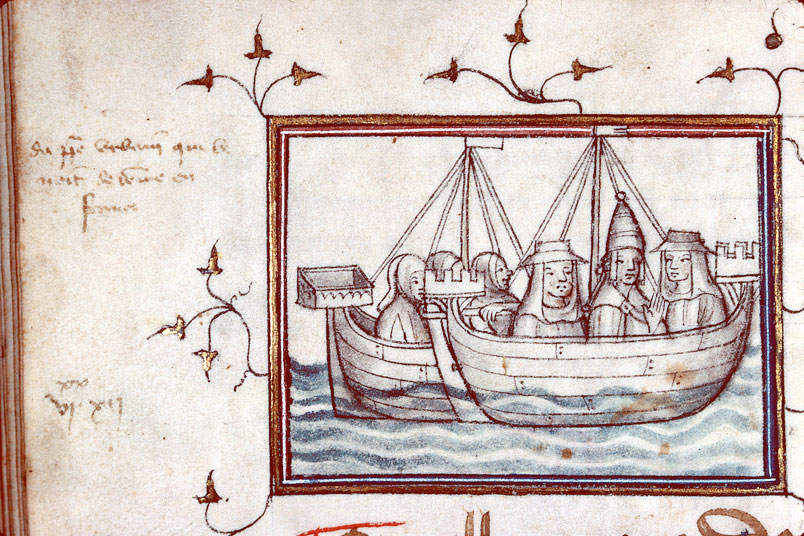
f) as depicted (with two cardinals; going by ship toward Rome) in a pen-and-ink drawing in margine in a later fourteenth-century historical miscellany (Avignon, Bibliothèque-Médiathèque Municipale Ceccano, ms. 1348, fol. 96v):


Mis-en-page:
http://tinyurl.com/28n7awl

g) as depicted (holding a paten bearing miniature busts of St. Peter and St. Paul) in a remounted late fourteenth-century fresco in the chiesa di Santa Maria della Croce (a.k.a. chiesa di Casaranello) at Casarano (LE) in Apulia:


h) as depicted (at far left, enthroned; second from left, King Peter I of Cyprus; at centre, Florimont de Lesparre making his apologies to the king) in a late fourteenth-century copy of Guillaume de Machaut's La prise d'Alexandrie (c. 1380-1395; Paris, BnF, ms. Français 9221, fol. 235v):
http://gallica.bnf.fr/ark:/12148/btv1b6000795k/f494.item.zoom

i) as depicted (with two cardinals; going by ship from Rome to Avignon) in a late fourteenth-century copy of Bernard Guidonis' Fleurs des chroniques (after 1384; Besançon, Bibliothèques municipales, ms. 677, fol. 102v):


j) as depicted (holding a tablet with bust-length portraits of Sts. Peter and Paul) in a probably late fourteenth-century fresco in the chiesa di San Francesco in Terni:


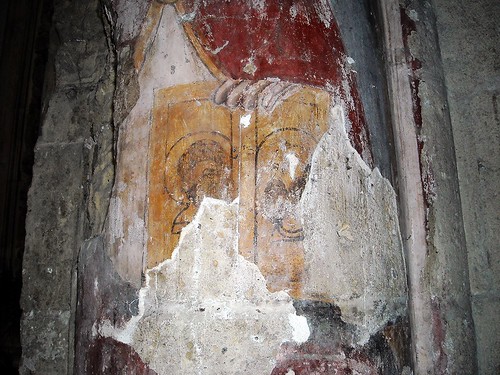
k) as depicted (holding a diptych with bust-length portraits of Sts. Peter and Paul) in a badly degraded probably late fourteenth-century fresco in the chiesa di Sant'Eligio Maggiore in Naples:


Detail view of the diptych of SS Peter and Paul:
http://farm6.static.flickr.com/5506/14455126726_906d5fbbdd.jpg

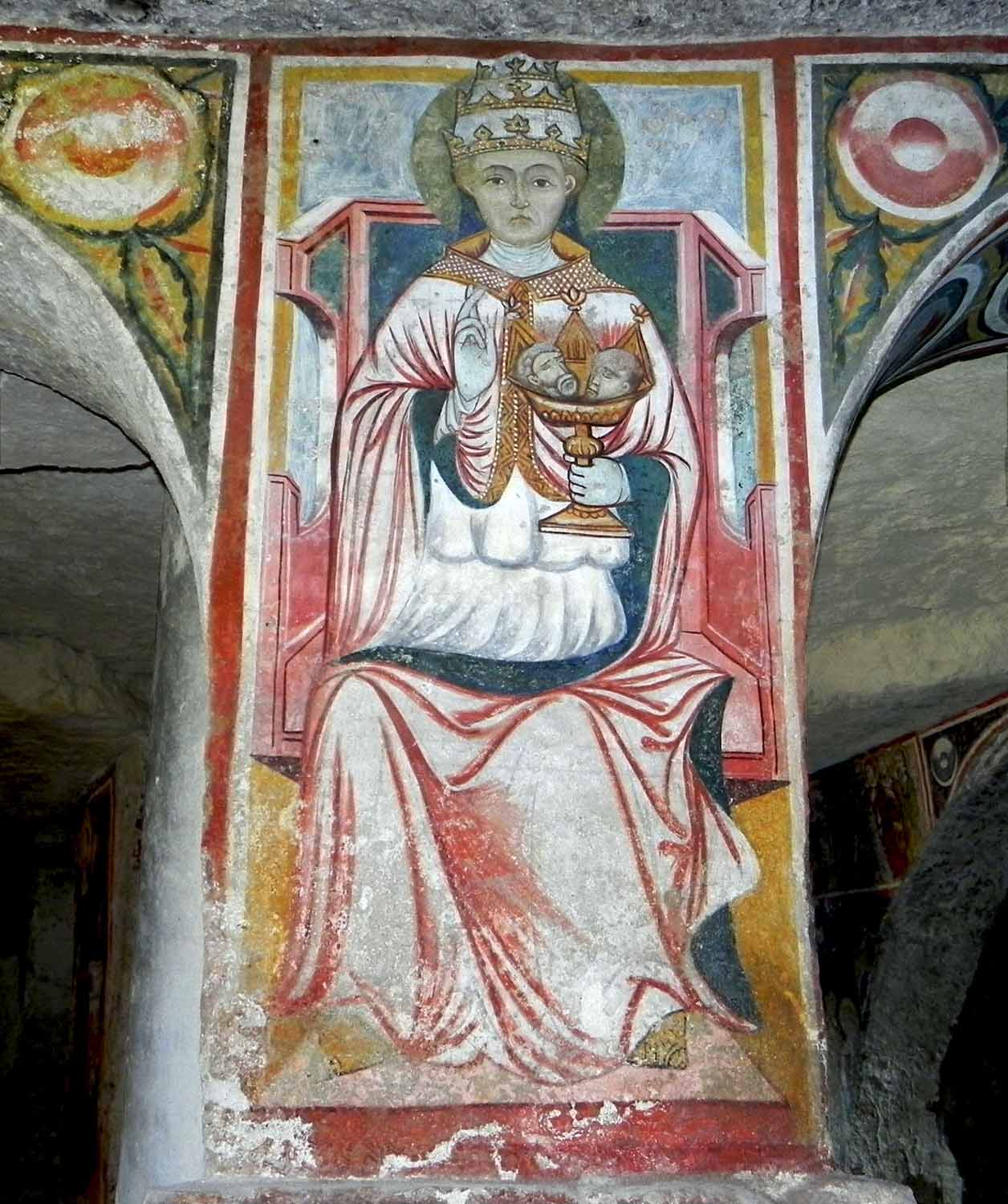
l) as depicted (holding a chalice containing miniature heads of Sts. Peter and Paul) in the late fourteenth- or early fifteenth-century frescoes of the rupestrian chiesa / cripta di Santa Croce ai Lagnoni in Andria (BT) in Apulia:


m) as depicted in an earlier fifteenth-century copy from Köln of the Vaticinia de summis pontificibus (c. 1401-1425; Paris, BnF, ms. Latin 10834, fol. 5v):


n) as depicted (holding a book surmounted by miniature busts of St. Peter and St. Paul) in an early fifteenth-century panel painting (c. 1410), seemingly of Italian origin, in the chapelle Saint-Privat in Mende's cathédrale Notre-Dame-et-Saint-Privat:


o) as depicted in an earlier fifteenth-century copy from northern Italy of the Vaticinia de summis pontificibus (c. 1410-1415; Kremsmünster, Stiftsbibliothek, Hs. CC Cim. 6, fol. 7r):

Vaticinium 13


p) as depicted in an earlier fifteenth-century copy from Florence of the Vaticinia de summis pontificibus (c. 1426-1450; London, BL, MS Harley 1340, fol. 7r):
http://www.bl.uk/catalogues/illuminatedmanuscripts/ILLUMINBig.ASP?size=big&IllID=51685

q) as depicted in an earlier fifteenth-century copy from Umbria of the Vaticinia de summis pontificibus (before 1431; Paris, BnF, ms. Nouvelle acquisition latine 2130, fol. 8r):


r) as depicted (at right; at left, St. Birgitta of Sweden) by Johannes Rosenrod in an earlier fifteenth-century fresco (1437) in Tensta kyrka, Tensta (Uppsala län):


Monday, 7 December 2015

St Ambrose


John Dillon posted on the Medieval Religion discussion group the following for today. I have added a few comment in [ ]:

In the Roman Calendar and in Ambrosian Calendar December 7th is the feast day of Ambrose of Milan (d. 397). Not to be confused with the Blessed Ambrose of Milan (Franciscan; d. 1525), this Ambrose is a Saint and a Doctor of the Church. A member of the imperial aristocracy, he was governor of Milan when he was elected bishop of that city in 374. Ambrose became an extraordinarily influential preacher, theologian, and ecclesiastical administrator. Along with St. Augustine of Hippo (whom he baptized) and St. Jerome he is one of the great western Christian churchmen of the fourth century.

Ambrose's dies natalis is 4. April (his feast day in the ninth-century martyrologies of St. Ado of Vienne and Usuard of Saint-Germain) but today, the anniversary of his consecration as bishop, was his feast day in some places since at least the ninth century, though what it represented was not always perfectly understood (the earlier ninth-century Marble Calendar of Naples describes it as the day of Ambrose's laying to rest). In the medieval Greek church today was Ambrose's feast day in both the later tenth-century Metaphrastic Menologion and the initially tenth- and eleventh-century Synaxary of Constantinople, as it also is now in some but not all Byzantine-Rite churches. Today was also Ambrose's principal feast day in the late medieval breviary of the Roman curia and from there the commemoration was continued in the later sixteenth-century Tridentine Calendar (as well of course as in the late sixteenth-century Roman Martyrology that was built around it).

An English-language translation of Ambrose's Vita by his former secretary Paulinus of Milan, written in Roman Africa at the behest of St. Augustine of Hippo, is here:
http://www29.homepage.villanova.edu/christopher.haas/Life%20of%20Ambrose.html

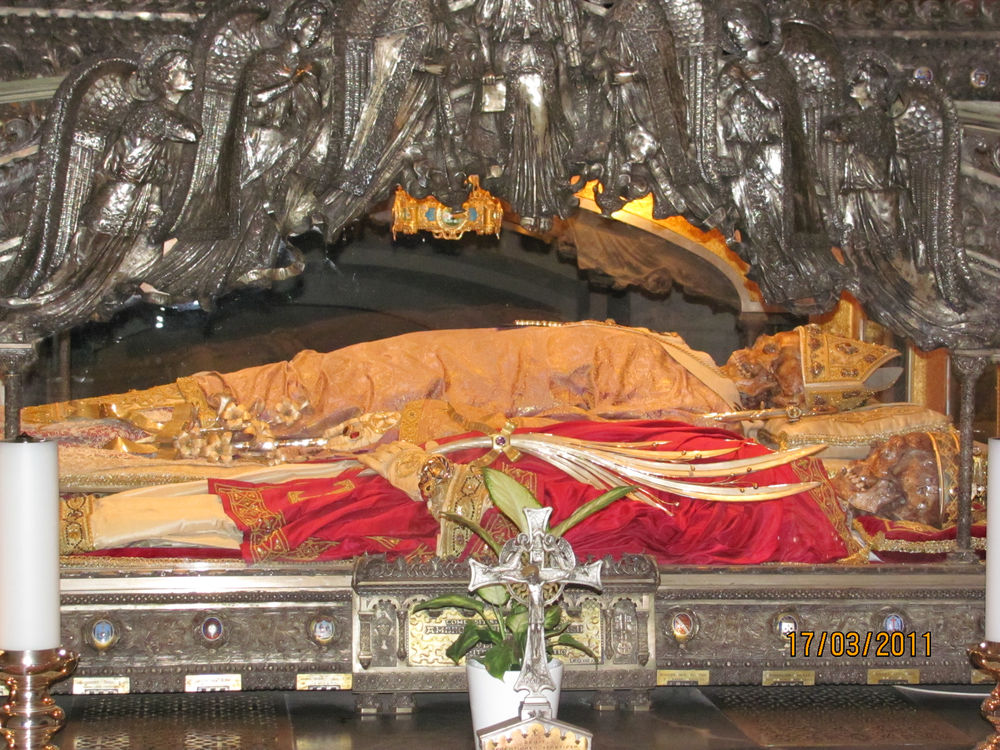
Skeletal remains believed to be those of St. Ambrose repose between those of Sts. Gervasius and Protasius in the cripta di Sant'Ambrogio in Milan's basilica di Sant'Ambrogio (the martyrs in red, Ambrose in white):


Supplementing Gordon Plumb's post from earlier today:

Wells Cathedral, SIII, 2b-3b, 2nd. qr. 14thC.:
https://www.flickr.com/photos/22274117@N08/14786023498

Bourges, Cathédrale Saint-Étienne, Bay 35, figure on right, c.1462:
https://www.flickr.com/photos/22274117@N08/4257386374

herewith are some links to other period-pertinent images of St. Ambrose of Milan:

a) as depicted in a restored fifth-century mosaic portrait in the basilica di Sant'Ambrogio's sacello di San Vittore:
http://www.atlantedellarteitaliana.it/immagine/00007/3858OP6466.jpg
http://tinyurl.com/2875f6x

b) as portrayed in relief in three panels on the rear side of the earlier to mid-ninth-century Golden Altar ("Pala d'Oro"; between 824 and 859, restored in 1966) in Milan's basilica di Sant'Ambrogio:
1) the miracle of the bees:


2) journeying on horseback from Liguria to Emilia:


http://img.over-blog-kiwi.com/0/54/79/43/20140626/ob_13819b_image5.jpg
3) blessing the altar's maker, Magister Wolvinus (or Vuolvinus):


c) as depicted lower register) in an eleventh-century copy of his De bono mortis from Fécamp (Paris: BnF, ms. Latin 2639, fol. 31v):
http://tinyurl.com/y9rm62v

d) as depicted in an eleventh-century manuscript of writings of Church Fathers (Avranches, Bibliothèque d'Avranches, ms. 72, f. 182v):
http://www.enluminures.culture.fr/Wave/savimage/enlumine/irht4/IRHT_074884-p.jpg

e) as depicted in a twelfth-century copy of his Hexaemeron (Charleville-Mézières, Médiathèque Voyelles, ms. 212, t. III, fols. 1-88v, fol. 1r):
http://www.enluminures.culture.fr/Wave/savimage/enlumine/irht6/IRHT_096061-p.jpg

f) as portrayed (at left) in a twelfth-century relief on Milan's Porta Romana:


g) as portrayed in a relief on the earlier twelfth-century west front of Milan's basilica di Sant'Ambrogio:

San Ambrogio


h) as depicted in the mid- or slightly later twelfth-century mosaics of the Cappella Palatina in Palermo:


http://tinyurl.com/3s9uolg

i) as depicted in one of four panels of a full-page illumination in the late twelfth-century so-called Bible of Saint Bertin (c. 1190-1200; Den Haag, KB, ms. 76 F 5, fol. fol. 38v, sc. 1A):
http://manuscripts.kb.nl/zoom/BYVANCKB%3Amimi_76f5%3A038v_min_a1

j) as depicted in two late twelfth-century panels (c. 1180) in a mostly early thirteenth-century composite window in the cathedral of St.-Étienne in Le Mans (photographs by Gordon Plumb):
1) St. Paul in a vision tells the sleeping Ambrose where to find the bodies of Sts. Gervasius and Protasius:
http://www.flickr.com/photos/22274117@N08/2209088732/
2) Ambrose (nimbed) and a brother bishop unearth the bodies of Sts. Gervasius and Protasius:
http://www.flickr.com/photos/22274117@N08/4714852210/

k) as depicted as depicted in a panel of a mid-thirteenth-century glass window (c. 1245-1250; w. 207) in Strasbourg's cathédrale Notre-Dame:


l) as portrayed in relief on a later thirteenth- or early fourteenth-century grosso of eight denari issued by the first Ambrosian Republic (i.e. communal Milan; 1250-1310):
https://www.numisbids.com/n.php?p=lot&sid=323&lot=197

m) as depicted (at right, barring the emperor Theodosius from the cathedral of Milan) in a late thirteenth-century copy of French origin of the Legenda aurea (San Marino, CA, Huntington Library, ms. HM 3027, fol. 47r):
http://digitalassets.lib.berkeley.edu/ds/huntington/images//000866A.jpg

n) as portrayed (flanked by Sts. Gervasius and Protasius) in a fourteenth-century statue on Milan's Pusterla di Sant'Ambrogio:


o) as depicted in the earlier fourteenth-century frescoes (c. 1312-1321) in one of the little domes of the monastery church of the Theotokos at Gračanica in, depending on one's view of the matter, either Serbia's province of Kosovo and Metohija or the Republic of Kosovo:
http://tinyurl.com/ydtx5b7

p) as depicted (upper roundel) in the earlier fourteenth-century frescoes (1330s) of the church of the Hodegetria in the Patriarchate of Peć at Peć in, depending on one's view of the matter, either the Republic of Kosovo or Serbia's province of Kosovo and Metohija:
http://tinyurl.com/ygxkvuw

q) as depicted (at left; at right, St. Patapius) in a December calendar composition in the earlier fourteenth-century frescoes (between 1335 and 1350) in the narthex of the church of the Holy Ascension at the Visoki Dečani monastery near Peć in, depending on one's view of the matter, either the Republic of Kosovo or Serbia's province of Kosovo and Metohija:
http://tinyurl.com/yaswkw7

r) as depicted in a mid-fourteenth-century glass window panel (c. 1340-1350) from Kärnten, now in The Cloisters collection of the Metropolitan Museum of Art in New York:

Saint Ambrose


s) as depicted (the miracle of the bees) in a mid-fourteenth-century copy, from the workshop of Richard and Jeanne de Montbaston, of the Legenda aurea in its French-language version by Jean de Vignay (1348; Paris, BnF, ms. Français 241, fol. 98r):
http://tinyurl.com/ygb8up7

t) as depicted by Vitale da Bologna in a mid-fourteenth-century panel painting (between 1350 and 1353) in the Pinacoteca of the Musei Civici in Pesaro:


v) as portrayed in a statuette and in two panels on St. Augustine's later fourteenth-century tomb in Pavia's basilica di San Pietro in Ciel d'Oro:
1) statuette (second from left; photograph by Genevra Kornbluth):
http://www.kornbluthphoto.com/images/Pavia_249.jpg
Detail (bust):
http://tinyurl.com/24nqhle
2) panel (upper register at right, preaching; Augustine among the listeners):
http://tinyurl.com/2cft8mj
3) panel (at left, officiating at at Augustine's vesting):
http://tinyurl.com/37xxotc
Views of these objects in stronger light will be found at Genevra Kornbluth's Archive page on the Arca di Sant'Agostino:
http://www.kornbluthphoto.com/Arca.html

w) as depicted (at right, barring the Emperor Theodosius from the cathedral of Milan) in a later fourteenth-century copy (c. 1370-1380) of Vincent of Beauvais' Speculum historiale in its French-language version by Jean de Vignay (Paris, BnF, ms. Nouvelle acquisition française 15943, fol. 58r):
http://gallica.bnf.fr/ark:/12148/btv1b8449689s/f123.highres

x) as depicted (at far left) by Niccolò di Pietro Gerini in one of four late fourteenth-century panel paintings of the Doctors of the Church (c. 1380) used for the altarpiece in the cappella maggiore of Florence's basilica della Santa Croce:


y) as portrayed (in the lower right-hand corner) by Pietro di Puccio in his late fourteenth-century mosaic (1388; heavily restored) on the facade of Orvieto's basilica cattedrale di Santa Maria Assunta:


z) as depicted (reading) in a late fourteenth- or early fifteenth-century copy of the _Legenda aurea_ in its French-language version by Jean de Vignay (Rennes, Bibliothèque de Rennes Métropole, ms. 266, fol. 105r):
http://tinyurl.com/q3pz84h

aa) as portrayed in high relief (in his study) by Lorenzo Ghiberti in a panel of his early fifteenth-century north doors for the baptistery in Florence:
http://tinyurl.com/yz6jvxn

bb) as depicted (at right; at left, St. Augustine of Hippo) as depicted by Filippo Lippi in an earlier fifteenth-century panel painting (c. 1440) in the Accademia Albertina di Belle Arti, Turin:


cc) as portrayed in relief on a mid-fifteenth-century grosso agontano issued by the second Ambrosian Republic (1447-1450):


dd) as depicted (at right, baptizing St. Augustine) in a mid-fifteenth-century copy of Giovanni Colonna's Mare historiarum (between 1447 and 1455; Paris, BnF, ms. Latin 4915, fol. 277v):
http://gallica.bnf.fr/ark:/12148/btv1b6000905v/f624.item.zoom

ee) as depicted by Giovanni di Paolo in a later fifteenth-century panel painting (c. 1465-1470) in the Metropolitan Museum of Art, New York:

Saint Ambrose


[ Note the use of pearls to decorate the mitre. The emblematic whip - coming from the pen#aence he imposed on Theodosius - is an earlier form of the cat o'nine tails]

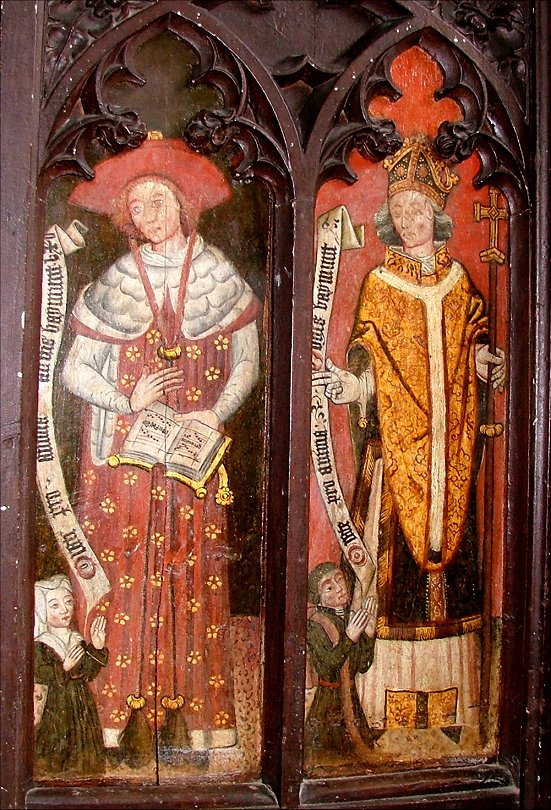
ff) as depicted (at right; at left, St. Jerome) on the late fifteenth-century rood screen in the church of St Thomas, Foxley (Norfolk):


gg) as depicted (at far right) by Michael Pacher on his late fifteenth-century Fathers of the Church altarpiece (c. 1483) in the Alte Pinakothek, Munich:


http://www.wga.hu/art/p/pacher/various/2father1.jpg

hh) as depicted (at left; at right, St. Augustine) by Giovanni Masone in a late fifteenth-century panel painting (Genoa, 1491) in the Musée Jacquemart-André, Paris:


ii) as depicted (left margin at top) in a hand-coloured woodcut in the Beloit College copy of Hartmann Schedel's late fifteenth-century Weltchronik (Nuremberg Chronicle; 1493) at fol. CXXXIIIIv:
http://www.beloit.edu/nuremberg/book/6th_age/left_page/38%20%28Folio%20CXXXIIIIv%29.pdf

jj) as depicted (second from left) by Carlo Bracceso in a late fifteenth-century panel painting (ca. 1495) in the Galleria Franchetti, Ca' d'Oro, Venice:


[I like the idea of unity of doctrine expressed in the same textile being worn in their vestments by SS Gregory, Ambrose and Augustine. I also  like St Jerome's pince nez ]

kk) as portrayed (in his study) in a late fifteenth- or early sixteenth-century wooden statue with traces of paint (c. 1500) from Palencia in The Cloisters collection of the Metropolitan Museum of Art in New York:

Saint Ambrose in His Study


Monday, 23 November 2015

St Clement


John Dillon has posted on the Medieval Religion discussion group a selection of images of Pope St Clement I, whose feast is today.


As a saint he was popular in Denmark, and hence dedications to him in the Danelaw and, most famously, St Clement Danes in London. St Clement's in Oxford was presumably the area settled by the Danes before, and perhaps after the St Brice's day massacre here. In my home town of Pontefract the collegiate chapel in the castle is also a probable legacy of Danish settlement - the archaeologists working on the site twenty five or so years ago thought it was situated on the highest natural part of the castle rock, and pre-dated the Norman castle

John Dillon writes as follows:
The author of an extant letter to the church of Corinth and the suppositious author of the pseudo-Clementine Recognitions and Homilies, Pope St. Clement I (d. c. 100) occupies either third or fourth place in early lists of the bishops of Rome. Although it now seems unlikely that he was martyred, throughout the Middle Ages he was accorded martyrial status (as he still is in many churches). According to his legendary late antique Passio (BHL 1848; translated into Greek, BHG 349-350), Clement was exiled by the Emperor Trajan to the mines of Crimea, evangelized there with much success (in which effort he was aided by his miraculous discovery of an underground stream from which his parched fellow workers then drank), and for his pains was thrown into the Black Sea weighted down with an anchor. In response to the prayers of his disciples Cornelius and Phoebus, the waters parted and Clement's body was miraculously revealed in a chapel where the faithful could venerate him annually for a week beginning on his _dies natalis_.

Thus far Clement's Passio. In the ninth century, Sts. Constantine / Cyril and Methodius brought to Rome from Constantinople bodily relics believed to be his. These were placed in Rome's basilica di San Clemente. Constantine / Cyril is said to have found or obtained them, together with the fatal anchor, in the Crimea. Here's a view of Constantine / Cyril and Methodius receiving Clement's remains by the Black Sea as depicted in the late tenth- or very early eleventh-century so-called Menologion of Basil II (Città del Vaticano, BAV, cod. Vat. gr. 1613, p. 204):

File:Menologion of Basil 062.jpg


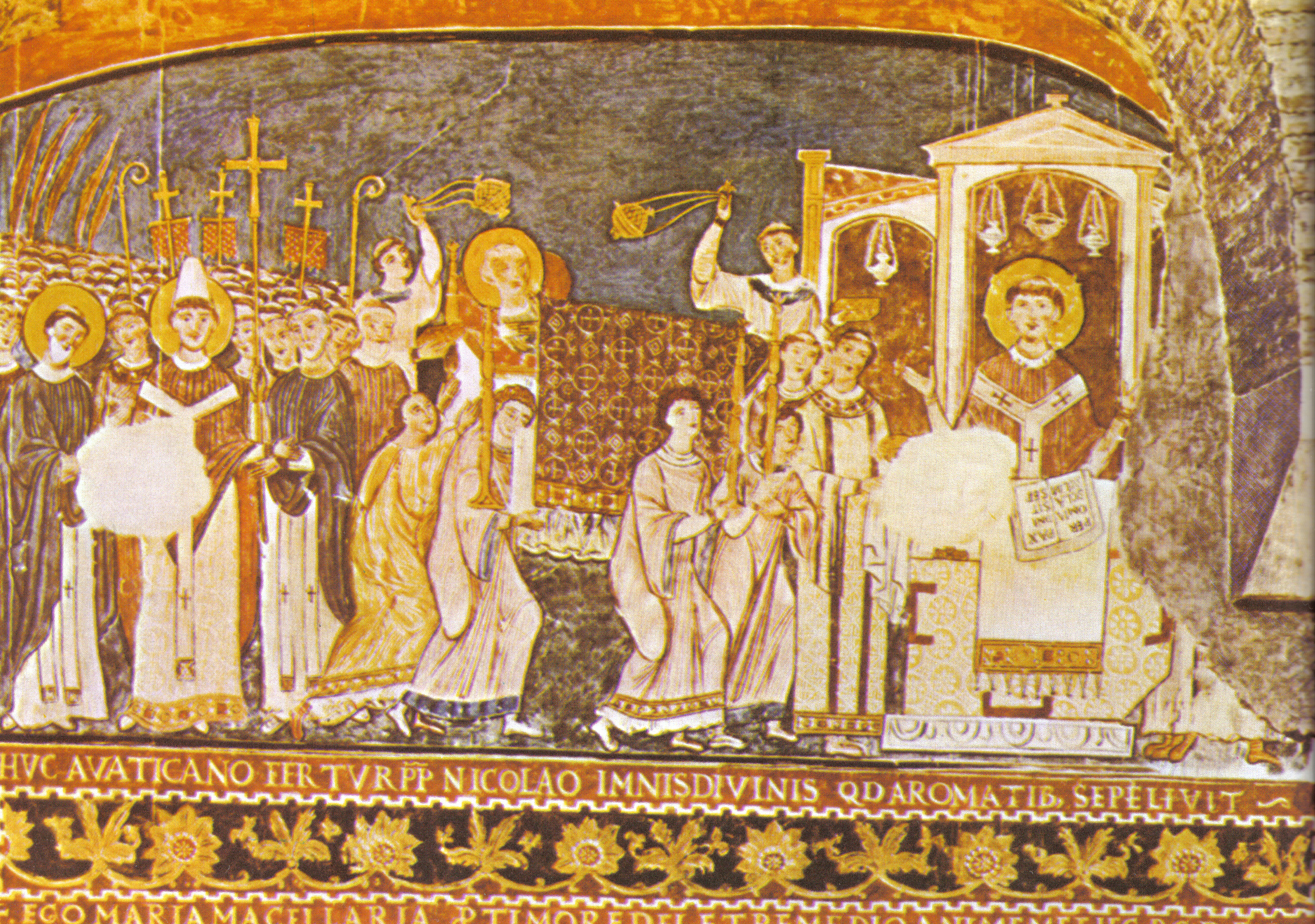
In an eleventh- or early twelfth-century fresco painted in what is now the lower church of San Clemente and depicting its reception of that saint's relics, Constantine/Cyril and Methodius (one nimbed, the other not) are shown at left accompanying the Pope:


Another view, taken from a watercolour of the fresco made shortly after its discovery in the nineteenth century:


A dubious tradition known to the author of the first Vita of St. Genovefa of Paris (BHL 3334; ca. 520) and perpetuated in, e.g., the legendary Passiones of St. Dionysius / Denys of Paris claims an apostolic origin for the church of Paris and for other Gallic churches through evangelization by missionaries whom Clement had sent out from Rome. Modern historical scholarship commonly rejects this notion.

In the (pseudo-)Hieronymian Martyrology and in the ninth-century martyrologies of St. Ado of Vienne and Usuard of Saint-Germain Clement's  dies natalis is given as VIIII Kal. Dec. (23. November). This remained Clement's feast day in the medieval Latin West and is still his feast day in churches whose sanctoral calendars descend from medieval Latin-rite Uses. In the medieval Greek church Clement's feast falls on 25. November in pre-Metaphrastic menologia, in the later tenth-century Metaphrastic Menologion, and in the initially tenth- and eleventh-century Synaxary of Constantinople. This remains his feast day in churches employing the Byzantine Rite.


By way of supplement to Gordon Plumb's recent post (23. Nov.) of links to medieval images of pope St. Clement I in glass, herewith links to some other period-pertinent images of this saint in various media:

a) as depicted (second from left, after St. Martin of Tours) in the heavily restored later sixth-century mosaic procession of male saints (c. 560) in the nave of Ravenna's basilica di Sant' Apollinare Nuovo:


Detail view (courtesy of Genevra Kornbluth):
http://www.kornbluthphoto.com/images/ApNSouth10.jpg

b) as depicted (second from left, after Pope St. Sylvester I) in a later eighth-century fresco ( between 757 and 767) in the nave of Rome's chiesa di Santa Maria Antiqua:


c) as depicted (left margin at bottom) in a ninth-century copy of St. John Damascene's Parallela sacra (Paris, BnF, ms. Grec 923, fol. 309v):
http://gallica.bnf.fr/ark:/12148/btv1b525013124/f622.item.zoom

d) as depicted (at centre, saying Mass) in an eleventh-century fresco in what is now the lower church of Rome's basilica di San Clemente:

 http://www.wga.hu/art/zgothic/mural/11c2/13clemen.jpg

e) as depicted in a mid-eleventh-century mosaic in the cathedral of St. Sophia in Kyiv / Kiev (lower portion restored with oil painting in the nineteenth century):


f) as portrayed in relief (upper register at centre) on the  tympanum (c. 1151-1175) above the west portal of the chiesa abbaziale di San Clemente a Casauria in Castiglione a Casauria (PE) in Abruzzo:


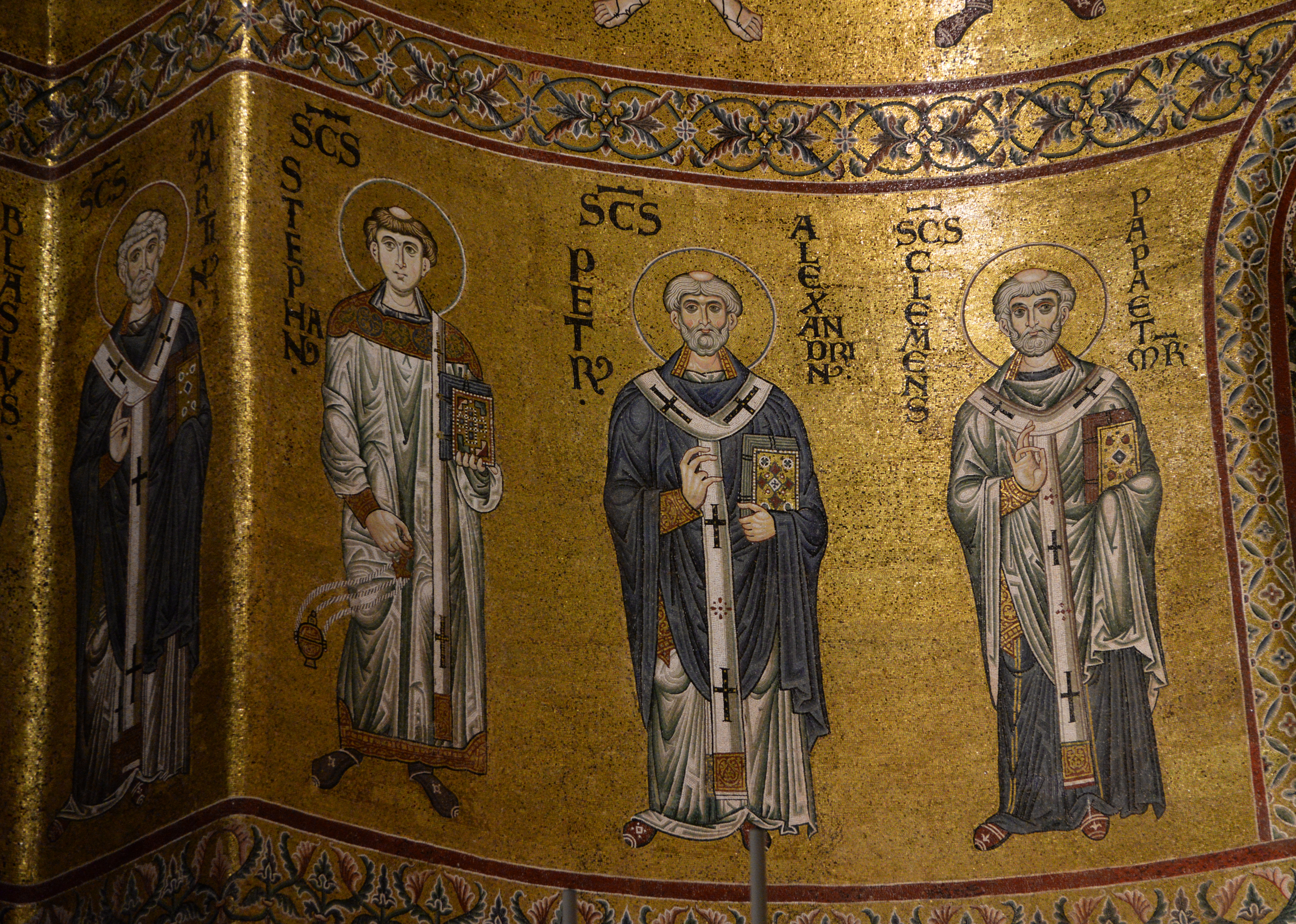
g) as depicted (at far right, after Sts. Martin of Tours, Stephen protomartyr, and Peter of Alexandria) in the late twelfth-century apse mosaics (c. 1182) in Monreale's basilica cattedrale di Santa Maria Nuova:


h) as depicted (at left, receiving the volume from its author-compiler) at the end of brother John Berard's late twelfth-century cartulary chronicle of the abbey of San Clemente a Casauria (1182; Paris, BnF, ms. Latin 5411, fol. 272v):
http://gallica.bnf.fr/ark:/12148/btv1b84526553/f556.item.zoom

i) as depicted (upper register at right; at left, St. Peter) in the very late twelfth- or very early thirteenth-century apse mosaic (c. 1200) of Rome's basilica di San Clemente:


j) as depicted in a thirteenth-century fresco in the rupestrian church of the grotta di San Giovanni at Cafaro, a locality of San Vito dei Normanni (BR) in southern Apulia:


k) as depicted (twice: at left, being baptized by St. Peter; at right, saying Mass) in a panel of the thirteenth-century St. Clement window in the choir of Köln's Basilika St. Kunibert (an earlier to mid-thirteenth-century replacement for a predecessor dedicated to Clement):
http://media.kunst-fuer-alle.de/img/41/g/41_00448697.jpg
Detail views:


l) as depicted (lower register at right; sending St. Dionysius and companions to Gaul) in a mid-thirteenth-century copy of a French-language Life of St. Dionysius of Paris (Paris, BnF, ms. Nouvelle acquisition française 1098, fol. 34r):
http://tinyurl.com/25year8

m) as depicted (upper register) in a panel of a mid-thirteenth-century glass window (c. 1245-1250; w. 201) in Strasbourg's cathédrale Notre-Dame:
http://therosewindow.com/pilot/Strasbourg/w201d-whole.htm

n) as depicted (martyrdom) in a late thirteenth-century copy of French origin of the _Legenda aurea_ (San Marino, CA, Huntington Library, ms. HM 3027, fol. 162v):
http://digitalassets.lib.berkeley.edu/ds/huntington/images//000918A.jpg

o) as depicted in the late thirteenth-century frescoes (c. 1295) by Michael Astrapas and Eutychios in the church of the Peribleptos (now Sv. Kliment Ohridski) in Ohrid:


p) as depicted (martyrdom) in a fourteenth-century glass window panel of French origin in the Burrell Collection, Glasgow:

Stained glass panel 'St. Clement of Rome', French, 14th century </br> © CSG CIC


q) as depicted (martyrdom) in an early fourteenth-century collection of French-language saint's lives (St John's College, Cambridge, MS B.9, fol. 133v):
http://tinyurl.com/2hendw

r) as depicted (at left; at right, St. Astius of Durrës / Durazzo) in the earlier fourteenth-century frescoes (c. 1308-1320) by Michael Astrapas and Eutychios in the church of St. Nicetas the Goth (Sv. Nikita) at Čučer in today's Čučer-Sandevo in the Former Yugoslav Republic of Macedonia:
http://tinyurl.com/ok8rar5

s) as depicted (at the foot of the page; martyrdom) in the early fourteenth-century Queen Mary Psalter (c. 1310-1320; London, BL, Royal MS 2 B VII, fol. 279r):
http://www.bl.uk/manuscripts/Viewer.aspx?ref=royal_ms_2_b_vii_f279r

t) as depicted (at left; at right, St. Meletius of Antioch) in the earlier fourteenth-century frescoes (ca. 1312-1321/1322) of the Paraclis of the Theotokos in the monastery church of the Theotokos at Gračanica in, depending on one's view of the matter, Serbia's province of Kosovo and Metohija or the Republic of Kosovo:
http://tinyurl.com/yekmrox
Detail view (Clement):
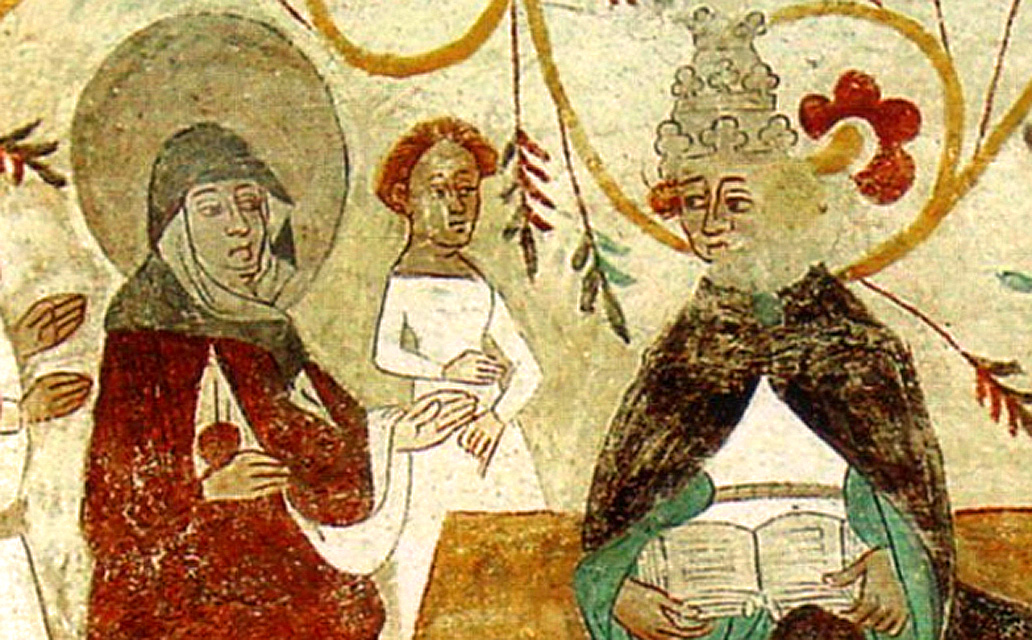


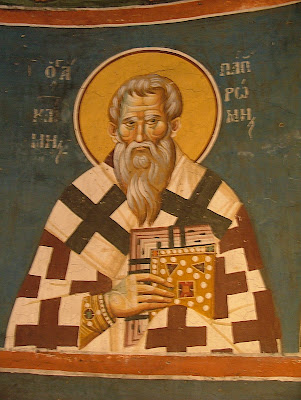
u) as depicted (at left, with St. Hippolytus, Bishop of Pontus  and St. Metrophanes [of Byzantium]) in the earlier fourteenth-century frescoes (c. 1313-1318; conservation work in 1968) by Michael Astrapas and Eutychios in the church of St. George at Staro Nagoričane in the Former Yugoslav Republic of Macedonia:
http://tinyurl.com/3zpcevk

v) as depicted (at left in panel at upper left; at right, the martyrdom of St. Peter of Alexandria) in an earlier fourteenth-century pictorial menologion from Thessaloniki (betw. 1322 and 1340; Oxford, Bodleian Library, MS Gr. th. f. 1, fol. 18v):
http://image.ox.ac.uk/images/bodleian/msgrthf1/18v.jpg

w) as depicted (second from right, sending St. Dionysius and other missionaries to Gaul) in an earlier fourteenth-century copy of theLegenda aurea in its French-language version by Jean de Vignay (ca. 1326-1350; Paris, BnF, ms. Français 185, fol. 204v):
http://tinyurl.com/yfrz7hr

x) as depicted (martyrdom) in an earlier fourteenth-century French-language legendary of Parisian origin with illuminations attributed to the Fauvel Master (ca. 1327; Paris, BnF, ms. Français 183, fol. 74r):
http://tinyurl.com/ylal2j2

y) as depicted (at left; at right, the martyrdom of St. Peter of Alexandria) in the earlier fourteenth-century frescoes (ca. 1335-1350) in the narthex of the church of the Holy Ascension at the Visoki Dečani monastery near Peć in, depending on one's view of the matter, either the Republic of Kosovo or Serbia's province of Kosovo and Metohija:


z) as depicted (martyrdom) in a mid-fourteenth-century copy, from the workshop of Richard and Jeanne de Montbaston, of the Legenda aurea in its French-language version by Jean de Vignay (1348; Paris, BnF, ms. Français 241, fol. 311r):
http://tinyurl.com/28sckhc

aa) as depicted in a cutting from a later fourteenth-century gradual (c. 1370) illuminated by Silvestro dei Gherarducci for the monastery of Santa Maria degli Angeli in Florence (Florence, Biblioteca Laurenziana, Cod. cor. 2; this image from fol. 159r):


bb) as depicted (twice: at left, uncovering the buried stream; at right, martyrdom) in a later fourteenth-century copy of books 11-13 of Vincent of Beauvais' Speculum historiale in its French-language version by Jean de Vignay (ca. 1370-1380; Paris, BnF, ms. Nouvelle acquisition française 15941, fol. 16v):
http://gallica.bnf.fr/ark:/12148/btv1b8449688c/f40.item.zoom

cc) as depicted in a fifteenth-century glass window panel of German origin in the Burrell Collection, Glasgow:
https://www.flickr.com/photos/paullew/8209861563

dd) as portrayed in a fifteenth-century polychromed wooden statue on the high altar of the Sankt Clemens Kirke in Rømø (Tønder Kommune), Syddanmark:


ee) as depicted (at right; baptizing St. Taurinus) in a panel of a mid-fifteenth-century glass window (c. 1450) in Évreux's église Saint-Taurin:


ff) as depicted in grisaille (martyrdom) by Jean le Tavernier in the mid-fifteenth-century Hours of Philip of Burgundy (ca. 1451-1460; Den Haag, KB, ms. 76 F 2, fol. 257r):
http://manuscripts.kb.nl/zoom/BYVANCKB%3Amimi_76f2%3A257r_min

gg) as depicted by Giovanni di Paolo in a mid-fifteenth-century panel painting (c. 1455; from a dismembered altarpiece) in the Musée du Petit Palais, Avignon:


hh) as depicted (lancet at far right; at left and centre, the martyrdom of St. Thomas of Canterbury) in a later fifteenth-century glass window (w. 214) in Paris' église Saint-Séverin:
http://www.flickriver.com/photos/29495960@N00/15021005293/

ii) as depicted (lower register at left; blessing St. Domitilla in prison) in an illumination depicting events from the legendary Passio of Nereus and Achilleus in a later fifteenth-century copy of Vincent of Beauvais' Speculum historiale in its French-language version by Jean de Vignay (1463; Paris, BnF, ms. Français 50, fol. 358v):


jj) as depicted by Peter Hemmel of Andlau in a panel of a later fifteenth-century glass window (1477-1478) in Ravensburg's Liebfrauenkirche:


kk) as depicted (upper register at far left) by Domenico Ghirlandaio in a later fifteenth-century panel painting (c. 1479) of the Madonna and Christ Child with Saints in Lucca's cattedrale di San Martino:


ll) as depicted (uncovering the buried stream) in a later fifteenth-century copy of Vincent of Beauvais' Speculum historiale in its French-language version by Jean de Vignay (c. 1480-1490; Paris, BnF, ms. Français 245, fol. 182v):
http://tinyurl.com/qjp32yd

mm) as depicted (right margin at top) in a hand-coloured woodcut in the Beloit College copy of Hartmann Schedel's late fifteenth-century Weltchronik (Nuremberg Chronicle_; 1493) at fol. CVIIIv:
http://www.beloit.edu/nuremberg/book/6th_age/left_page/12%20%28Folio%20CVIIIv%29.pdf

nn) as depicted by Bernardino Fungai in two late fifteenth- or early sixteenth-century predella panel paintings (c. 1498-1501; from his Coronation of the Virgin altarpiece in Siena's chiesa di Santa Maria dei Servi) in the York Art Gallery, York:
1) Uncovering the buried stream:

St Clement Striking the Rock

2) Martyrdom:

The Martyrdom of St Clement


oo) as depicted in a late fifteenth-or early sixteenth-century vault fresco (c. 1500-1503; restored, 1896-1899) in Skivholme Kirke (Skanderborg Kommune), Midtjylland:


pp) as depicted (at right; at left, St. Christopher) in an early sixteenth-century fresco (c. 1515-1520) in Aarhus Domkirke (dedicated to Clement):