Once I was a clever boy learning the arts of Oxford... is a quotation from the verses written by Bishop Richard Fleming (c.1385-1431) for his tomb in Lincoln Cathedral. Fleming, the founder of Lincoln College in Oxford, is the subject of my research for a D. Phil., and, like me, a son of the West Riding. I have remarked in the past that I have a deeply meaningful on-going relationship with a dead fifteenth century bishop... it was Fleming who, in effect, enabled me to come to Oxford and to learn its arts, and for that I am immensely grateful.


Showing posts with label Pope Boniface VIII. Show all posts

Wednesday, 28 May 2025

The Papal Tiara


In my recent article about the Pope inaugurating his Petrine ministry at the Vatican a week last Sunday and his taking possession of the Lateran last Sunday I stated my great regret at the fact that the Popes since Paul VI abandoned wearing the tiara, and gave away the one his old diocese of Milan had given him upon his election. Since 2005, it is no longer used it on their coats of arms; as I pointed out in my note about Papal Heraldry saecular monarchs use a crown on their arms whether they are actually crowned or not, or even if they do not actually have a crown.

The excellent website produced by Allan  Barton The Antiquary marked the new Pope’s inauguration with a video about the history of this distinctive piece of insignia, about earlier ones which no longer survive, about the Papal Coronation and about the splendid collection of tiaras in the Vatican.

Although much of this was not new to me it was good to see so comprehensive marshalling of the relevant material. One thing where I might disagree slightly is that I think it was Boniface VIII, and not his one of his successors who added the two additional circlets above the original jewelled band of the Tiara. One I suspect sat immediately on top of that jewelled band, and was not immediately distinct from it. I say this because I think I saw in the printed inventory of Boniface VIII’s possessions mention of a Tiara with three crowns. Just when you want to have a book to hand…. I am open to correction on the point. Such a change would certainly fit with Boniface’s sweeping vision of Papal authority, and, lest you think the author of Unam Sanctam belongs to the medieval past, do not forget what Pius XII wrote in Mystici Corporis in 1943:
That Christ and His Vicar constitute one only Head is the solemn teaching of Our predecessor of immortal memory Boniface VIII in the Apostolic Letter Unam Sanctam; and his successors have never ceased to repeat the same.

One thing that I did learn from the video was that Julius II’s tiara survived until the French invaded the Papal States at the very end of the eighteenth century. Nor did I know of Benedict XV selling jewels from the tiaras to fund relief work in the First World War. The tradition of churchmen selling plate and jewels in aid of good and worthy causes is, of course, a long-standing one.

Although I suspect Allan Barton is not quite so much an enthusiast for the Papal Tiara as I am I certainly would recommend the video, which can be seen at The History of the PAPAL TIARA


The effect of watching the video was, of course, to make me yearn for, believe all the more, in its return to use.

Wednesday, 8 May 2013

A new face for Pope Celestine V


Pope Celestine V
An early mural painting and the new face mask
 
Image:news.discovery.com


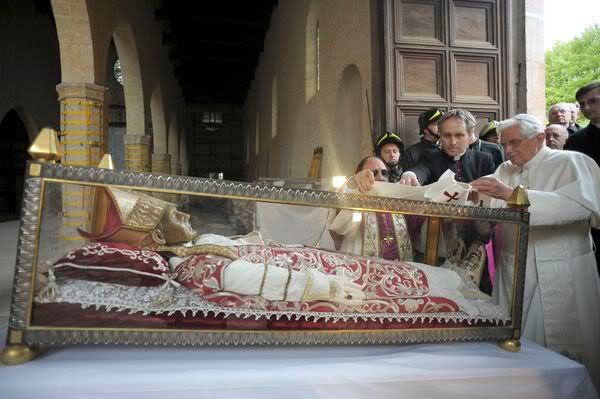
I see from a post on the Medieval religion discussion group that over the course of several months the remains of Pope Celestine V - St Peter of Morrone  - have been examined, and a new funerary mask has been created. Born in 1215, and a hermit-monk, he was elected as Pope in 1294, and abdicated later on that year, and died as, in effect, a prisoner of his successor, Pope Boniface VIII, in 1296. He was canonised in 1313, and his feast day falls on May 19th.

There is an illustrated introduction to his life here, and there is another one here, with some additional illustrations.  A further account, with amore hagiographic emphasis with more pictures can be found on the link to the blog post here.

The remains are preserved at L'Aquila and survived the serious earthquake there in 2009, and indeed were visited in its wake by Pope Benedict XVI, who have his inauguration pallium for his predecessor to wear:


Image:365rosaries.blogspot.co.uk

Amongst the results of this latest examination of the relics was  confirmation (not for the first time) that the hole in his skull was made after his death, and so he definitely was not murdered, according to legend, by having a nail driven into his skull.


Murder Examination of Pope Celestine V

The skull of Pope Celestine V

Image: archelaos.com

The examination also indicated his height - five foot five inches - and much of his medical history.

A careful study was done of his cranium, leading to afacial reconstruction. However this was of a fifty year old, so the artist who made the silver mask had then to interpret that to produce an idea of what he looked like at the time of his death, when he was eighty or thereabouts.

There is an account of the discoveries in English here and two more accounts, with different illustrations, in Italian here and here.


Sunday, 18 November 2012

Unam Sanctam


Today is the 710th anniversary of the issue in 1302 by Pope Boniface VIII of his bull Unam Sanctam.

Bonifatius VIII Grabstatue.JPG

Pope Boniface VIII

Image: fr.wikipedia.org

The bull, withits resounding concluding sentence "Furthermore, we declare, we proclaim, we define that it is absolutely necessary for salvation that every human creature be subject to the Roman Pontiff ", is often regarded as the ultimate official expression of Papal claims to hegemony over both ecclesiastical and secular matters.

The bull was seen to be directed in particular against King Philip IV of France, with whom the Pope had been in dispute over their calims and ambitions to control the Church in France.


King Philip IV
The tomb effigy at St Denis

Image:paradoxplace.com

The text of Unam sanctam can be read in translation here

There is an online article about the bull and the events that led the Pope to issue it which can be read here. An online biography of Pope Boniface VIII can be here and one of King Philip IV here.


Pope Boniface VIII
Statue by Arnolfo di Cambio
Museo dell'Opera dell Duomo Florence
The position of the Papal pallium looks utterly impractical - I think it must be attributed to artistic licence, not actual liturgical practice.

Image:paradoxplace

However Unam Sanctam is not just something for historians of the Papacy and the Middle Age. It remains part of the living tradition of Papal claims to exercise its plenitudo potestatis and to its exercise of the Petrine ministry.

Thus Pope Pius XII in Mystici Corpus Christi ( June 29 1943) wrote: " That Christ and His Vicar constitute one only Head is the solemn teaching of Our predecessor of immortal memory Boniface VIII in the Apostolic Letter Unam Sanctam."