Once I was a clever boy learning the arts of Oxford... is a quotation from the verses written by Bishop Richard Fleming (c.1385-1431) for his tomb in Lincoln Cathedral. Fleming, the founder of Lincoln College in Oxford, is the subject of my research for a D. Phil., and, like me, a son of the West Riding. I have remarked in the past that I have a deeply meaningful on-going relationship with a dead fifteenth century bishop... it was Fleming who, in effect, enabled me to come to Oxford and to learn its arts, and for that I am immensely grateful.


Showing posts with label Pope Benedict XVI. Show all posts

Sunday, 16 April 2017

Easter Day


Christ is Risen, Alleluia! He is Risen Indeed, Alleluia!


Della Francesca’s ‘Resurrection’

The Resurrection
Piero della Francesca c.1463
Sansepolchro, Tuscany

Image:Spectator


I originally posted this piece in 2011 and have decided to do so again this year, with some adaptation and additions.

The depiction of Our Lord is one of the most powerful ever created and impresses itself deep into one's consciousness. It is one of the few which have attempted to capture the moment of Resurrection, although carving from the same periood in alabaster from English workshops are well known as are smaller manuscript and embroidered depictions. Aldous Huxley described Piero's work  in an essay in 1925 as "the greatest painting in the world." For Huxley here was the face of someone who had indeed conquered Death and Hell.

There are online articles about Piero della Francesca's The Resurrection here and here. There are also more recent posts by Christopher Booker: The mathematical revolution behind 'the greatest picture in the world' and by Christine Zappella:Piero della Francesca, Resurrection

These articles refer to its near destruction in the Second World War, and there is more about the man who ensured its survival, Tony Clarke, in The man who saved The Resurrection


"Does not a ray of light issue from Jesus, growing brighter accross the centuries, that could not come from any mere man and through which the light of God truly shines into the world? Could the apostolic preaching have found faith and built up a worldwide community unless the power of truth had been at work within it?

If we attend to the witnesses with listening hearts and open ourselves to the signs by which the Lord again and again authenticates both them and himself, then we know that he is truly risen. He is alive. Let us entrust ourselves to him, knowing that we are on the right path. With Thomas let us place our hands into Jesus' pierced side and confess: "My Lord and my God!" "

Pope Benedict XVI
Jesus of Nazareth: Holy Week
2011

From pp.276-77

Friday, 12 February 2016

Three Years Later


Lawrence England of the blog That the Bones You Have Crushed May Thrill, and Chairman of the Guild of St Titus Brandsma, has a thoughtful piece on the blog of the latter organisation to mark the third anniversary of Pope Benedict XVI announcing his abdication, and providing Lawrence's interpretation of what has happened in the ensuing period.

It can be read at  http://guildofblessedtitus.blogspot.co.uk/2016/02/three-years-later.html


Sunday, 5 April 2015

Christ is Risen! Alleluia!


The Resurrection
Piero della Francesca c.1463
Sansepolchro, Tuscany

This is essentially a reworking of my post for Easter in 2011. That is partly because, as I have observed before, the Resurrection has proved far more difficult for artists to depict than the Crucifixion. One of the few paintings which achieves its purpose is Piero della Francesca's awe-inspiring composition. It is reminiscent of other late medieval representations with Christ, banner in hand, stepping out of table tomb rather than a rock cut sepulchre. Literalism, or its absence is not the point - this painting conveys with an almost unique power the world shattering significance of what has happened. Aldous Huxley described the fresco in an essay as "the greatest painting in the world" because in it Christ has the face of someone who has indeed conquered Death and Harrowed Hell.

There are online articles about Piero della Francesca's
The Resurrection here and here.

Does not a ray of light issue from Jesus, growing brighter accross the centuries, that could not come from any mere man and through which the light of God truly shines into the world? Could the apostolic preaching have found faith and built up a worldwide community unless the power of truth had been at work within it?

If we attend to the witnesses with listening hearts and open ourselves to the signs by which the Lord again and again authenticates both them and himself, then we know that he is truly risen. He is alive. Let us entrust ourselves to him, knowing that we are on the right path. With Thomas let us place our hands into Jesus' pierced side and confess: "My Lord and my God!"

Pope Benedict XVI
Jesus of Nazareth: Holy Week
2011

From pp.276-77


Thursday, 29 May 2014

Ascension Day


Today is Ascension Day, and I shall observe it with Mass in the Traditional rite at the Oxford Oratory at lunchtime. I am quite happy to celebrate it again on Sunday as being the Sunday in Ascensiontide, but do beleive the feast itself should be kept on the fortieth day after Easter.


http://www.cruzblanca.org/hermanoleon/sem/c/pasq/ascension/nuevos/ascension.JPG

Image:cruzblanca.org


There is a reflective post from 2011 from Father Z, quoting from writings of Pope Benedict XVI, which can be read at The Ascension and Feet, and Fr Zuhlsdorf has two posts about the unwise choice to allow the transfer of the celebration of the Ascension to the following Sunday. The first one, Fr. Z's annual rant about Ascension Thursday Sunday, is from 2011, and the second, Ascension Thursday,
citing an article in the Catholic Herald by Fr Alexander Lucie-Smith, is from 2012.

Wednesday, 16 April 2014

Happy birthday to the Pope Emeritus


Today is the 87th birthday of the Pope Emeritus, and an opportunity to express good wishes to Pope Benedict in his retirement and to put on record my appreciation of his great and long service to the Church as a theologian, pastor, administrator as well as Pope, and for the rich legacy he has given the faithful by example and by the written and spoken word.


Image;blogs.telegraph.co.uk

May he continue to enjoy his retirement and know the love and regard of those he has served so faithfully.


Thursday, 13 February 2014

The resignation of Pope Benedict XVI - one year on


Tuesday was the anniversary of the announcement by Pope Benedict XVI of his intention to abdicate as Supreme Pontiff at the end of the month.  A lot has happened in the intervening twelve months, and there has been much speculation as to why the Pope made his announcement, and reflection upon his legacy.


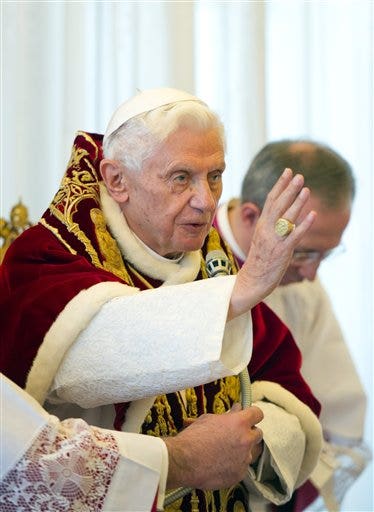
Pope Benedict XVI announces his impending abdication in 2013

Image:nytimes.com

Yesterday the Zenit Catholic news website had a series of reports about the anniversary, which may be of interest to readers, and are in any case a warm tribute to the Pope Emeritus and his contribution to the life of the Church.


As an academic friend and I agreed some months ago we are still mourning Pope Benedict's departure from the Chair of Peter, whilst respecting his decision. His legacy is significant and looks  capable of influencing the Church for many years to come. 

It also appears that there are some who are anxious to take the Church in different directions that Pope Benedict would like or wish, and indeed to undo what Pope Benedict achieved both before and after his election. That will, hopefully, be resisted within the life of the Church. The very positive statements quoted above are a remedy in part for that threat. Vigilance is required to secure the Ratzinger heritage and to continue to convey his message and insights. Nonetheless Pope Benedict remains his own best guarantee by his long and prayerful life and witness to the Church and the world.

Tuesday, 31 December 2013

Understanding Pope Benedict aright


As we come to the end of the year which saw Pope Benedict XVI's abdication the always thoughtful Fr Blake has an interesting reflection on the Benedictine pontificate which can be read at  Fleeing from the wolves.


Monday, 25 November 2013

The Pope on the Council of Trent


Rorate Coeli had an interesting post yesterday where it publishes the text of the letter from the Pope appointing Cardinal Walter Brandmuller as his representitive at the ceremonies to mark the 450th anniversay of the closing of the Council of Trent in 1563. In it the Pope reaffirms for Trent the key point made by Pope Benedict XVI in 2005 about the Hermeneutic of Continuity and Conciliar authority. The post can be read at  Francis, writing on the Council of Trent, explicitly affirms the authority of the 'hermeneutic of reform in continuity'.

Saturday, 19 October 2013

More about understanding the Pope


Further to my recent post about attitudes to the Pope from the media and bloggers I see there is another post on Rorate Caeli which looks at aspects of this question. 

Now it is only fair to say that Rorate Caeli does not appear to be very keen on Pope Francis - that became clear from their coverage of his time as Cardinal Archbishop of Buenos Aires with regard to the application of Summorum Pontificum on the night of his election. This latest post is a digest of a number of opinion pieces by established European commentators on the Church, and makes for interesting reflection. We do, of course, need to remember that we are dealing with the work of writers who need to say something provocative or controversial to catch their readers' eye, but Press summary: The dangerous dilemma of the two living popes  is an interesting account of what is being written on the continent at the moment. 

As I said previoulsy I am not taking sides in these matters, but there is clearly an interesting debate going on, and one of which Catholics, and others, should be aware.


Wednesday, 8 May 2013

A new face for Pope Celestine V


Pope Celestine V
An early mural painting and the new face mask
 
Image:news.discovery.com


I see from a post on the Medieval religion discussion group that over the course of several months the remains of Pope Celestine V - St Peter of Morrone  - have been examined, and a new funerary mask has been created. Born in 1215, and a hermit-monk, he was elected as Pope in 1294, and abdicated later on that year, and died as, in effect, a prisoner of his successor, Pope Boniface VIII, in 1296. He was canonised in 1313, and his feast day falls on May 19th.

There is an illustrated introduction to his life here, and there is another one here, with some additional illustrations.  A further account, with amore hagiographic emphasis with more pictures can be found on the link to the blog post here.

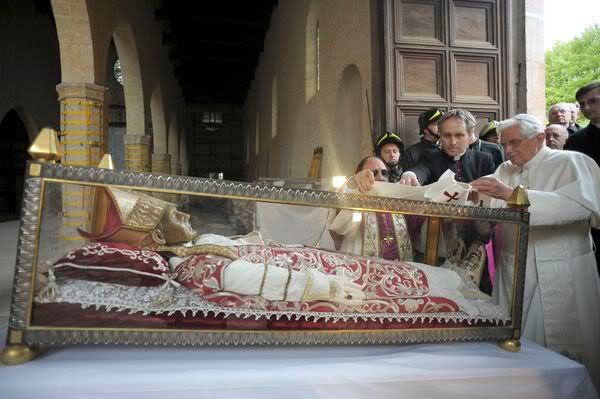
The remains are preserved at L'Aquila and survived the serious earthquake there in 2009, and indeed were visited in its wake by Pope Benedict XVI, who have his inauguration pallium for his predecessor to wear:


Image:365rosaries.blogspot.co.uk

Amongst the results of this latest examination of the relics was  confirmation (not for the first time) that the hole in his skull was made after his death, and so he definitely was not murdered, according to legend, by having a nail driven into his skull.


Murder Examination of Pope Celestine V

The skull of Pope Celestine V

Image: archelaos.com

The examination also indicated his height - five foot five inches - and much of his medical history.

A careful study was done of his cranium, leading to afacial reconstruction. However this was of a fifty year old, so the artist who made the silver mask had then to interpret that to produce an idea of what he looked like at the time of his death, when he was eighty or thereabouts.

There is an account of the discoveries in English here and two more accounts, with different illustrations, in Italian here and here.


Sunday, 21 April 2013

Happy birthday Ma'am


Today is the birthday of Her Majesty The Queen and this post is simply to express my loyal and warm good wishes on the 87th anniversary of her birth.

As so often when sending birthday wishes to my own friends I find I have missed those of others, and this is true of two other recent birthdays of public figures I admire and respect, and who happen to share the same birthday on April 16th. So I would also wish to express my good wishes also to Pope Emeritus Benedict XVI, who was 86 that day, and to Her Majesty the Queen of Denmark, who was 73.


Monday, 25 March 2013

Pope and Pope Emeritus together


Fr Blake has a good post about the historic, indeed unprededented, meeting on Saturday of the Pope and the Pope Emeritus at Castelgandolfo on Saturday. It can be read at We are Brothers. It is particularly useful as it has a link to a post on Andrea Tornielli's blog Vatican Insider which draws out the continuity of approach between the two Popes and seeks to dispel some of the stories and rumours that are winging their way round the internet and through the media. I have added a link to Tornelli's blog to my sidebar.

Friday, 15 March 2013

Reactions to Pope Francis


Pope Francis preaches at Mass in the Sistine Chapel.

Image: Reuters/Vatican CTV/ITV.

In the 48 hours since his election as Pope was announced there have been formal congratulations to Pope Francis, much comment on what his election means or portends, theories as to the style and tone of his papacy, studies of how the bloc of reformers and that of curialists cancelled one another out in the Conclave leading to his emergence as the surprise (to the outside world at least ) choice, even an interview with his girlfriend of more than half a century ago.

Much of the comment has been very positive in the press and online as well as on television. A friend has pointed out to me two favourable assessments which lay stress on the Pope's Jesuit formation which can be read here. One is by George Weigel, well known as an interpreter of Pope John Paul II, the other from Fr Fessio SJ, the founder of Ignatius Press and very much a voice of the pontificate of Pope Benedict XVI.
 
In both his homily at the Mass Pro Ecclesia in the Sistine Chapel and in his address to the College of Cardinals the new Pope paid tribute to the work of his predecessor, and this all points to continuity of approach.
The speed of the Conclave and the choice of a cardinal few expected has contributed to the slight feeling of unreality and uncertainty; as Fr Blake pointed out with customary sagacity on his blog, this partly arises from the circumstances of the abdication of Pope Benedict - we have not mourned him as might normally be expected for abeloved Pope before the election of his successor.
There have also been critical, even hostile, voices. This included the post, and its further expansion, on Rorate Coeli about the way in which Summorum Pontificum was implemented in the diocese of Buenos Aires under Cardinal Bergoglio. That said a  friend pointed out that in his early days as pontiff Pope Benedict was also attacked for not doing more for the traditionalist cause by bloggers.

On Thursday evening one friend was very put out by what he had seen of the Mass celebrated by the new Pope in the Sistine Chapel. He saw it as undoing, a rolling back, of all of Pope Benedict's renewal of customary liturgical practice, with, as he saw it, polyester vestments and just two candles at one corner of the forward altar. This sounded very worrying I must admit, but I looked online at photographs and video and found that my friend must have been genuinely mistaken in some of what he had seen. Certainly there was a forward altar, as there had been in 2005, but the lay out was as encouraged by Pope Benedict and the vestments ones I had seen him photographed wearing.I do rather doubt if they are polyester.


http://wtxf.images.worldnow.com/images/21644266_BG1.jpg

The 'Benedictine' arrangement of the altar

Image:myfoxphilly

There has also been raking over the past in respect of the Pope's actions in Argentina in the years of military rule before 1982. This I gather comes from a particular radical journal, and is inevitable for any public figure from a country with as unsettled a political history as has Argentina.

The British press has found a particular local difficulty for His Holiness in respect of this country, and tat lies in anumber of statements he has made in relatively recent years about the Argentine claim to the Falklands when he has spoken at requiems for the dead of the 1982 war. That he is a patriot for his own native country should not be cause of criticism, but in terms of relations with the United Kingdom they are unfortunate. They are words which have become hostages to fortune, and will not help with alrge section of the British public. Time will, predictably, tell on that issue...

And that is just the first two days of the Pontificate...


Tuesday, 12 March 2013

A future Pope on the Holy Spirit and the Conclave


http://www.vatican.va/news_services/press/img/ss_scv/insigne/santa-sede_stemma.gif

Lest anyone forget amid all the media and online listing of Papal candidates, theologically speaking, the Holy Spirit has a vital role to play in the process of the Conclave. Selecting the new Pope is not just a matter of building an electoral base, as may have occurred in the past, but is also seen as a Divine guidance for the Body of Christ.
Pope Benedict XVI addressed this matter in 1997 during an interview with Bavarian television, whilst he was still Cardinal Joseph Ratzinger and Prefect of the CDF. This was the year after Pope John Paul published his codification of papal electoral procedures. The comments were reprinted in the book Conclave by the Vatican journalist  John Allen, on pp 135-8.
The Cardinal said that the Holy Spirit does not actually choose the new Pope since "there are too many contrary instances of Popes the Holy Spirit would obviously not have picked." The Pope Emeritus has, I think, a nicely nuanced sense of the history of the Church, which is evident in many of his books and articles.

He went on to say "I would say that the Spirit does not exactly take control of the affair, but rather like a good educator, as it were, leaves us much space, much freedom, without entirely abandoning us."

The future Pope continued: "Thus the Spirit's role should be understood in a much more elastic sense, not that He dictates the candidate for whom one must vote. Probably the only assurance he offers is that the thing cannot be totally ruined."

Friday, 1 March 2013

Marking the end of a Pontificate


I marked the end of the Pontificate of Pope Benedict XVI where it began for me, in the Oratory Church here in Oxford. Last night the 6pm Mass was followed by exposition of the Blessed Sacrament until 7pm when the Papal abdication became a reality. The church was full and there was a strong sense of a shared feeling of loss combined with real thanksgiving for the Pope's ministry.

Almost eight years ago, on April 19th  2005, and only three weeks since my reception into the Church, I arrived early for the 6pm Mass at the Oratory in order to pray for the outcome of the Conclave in Rome. As I arrived I was told that white smoke was reported as coming from the chimney of the Sistine Chapel. As this must have been from only the third ballot I calculated, and hoped, that the only Cardinal likely to have amassed so many votes so quickly was Joseph Ratzinger. I waited prayerfully in church, and shortly before 6 the then Provost, Fr Robert Byrne, appeared and announce to us "The Cardinals have elected, and he has taken the name of Benedict XVI [ here I had a momentary worry, having convinced myself, for some unclear reason, that Cardinal Ratzinger would take the name Gregory XVII ]  - and it's Cardinal Ratzinger." The delight of those in church was evident, and thus I was at the first Mass offered in the Pontificate of Pope Benedict XVI, which was also celebrated with the singing of the Te Deum - which I had already said privately before Mass commenced.

Last night the celebrant was once again Fr Robert, and he spoke in his homily of how, having heard that a Pope had been elected, he went into the Sacristy to prepare for Mass when one of the other Oratorians ran in to tell him that the new Pontiff was Cardinal Ratzinger who had taken the name of Benedict XVI.

Fr Robert drew attention to three points which he saw as central to the Pope's pontificate. The first was the  New Evangelisation, seeking to draw people back into a relationship with Jesus. The second was the Pope's concern with the Christian engagement with world, and that Christians should participate in the political and social conversation of our time. The third was a concern for the beauty of holiness in worship, music and art.

When Mass started we sang Cardinal Wiseman's "Full in the panting heart of Rome"to honour the still reigning Pontiff, but when we left church we were in the time of Sede vacante and entrusted our prayers for the Church and for the Pope Emeritus to God.


Thursday, 28 February 2013

Thank you Holy Father


Pope Benedict XVI gives his final blessing to his cardinals at the Vatican this afternoon

Image:AP/PA
In these last hours of his pontificate I would wish to put on record my gratitude to the Holy Father for his time as Pope, and indeed for all his lifetime of service as pastor, administrator, theologian and writer to the life of the Church. His withdrawal from the public scene is not after just eight years at the centre, but far longer - for over thirty years he has been a leading figure, and ultimately the leading figure, in the administration of the Church. It is not easy to imagine the Church without him. We must trust that his legacy endures.

I shall miss that quiet, calm, authoritative scholarly voice whether when speaking or in his writings which has characterised his pontificate. These one can, and will, still refer to and use - Jesus of Nazareth and the other books based on his addresses are no mean achievement in themselves  in addition to his existing previous books, and produced whilst he had the responsibility of the Papacy.  He possesses  a remarkable clarity and beauty of thought and expression.

He has shown himself to be a  true pastor, a task he has exercised with dignity leavened by quiet humour and gentleness. 

To my mind his pontificate may well come to be seen as the steadying hand on the tiller of the barque of the Church, reestablishing a more certain passage through the troubled waters of this world - but for that judgement of history we shall have to wait.

Together with many friends I have been the beneficiary of what he gave in Summorum Pontificum and in Anglicanorum Coetibus - very significant moves indeed in the spheres of liturgy and ecumenical dialogue. 

His emphasis on liturgical restoration is one of the most obvious features of his pontificate. This has been clear in the dignity of ceremonial and attire  at Papal Masses and ceremonies since  2005. The dignity of the Papal office has been signified, and venerable practices re-established. I hope very much that continues and is maintained by his successors. These things are not, or should not, be matters of personal preference but rather the indicators of what the Papacy is - in preceding decades it seemed to become prone to too great a dependency on the personality of the individual Pope rather than the inherent authority of the office. The present Pope's personal humility of manner has counterbalanced this with dignity and discretion.

I saw him twice during his memorable visit to this country in 2010 - at Westminster and at the beatification of John Henry Newman in Birmingham -  both of them remarkable things to experience.
 
His address yesterday at his final General Audience can be read at  Pope's Final General Audience Address

I wish him well in his retirement to a life of prayer, and will certainly keep him in my prayers.

Thank you, Holy Father, and God bless you.


Wednesday, 27 February 2013

The Heavens declare the Glory of God


http://www.buzzhunt.co.uk/wp-content/2013/02/lightning-strikes-st.-peter-basilika.jpg

Image:buzzhunt.co.uk

The spectacular lightening strike on St Peter's on February 11th, a few hours after the Pope announced his intention of abdicating drew predictable comments in the press and suggests that people still look for signs and wonders, for portents and supernatural indicators. The modern scientific mind is likely to dimiss such things as coincidence at best, although lightening in February is rarer than at other times of the year. Yesterday evening I was, however, told by a priest of one explanation - one which saw the lightening as neither approval or disapproval, but a Divine message none the less - simply that God is still very much in business. I merely pass on the idea for reflection.


Thursday, 21 February 2013

The Pope and SSPX


The well-informed and serious Rorate Caeli has a valuable and insightful piece from the religion blog at Le Figaro about the negotiations to regularise the position of SSPX as the present Pontificate approaches its conclusion. It is written with genuine passion for what is at stake. It is also more than that, in that it is also a reflection on the achievements of the Pope in respect of liturgical restoration. 

It can be read at Benedict XVI - SSPX: Quarter to midnight.


https://blogger.googleusercontent.com/img/b/R29vZ2xl/AVvXsEgJ_sT3STVGdVsvgBxay886oJ_jPXAuw2c7YMhgz5DYow9sUZ8nvrIrHlhX5b9_B0jJlF935-hY0f5NpCvluCNHzk1QUySwGbifDsYwnbBvcsqqHnW41R9Fl3YCVKs33s4TlQOJvdawEoHh/s1600/ARFE.jpg 

The Pope in Eucharistic Adoration at the Madrid World Youth Day - for the writer in Le Figaro this is the quintessential image of the papacy of Pope Benedict XVI 


An important article that is well worth reading - and with matters well worth praying about.


The Pope reflects on Vatican II


Last Thursday the Pope gave an address to the parish priests and clergy of the Diocese of Rome in which he reflected on Vatican II. This address is now being made available on the always useful Zenit website in installments, but the whole text can be read from the Vatican website here.

This is, it seems to me, a very important speech. Much more than a leave taking of his diocesan clergy it comprises the reflections of a man who has been at the heart of the debates about the choices facing and made by the Council since before it even met fifty years ago. The Pope is clearly a man with a profound historical sense about the Church and that is evident in this address.

It is also important as it is doubtless the last word we shall hear from Pope Benedict on these matters - I am sure his retirement to a life of prayer will be just that, he will not be writing, let alone speaking in public, about the Church or the Council.

The speech is quite lengthy, and I suspect some of my friends may not entirely like some of the views His Holiness expresses about the pre-Conciliar liturgy, but it is, as I said, an important text. It certainly stands in the tradition of the hermeneutic of continuity, and it also recalls the real enthusiasm of the young peritus Joseph Ratzinger for what the Council might achieve. It can also be seen as setting out an agenda for the continuing and future perception of Vatican II.


Tuesday, 12 February 2013

The Pope's Abdication


It was not until late afternoon yesterday that I learned of the Pope's announcement of his intention to abdicate as of the evening of February 28th. His announcement appears to have caught virtually everyone by surprise, though I recall that he had said in an interview with Peter Seewald that he would consider abdication if he thought he was no longer physically able to exercise the Papal office as he thought it should be done. He has been a Pope of surprises, and in this final announcement has continued that way of operating.


The Pope gives his benediction after his announcement

Image:Fox News

This is clearly the Holy Father's free personal choice, after prayer and reflection, as he said. It should be accepted with respect, and without the wilder theories that will doubtless go the rounds of the internet. He clearly wishes not only to avoid personal distress through infirmity, but to spare the Church another period of leadership by an ailing Pope. That is something he himself will well understand from the latter years of Pope John Paul II. From yesterday's pictures he appears more aged than hitherto, though the emotion of the choice and occasion must have taken its toll.

I am saddened by this news for two reasons. Firstly I am very sorry that someone for whom I have enormous, boundless, respect and admiration considers that they are too frail to continue in office. I have real human sympathy for the Pope, and wish him well in his retirement, the chance to relax and to spend time with his brother, and with God in prayer.

Secondly I am sorry that he will not continue to lead the Church along the lines he has led it since his election - despite his age I looked forward to new initiatives and genuine renovation coming from him.

I also feel great gratitude for all that the Pope has achieved in his pontificate and all that he has given to the life of the Church over so many years. This will be, I am sure, an enduring legacy of writings, formation, liturgical renewal - not just Summorum Pontificum but the new English translation and a real concern for the dignity and tradition of worship in and around the Papacy itself - the initiation and establishment of the Ordinariates, and the intellectual confrontation with secularism.

As someone who was received into full peace and communion two days before Pope John Paul II died I have been so far,  ipso facto, a Pope Benedict XVI Catholic, and consider myself very fortunate indeed to have had him as the visible head of the Church as I have grown into its life and practice.

The precedents for Papal abdication are few. He will apparently return to the status of being a Cardinal again, as did Popes Gregory XII and Pope John XXIII in the early fifteenth century. Will a life of cloistered prayer within the Vatican be possible for him without having the real opportunity to publish or speak again for fear of it being seen as a criticism of his successor? Will he be left in peace to do what he wishes?


Pope benedict XVI in 2009 visiting the reliquary of Pope Celestine V - St Peter of Morrone - who abdicated in 1294, the last Pope of an undivided Western Church to abdicate.

Images:New Liturgical Movement

As loyal Catholics we must continue to pray for the Pope, and for the Cardinals who will elect his successor, for that successor and for the Church.