Once I was a clever boy learning the arts of Oxford... is a quotation from the verses written by Bishop Richard Fleming (c.1385-1431) for his tomb in Lincoln Cathedral. Fleming, the founder of Lincoln College in Oxford, is the subject of my research for a D. Phil., and, like me, a son of the West Riding. I have remarked in the past that I have a deeply meaningful on-going relationship with a dead fifteenth century bishop... it was Fleming who, in effect, enabled me to come to Oxford and to learn its arts, and for that I am immensely grateful.


Showing posts with label King Edward III. Show all posts

Tuesday, 27 June 2017

King Edward III - family man


Following on from the recent 640th anniversary of the death of King Edward III I found this link to an article in the online version of the BBC History Magazine; the article first appeared in the November 2011 issue of the Magazine. The King's recent biographer Mark Ormrod explains the significance of the monarch's celebrated family in King Edward III: The family man 

Prof. Ormrod writes of how King Edward III’s wife and children played central roles in his private life and his dreams of empire. …  In the winter of 1342–43 King Edward III spent several months away from home fighting in Brittany. He kept in close touch with his family by letter, writing regularly to his wife, Queen Philippa, as his ‘sweetheart’...

I think this is an article that is both interesting and insightful, and a reminder of the genuine humanity of people in the past.  Read the full story


Wednesday, 21 June 2017

Death of King Edward III


Today is the 640th anniversary of the death at Sheen Palace on June 21 1377 of King Edward III. He was 65 and the longest lived English monarch until Queen Elizabeth I.

It is said that his mistress Alice Perrers snatched the rings from the dying kings hands when she realised what was happening. If the story is true it marks an undignified end to areign of just over fifty years and one mrked by signal victorie sin France and Scotland and was period crucial to the develiopment of English national identity. The King is buried in Westminster Abbey.

There is an online biography of the King at Edward III of England


http://www.westminster-abbey.org/__data/assets/thumbnail/0013/23152/Edward-III-funeral-effigy-72-Westminster-Abbey-copyright-photo-1.jpg

The funeral effigy of King Edward III at Westminster Abbey

 Image: westminster-abbey.org


The King died of a stroke at Sheen Palace on 21 June 1377. A torch lit procession accompanied the coffin which first stopped at St Paul's cathedral. His funeral took place in the Abbey on 5 July and he was buried near his wife's monument in the chapel of St Edward the Confessor. His bones lie in the tomb chest

The wooden effigy, which was carried at his funeral, is preserved in the Abbey collection and the face (a plaster mask fixed to the wood, slightly distorted on the left side of the mouth) is thought to be taken from a death mask.

On his Purbeck marble tomb is a gilt bronze effigy, with long hair and beard, which is possibly by John Orchard. He wears his coronation robes and holds the handles of two sceptres (the rest being broken off). He has small buttons on his cuffs and decoration on his shoes. On the flat  tomb top are niches, some of which still hold small gilt angels. The pillow below the king's head is a replacement from 1871 (given by Queen Victoria), the original having been lost. The lion at his feet (shown in an engraving of 1677) has now gone. The inscription can be translated:

"Here is the glory of the English, the paragon of past kings, the model of future kings, a merciful king, the peace of the peoples, Edward the third fulfilling the jubilee of his reign, the unconquered leopard, powerful in war like a Maccabee.  While he lived prosperously, his realm lived again in honesty.  He ruled mighty in arms; now in Heaven let him be a king".

Originally there were bronze weepers (or statuettes) of twelve of his children round the tomb but only six of these now remain on the south side - Edward the "Black Prince", Edmund of Langley, William of Hatfield, Lionel of Antwerp, Mary of Brittany and Joan of the Tower. (Those that are now missing were to Isabel, Dame de Couci, William of Woodstock, John of Gaunt, Blanche of the Tower, Margery Countess of Pembroke and Thomas Duke of Gloucester, with their enamelled coats of arms below).

Above the tomb is an elaborate wooden tester by Hugh Herland. The arches terminate in half-angels as pendants. The soffit has a rich ribbed vault of six bays with cusping and bosses carved with human and beast-heads, many of which are missing. Four large enamelled shields (showing the cross of St George and the arms of France and England quarterly) remain on the south side of the tomb chest.

A state sword, seven feet long, was traditionally associated with this king and was kept near his tomb for many centuries. Also a shield covered with canvas and black leather, now much mutilated.

During the Great War the effigy was stored in the crypt of the Chapter House. Both effigy and tester were evacuated to a country house during the Second World War.

Tomb dimensions in metres: length 2.90. width 1.35. height 1.70.

The funeral effigy,  state sword and the shield will be on show in the new Jubilee Galleries, due to open in mid 2018.

From the Westmister Abbey website


http://www.bbc.co.uk/staticarchive/ac853de80f52979b4261fdff5acda6ef4e3f0271.jpg

King Edward III
The tomb effigy in Westminster Abbey

Image westminster-abbey.org

https://www.royal.uk/sites/default/files/images/encyclopaedia/rs559032_600403-lpr-1.jpg-edit_0.jpg

 King Edward III from the paintings in St Stephen's Chapel in the old Palace of Westminster and dated to the early 1360s

Image: royal.uk

He was succeeded by his grandson King Richard II.


Wednesday, 6 April 2016

Windsor Castle


The recent reports about plans to develop visitor facilities and open up more of the Royal Apartments at Windsor Castle included this picture of  the undercroft in the Upper Ward of the castle which dates from the rebuilding of the residential part of the complex in the 1360s. I have seen the point made that, proportionately, King Edward III spent as much on these works as King Louis XIV did at Versailles three centuries later. The surviving portions suggest something of the scale of what the Kingcreated, and which underlie later rebuildings and reconstructions. The present plans envisage turning this into the restaurant for visitors.

The 14th-Century Undercroft at Windsor 

King Edward III's undercroft at Windsor Castle

Image: Mark Fiennes/Royal Collection Trust/ Daily Telegraph 

Tuesday, 13 November 2012

King Edward III


Today is the 700th anniversary of birth of the future King Edward III at Windsor in 1312.

There is an online account of his life and reign here and there is also a detailed life of the King by W.M.Ormrod, who has also written a full length study of the reign, from the Oxford DNB, which gives a number of very interesting details about  Edward' s birth, naming and baptism and about his early upbringing, and which can be read here.


Edward III

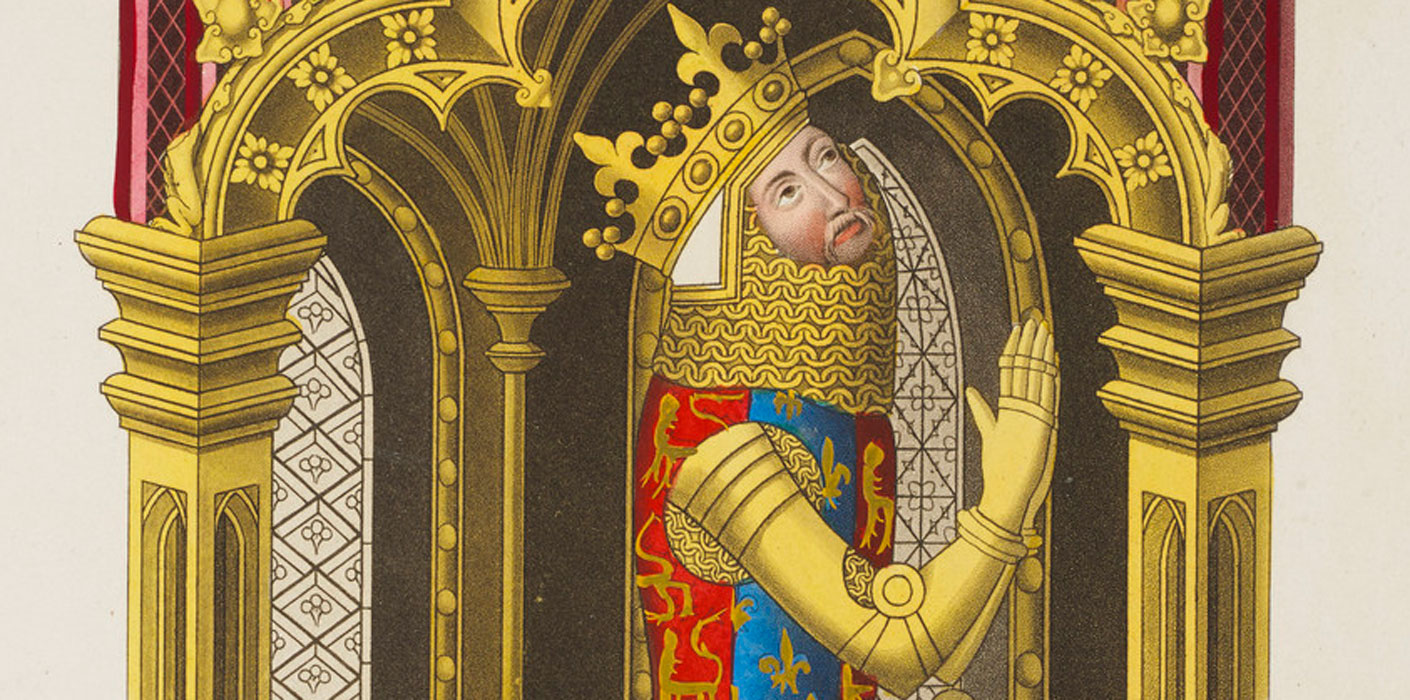
King Edward III
A drawing of the remains of the painted figure from St Stephen's Chapel Westminster commissioned by the King, and rediscovered after the 1834 fire.

Image:etc.usf.edu

edwIIIbig 241x300 Tomb of Edward III

King Edward III
Tomb effigy at Westminster Abbey

Image: theplantagenets.com

14th century manuscript initial depicting Edwa...

King Edward III enfeoffs Edward Prince of Wales with the Duchy of Aquitaine

Image: Wikipedia

Tuesday, 22 February 2011

King David II


Today is the 640th anniversary of the unexpected death at the age of 46 of King David II of Scots in 1371, an event which brought to the throne the Stewart family in the person of his nephew King Robert II. There is an illustrated online biography of King David here. A much fuller critical biography and assessment by Bruce Webster in the Oxford DNB can be read here and provides an excellent account of his life and reign.

That life and reign, with its pattern of minority and regency, upbringing abroad and english invasion and domination, not to mention personal and marital difficulties was typical of most Scottish monarchs until the accession of King James VI to the English throne in 1603. What is almost more remarkable is the achievement of the Scottish monarchy in retaining and consolidating its hold on the country. Historians today are, as Webster indicates more inclined to a positive view of his achievements as monarch than was the case in the past, notably in the eighteenth and nineteenth centuries

The illuminated initial of him with his brother-in-law King Edward III reproduced below has always struck me as more than usually insightful for such a piece. It is not only elegant, but manages to convey the Scottish King's discomfiture in the presence of the seemingly more urbane and successful English King, of whom he was a prisoner. King David looks somehow rather dowdy by comparison with the more fashionably attired King Edward.
David II with Edward III

King David II and King Edward III after the battle of Neville's Cross, 1346.
Each king is surmounted by his Coat of Arms
© British Library

Image: royal.gov.uk


On his Great Seal King David II does look more confidently regal:

News Photo: royal seal from 1329 depicting David II King…

Image: Getty images.com