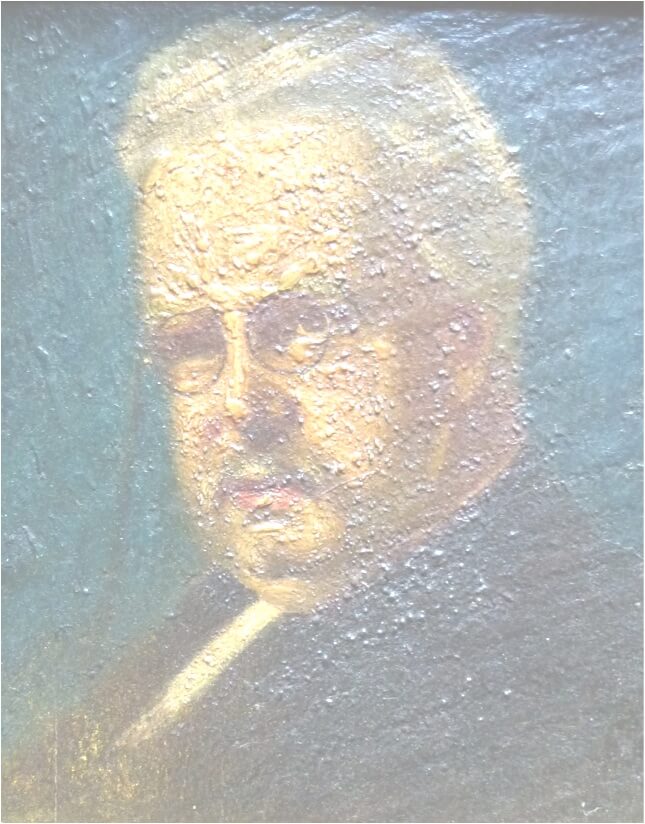
Once I was a clever boy learning the arts of Oxford... is a quotation from the verses written by Bishop Richard Fleming (c.1385-1431) for his tomb in Lincoln Cathedral. Fleming, the founder of Lincoln College in Oxford, is the subject of my research for a D. Phil., and, like me, a son of the West Riding. I have remarked in the past that I have a deeply meaningful on-going relationship with a dead fifteenth century bishop... it was Fleming who, in effect, enabled me to come to Oxford and to learn its arts, and for that I am immensely grateful.


Showing posts with label G.K.Chesterton. Show all posts

Monday, 14 September 2015

Open Doors at the Oxford Oratory


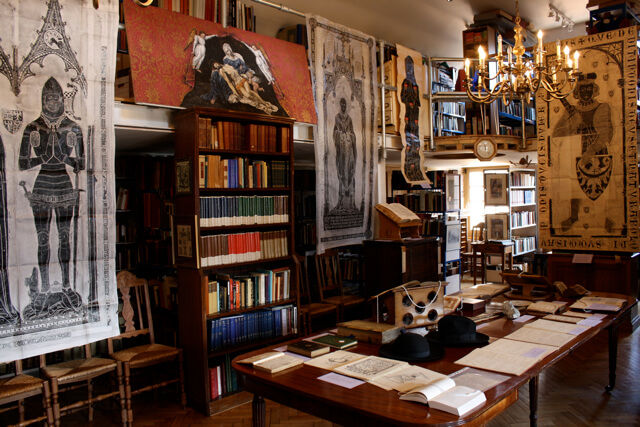
Yesterday afternoon I spent as one of the team of parishioners stewarding the display in the Oxford Oratory library which had been put on for the Open Doors weekend. Here is the post about it from the Oratory website, with some additional labelling by myself:

Fr Jerome has been busy last week preparing an exhibition in the library for the Oxford Open Doors weekend. Visitors had a chance to see some of our more interesting books — fine bindings, early printings and detailed calligraphy, as well as items from the Chesterton library and brass rubbings. The library building was completed when we opened our new building two years ago. The inside will continue to have temporary metal shelving until we raise the money for the permanent wooden shelving.
IMG_8796

Brass rubbings by Fr Jerome, G.K.Chesterton's hat and stick, as well as one of his schoolbooks and leaves from the ditchling Press edition of The Turk and the Turkey. To the right are a burial register written up by Gerard Manley Hopkins, and a marriage register from 1908 signed by Winston Churchill at his brother's wedding in the church
IMG_8769

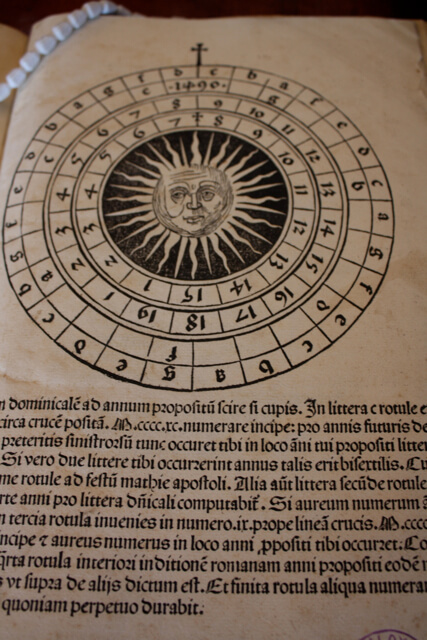
A table for calculating the date of Easter, from a German book printed in 1490

IMG_8765

A sixteenth century book binding, and the modern green binding to the right is from the bequest of Mgr Graham Leonard
IMG_8771

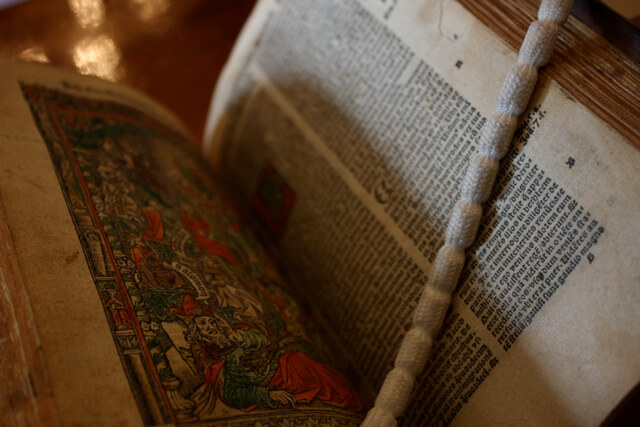
A late fifteenth century printed book
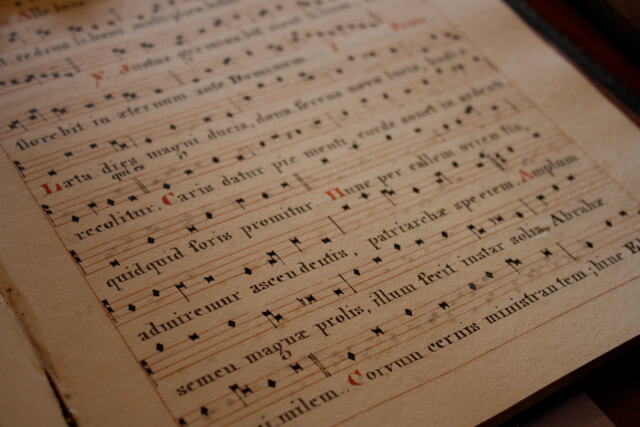
IMG_8782

A nineteenth century music manuscript in traditional form
IMG_8784

A seventeenth century devotional manuscript

IMG_8791

An illuminated manuscript of circa 1860 of the Mass for the Feast of St Aloysius

IMG_8792
A seventeenth century Greek manuscript of St Theodoret

Images:Oxford Oratory website

Monday, 25 May 2015

Chesterton Open Day pictures


I recently advertised last Saturday's Chesterton Library Open Day at the Oxford Oratory. Today the Oratory website has pictures of the day and associated activities at Photos from the Chesterton Open Day, which may whet the appetite of readers for future such openings.


Tuesday, 19 May 2015

Chesterton exhibition at the Oxford Oratory

This coming Saturday, May 23rd, the Chesterton library collection, now housed at the Oxford Oratory, will be open for visitors from 2.30 until 5.30.

The collection consists of what survives of Chesterton's library, including annotated and signed copies of his books, as well as personal memorabilia from his possessions.

The afternoon is advertised as offering treasures, tours and teas - what more could the Chestertonian enthusiast want?


Wednesday, 26 March 2014

G.K.Chesterton exhibition at the Oxford Oratory - this Sunday


The library at the Oxford Oratory holds a collection of memorabilia of G.K. Chesterton and these include personal possessions, including his hat, walking sticks, typewriter and chair as well as books and manuscript material.

This Sunday there is a rare opportunity to view some of this important collection:


The G.K.Chesterton Library at the Oxford Oratory

An Exhibition
Of Books, Drawings, Manuscripts and Assorted Articles

chesterton

The Oxford Oratory Library
Sunday March 30th
12.00 to 13.00 and 14.30 to1700

Image:Oxford Oratory website


Thursday, 20 June 2013

Viewing the new building at the Oxford Oratory


Earlier this evening,together with other members of the Oratory's Benedictine Oblates group, I was given atour of the newly developed building for which the Oratory has been raising funds. This is Phase One. The building work is now completed, although some fitting out works remains to be carried out before His Grace the Archbishop of Birmingham is comes to celebrate Mass and bless the completed work on August 4th.

This evening we saw the impressive conversion of the old parish centre, complete with new kitchen and bar, the library created in the room above - originally these housed the parish school. The library promises to be a fine galleried room with space to house the sizeable Oratory library, including the Gaisford collection, part of the library of Mgr Graham Leonard and the remains of G. K.Chesterton's library and related manuscript material.

Beyond this lies a set of new rooms for Fathers of the Oratory and guest accomodation, giving the community the ability to expand. What is striking about the extension and conversion is the skill of the architect in creating so much space on a limited site and the care in providing the finishing touches to make it a properly finished building.

After all the work of fund raising and the wait to see what was going on behind the screened-off area it was very satisfying to see what has been achieved, to look forward to the completion of this Phase, and then, of course, to go on to Phase Two...

There is more about the project on the Oxford Oratory Appeal website.

Wednesday, 14 December 2011

The Prince Consort


150 years ago today the Prince Consort died. A highly gifted man who was not always appreciated by his wife's subjects as he was entitled to be by reason of his abilities and the support he gave her, and who after the Queen's death became something of an image of what was seen as an old fashioned world, it has only in recent decades that his reputation has been recovered and his talents valued. Rather like the Albert Memorial he was an object of wry amusement or even ridicule until restoration occurred to both reputation and monument. It is wonderful to be able to see the latter once again as it was intended, and to take in the craftsmanship and the grandeur of the composition.

http://www.aviewoncities.com/img/london/kveen1201s.jpg

The Albert Memorial

Image:aviewoncities.com

Although the link above questions the story that his statue was painted black during the Great War on the odd sounding notion that its reflection would help German zeppelin raids on the capital - and thinks it was a pre-1914 response to atmospheric pollution which had destroyed the gold leaf - the idea does convey something of the attitude to 'German' Albert.

http://www.yourlocalweb.co.uk/images/pictures/11/50/albert-memorial-112873.jpg

The restored statue of the Prince Consort on the Albert Memorial

Image: yourlocalweb.cm/Westminster

I think there is something deliberately and unpleasantly offensive in G.K.Chesterton's strictures from 1920 or thereabouts on the Memorial.
Writing after visiting Jerusalem the rabidly anti-German GKC considered there was nothing so conspicuous, gilded or gaudy in Jerusalem, and that an Orthoox pilgrim confronted by it would probably hope it was a temple erected to Christ, fear it was to Antichrist and probably recoil with unimaginable perplexity if told that the gilded idol was really "a petty German prince who had some slight influence in turning us into the tools of Prussia."( Dudley Barker G.K.Chesterton p.241).

I see that there is a new book by Helen Rappaport, who I met through St Bede's Hall when it was functioning, which looks at Albert's death and its impact on the Queen, the Crown and the nation.
Magnificent Obsession:Victoria, Albert and the Death That Changed the Monarchy was published last month by Hutchinson, and is a book I would like to find time to read.

Amongst Prince Albert's many achivements is the church at Whippingham on the Osborne estate on the Isle of Wight. Built in 1854-5 and completed in 1861-2 it is the work of the architect A. J. Humbert, but working on the Prince's overall design. The church website is here. What makes the church particularly interesting is the insight it gives into the spirituality of Victoria and Albert. Along with their Mausoleum at Frogmore and the work carried out by the Queen at St George's Windsor, and the number of paintings with a religious theme in their appartments at Osborne. This is not 'Black Protestantism' by any means, and ought to provide for more fruitful academic attention than it has hitherto received - but I will come back to that topic on another occasion.

Meanwhile let us remember the Prince Consort with gratitude for his great achievements - not least the South Kensington complex and his contribution to the development of the monarchy in the nineteenth century.