John Dillon posted a whole series of further images of St James the Great that are either late antique and medieval on the Medieval Religion discussion group site:
c) as depicted (fourth from left) in the earlier to mid-sixth-century mosaics of the presbytery arch (carefully restored, 1890-1900) in the Basilica Eufrasiana in Poreč:
d) as portrayed in relief (at far left) on a leaf of the mid-tenth-century ivory Harbaville Triptych in the Musée du Louvre, Paris:
http://tinyurl.com/qdsovlz
e) as depicted in the earlier eleventh-century mosaics (restored betw. 1953 and 1962) in the narthex of the katholikon of the monastery of Hosios Loukas near Distomo in Phokis:
g) as depicted (lower register, center) in the mid-twelfth-century apse mosaics (completed in 1148) of the basilica cattedrale della Trasfigurazione in Cefalù:
k) as portrayed in relief in an earlier thirteenth-century enameled copper repoussé plaque of Limousin origin (ca. 1220-1230) from the high altar of the abbey church of Grandmont, now in the Metropolitan Museum of Art, New York:
l) as portrayed in relief on the mid-thirteenth-century châsse of St. Eleutherius in the cathedral of Tournai/Doornik:
m) as depicted in the mid-thirteenth-century Touke Psalter from Bruges (ca. 1250-1260; Baltimore, Walters Art Gallery, Walters ms. W.36, fol. 50r):
p) as depicted in the late thirteenth-century Livre d'images de Madame Marie (ca. 1285-1290; Paris, BnF, ms. Nouvelle acquisition française 16251, fol. 66r):
r) as depicted (martyrdom) in an earlier fourteenth-century copy (ca. 1301-1350), with illuminations attributed to the Fauvel Master, of a collection of French-language saint's lives (Paris, BnF, ms. Français 183, fol. 34v):
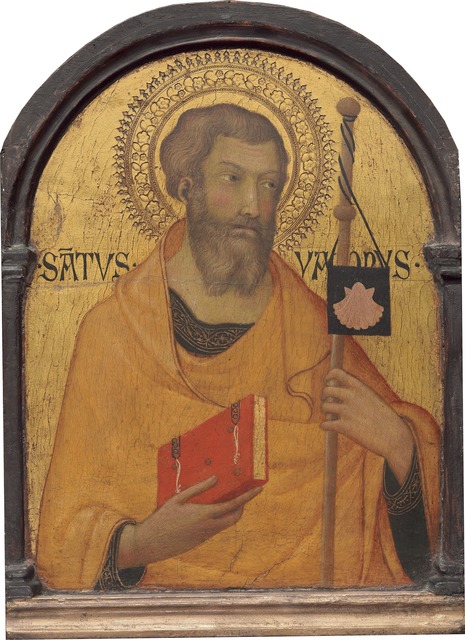
s) as depicted by the workshop of Simone Martini in an early fourteenth-century panel painting (ca. 1317-1320) in the National Gallery of Art, Washington, DC:
t) as depicted in an earlier fourteenth-century copy (1348) of the Legenda aurea in its French-language version by Jean de Vignay (Paris, BnF, ms. Français 241, fol. 169v):
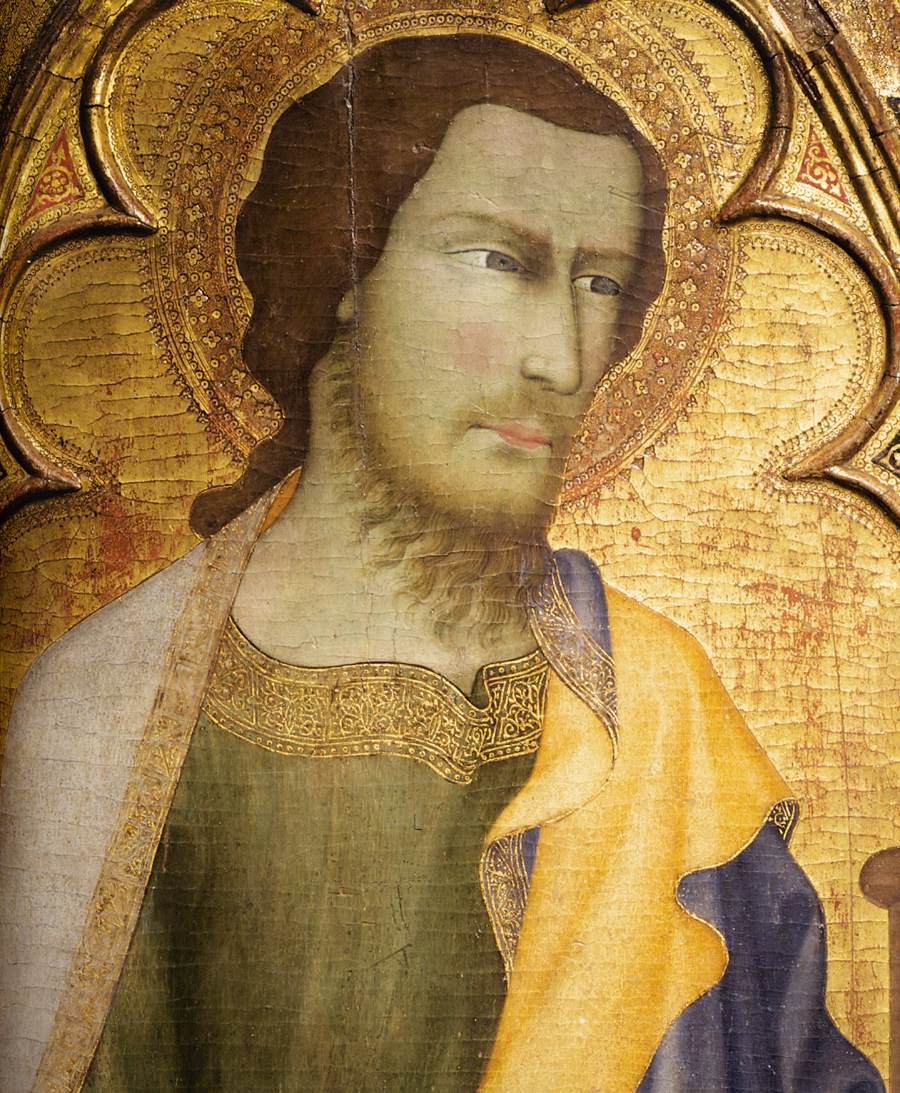
u) as depicted in a mid-fourteenth-century panel painting (betw. 1355 and 1360) by Andrea di Vanni d'Andrea, now in the Museo Nazionale di Capodimonte, Naples:
Detail view:
v) as portrayed in relief (third from right) on the late fourteenth- or early fifteenth-century tomb of St. Wendelin in his basilica in Sankt Wendel:
w) as portrayed in relief in a fifteenth-century English alabaster in the Victoria and Albert Museum, London:
x) as depicted by Martino da Verona (attrib.) in an early fifteenth-century fresco in the chiesa di San Giacomo del in Vago di Lavagno (VR) in the Veneto:
y) as depicted in an earlier fifteenth-century fresco (ca. 1440) in Ballerups kirke, Ballerup (Sjælland):
z) as depicted by Cosmè Tura in a later fifteenth-century panel painting (ca. 1475) from a dismembered altarpiece, now in the Musée des Beaux-Arts, Caen:
aa) as portrayed in a later fifteenth-century limestone statue (betw. 1475 and 1500) of Burgundian origin in the Metropolitan Museum of Art, New York:
Detail view:
cc) as portrayed by Gil de Siloe in a late fifteenth-century alabaster statue (ca. 1489–1493) now in the Metropolitan Museum of Art, New York. In 1486, Isabel of Castile, patroness of the explorer Christopher
Columbus, commissioned an elaborate alabaster tomb for her parents, King Juan
II of Castile and his Queen Isabel of Portugal. This star-shaped tomb, still
standing in the center of the church of the Carthusian monastery of
Miraflores, outside Burgos, was made between 1489 and 1493 by Siloe, a sculptor thought to be of Netherlandish origin. This statuette
of the patron saint of Spain is known from old photographs to have been
originally placed near the head of the Queen.:
dd) as portrayed in a very late fifteenth- or very early sixteenth-century wooden statue from Hasslöv (Hallands län), now in the Historiska Museet in Stockholm:
ee) as portrayed (third from left) in the very late fifteenth- or very early sixteenth-century statues of the apostles (betw. 1498 and 1509) in the south porch of the chapelle St.-Herbot in Saint-Herbot, a locality of Plonévez-du-Faou (Finistère):
ff) as portrayed (seated) in an early sixteenth-century polychromed wooden statue (betw. 1501 and 1515) in the Deutsches Historisches Museum, Berlin: